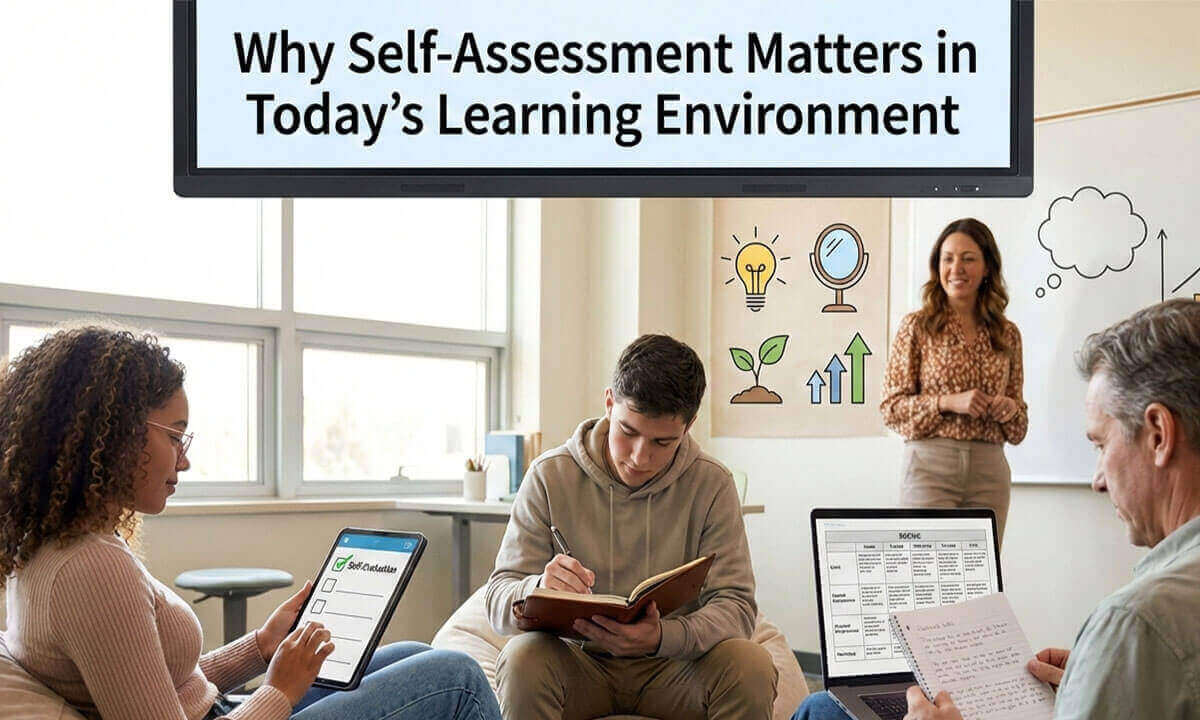
Why Self-Assessment Matters in Today’s Learning Environment:
Education is evolving faster than ever before. With rapid technological advancement, easy to access information, and shifting workforce demands, traditional learning models that rely heavily on teacher-led instruction and standardized testing are no longer sufficient. Today’s learners must be adaptable, reflective, and capable of directing their own learning. In this changing educational landscape, self-assessment has emerged as a powerful tool that empowers students to take ownership of their learning. Self-assessment goes beyond grades and test scores. It encourages learners to reflect on what they know, identify gaps in understanding, and actively work toward improvement. Rather than viewing learning as something that happens to them, students begin to see learning as something they actively shape. This article explores why self-assessment matters in today’s learning environment (what self-assessment is, why traditional assessment methods fall short, the transformative power of self-assessment, and how it can be effectively implemented in modern learning environments).
What Is Self-Assessment in Education?
Self-assessment in education refers to the deliberate process by which students evaluate their own learning, performance, and understanding based on clearly defined criteria. Rather than relying solely on teachers, exams, or grades to determine success, self-assessment places learners at the center of the evaluation process. It encourages students to think critically about how they learn, what they have learned, and what they need to improve.
At its core, self-assessment is not about students simply giving themselves a score. Instead, it is a reflective and metacognitive practice that helps learners judge the quality of their work and learning strategies. According to Andrade (2005), effective self-assessment requires students to compare their work against explicit goals or standards, which helps them better understand expectations and quality learning outcomes.
Key Components of Self-Assessment: Self-assessment typically involves several interconnected practices:
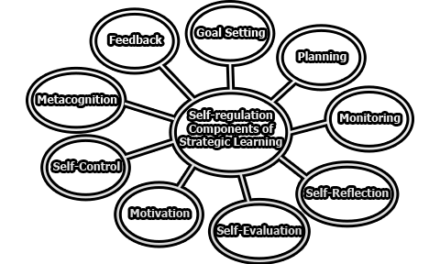
Reflection on strengths and weaknesses: Students examine what they understand well and where they struggle. This reflection builds self-awareness and helps learners recognize patterns in their learning. Boud, Keogh, and Walker (1985) emphasize that reflection is essential for turning experience into learning, as it allows students to make sense of their successes and challenges.
Identification of learning gaps: Through self-assessment, students learn to identify specific areas that need improvement instead of viewing performance in broad terms such as “good” or “bad.” This targeted awareness supports deeper learning and reduces dependence on external feedback (Nicol & Macfarlane-Dick, 2006).
Goal setting and planning: Self-assessment encourages students to set realistic, meaningful learning goals based on their reflections. Zimmerman (2002) explains that goal-oriented self-assessment is a key feature of self-regulated learning, helping students plan strategies and monitor progress over time.
Monitoring progress over time: Rather than focusing on one-time performance, self-assessment allows learners to track growth across weeks, months, or semesters. This longitudinal perspective reinforces the idea that learning is a process, not a single outcome (Biggs & Tang, 2011).
Self-Assessment as a Metacognitive Skill: One of the most important aspects of self-assessment is its connection to metacognition (thinking about one’s own thinking). When students ask themselves questions such as Do I really understand this concept? or Could I explain this to someone else?, they engage in higher-order thinking. Research shows that students who regularly practice metacognitive self-assessment demonstrate stronger comprehension and problem-solving skills (Brookhart, 2010).
Black and Wiliam (1998) argue that self-assessment is a cornerstone of formative assessment because it helps learners actively close the gap between current performance and desired goals. Instead of passively receiving feedback, students become partners in the learning process.
How Self-Assessment Differs from Traditional Evaluation: Unlike traditional assessment, which is often teacher-controlled and summative, self-assessment is learner-centered and formative. Traditional tests typically answer the question, How did the student perform? Self-assessment, however, asks deeper questions such as:
- Why did I perform this way?
- What strategies worked or didn’t work?
- What should I do differently next time?
This shift helps students move from surface learning to deeper understanding, a transition that Biggs and Tang (2011) identify as essential for meaningful education.
The Purpose of Self-Assessment in Education: The ultimate goal of self-assessment is not accuracy in grading but growth in learning. While students may not always judge themselves perfectly at first, regular practice—combined with teacher guidance—improves their ability to evaluate themselves realistically (Andrade & Du, 2007). Over time, learners develop confidence, autonomy, and responsibility for their own learning.
Thus, self-assessment acts like a mirror rather than a scoreboard. It allows students to see where they are, understand how they got there, and decide where they want to go next. In today’s rapidly changing educational environment, this ability to self-reflect and self-direct is not optional; it is fundamental to lifelong learning.
Why Traditional Assessment Falls Short:
Traditional assessment methods (such as standardized tests, timed examinations, quizzes, and final grades) have long been the backbone of formal education. While these tools can provide useful snapshots of student performance, they often fail to capture the complexity of learning in today’s educational environment. As education increasingly emphasizes critical thinking, creativity, and lifelong learning, the limitations of traditional assessment have become more apparent.
- Emphasis on Memorization Over Understanding: One of the most significant shortcomings of traditional assessment is its focus on rote memorization. Many exams reward students for recalling information rather than understanding concepts or applying knowledge in meaningful ways. As a result, students often adopt surface learning strategies, such as cramming, to achieve high scores without developing long-term understanding. Biggs and Tang (2011) note that assessment systems strongly influence how students learn, and when assessments prioritize recall, deep learning is unlikely to occur.
Research has consistently shown that knowledge gained through memorization is easily forgotten, especially when it is not connected to real-world contexts. This approach undermines the goal of education as a process of building transferable skills and conceptual understanding.
- Limited Insight Into the Learning Process: Traditional assessments typically provide a final score or grade but offer little insight into how students arrived at that outcome. A single test result cannot reveal whether a student misunderstood a concept, lacked effective study strategies, or experienced anxiety during the exam. Black and Wiliam (1998) argue that such assessments are largely summative and fail to support learning because they do not guide students on how to improve.
Without opportunities for reflection and feedback, students remain unaware of their learning processes. This absence of self-awareness prevents learners from developing self-regulation skills that are essential for academic and professional success (Zimmerman, 2002).
- Increased Stress and Performance Anxiety: High-stakes assessments often create significant pressure for students. When grades are treated as the primary indicator of ability or intelligence, learning becomes associated with fear of failure rather than curiosity and growth. Test anxiety has been shown to negatively affect concentration, memory, and overall performance, particularly among younger learners and high-achieving students (Putwain, 2007).
This stress-driven environment can discourage risk-taking and creativity. Students may avoid challenging tasks or innovative thinking in favor of “safe” answers that they believe will be rewarded on exams, limiting intellectual growth.
- One-Size-Fits-All Approach: Traditional assessments tend to assume that all students learn and demonstrate understanding in the same way. Timed tests and written exams often disadvantage learners with different cognitive styles, language backgrounds, or learning needs. Such uniform assessment methods overlook individual strengths and fail to recognize diverse ways of knowing and understanding (Brookhart, 2010).
This lack of flexibility contradicts modern educational goals that emphasize inclusivity and personalized learning. When assessment does not account for learner diversity, it risks misrepresenting students’ true abilities.
- Overreliance on External Evaluation: Another critical limitation of traditional assessment is its dependence on external judgment. Students are conditioned to wait for teachers or examiners to tell them how well they performed. Over time, this reliance can weaken learners’ ability to evaluate their own work and make independent decisions about improvement. Nicol and Macfarlane-Dick (2006) emphasize that effective learning requires students to internalize criteria for quality, which traditional assessments rarely support.
Without self-evaluation skills, students struggle to adapt in environments where feedback is less structured, such as higher education or the workplace.
- Failure to Promote Lifelong Learning Skills: Perhaps the most significant weakness of traditional assessment is its inability to prepare students for life beyond school. In real-world settings, individuals are rarely graded or tested under timed conditions. Instead, they must continuously assess their performance, identify weaknesses, and adjust strategies accordingly. Traditional assessments do little to develop these reflective and adaptive skills, which are essential for lifelong learning (Zimmerman, 2002).
Consequently, while traditional assessments can measure certain aspects of performance, they fall short in supporting deep learning, reflection, inclusivity, and long-term skill development. By focusing narrowly on outcomes rather than processes, they limit students’ ability to understand how they learn and how they can improve. These shortcomings highlight the need for complementary approaches (such as self-assessment) that place learners at the center of the educational experience and better align assessment with the demands of modern learning.
The Power of Self-Assessment in Learning:
Self-assessment has emerged as one of the most powerful practices in modern education because it transforms students from passive recipients of information into active participants in their own learning. Unlike traditional assessment, which focuses primarily on outcomes, self-assessment emphasizes the learning process itself. By engaging learners in reflection, judgment, and goal setting, self-assessment supports deeper understanding, stronger motivation, and the development of lifelong learning skills.
- Promoting Learner Responsibility and Autonomy: One of the most significant strengths of self-assessment is its ability to foster responsibility and independence in learners. When students regularly evaluate their own work, they begin to take ownership of their learning rather than relying solely on teachers for validation. Nicol and Macfarlane-Dick (2006) argue that self-assessment is central to self-regulated learning because it helps students internalize standards and monitor their own progress.
As learners become more autonomous, they develop confidence in making academic decisions (such as choosing effective study strategies or revising work independently) which prepares them for higher education and professional environments.
- Enhancing Motivation and Self-Confidence: Self-assessment plays a crucial role in building motivation by helping students recognize their own progress. Instead of focusing only on final grades, learners learn to value improvement and effort. Bandura’s (1997) theory of self-efficacy highlights that individuals who believe in their ability to improve are more likely to persist through challenges.
By reflecting on what they have accomplished and identifying areas of growth, students develop a sense of competence and control over their learning. This intrinsic motivation is more sustainable and meaningful than motivation driven solely by external rewards such as grades.
- Encouraging a Growth Mindset: Self-assessment supports the development of a growth mindset by reframing mistakes as opportunities for learning. Rather than viewing failure as a reflection of fixed ability, students learn to see challenges as part of the learning process. Dweck (2006) emphasizes that learners with a growth mindset are more resilient, more willing to take risks, and more open to feedback.
Through regular self-reflection, students learn to ask constructive questions such as What went wrong? and What can I do differently next time? This mindset shift is essential for long-term academic and personal development.
- Strengthening Critical Thinking and Metacognitive Skills: At its basic, self-assessment is a metacognitive activity. When students assess their own work, they engage in higher-order thinking by analyzing, evaluating, and making judgments about quality. Brookhart (2010) notes that such reflective practices help students develop critical thinking skills by encouraging them to justify their reasoning and evaluate evidence.
Questions like Did I fully address the task? or Can I explain this concept in my own words? push learners beyond surface-level understanding and promote deeper comprehension.
- Supporting Continuous Feedback and Improvement: Unlike traditional assessments, which often provide feedback after learning has ended, self-assessment enables continuous feedback during the learning process. Black and Wiliam (1998) emphasize that formative assessment practices, including self-assessment, are most effective when they help learners close the gap between current performance and desired goals.
By regularly reflecting on their work, students can make timely adjustments, revise strategies, and improve outcomes before final evaluation occurs.
- Preparing Students for Real-World Learning: Perhaps the greatest power of self-assessment lies in its relevance beyond the classroom. In real-life contexts (whether in the workplace or personal development) individuals must evaluate their own performance, identify weaknesses, and adapt accordingly. Zimmerman (2002) argues that self-assessment is a foundational skill for lifelong learning, enabling individuals to learn independently in rapidly changing environments.
By practicing self-assessment in educational settings, students acquire transferable skills such as reflection, adaptability, and self-direction that remain valuable long after formal schooling ends.
So, self-assessment empowers learners by fostering autonomy, motivation, critical thinking, and resilience. It shifts the focus of education from simply achieving grades to developing self-aware, capable, and reflective learners. Supported by research and grounded in real-world relevance, self-assessment is not just an instructional strategy; it is a foundation of effective and meaningful learning.
How to Implement Self-Assessment Effectively:
While self-assessment offers clear benefits, its success depends largely on how it is implemented. Simply asking students to evaluate themselves is not enough; they must be guided, supported, and given clear structures to ensure the process is meaningful and accurate. Research consistently shows that self-assessment is most effective when it is embedded into everyday learning and supported by clear criteria, reflection, and feedback (Black & Wiliam, 1998; Andrade, 2005).
- Provide Clear Criteria and Expectations: Effective self-assessment begins with transparency. Students need a clear understanding of what quality work looks like before they can evaluate their own performance. Rubrics, exemplars, and checklists help make expectations explicit and reduce ambiguity. Andrade (2005) emphasizes that when students understand assessment criteria, they are better able to judge their own work and make improvements.
Teachers can model how to use rubrics by evaluating sample work together with students, discussing why certain elements meet or fall short of expectations. This practice helps learners internalize standards and apply them independently over time.
- Use Structured Self-Reflection Activities: Reflection is the foundation of self-assessment. Structured reflection activities (such as guided questions or learning prompts) encourage students to think deeply about their learning experiences. Questions like What did I learn today?, What challenged me most?, and What strategy worked best? promote metacognitive awareness.
Boud, Keogh, and Walker (1985) argue that reflection transforms experience into learning by helping students analyze their actions and outcomes. Regular reflective practices, such as weekly learning journals or post-assignment reflections, help students develop consistent self-assessment habits.
- Incorporate Goal Setting and Progress Monitoring: Self-assessment becomes more purposeful when students set personal learning goals. These goals provide a reference point for reflection and help learners track improvement over time. Zimmerman (2002) identifies goal setting as a central component of self-regulated learning, enabling students to plan, monitor, and adjust their strategies.
Teachers can support this process by encouraging students to set specific, achievable goals and revisit them periodically. Comparing current performance with initial goals reinforces the idea that learning is an ongoing process rather than a single outcome.
- Integrate Peer Assessment as a Complement: Peer assessment can strengthen self-assessment by exposing students to different perspectives and quality standards. When learners review their peers’ work, they often become more aware of strengths and weaknesses in their own work. Topping (2017) notes that peer assessment promotes critical judgment and deepens understanding of assessment criteria.
To be effective, peer assessment should be guided by clear guidelines and conducted in a supportive environment. This ensures feedback remains constructive and focused on improvement rather than comparison.
- Embed Self-Assessment Into Daily Learning: Self-assessment should not be treated as an occasional activity but as a regular part of the learning process. Short self-checks during lessons, exit reflections, or self-grading quizzes encourage students to continuously monitor their understanding. Black and Wiliam (1998) emphasize that formative assessment practices are most effective when they are ongoing and integrated into instruction.
By making self-assessment routine, students gradually develop confidence and accuracy in evaluating their own learning.
- Use Technology to Support Reflection and Feedback: Digital tools can make self-assessment more accessible and engaging. Online quizzes, reflection forms, learning management systems, and progress trackers allow students to receive immediate feedback and monitor their learning over time. Redecker and Johannessen (2013) highlight that technology-enhanced assessment supports learner autonomy by enabling continuous reflection and self-monitoring.
When used thoughtfully, digital tools can enhance (not replace) meaningful self-assessment practices.
- Provide Ongoing Feedback and Guidance: Especially in the early stages, students may struggle to assess themselves accurately. Teacher feedback plays a critical role in calibrating students’ self-judgments. Andrade and Du (2007) suggest that feedback on self-assessments helps students refine their evaluative skills and develop more realistic perceptions of their performance.
Over time, as students gain experience, they become more confident and independent in their self-assessment abilities.
Ultimately, effective implementation of self-assessment requires clear criteria, structured reflection, goal setting, regular practice, and supportive feedback. When thoughtfully integrated into teaching and learning, self-assessment becomes more than a technique; it becomes a habit of mind that empowers students to take control of their learning and grow as reflective, self-directed learners.
Addressing the Challenges of Self-Assessment:
Although self-assessment offers significant benefits for learning, it is not without challenges. Students do not automatically know how to evaluate their own work accurately or reflect meaningfully on their learning. Without proper guidance, self-assessment can become superficial, biased, or confusing. Recognizing and addressing these challenges is essential to ensure that self-assessment truly supports learning rather than becoming a token exercise.
- Inaccurate Self-Judgment: One of the most common challenges in self-assessment is inaccurate self-judgment. Some students tend to overestimate their abilities, while others underestimate their performance due to lack of confidence. Research suggests that novice learners, in particular, often struggle to judge the quality of their work accurately because they have not yet internalized clear standards of excellence (Andrade & Du, 2007).
This issue can be addressed by providing students with explicit criteria, exemplars, and guided practice. When learners compare their work with models of high-quality performance, they gain a clearer understanding of expectations and become more realistic in their self-evaluations (Andrade, 2005).
- Limited Reflection Skills: Meaningful self-assessment requires reflection, yet many students are unfamiliar with reflective thinking. They may provide vague responses such as “I did well” or “I need to study more” without identifying specific strengths or areas for improvement. Boud, Keogh, and Walker (1985) emphasize that reflection is a learned skill that develops over time through structured practice.
Teachers can support reflective development by using guided prompts and scaffolding questions that encourage deeper analysis, such as What strategy helped you most? or What would you change if you did this task again?
- Fear of Honesty and Evaluation: Some students may resist honest self-assessment because they fear negative consequences or judgment. In highly grade-focused environments, learners may believe that admitting weaknesses will harm their academic standing. This fear can undermine the purpose of self-assessment and lead to inflated or defensive responses.
Creating a supportive classroom culture is essential. Black and Wiliam (1998) argue that formative assessment practices are most effective when learners feel safe to make mistakes and view feedback as a tool for improvement rather than punishment. Emphasizing growth over grades helps students engage more openly in self-reflection.
- Lack of Motivation or Engagement: Students may view self-assessment as extra work if they do not understand its value. When self-assessment tasks feel disconnected from learning goals or outcomes, motivation declines. Nicol and Macfarlane-Dick (2006) highlight that learners are more engaged when assessment practices clearly support improvement and autonomy.
To address this, educators should explicitly explain the purpose of self-assessment and show how it helps students improve performance. Linking self-assessment activities directly to revisions, goal setting, or feedback makes the process more meaningful.
- Inconsistency and Irregular Practice: Self-assessment is most effective when practiced regularly, yet it is often introduced sporadically. Inconsistent use prevents students from developing confidence and accuracy in evaluating their own learning. Zimmerman (2002) emphasizes that self-regulation skills, including self-assessment, require sustained practice over time.
Embedding small, frequent self-assessment activities (such as lesson reflections or progress check-ins) helps normalize reflection and strengthens self-evaluative skills.
- Teacher Readiness and Support: Another challenge lies in teacher preparedness. Implementing self-assessment effectively requires time, training, and a shift in traditional roles. Teachers must move from being sole evaluators to facilitators of reflection and learning. Without adequate support, self-assessment may be poorly implemented or undervalued.
Professional development and collaboration can help educators design effective self-assessment strategies and integrate them into existing curricula (Brookhart, 2010).
Eventually, while self-assessment presents challenges such as inaccurate judgment, limited reflection skills, and resistance from learners, these obstacles are not insurmountable. With clear criteria, structured guidance, supportive classroom cultures, and consistent practice, students can develop the skills needed to assess themselves effectively. Addressing these challenges thoughtfully ensures that self-assessment fulfills its potential as a powerful tool for deep learning and lifelong self-regulation.
In conclusion, as education continues to evolve, the ability to reflect, adapt, and self-regulate has become just as important as subject knowledge. Self-assessment empowers students to become active participants in their learning rather than passive recipients of grades. It nurtures responsibility, confidence, critical thinking, and lifelong learning skills that extend far beyond the classroom.
By embracing self-assessment, educators move from simply measuring learning to developing learners. Whether you are a student striving for improvement, a teacher seeking to empower, or a parent supporting academic growth, self-assessment is not just an educational strategy; it is a foundation for future success.
The real question is no longer whether self-assessment matters, but whether we are ready to fully embrace its potential in shaping the learners for tomorrow.
Frequently Asked Questions (FAQs):
What is self-assessment in education?
Self-assessment in education is the process through which students evaluate their own learning, performance, and progress. It involves reflecting on strengths and weaknesses, identifying areas for improvement, and measuring learning against clear criteria or goals. Rather than relying only on teachers or exams, students take an active role in understanding how well they are learning.
How is self-assessment different from traditional assessment?
Traditional assessment is usually teacher-led and focuses on grades or final outcomes, such as test scores. Self-assessment, on the other hand, is learner-centered and focuses on the learning process. It encourages students to reflect on how they learn, why they make mistakes, and how they can improve, making learning more meaningful and continuous.
Can students accurately assess their own learning?
At first, some students may struggle to assess themselves accurately. However, with clear criteria, examples, and regular practice, students become better at judging their own work. Guidance from teachers helps students develop realistic and honest self-evaluation skills over time.
Does self-assessment replace teacher assessment?
No, self-assessment does not replace teacher assessment. Instead, it complements it. Teacher feedback remains essential, especially in guiding students and validating their reflections. When combined, self-assessment and teacher assessment create a more balanced and effective evaluation system.
How does self-assessment benefit students academically?
Self-assessment helps students develop deeper understanding, stronger motivation, and better critical thinking skills. By reflecting on their learning, students become more aware of what they know and what they need to improve, leading to improved academic performance and greater independence.
Is self-assessment suitable for all age groups?
Yes, self-assessment can be adapted for learners of all ages. Younger students may use simple reflection questions or visual checklists, while older students can engage in more detailed reflections, rubrics, and goal-setting activities. The key is to match the approach to students’ developmental levels.
What role do teachers play in self-assessment?
Teachers play a guiding role in self-assessment. They provide clear expectations, model reflective thinking, offer feedback, and create a supportive environment where students feel comfortable reflecting honestly on their learning. Teachers help students learn how to self-assess effectively.
How often should self-assessment be used?
Self-assessment is most effective when used regularly rather than occasionally. Short, frequent reflection activities (such as lesson check-ins or post-task reflections) help students build consistent self-assessment habits and strengthen their self-regulation skills.
Can self-assessment improve motivation and confidence?
Yes, self-assessment can significantly boost motivation and confidence. By recognizing their own progress and growth, students develop a sense of achievement and control over their learning, which encourages persistence and a positive attitude toward challenges.
How does self-assessment prepare students for real life?
In real-world situations, individuals must constantly evaluate their performance and make improvements without formal grading systems. Self-assessment equips students with lifelong skills such as reflection, adaptability, and self-directed learning, preparing them for higher education, work, and personal growth.
References:
- Andrade, H. G. (2005). Teaching With Rubrics: The Good, the Bad, and the Ugly. College Teaching, 53(1), 27–31. https://doi.org/10.3200/CTCH.53.1.27-31
- Andrade, H., & Du, Y. (2007). Student responses to criteria‐referenced self‐assessment. Assessment and Evaluation in Higher Education, 32(2), 159–181. https://doi.org/10.1080/02602930600801928
- Bandura, A. (1997). Self-efficacy: The exercise of control. W H Freeman/Times Books/ Henry Holt & Co.
- Biggs, J., & Tang, C. (2011). Teaching for Quality Learning at University. Maidenhead, UK: Open University Press.
- Black, P., & Wiliam, D. (1998). Assessment and Classroom Learning. Assessment in Education: Principles, Policy & Practice, 5(1), 7–74. https://doi.org/10.1080/0969595980050102
- Boud, D., Keogh, R., & Walker, D. (1985). Reflection: Turning Experience into Learning. London: Kogan Page.
- Brookhart, S. (2010). How to Assess Higher-Order Thinking in Your Classroom. ASCD, Alexandria.
- Dweck, C. S. (2006). Mindset: The new psychology of success. Random House.
- Nicol, D. J., & Macfarlane‐Dick, D. (2006). Formative assessment and self‐regulated learning: a model and seven principles of good feedback practice. Studies in Higher Education, 31(2), 199–218. https://doi.org/10.1080/03075070600572090
- Putwain, D. W. (2007). Test anxiety in UK schoolchildren: Prevalence and demographic patterns. British Journal of Educational Psychology, 77(3), 579–593. https://doi.org/10.1348/000709906X161704
- Redecker, C., & Johannessen, Ø. (2013). Changing assessment — Towards a new assessment paradigm using ICT. European Journal of Education, 48(1), 79–96. https://doi.org/10.1111/ejed.12018
- Topping, K. J. (2017). Peer assessment: Learning by judging and discussing the work of other learners. Interdisciplinary Education and Psychology, 1(1), 1–17. https://doi.org/10.31532/InterdiscipEducPsychol.1.1.007
- Zimmerman, B. J. (2002). Becoming a self-regulated learner: An overview. Theory Into Practice, 41(2), 64–70. https://doi.org/10.1207/s15430421tip4102_2

is an experienced educator and academic currently serving as a Lecturer at Nurul Amin Degree College. With a career dedicated to student development and institutional excellence, he brings a wealth of classroom expertise and pedagogical knowledge to his current role. Before joining the faculty, he served as an Assistant Teacher at Zinzira PM Pilot School and College.