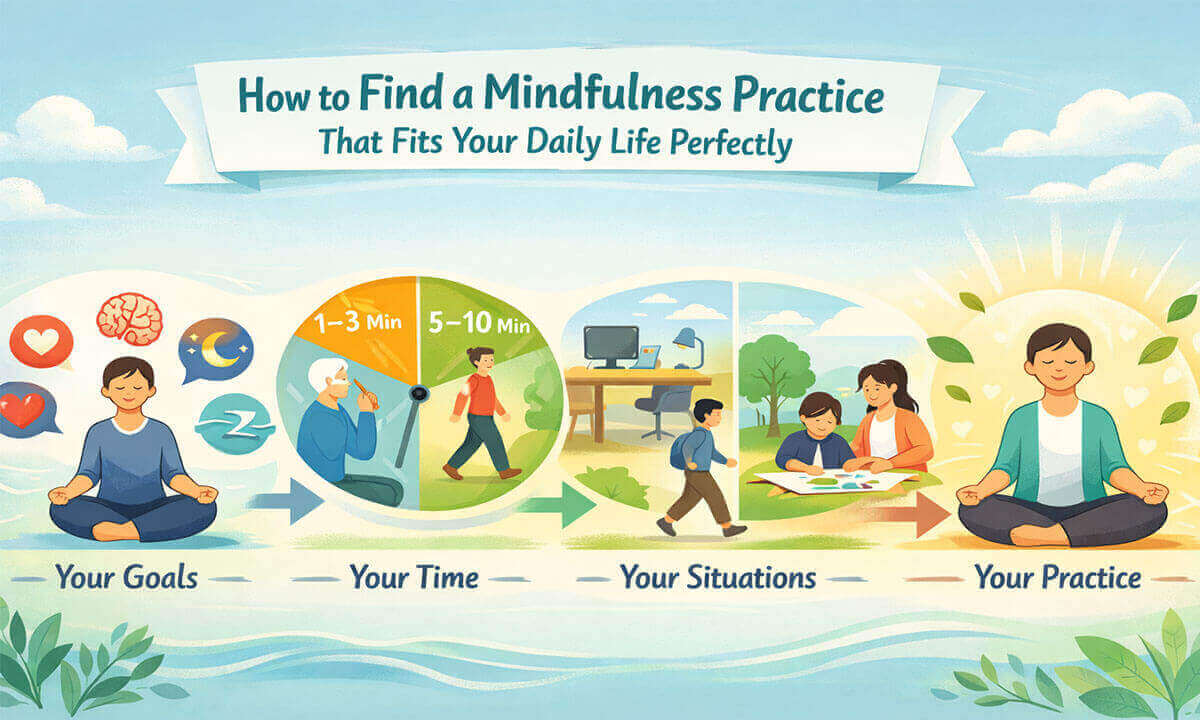
How to Find a Mindfulness Practice That Fits Your Daily Life Perfectly:
In recent years, mindfulness has gained widespread attention as a practical approach to improving mental well-being, emotional balance, and overall quality of life. Yet, despite its growing popularity, many people hesitate to begin because they believe there is a single “correct” way to practice. In reality, mindfulness is a flexible and deeply personal experience; one that can be adapted to fit individual needs, lifestyles, and intentions. Rather than striving for perfection or trying to eliminate thoughts and emotions, mindfulness invites us to relate to our experiences with openness and compassion. As Kornfield (2015) mentioned, “to let go does not mean to get rid of. To let go means to let be. When we let be with compassion, things come and go on their own.” At its core, mindfulness involves paying attention to the present moment with a non-judgmental attitude. It is not a quick fix or a technique to control the mind, but a way of cultivating awareness of thoughts, feelings, and sensations as they naturally arise and pass. For beginners, however, the wide range of available practices (from meditation to mindful walking or breathing) can feel overwhelming. Questions such as “Where do I start?” or “Which method is right for me?” are both common and valid. This guide explains how to find a mindfulness practice that fits your daily life perfectly by emphasizing that there is no one-size-fits-all approach. Instead, it offers practical insights to help you choose a mindfulness practice that aligns with your personal goals, available time, and everyday context, making it easier to integrate mindfulness into your daily life in a meaningful and sustainable way.
How to Integrate Mindfulness Into Everyday Life:
- No One-Size-Fits-All Approach: Integrating mindfulness into everyday life begins with understanding that there is no universal method that works for everyone. Mindfulness is highly personal, and the way it is practiced should reflect your individual needs, goals, and daily circumstances. Instead of trying to follow a rigid structure, it is more helpful to pause and ask yourself a few guiding questions: What do I need right now? How much time do I realistically have? In which situations would mindfulness be most helpful for me?
These questions create a sense of intentionality and ensure that your practice is not only practical but also meaningful. When mindfulness aligns with your real-life context, it becomes easier to sustain over time.
- Building a Structured Practice with Intention: Once you gain clarity about your needs and daily routine, you can begin to develop a structured mindfulness practice. This does not mean creating a strict or demanding schedule; rather, it involves making small, conscious choices to bring awareness into your everyday experiences. At first, this may require deliberate effort, as mindfulness is not yet a habit. However, with consistency and intention, it gradually becomes a natural way of being rather than something you have to remember to do.
- Habit Pairing (Anchoring Mindfulness to Daily Routines): A practical and sustainable way to integrate mindfulness is through habit pairing; linking mindfulness to activities you already perform regularly. Instead of adding something entirely new to your routine, you attach mindful awareness to existing habits such as brushing your teeth, drinking your morning coffee, walking to work, or even pausing for three mindful breaths before opening your emails.
This approach reduces the likelihood of forgetting or avoiding the practice because it is already built into your day. Over time, this intentional way of paying attention begins to “spill over” into other situations. You may find yourself becoming more present not only during these specific moments but also in conversations, work tasks, and daily interactions, gradually cultivating a more mindful way of living.
- Start Small and Stay Consistent: One of the most common misconceptions about mindfulness is that it requires long periods of meditation to be effective. In reality, starting small is often more beneficial, especially for beginners. Practicing for just one to five minutes a day can be enough to begin developing awareness.
What matters most is not the length of the practice but the consistency with which it is done. Repetition helps train the mind to return to the present moment more easily. By keeping the practice short and manageable, you reduce resistance and increase the likelihood of maintaining it over time. As mindfulness becomes more familiar, you can gradually extend the duration if it feels appropriate, but the foundation is built through regular, simple practice.
- Reflection and Meta-Awareness: Reflection is a crucial component of mindfulness because it deepens your understanding of your inner experiences. A key mechanism underlying mindfulness is meta-awareness, which refers to the ability to observe your own thoughts, emotions, and mental processes. Instead of becoming automatically caught up in these experiences, you begin to notice them as they arise and pass. This shift from reacting to observing is central to the effectiveness of mindfulness (Lindsay & Creswell, 2017).
Incorporating a brief moment of reflection at the end of your practice can help strengthen this awareness. Asking yourself simple questions such as What did I notice? Did anything feel different? How did I respond to distractions or wandering thoughts? encourages a deeper level of engagement. Over time, this reflective habit enhances your ability to relate to your thoughts and emotions with greater clarity and less reactivity.
- Choosing What Fits Your Life: Ultimately, the key to successfully integrating mindfulness into everyday life lies in choosing practices that genuinely fit your personal needs, time availability, and daily context. When mindfulness feels relevant and adaptable, it becomes less of a task and more of a supportive presence in your life. Rather than forcing yourself into a rigid routine, you allow mindfulness to evolve naturally within your lifestyle. This flexibility not only makes the practice more sustainable but also helps it become a meaningful and lasting part of your everyday experience.
Choose a Mindfulness Practice by Goal:
- The Importance of Setting a Clear Goal: Identifying a clear goal is an essential first step in choosing the right mindfulness practice. Just like any other form of personal development, having a specific intention increases the likelihood of achieving meaningful outcomes. In the context of mindfulness, your goal might be to reduce anxiety, improve sleep, enhance focus, or better understand your emotions. When your purpose is clearly defined, it becomes easier to select practices that directly support that intention. Rather than practicing randomly, you are engaging in mindfulness with direction and awareness, which makes the experience more effective and personally relevant.
- Calming Anxiety or Physiological Stress: If your primary goal is to reduce anxiety or manage physiological stress, mindfulness can be especially beneficial. Research shows that mindfulness-based interventions can significantly reduce anxiety symptoms over time (Khoury et al., 2013). One of the most effective approaches in this area is to focus on bodily sensations, often referred to as body-based practices. These practices help shift attention away from distressing thoughts and toward present-moment physical experiences, which can reduce emotional reactivity.
For example, mindful breathing encourages you to gently observe the natural rhythm of your breath, helping calm the nervous system. Gentle breath-regulation practices (such as slightly lengthening the exhale) can further promote relaxation. Additionally, mindful walking, where you consciously notice each step and the sensations in your body as you move, can ground you in the present moment and reduce stress.
- Reducing Overthinking or Rumination: Overthinking and rumination often involve getting caught in repetitive thought patterns about the past or future. Mindfulness helps address this by developing cognitive flexibility (the ability to shift perspectives) and decentering, which allows you to observe thoughts as temporary mental events rather than absolute truths (Lindsay & Creswell, 2017).
Practices such as mindful thinking teach you to notice thoughts as they arise and pass, without becoming entangled in them. Mindful meditation strengthens this skill by training your attention and awareness over time. Additionally, mindful journaling offers a reflective space where you can write about your thoughts and experiences with curiosity and non-judgment. These practices gradually help create distance from unhelpful thinking patterns, reducing their intensity and frequency.
- Improving Focus or Concentration: If your goal is to enhance focus and cognitive performance, mindfulness can play a powerful role. A large meta-analysis found that mindfulness training improves various aspects of cognition, including sustained attention, the ability to maintain focus, and accurate information processing (Zainal & Newman, 2024).
To support this goal, mindful meditation helps train the mind to return to a chosen point of focus whenever distractions arise. Single-task mindfulness—fully engaging in one activity at a time rather than multitasking—strengthens concentration and reduces mental clutter. Even simple practices like mindful breathing can sharpen attention by repeatedly bringing awareness back to the present moment. Over time, these techniques enhance your ability to stay engaged and mentally clear in daily tasks.
- Increasing Emotional Awareness: For those who feel disconnected from their emotions or overwhelmed by them, mindfulness offers a way to develop greater emotional awareness. It encourages observing internal experiences with curiosity and without judgment, creating space to understand emotions rather than react to them.
Embodied practices are particularly helpful in this area. Mindful yoga combines movement and awareness, helping you connect physical sensations with emotional states. Mindful journaling focused on emotions allows you to explore and label your feelings more clearly. Body scan exercises, where you systematically bring attention to different parts of the body, can reveal subtle emotional cues stored in physical sensations. These practices help build a more compassionate and informed relationship with your inner experiences.
- Improving Sleep Quality: Mindfulness can also be highly effective in improving sleep, particularly by reducing mental restlessness and repetitive thinking that often interfere with falling asleep. Research suggests that mindfulness practices can enhance sleep quality by calming the mind and reducing rumination (Rusch et al., 2019).
Practices that anchor attention in the body are especially useful before bedtime. Mindful breathing can help slow down the mind and relax the body. Body scan exercises guide attention progressively through the body, releasing tension and promoting a sense of calm. Additionally, mindful listening, such as focusing on sleep meditations or ambient sounds, can gently occupy the mind and create a soothing environment for sleep.
- Aligning Practice with Personal Needs: Eventually, the effectiveness of mindfulness depends on how well the chosen practice aligns with your specific goals and life context. By selecting techniques that directly address your needs (whether it is reducing stress, improving focus, or enhancing emotional awareness) you make mindfulness more purposeful and easier to maintain. This goal-oriented approach transforms mindfulness from a general concept into a practical and supportive tool for everyday living.
Choose a Mindfulness Practice by Time:
- Mindfulness Can Fit Into Any Schedule: One of the most encouraging aspects of mindfulness is that it does not require large amounts of free time or a perfectly structured routine. Mindfulness can be practiced informally during everyday activities such as eating, walking, or even pausing between tasks. However, for many people (especially beginners) setting aside small, structured moments in the day can make the practice more intentional and easier to maintain. The key is to choose a time commitment that realistically fits your lifestyle, rather than forcing an ideal that may be difficult to sustain.
- Consistency Over Duration: Research shows that even brief mindfulness exercises can produce measurable cognitive and mental health benefits (Zeidan et al., 2010). This highlights an important principle: consistency matters more than how long you practice. Short, regular practices help build the habit and make mindfulness a natural part of your routine. At the same time, as you become more comfortable, longer sessions can help deepen your skills and enhance the overall impact of the practice. In this way, both short and extended practices have value; they simply serve different purposes.
- If You Have 1 to 3 Minutes: Even with just a few minutes available, you can engage in meaningful mindfulness practice. These brief moments can serve as powerful “reset points” throughout the day. For example, taking three conscious breaths while fully noticing the sensations of inhaling and exhaling can quickly bring your attention back to the present moment.
Another simple practice is a sensory check-in, where you pause and observe your surroundings by asking: What can I see, hear, smell, feel, or taste right now? This helps ground you in immediate experience and interrupts automatic thinking patterns.
You can also try a 1–3 minute mindful meditation, focusing gently on your breath or bodily sensations. Although short, these practices can significantly improve awareness and reduce stress when done consistently.
- If You Have 5 to 10 Minutes: With slightly more time, you can engage in practices that allow for deeper attention and reflection. Mindful eating or mindful walking are excellent options, as they integrate awareness into natural activities; encouraging you to fully notice tastes, textures, movements, and bodily sensations.
A journaling practice can also be beneficial, providing space to reflect on thoughts and emotions with mindfulness and curiosity. Additionally, a 5–10 minute mindful meditation allows for more sustained focus, helping you strengthen attention and develop greater mental clarity. These practices strike a balance between being manageable and allowing for meaningful engagement.
- If You Have 15+ Minutes: When you have more time available, you can explore more immersive mindfulness practices that deepen awareness and relaxation. An extended body scan involves slowly bringing attention to different parts of the body, noticing sensations and releasing tension along the way.
A mindful yoga session combines movement with breath awareness, helping you connect the mind and body in a dynamic way. Longer mindful meditation sessions also provide the opportunity to cultivate sustained attention, emotional regulation, and insight.
At this stage, you can also engage in any other mindfulness practices that resonate with you, allowing for flexibility and personal exploration.
- Adapting Mindfulness to Your Availability: Consequently, the effectiveness of mindfulness depends not on how long you practice, but on how well the practice fits into your daily life. By honestly assessing your availability and choosing practices that align with your schedule, you create a routine that is both realistic and sustainable. Whether it is a few mindful breaths or a longer meditation session, each moment of awareness contributes to building a more present, balanced, and attentive way of living.
Choose a Mindfulness Practice by Situation:
- Adapting Mindfulness to Your Environment: Mindfulness becomes far more sustainable when it is adapted to your specific situation or environment. Rather than viewing it as something separate from daily life, it can be shaped to fit naturally into where you are and what you are doing. An important consideration is that the environment should feel relatively safe and supportive, allowing you to relax and bring your attention to the present moment. By aligning your mindfulness practice with your surroundings (whether at work, during emotional stress, or at home with family) you make it more accessible, practical, and meaningful.
- Practicing Mindfulness at Work: The workplace is often associated with multitasking, deadlines, and stress, making it an ideal setting for mindfulness. Incorporating simple practices into your workday can improve focus, enhance productivity, and help you respond more effectively to challenging situations.
For example, taking one minute of breath awareness before starting a task or entering a meeting can help you reset your attention and approach the situation with greater clarity. Practicing single-task focus, where you fully immerse yourself in one activity at a time instead of switching between multiple tasks, can reduce cognitive overload and improve the quality of your work.
Additionally, mindful pauses throughout the day (such as briefly stepping away to walk, eat, or meditate with awareness) can provide mental breaks that restore energy and reduce stress. These small moments of mindfulness can significantly improve how you experience and manage your work environment.
- Mindfulness During Emotional Overwhelm: When you are feeling emotionally overwhelmed, mindfulness can serve as a grounding tool to help regulate your stress response. In such moments, the goal is not to eliminate emotions but to create space to experience them without becoming consumed by them.
Gentle breath regulation practices, such as slowing and deepening the breath, can calm the nervous system and reduce immediate intensity. A body scan helps redirect attention to physical sensations, which can anchor you in the present moment and provide a sense of stability.
Practicing mindful awareness of emotions involves noticing feelings as they arise, allowing them to exist without judgment, and observing them with curiosity rather than resistance. This approach helps shift your relationship with emotions; from reacting automatically to responding with awareness and compassion.
- Mindfulness with Family and Children: Mindfulness is not limited to individual practice; it can also be shared within family life, including with children. In fact, simple, sensory-based practices are often the most accessible and engaging for younger individuals. Practicing mindfulness together can strengthen emotional connections, improve communication, and create a calmer home environment.
Activities such as mindful coloring encourage focus and creativity while promoting relaxation. The grounding exercise (identifying five things you can see, four you can hear, three you can feel, and so on) helps both children and adults become more aware of their surroundings in a playful and engaging way.
Shared mindful breathing, where family members take a few slow breaths together, can be a simple yet powerful way to create a sense of calm and connection. These practices show that mindfulness does not have to be complex; it can be integrated into everyday family moments in a natural and enjoyable way.
- Making Mindfulness Situational and Practical: So, choosing mindfulness practices based on your situation allows you to respond more effectively to the demands of daily life. Whether you are navigating workplace stress, managing intense emotions, or spending time with family, mindfulness can be adapted to support you in that specific context. This situational flexibility makes mindfulness not just a practice, but a way of being; one that meets you wherever you are and helps you engage with life more calmly, clearly, and consciously.
In conclusion, mindfulness is not something that needs to be confined to a specific time, place, or formal routine; it is a flexible and adaptable practice that can be woven into the fabric of everyday life. Whether you are walking, working, eating, or simply pausing between tasks, each moment offers an opportunity to bring gentle awareness to your experience. Over time, these small, intentional moments of presence can transform mindfulness from something you do into a natural way of being.
What makes mindfulness truly powerful is its adaptability. It allows you to respond to your needs as they change from day to day; sometimes through a structured meditation, and at other times through simple practices like mindful breathing or walking. There is no single “correct” approach; instead, the most effective practice is the one that feels realistic, supportive, and meaningful to you.
Finally, the key to integrating mindfulness into your life lies in consistency and self-awareness. By choosing practices that align with your lifestyle and staying open to what works best in each moment, you create a sustainable habit that supports both your mental and emotional well-being. In this way, mindfulness becomes less about effort and more about living with greater clarity, balance, and presence.
Frequently Asked Questions (FAQs):
Should I stick to one mindfulness practice or rotate between several?
There is no strict rule that you must follow only one mindfulness practice. In fact, both approaches can be beneficial depending on your needs. Sticking to one practice (such as mindful breathing or meditation) can help you build consistency and deepen your skill over time. On the other hand, rotating between different practices (e.g., walking, journaling, body scan) can keep your experience fresh and better suited to different situations or goals. A balanced approach often works best: maintain one core practice while occasionally exploring others to support flexibility and engagement.
What if mindfulness doesn’t seem to work for me?
It is common for mindfulness to feel ineffective or even frustrating at the beginning. Many people expect immediate calm or relief, but mindfulness is not about eliminating thoughts or emotions; it is about changing your relationship with them. If it doesn’t seem to work, consider starting with shorter sessions, trying a different type of practice, or adjusting your expectations. Sometimes, more active or sensory-based practices (like mindful walking or breathing) are easier than sitting meditation. With patience and consistency, the benefits often become more noticeable over time.
How long should I practice mindfulness each day?
There is no fixed duration required. Even a few minutes a day can be beneficial, especially when practiced consistently. Beginners may start with 1–5 minutes and gradually increase the duration as they feel more comfortable. The key is to choose a length of time that feels manageable and sustainable rather than overwhelming.
Can mindfulness really help with stress and anxiety?
Yes, mindfulness has been widely shown to support stress and anxiety reduction. By focusing on the present moment and observing thoughts without judgment, you can reduce overthinking and emotional reactivity. While it may not eliminate stress entirely, it helps you respond to it in a calmer and more balanced way.
Do I need a quiet or special place to practice mindfulness?
While a quiet environment can be helpful (especially for beginners) it is not necessary. Mindfulness can be practiced anywhere, including during daily activities like commuting, eating, or working. Over time, you can learn to be mindful even in busy or noisy environments.
Is mindfulness the same as meditation?
Not exactly, meditation is one formal way to practice mindfulness, but mindfulness itself is a broader concept. It involves bringing awareness to the present moment in any situation, whether you are sitting in meditation or engaging in everyday tasks.
What should I do when my mind keeps wandering?
A wandering mind is completely normal and part of the practice. Instead of getting frustrated, gently notice that your attention has drifted and bring it back to your point of focus, such as your breath or body sensations. Each time you do this, you are strengthening your mindfulness skill.
Can children or families practice mindfulness together?
Yes, mindfulness can be adapted for all ages. Simple, engaging practices such as mindful breathing, sensory games, or mindful coloring can be effective for children. Practicing together as a family can also promote calmness, connection, and emotional awareness.
How do I stay consistent with mindfulness practice?
Consistency can be supported by starting small, linking mindfulness to daily habits (like brushing your teeth or drinking coffee), and choosing practices that feel enjoyable rather than forced. Setting realistic expectations and being flexible with your approach can also help maintain motivation over time.
References:
- Khoury, B., Lecomte, T., Fortin, G., Masse, M., Therien, P., Bouchard, V., Chapleau, M. A., Paquin, K., & Hofmann, S. G. (2013). Mindfulness-based therapy: A comprehensive meta-analysis. Clinical Psychology Review, 33(6), 763–771. https://doi.org/10.1016/j.cpr.2013.05.005
- Kornfield, J. [@JackKornfield]. (2015, February 12). To let go does not mean to get rid of. To let go means to let be. [Tweet]. X. https://x.com/JackKornfield/status/565996640981778433
- Lindsay, E. K., & Creswell, J. D. (2017). Mechanisms of mindfulness training: Monitor and Acceptance Theory (MAT). Clinical Psychology Review, 51, 48–59. https://doi.org/10.1016/j.cpr.2016.10.011
- Rusch, H. L., Rosario, M., Levison, L. M., Olivera, A., Livingston, W. S., Wu, T., & Gill, J. M. (2019). The effect of mindfulness meditation on sleep quality: A systematic review and meta-analysis of randomized controlled trials. Annals of the New York Academy of Sciences, 1445(1), 5–16. https://doi.org/10.1111/nyas.13996
- Zainal, N. H., & Newman, M. G. (2024). Mindfulness enhances cognitive functioning: A meta-analysis of 111 randomized controlled trials. Health Psychology Review, 18(2), 369–395. https://doi.org/10.1080/17437199.2023.2248222
- Zeidan, F., Johnson, S. K., Diamond, B. J., David, Z., & Goolkasian, P. (2010). Mindfulness meditation improves cognition: Evidence of brief mental training. Consciousness and Cognition, 19(2), 597–605. https://doi.org/10.1016/j.concog.2010.03.014

Library Lecturer at Nurul Amin Degree College