How to Make Problem-Solving More Engaging for Students:
Problem-solving is one of the most essential skills students can develop, not only for academic success but for navigating life’s everyday challenges. Whether tackling a tricky math equation, figuring out logistics for a project, or addressing a social dilemma, effective problem-solving builds critical thinking, resilience, and confidence. However, traditional instructional methods often render problem-solving dry or intimidating, leaving many students unmotivated. In this article, we will explore how to make problem-solving more engaging for students.
Why Is Problem-Solving Important?
Problem-solving is more than an academic skill; it is a foundational ability that shapes how students think, learn, and interact with the world around them. From early childhood through higher education and adulthood, individuals constantly face situations that require analysis, decision-making, and creative thinking. Developing strong problem-solving skills equips students not only to succeed in school but also to navigate real-life challenges with confidence and resilience.
A) Problem-Solving Is a Core Life Skill: In everyday life, students encounter problems that rarely have clear instructions or single correct answers. Whether managing time, resolving conflicts, or making financial decisions, effective problem-solving helps individuals adapt to changing situations. Educational research emphasizes that engaging students in authentic, problem-based tasks prepares them for real-world responsibilities by encouraging practical thinking and adaptability (Nemakhavhani, 2024).
When students learn how to approach problems systematically (by identifying the issue, considering possible solutions, and evaluating outcomes), they develop skills that remain relevant long after formal schooling ends.
B) It Develops Critical and Analytical Thinking: Problem-solving encourages students to move beyond memorization and passive learning. Instead of simply recalling information, students must analyze situations, recognize patterns, evaluate evidence, and justify their decisions. According to active learning theories, deeper understanding occurs when learners actively construct knowledge through meaningful engagement with problems (Chi, 2009).
Research on problem-based learning shows that students who regularly engage in problem-solving tasks demonstrate stronger critical thinking abilities because they are required to question assumptions, explore alternatives, and reflect on their reasoning (Lee, 2025). These skills are essential across all academic disciplines, from mathematics and science to humanities and social sciences.
C) It Builds Confidence and Resilience: Successfully solving a problem (especially a challenging one) provides students with a powerful sense of accomplishment. Each success reinforces their belief in their ability to handle difficulty, which gradually builds academic confidence. Even when students struggle, guided problem-solving teaches them that mistakes are part of learning rather than signs of failure.
Studies suggest that structured problem-solving experiences help students develop persistence and resilience by encouraging them to view challenges as opportunities for growth rather than obstacles (Sweller & Cooper, 1985). Over time, this mindset reduces fear of failure and promotes a healthier attitude toward learning.
D) It Improves Academic Performance Across Subjects: Problem-solving skills are closely linked to academic success. Students who can break down complex tasks, identify key information, and apply appropriate strategies tend to perform better in subjects such as mathematics, science, reading comprehension, and even writing. Problem-based learning approaches have been shown to enhance learning outcomes by promoting deeper understanding rather than surface-level knowledge (Lee, 2025).
By strengthening problem-solving abilities, students become more independent learners who can transfer skills from one subject to another, improving overall academic performance.
E) It Prepares Students for Collaboration and the Modern World: Modern education and workplaces increasingly emphasize collaboration, innovation, and adaptability. Many real-world problems require teamwork, communication, and creative thinking. Collaborative problem-solving experiences help students learn how to share ideas, negotiate solutions, and work effectively with others (Xu et al., 2023).
These experiences mirror real-life situations, preparing students for higher education, professional environments, and civic engagement.
Thus, problem-solving is important because it equips students with lifelong skills that extend far beyond the classroom. It fosters critical thinking, builds confidence, enhances academic performance, and prepares learners for real-world challenges. Research consistently shows that when students are actively engaged in solving meaningful problems, learning becomes deeper, more relevant, and more enduring.
Strategies That Make Problem-Solving More Engaging for Students:
1. Turn Problems into Stories:
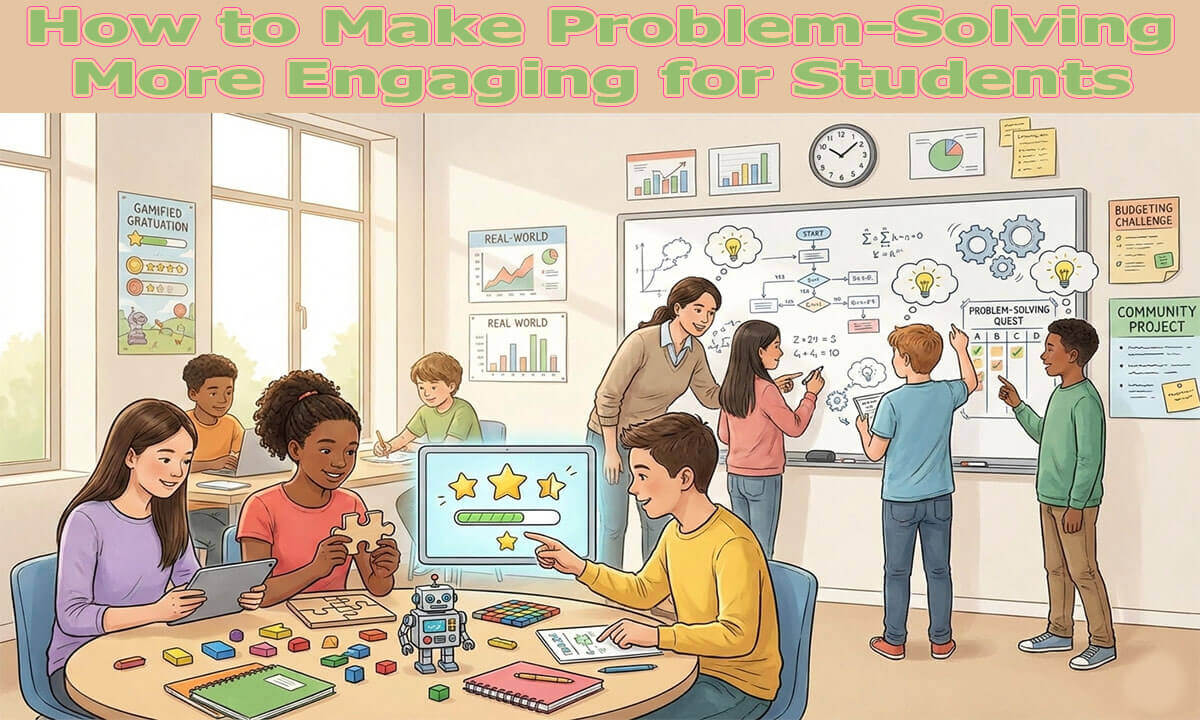
Why This Approach Works: Storytelling is one of the oldest and most powerful learning tools humans have used. Our brains are naturally wired to process and remember information better when it is embedded in a narrative. When a problem is presented as a story, it activates students’ imagination, emotions, and curiosity, making them more willing to engage with the task. Instead of seeing a problem as a dry academic requirement, students begin to view it as a meaningful challenge with purpose.
Educational research supports this idea by showing that learning becomes more effective when students can connect new information to familiar or engaging contexts. Narrative-based learning encourages deeper cognitive processing, which helps students understand why they are solving a problem, not just how to solve it (Lee, 2025).
How to Apply It in Practice: Rather than presenting abstract questions, teachers can frame problems within imaginative or relatable scenarios. For example, a mathematics problem involving speed and distance can be transformed into a rescue mission, a treasure hunt, or a space exploration task. Similarly, a science problem can be framed as an environmental crisis that students must solve to save a community.
When students feel like they are part of a story, problem-solving becomes purposeful. They are no longer solving equations for grades alone; they are solving problems to achieve a goal within the narrative. This sense of purpose increases motivation, focus, and persistence, especially among students who struggle with traditional instructional formats.
2. Use Real-World Scenarios:
Why This Approach Works: One of the most common questions students ask is, “When will I ever use this in real life?” When problems feel disconnected from students’ everyday experiences, motivation often drops. Real-world scenarios bridge this gap by showing students how problem-solving skills apply beyond the classroom.
Research on problem-based learning highlights that students learn more effectively when they work on authentic, real-life problems that mirror real situations. These scenarios promote deeper understanding, encourage decision-making, and help students transfer their knowledge to new contexts (Nemakhavhani, 2024).
How to Apply It in Practice: Teachers and parents can design problems based on situations students recognize, such as managing money, planning events, or solving community issues. For example:
- Creating a budget for a class trip using real prices
- Planning a school fundraiser within financial constraints
- Solving environmental or social problems relevant to students’ communities
These tasks feel meaningful because students can see the immediate relevance of their efforts. When learners understand how problem-solving connects to real decisions they may face in life, engagement naturally increases, and learning becomes more lasting.
3. Gamify the Problem-Solving Process:
Why This Approach Works: Gamification uses elements such as competition, rewards, levels, and challenges to increase motivation and engagement. Games create a safe space for trial and error, encouraging students to take risks without fear of failure. This is particularly important in problem-solving, where persistence and experimentation are key.
Studies show that gamified learning environments can significantly enhance student engagement, motivation, and even critical thinking when designed thoughtfully. By turning problem-solving into a game-like experience, educators tap into students’ natural desire for play and achievement (EducationAndAcademy, 2024; GamificationHub, 2024).
How to Apply It in Practice: Gamification does not require complex technology. Simple strategies can make a big difference, such as:
- Awarding points for correct, creative, or efficient solutions
- Organizing problem-solving races or timed challenges
- Designing classroom “escape room” activities where each solved problem unlocks the next clue
These methods shift the focus from fear of mistakes to enjoyment of the process. Students become more willing to engage, collaborate, and persist through difficult problems because the experience feels exciting rather than stressful.
4. Encourage Collaboration and Teamwork:
Why This Approach Works: Problem-solving can feel intimidating when students work alone, especially when tasks are complex or unfamiliar. Collaborative problem-solving reduces this pressure by allowing students to share responsibility, exchange ideas, and learn from one another. When students work in groups, they are exposed to multiple perspectives, which helps them develop flexible thinking and a deeper understanding.
Research on collaborative learning indicates that working together can increase engagement, motivation, and communication skills. While individual critical thinking remains important, collaboration supports social interaction and helps students articulate their reasoning, clarify misconceptions, and refine their solutions (Xu et al., 2023). This social dimension makes problem-solving more approachable and less isolating.
How to Apply It in Practice: Educators can design activities that require meaningful collaboration rather than simple task division. Strategies include:
- Think-Pair-Share: Students first think individually, then discuss with a partner, and finally share insights with the class.
- Group Problem Tasks: Assign complex problems where each group member contributes a different skill or perspective.
- Peer Review Sessions: Students review and give feedback on each other’s solutions, encouraging reflection and improvement.
Collaboration teaches students that problem-solving is often a shared process in real life, preparing them for teamwork in academic, professional, and social settings.
5. Break Problems into Smaller, Manageable Challenges:
Why This Approach Works: Many students struggle with problem-solving, not because they lack ability, but because they feel overwhelmed by the size or complexity of the task. Cognitive load theory suggests that when too much information is presented at once, students may disengage or give up. Breaking problems into smaller steps helps students focus, process information more effectively, and build confidence gradually (Sweller & Cooper, 1985).
This step-by-step approach allows students to experience small successes along the way, which reinforces motivation and persistence.
How to Apply It in Practice: Teachers can scaffold problem-solving by:
- Presenting problems in stages rather than all at once
- Guiding students through identifying known information, unknowns, and possible strategies
- Starting with simpler problems that gradually increase in complexity
For example, instead of asking students to solve a full multi-step equation immediately, instructors can first ask them to simplify expressions, then isolate variables, and finally solve the complete problem. This structured progression keeps students engaged and reduces frustration.
6. Use Creative Tools and Technology:
Why This Approach Works: Today’s students grow up surrounded by digital technology, making interactive tools a natural way to engage them in learning. Technology can transform problem-solving from a static task into a dynamic, visual, and interactive experience. Digital tools also support different learning styles, allowing students to explore problems at their own pace.
Educational research highlights that technology-enhanced learning environments encourage active participation and experimentation, which are essential for effective problem-solving (Chi, 2009).
How to Apply It in Practice: Educators can integrate technology in meaningful ways, such as:
- Interactive platforms: Tools like Kahoot or Quizizz turn problem-solving into an engaging quiz-based experience.
- Visual tools: Mind maps, flowcharts, and simulations help students visualize relationships and processes.
- Coding and logic platforms: Tools like Scratch or Code.org allow students to solve problems through programming, strengthening logical thinking.
When used thoughtfully, technology shifts problem-solving from passive worksheet completion to active exploration, making learning both engaging and memorable.
7. Reward Creativity, Not Just the “Right” Answer:
Why This Approach Works: In many classrooms, problem-solving is treated as a process with only one correct answer. While accuracy is important, this approach can unintentionally discourage creativity, experimentation, and risk-taking. Students may become afraid of making mistakes and focus only on memorizing procedures rather than understanding concepts.
Research on active learning emphasizes that meaningful engagement occurs when students are allowed to interact with problems creatively and construct their own solutions. According to Chi’s ICAP framework, students learn more deeply when they are actively and constructively engaged; generating ideas, testing strategies, and reflecting on outcomes rather than simply reproducing answers (Chi, 2009). When creativity is valued, students feel safer exploring different approaches, which strengthens problem-solving skills.
How to Apply It in Practice: Teachers can encourage creative problem-solving by:
- Allowing students to present multiple solution methods for the same problem
- Designing open-ended problems with more than one acceptable outcome
- Praising innovative thinking, even when solutions are not perfect
For example, students might be asked to design a bridge using limited materials or create a strategy to reduce waste in their school. The emphasis shifts from getting it right to thinking it through. This approach builds confidence, adaptability, and resilience; key skills students need both academically and in real life.
In conclusion, Problem-solving doesn’t have to be a source of anxiety or boredom for students. By embedding problems within stories, real challenges, games, collaborative tasks, and technology, educators can transform it into an engaging and rewarding journey. The goal is not simply to find answers but to cultivate curiosity, resilience, and a joy for thinking. When students feel capable, connected, and invested in the process, problem-solving becomes not just a skill but an adventure worth pursuing.
Frequently Asked Questions (FAQs):
Why do many students struggle with problem-solving?
Many students struggle with problem-solving because they feel overwhelmed, lack confidence, or do not see the relevance of the problem to real life. Traditional teaching methods often focus on memorization and correct answers rather than understanding the process. When students are afraid of making mistakes or do not understand why they are solving a problem, motivation decreases.
At what age should problem-solving skills be introduced?
Problem-solving skills can and should be introduced from an early age. Young children naturally solve problems through play, exploration, and curiosity. As students grow older, these skills can be developed further through structured activities, real-life scenarios, and academic challenges. The key is to adapt problem-solving tasks to the student’s developmental level.
How can teachers make problem-solving fun without losing academic value?
Problem-solving can be fun and academically meaningful at the same time. Strategies such as storytelling, gamification, group challenges, and real-world applications maintain academic rigor while increasing engagement. The focus remains on thinking, reasoning, and applying knowledge—just presented in a more interactive and motivating way.
Does gamification really help students learn better?
Yes, when used thoughtfully, gamification can significantly increase engagement and motivation. Game elements such as points, levels, challenges, and teamwork encourage students to persist and participate actively. However, gamification should support learning goals rather than distract from them. The emphasis should remain on problem-solving strategies, not just winning.
How can parents support problem-solving at home?
Parents can encourage problem-solving by involving children in everyday decisions and challenges. Activities like planning meals, managing a small budget, solving puzzles, or discussing “what would you do if…” scenarios help children practice problem-solving naturally. Asking guiding questions instead of giving direct answers is especially effective.
What if a student gives a creative answer that is incorrect?
Creative but incorrect answers should still be valued. They show that the student is thinking actively and exploring possibilities. Teachers can guide students to reflect on their approach, identify where the reasoning went off track, and refine their solution. This process builds confidence and deepens understanding more than simply marking an answer wrong.
How does collaboration improve problem-solving skills?
Collaboration allows students to share ideas, explain their thinking, and learn from different perspectives. Working with peers helps students clarify concepts, develop communication skills, and understand that complex problems often benefit from teamwork. Collaborative problem-solving also mirrors real-world situations students will face in the future.
Can technology replace traditional problem-solving methods?
Technology should support (not replace) effective teaching. Digital tools can enhance problem-solving by providing interactive experiences, visualizations, and immediate feedback. However, hands-on activities, discussion, and reflection remain essential. A balanced approach that combines technology with human interaction works best.
How can teachers assess problem-solving skills fairly?
Assessment should focus on the process as well as the final answer. Teachers can evaluate how students analyze the problem, choose strategies, explain their reasoning, and reflect on outcomes. Rubrics, project-based assessments, and open-ended tasks are effective ways to assess problem-solving skills fairly and meaningfully.
What is the biggest takeaway for educators and parents?
The most important takeaway is that problem-solving should be engaging, supportive, and meaningful. When students feel safe to explore ideas, make mistakes, and think creatively, they become more confident and capable learners. Making problem-solving enjoyable is not about simplifying learning—it’s about making it deeper and more effective.
References:
- Chi, M. T. H. (2009). Active-constructive-interactive: A conceptual framework for differentiating learning activities. Topics in Cognitive Science, 1(1), 73–105. https://doi.org/10.1111/j.1756-8765.2008.01005.x
- EducationAndAcademy. (2024). Top 5 ways gamification transforms modern classrooms. https://educationandacademy.com/top-5-ways-gamification-transforms-modern-classrooms/
- GamificationHub. (2024). Game-based learning in education. https://www.gamificationhub.org/game-based-learning-in-education/
- Lee, Y. C. (2025). Changes in learning outcomes of students participating in problem-based learning for the first time: A case study of a financial management course. The Asia-Pacific Education Researcher, 34, 511–530. https://doi.org/10.1007/s40299-024-00873-y
- Nemakhavhani, R.B. (2024). Enhancing Student Engagement Through Problem-Based Learning: A Case of the Built Environment. International Conference on Education Research, 247-254. https://doi.org/10.34190/icer.1.1.3053
- Sweller, J., & Cooper, G. A. (1985). The use of worked examples as a substitute for problem solving in learning algebra. Cognition and Instruction, 2(1), 59–89. https://doi.org/10.1207/s1532690xci0201_3
- Xu, E., Wang, W., & Wang, Q. (2023). The effectiveness of collaborative problem solving in promoting students’ critical thinking: A meta-analysis based on empirical literature. Humanities and Social Sciences Communications, 10, Article 16. https://doi.org/10.1057/s41599-023-01508-1

is an experienced educator and academic currently serving as a Lecturer at Nurul Amin Degree College. With a career dedicated to student development and institutional excellence, he brings a wealth of classroom expertise and pedagogical knowledge to his current role. Before joining the faculty, he served as an Assistant Teacher at Zinzira PM Pilot School and College.