Understanding the Stock Market: A Beginner’s Guide for Students
The stock market may sound confusing at first, especially for students. However, the basic idea is quite simple. It is a marketplace where people buy and sell small parts of companies called stocks or shares. Learning about stocks does not have to be difficult. Once the basic ideas are understood, students can better understand how investing works and why the stock market matters. This guide explains understanding the stock market: a beginner’s guide for students. It covers the key ideas that students need to know about stocks, investing, and financial decisions.
What Is the Stock Market?
The stock market is a place where people buy and sell small parts of companies. These small ownership pieces are called stocks or shares.
For example, imagine you own a lemonade business and need more money to grow it. You could sell small parts of your business to your friends. Anyone who buys a part becomes a small owner of the business.
If the business does well and makes more money, the value of those shares may increase. If the business performs off-color, their value may decrease.
The stock market works in a similar way, but on a much larger scale. When you buy a stock, you become a small owner of that company.
How Does the Stock Market Work?
Let us look at how the stock market works step by step.
1. Companies Go Public: The process often begins when a private company decides to become a public company. A company may choose to go public because it needs money to expand its business, develop new products, hire more workers, or enter new markets.
To raise money from the public, the company can offer shares of its ownership for sale. This process is called an Initial Public Offering, or IPO.
During an IPO, the company sells shares to investors for the first time. After the shares are offered to the public, investors can buy them and become partial owners of the company.
For example, imagine that a growing company needs a large amount of money to expand its business. Instead of borrowing all the money from a bank, the company may offer shares to the public. People who buy those shares become shareholders.
An IPO is an important step because it allows a company to raise capital while giving investors an opportunity to own part of the business.
2. Investors Buy and Sell Stocks: After a company becomes publicly traded, its shares can be bought and sold by investors.
Investors usually buy and sell stocks through a brokerage account. A broker or online trading platform connects investors with the stock market and helps them place orders.
There are many stock exchanges around the world. Two well-known examples in the United States are the New York Stock Exchange (NYSE) and Nasdaq.
Investors can decide to buy a stock because they believe the company will grow in the future. They may expect the company’s profits to increase and its stock price to rise.
Other investors may decide to sell because they want to take a profit, need money, or believe the stock price may fall.
This continuous buying and selling creates activity in the stock market.
3. Stock Prices Change: One of the most important things to understand about the stock market is that stock prices are not fixed. They can change many times during a trading day.
The main force behind these changes is supply and demand.
When Demand Is High:
Suppose many investors want to buy shares of a particular company. There may not be enough shares available at the current price. Buyers may then be willing to pay a higher price to get the stock.
As a result, the stock price may rise.
For example, imagine that a stock is trading at $50. If many investors believe the company has strong future growth, more people may want to buy it. Increased demand could push the price to $55, $60, or even higher.
When Supply Is High:
The opposite can also happen. Suppose many investors want to sell a particular stock. There may be more shares available for sale than buyers are willing to purchase at the current price.
Sellers may then accept lower prices to attract buyers. As a result, the stock price may fall.
For example, a stock trading at $50 could fall to $45 or $40 if many investors are trying to sell it.
4. Why Do People Buy and Sell Stocks? People buy and sell stocks for many different reasons.
Some investors buy shares because they believe a company will become more valuable in the future. They hope the stock price will increase and allow them to make a profit.
Others invest in companies that pay dividends. A dividend is a payment that some companies make to their shareholders from their profits.
Some people sell stocks because the price has increased and they want to take their profit. Others may sell because they believe the company is not performing well or because they need money for another purpose.
This difference in investor opinions is one of the reasons why the stock market is always changing.
5. Investors Can Make or Lose Money: The stock market gives investors an opportunity to make money, but there is always risk.
An investor can make a profit when a stock is bought at a lower price and later sold at a higher price.
For example, suppose a student buys 10 shares at $20 per share. The total investment is $200. Later, the stock price increases to $30 per share. If the student sells the shares, the total value would be $300. The difference is a $100 profit before any fees or taxes.
However, the opposite can also happen.
Suppose the same student buys the shares at $20, but the price later falls to $15. If the student sells the shares at that price, the total value would be $150. The investor would have a $50 loss before any fees or taxes.
This example shows why investing in the stock market always involves risk.
6. The Role of Investors’ Expectations: Stock prices are affected not only by what is happening today but also by what investors expect to happen in the future.
For example, a company may announce that it has developed a new product that could become very successful. Investors may become optimistic about the company’s future and start buying its shares.
On the other hand, if a company reports weak earnings, faces serious problems, or receives negative news, investors may become worried. They may sell their shares, which can cause the stock price to fall.
Therefore, stock prices are influenced by investor expectations, company performance, economic conditions, and many other factors.
7. The Stock Market Works Through Buyers and Sellers: The stock market works because buyers and sellers are constantly interacting.
A buyer wants to purchase a stock at a certain price, while a seller wants to sell it at a certain price. When their orders match, a trade takes place.
Modern stock markets use electronic systems to match these buy and sell orders very quickly. This allows thousands or even millions of transactions to take place during a trading day.
The process may happen in seconds, but behind every transaction there is an investor making a decision based on information, expectations, goals, or personal financial needs.
Why Should Students Care About the Stock Market?
Many students may wonder why they should learn about the stock market while they are still in school or college. They may think that investing is something they can learn later, after getting a job and earning more money. However, learning about the stock market early can give students a valuable advantage in their financial life.
Students do not need to become professional investors. They simply need to understand the basic ideas of saving, investing, risk, and long-term financial planning. This knowledge can help them make better decisions about money in the future.
1. Early Investing Can Give You More Time to Grow: One of the major reasons students should learn about investing is time.
When a person starts investing early, the money has more time to grow. Even a small amount of money can become more valuable over a long period when it earns returns and those returns are reinvested.
This is closely related to the idea of compound interest. Compound growth means that money can earn returns, and those returns can also earn additional returns over time.
For example, imagine that a student starts putting a small amount of money into a suitable long-term investment. The student may not see a huge change after a few months. However, over many years, regular contributions and growth can make a significant difference.
This does not mean that investing always produces profits. Investments can lose value, and returns are never guaranteed. The important lesson is that starting early gives a person more time to learn, invest responsibly, and potentially benefit from long-term growth.
2. Financial Literacy is an Important Life Skill: Financial literacy means understanding how money works and knowing how to make sensible financial decisions.
Students who learn about the stock market also begin to understand important financial ideas such as saving, investing, risk, return, interest, inflation, and diversification.
This knowledge can help students make better decisions when they start earning their own money.
For example, a financially informed person may think carefully before spending all of their income. They may create a budget, build an emergency fund, save for future goals, and consider appropriate investment options.
Without basic financial knowledge, people can make costly mistakes. They may spend too much, borrow unnecessarily, invest without understanding the risks, or follow financial advice without checking whether it is reliable.
Learning about the stock market is therefore not only about buying shares. It is also about developing good money habits.
3. It Can Help Students Think About Their Future: Students often focus on immediate goals such as exams, education, careers, and personal interests. These things are important, but it is also useful to think about long-term financial goals.
Learning about investing can encourage students to think about questions such as:
- How much money might I need in the future?
- How can I save for major goals?
- How can I prepare for unexpected expenses?
- How can I build financial security over time?
These questions can help students develop a more responsible approach to money.
Planning early does not mean that students need to invest large amounts of money. It simply means learning how financial decisions made today can affect future opportunities.
4. It Can Improve Decision-Making: The stock market teaches an important lesson about decision-making.
Stock prices change frequently. Sometimes prices rise quickly. At other times, they fall. This can create excitement, fear, or pressure.
Students who study investing can learn to make decisions based on research and long-term goals rather than emotions.
For example, a person should not buy a stock simply because it is popular on social media. A good investor tries to understand the company, its business, its financial condition, and the risks involved.
This habit of careful decision-making can be useful far beyond investing. It can help students become more thoughtful when making decisions about education, careers, spending, and personal finances.
5. It Can Introduce Students to Career Opportunities: The stock market is connected to many areas of business and the economy. Students who become interested in investing may discover career opportunities they had not previously considered.
Possible areas include finance, economics, accounting, business management, banking, investment research, financial planning, and financial technology.
Students who enjoy working with numbers may be interested in financial analysis. Those who enjoy business may want to study companies and markets. Others may become interested in economics and how financial markets affect the wider economy.
Learning about the stock market can therefore be the beginning of a broader interest in business and finance.
6. Investing is Not Only for Wealthy People: Many students believe that investing is only for rich people or professional investors. This is not necessarily true.
Today, many investment services allow people to start with relatively small amounts of money. However, accessibility does not mean that everyone should invest immediately or without preparation.
Students should first learn the basics and understand the risks involved. They should also remember that money needed for essential expenses should not be placed into risky investments simply because someone hopes to make a quick profit.
The most important point is that financial education is available to everyone. A person does not need to be wealthy to learn how investing works.
7. Learning Early Can Prevent Financial Mistakes: Young people may make financial mistakes simply because they have never been taught how money works.
Learning about the stock market can help students understand that investing involves both opportunities and risks. They can learn why diversification matters, why prices change, and why past performance does not guarantee future results.
Students can also become more careful about financial scams and unrealistic promises.
For example, someone who understands basic investing is less likely to believe a claim that promises guaranteed high profits with no risk. They may recognize that genuine investments always involve some level of uncertainty.
This knowledge can help protect people from poor financial decisions.
8. It Encourages Long-Term Thinking: The stock market can teach students to think beyond immediate results.
Many people want quick profits, but responsible investing often requires patience. Markets can move up and down over short periods, and trying to predict every movement can be difficult.
Students who learn about long-term investing can begin to understand the value of patience and consistency.
This way of thinking can also be useful in other parts of life. Education, career development, physical health, and personal growth all require time and regular effort.
Key Stock Market Terms Every Student Should Know:
Before students start reading stock market news or thinking about investing, they should understand some basic financial terms, which are explained briefly.
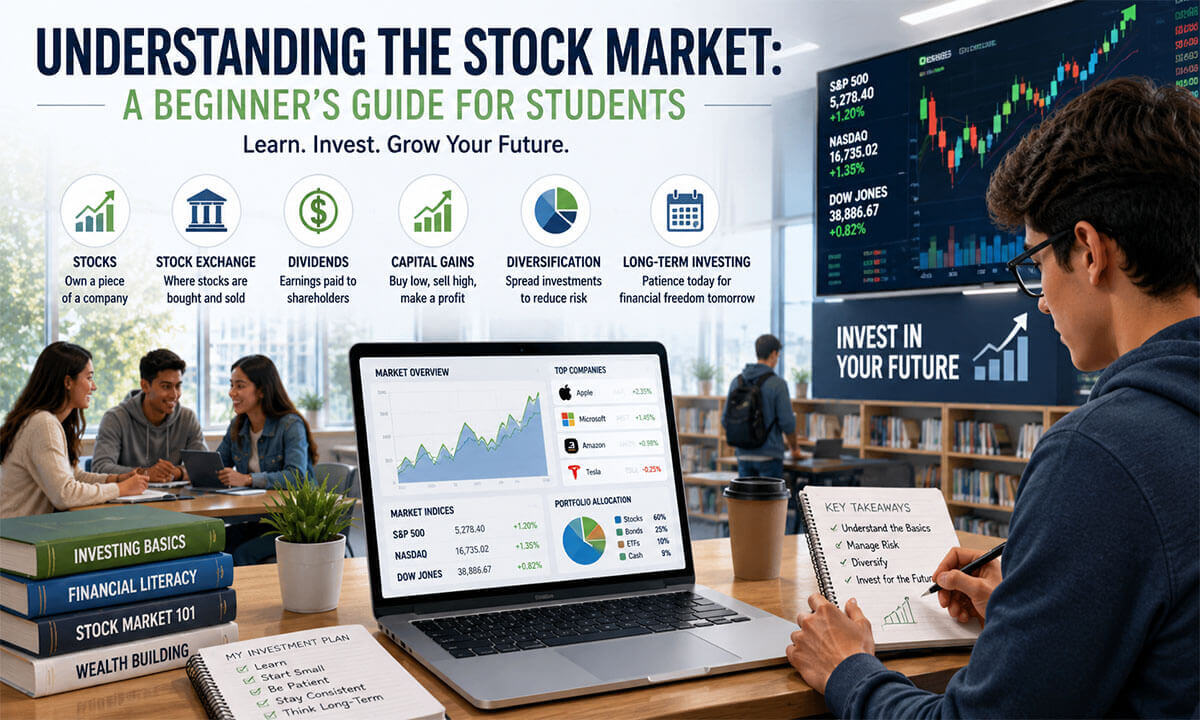
- Stock or Share: A stock or share represents ownership in a company. When a company sells shares to the public, investors can buy those shares and become partial owners of the company.
For example, imagine that a company has one million shares and a student owns one share. The student owns a very small part of that company.
If a student owns shares of Apple Inc., for example, the student owns a tiny part of Apple. The amount of ownership depends on the number of shares the person owns compared with the total number of shares issued by the company.
The price of a share can rise or fall. If the company performs well and investors become more confident about its future, the share price may increase. However, the price can also decrease because of poor company performance, economic problems, or changes in investor expectations.
The most important thing for beginners to remember is simple: buying a stock means buying a small ownership interest in a company.
- Stock Exchange: A stock exchange is a marketplace where shares of publicly traded companies are bought and sold.
Stock exchanges provide an organized system that allows buyers and sellers to trade shares. They also operate under rules and regulations designed to support fair and orderly trading.
Two well-known stock exchanges in the United States are the New York Stock Exchange (NYSE) and Nasdaq. Many other countries also have their own stock exchanges.
Stock exchanges play an important role in the financial system because they connect investors with companies whose shares are available for public trading.
In simple terms, a stock exchange is like a large marketplace, but instead of buying food or clothing, people buy and sell shares of companies.
- Broker: A broker is a person or company that helps investors buy and sell stocks.
In the past, investors often depended on professional brokers to place orders for them. Today, many investors use online brokerage platforms and mobile applications.
Examples of well-known brokerage services in the United States include Fidelity, E Trade, and Robinhood. The availability of these services depends on the country where an investor lives.
When someone wants to buy a stock, the investor places an order through a broker or brokerage platform. The broker then helps send the order to the market.
A broker may also provide useful services such as market information, investment research, account management, and tools for tracking investments.
Students should remember that brokers are an important connection between individual investors and financial markets.
- Dividend: A dividend is a payment that some companies make to their shareholders.
When a company earns profits, it may decide to use those profits in several ways. It may reinvest the money into the business, save it for future needs, pay down debt, or distribute part of the profits to shareholders.
When a company chooses to distribute money to shareholders, the payment is called a dividend.
For example, suppose an investor owns 100 shares of a company. If the company announces a dividend of $1 per share, the investor would receive $100, assuming the investor is eligible for the payment and other conditions are met.
However, not all companies pay dividends. Some growing companies prefer to reinvest their profits into the business. This can help them expand, develop new products, or enter new markets.
Therefore, investors should not assume that every stock provides regular dividend income.
- Bull Market: A bull market is a period when stock prices are generally rising or when investors have a positive view of the market.
During a bull market, people often feel more confident about the economy and the future performance of companies. More investors may be willing to buy stocks, which can contribute to higher prices.
For example, if many companies are reporting strong financial results and investors expect the economy to continue growing, the overall stock market may experience a strong upward trend.
The term bull is often easy to remember because a bull is commonly associated with moving forward and pushing upward.
A bull market does not mean that every stock will increase in price. Some individual stocks can still fall even when the overall market is rising.
- Bear Market: A bear market is a period when stock prices are generally falling, and investors become more cautious or pessimistic.
During a bear market, investors may worry about problems such as economic slowdown, high interest rates, weak company earnings, or other financial difficulties.
When investors become concerned, they may sell stocks. Increased selling pressure can contribute to falling prices.
The term bear is often used as the opposite of bull. A bear is commonly associated with downward movement, which makes the term easier to remember.
Like a bull market, a bear market does not mean that every stock will fall. Some companies may perform well even when the overall market is weak.
Bull Market vs. Bear Market:
The difference between these two terms is easy to understand.
A bull market generally means that prices are moving upward and investor confidence is stronger.
A bear market generally means that prices are moving downward and investors are more cautious.
A simple way to remember the difference is this:
Bull = rising market
Bear = falling market
Understanding these terms can help students follow financial news more easily. For example, when a news report says that the market has entered a bear market, students can understand that stock prices have been falling and investor confidence may be weaker.
How Do People Make Money from Stocks?
Many people invest in stocks because they hope to make money over time. When you buy a stock, you become a small owner of a company. If the company grows or earns profits, your investment may become more valuable.
There are two main ways investors can make money from stocks: capital gains and dividends.
- Capital Gains: A capital gain happens when you buy a stock for a lower price and later sell it for a higher price.
For example, imagine that you buy one share of a company for $50. After some time, the price of that stock increases to $70. You decide to sell the share for $70.
You originally paid $50 and received $70 when you sold it.
Your gain is:
$70 − $50 = $20
So, you make a $20 profit, before considering any fees or taxes.
Capital gains can be an important way for investors to earn money from stocks. Investors often look for companies that they believe can grow in value over time.
However, capital gains are not guaranteed. A stock can also lose value.
For example, suppose you buy a stock for $50, but its price later falls to $35. If you sell it at $35, you lose $15.
This is why investing in stocks involves risk. The price can move in either direction.
Long-Term Capital Gains:
Some investors buy stocks because they believe the company will become more valuable over many years. They may hold their shares for a long time rather than trying to make quick profits.
For example, a student may invest in a company that has strong products, good management, and potential for future growth. If the company grows successfully over the years, the value of its shares may increase.
However, investors should remember that even strong companies can face challenges. Past performance does not guarantee future results.
- Dividends: The second major way people can make money from stocks is through dividends.
A dividend is a payment that some companies make to their shareholders. Companies may distribute part of their profits to investors who own their shares.
For example, imagine that you own 100 shares of a company. The company announces a dividend of $1 per share.
You would receive:
100 shares × $1 = $100
So, you would receive $100 in dividends, assuming you meet the company’s requirements for receiving the payment.
Dividends can provide investors with income while they continue to own the stock. This is one reason some people compare dividend payments to receiving a small regular payment from an investment.
However, dividends are not guaranteed. Not every company pays dividends. Some companies choose to keep their profits and use the money to expand their business, develop new products, or improve their operations.
How Capital Gains and Dividends Are Different:
Capital gains and dividends are both ways investors may benefit from owning stocks, but they work differently.
With capital gains, an investor makes money by selling a stock for more than the purchase price.
With dividends, an investor receives payments from a company while continuing to own the shares.
For example, suppose an investor buys shares for $1,000. Later, the shares become worth $1,200. The investor has a potential $200 capital gain if the shares are sold at that price.
At the same time, the company may also pay dividends while the investor owns the shares.
This means an investor may benefit from both an increase in share value and dividend payments. However, neither type of return is guaranteed.
Reinvesting Dividends:
Some investors choose to reinvest their dividends instead of spending them.
For example, suppose an investor receives $50 in dividends. Instead of taking the money as cash, the investor may use it to buy additional shares, depending on the investment platform and the available options.
Over time, these additional shares may also produce dividends or increase in value. This can support long-term compound growth.
Reinvesting dividends can therefore be useful for investors who are focused on building wealth over a long period.
Why Do Stock Prices Increase?
Stock prices can increase for many different reasons.
A company may report strong profits, launch a successful product, enter a new market, reduce its costs, or show strong future growth potential. When investors become more confident about a company’s future, they may be willing to pay more for its shares.
Supply and demand also play an important role. When more people want to buy a particular stock, its price may rise.
However, stock prices can also fall because of poor company results, economic problems, changes in interest rates, negative news, or lower investor confidence.
How to Start Investing as a Student:
Many students become interested in investing after learning how the stock market works. They may want to save money for the future or learn how to manage their finances more effectively. The good news is that students can start learning about investing at a young age.
However, investing should not be treated as a way to become rich quickly. It requires knowledge, patience, and careful planning. Students should first understand the basic ideas and then take small and sensible steps.
Here are some important steps for students who want to begin learning about investing.
- Learn the Basics First: The first step is to learn how investing works. A student should understand important ideas such as stocks, shares, dividends, capital gains, risk, diversification, and compound growth.
There are many ways to learn. Students can read books, follow reliable financial websites, watch educational videos, and study basic financial news. They can also learn about companies and understand why stock prices change.
It is important to use reliable sources. Not everything posted on social media is correct. Some people may make unrealistic promises about making quick profits from stocks.
Learning before investing can help students avoid common mistakes. Knowledge also makes it easier to understand both the opportunities and the risks of the stock market.
- Open a Brokerage Account: To buy and sell stocks, investors normally need a brokerage account. A brokerage account is an account that allows a person to access the financial markets through a broker or investment platform.
Today, many brokerage companies provide websites and mobile applications that make investing easier to access. Examples of well-known brokerage companies include Fidelity and Charles Schwab. Robinhood is another example of an investment platform in the United States.
However, students should check whether a particular brokerage service is available in their country. They should also understand the account requirements, fees, regulations, and minimum investment amounts before opening an account.
Students who are under the legal age for opening an individual investment account may need a parent or guardian and may have to use an account designed for minors, depending on local laws.
- Start Small: Students do not need a large amount of money to begin learning about investing.
Some investment platforms offer fractional shares. A fractional share is less than one full share of a company. This means an investor may be able to invest a small amount of money instead of buying one complete share.
For example, suppose a company’s stock costs $500 per share. A platform that supports fractional investing may allow someone to invest $10 or $20 in that company instead of paying $500 for one full share.
Starting small can be useful for beginners because it allows them to gain practical experience without committing a large amount of money.
However, students should only invest money that they can afford to leave invested or potentially lose. Money needed for tuition, food, rent, emergencies, or other important expenses should come first.
- Think Long-Term: One of the most important lessons for new investors is to think about the long-term.
Investing is generally not a strategy for getting rich overnight. Stock prices can move up and down every day. Trying to make quick profits by constantly buying and selling can be difficult and risky.
Instead, many investors focus on companies and investments that they believe can perform well over a long period.
For example, a student may choose to invest regularly and hold suitable investments for many years. During that time, the value of the investment may rise and fall.
Long-term investing also requires patience. A temporary fall in the market does not always mean that an investment has failed. At the same time, investors should continue to review their investments and make changes when their goals or circumstances change.
- Diversify Your Investments: Another imperative principle is diversification.
Diversification means spreading investments across different companies, industries, or types of assets rather than putting all the money into one stock.
Imagine that a student invests all of their money in one company. If that company experiences serious problems and its share price falls sharply, the student’s entire investment could be affected.
Now imagine that the student spreads the money across several different investments. A poor result from one investment may have a smaller effect on the overall portfolio.
Diversification does not remove all investment risk. However, it can help reduce the risk of depending too heavily on one company or one type of investment.
- Understand Your Risk Level: Every investment has some level of risk. Before investing, students should think about how comfortable they are with the possibility of losing money.
A person’s age, financial situation, investment goals, and time horizon can all affect the amount of risk that may be appropriate.
For example, a student who is investing for a goal many years away may have a different approach from someone who needs the money in the near future.
Understanding personal risk is important because it can prevent emotional decisions. An investor who cannot tolerate large price changes may panic when the market falls and sell at the wrong time.
- Avoid Following Trends Blindly: Students may see popular stocks discussed on social media, YouTube, or online forums. Some of these discussions can be useful, but they should not be treated as guaranteed investment advice.
A stock may become popular because many people are buying it. That does not automatically mean it is a good investment.
Before buying a stock, students should try to understand the company and why they are considering the investment. They should look at the business, its financial performance, future plans, and possible risks.
Making an investment decision based only on popularity can lead to poor results.
- Build Good Financial Habits: Investing should be part of a broader financial plan.
Students should first learn how to manage their everyday money. This may include creating a budget, controlling unnecessary spending, and building savings.
A person who spends more than they earn may struggle even if they have investments. Good financial habits can make investing more sustainable.
Students should also understand the difference between money for short-term needs and money for long-term goals.
- Be Patient and Keep Learning: Investing is a learning process. Students will not understand everything immediately, and that is normal.
The most important thing is to keep learning and improve gradually. Students can follow market news, read financial reports, study successful businesses, and learn from mistakes.
They should also remember that even experienced investors cannot predict the future with certainty.
The goal is not to predict every market movement. The goal is to make informed decisions based on knowledge, personal goals, and an understanding of risk.
Common Mistakes Beginners Should Avoid When Investing:
Investing in the stock market can be exciting. It can also be confusing and risky, especially for beginners. New investors may make mistakes because they are excited about making money or because they do not fully understand how the market works. Making mistakes is part of learning, but some mistakes can be costly. Beginners should understand the most common problems and try to avoid them.
- Investing Without Research: One of the biggest mistakes beginners make is buying a stock without doing proper research.
A stock may become popular because of social media, news reports, or recommendations from friends. However, popularity does not mean that the stock is a good investment.
Before buying a stock, an investor should learn about the company. It is useful to understand what the company does, how it makes money, how its business is performing, and what risks it faces.
Investors can also look at information about the company’s financial performance, products, services, competitors, and future plans.
For example, imagine that a particular stock is suddenly trending online. Many people are buying it, so a beginner may feel pressure to buy it too. But without research, the investor may not understand why the price has risen or whether the company can continue to grow.
The important lesson is simple: do not buy a stock simply because everyone else is buying it. Learn about the investment first.
- Trying to Get Rich Quickly: Another common mistake is expecting to become rich in a very short time.
Some beginners enter the stock market because they have seen stories about people making large amounts of money quickly. This can create unrealistic expectations.
The reality is that stock prices can rise and fall. There is no guaranteed way to make quick profits from the market.
Trying to make money too quickly can also encourage risky behavior. A person may buy stocks without research, trade too frequently, or put too much money into one investment.
Successful investing often requires patience. Many investors focus on long-term goals rather than trying to predict every daily price movement.
For example, a student who invests with a long-term goal may accept that the market will sometimes fall. Instead of panicking, the student can continue learning and follow a sensible investment plan.
The goal should not be to become rich overnight. The goal should be to build financial knowledge and make responsible decisions over time.
- Investing Money You Cannot Afford to Lose: Beginners should never invest money that they need for essential expenses.
Important expenses may include food, rent, tuition fees, transportation, medical costs, or emergency needs. That money should be available when it is needed.
Stock prices can fall, sometimes unexpectedly. If an investor needs to sell during a market decline because the money is needed for an essential expense, the investor may have to accept a loss.
For example, suppose a student has saved money for tuition fees. If the student invests that money in stocks and the market falls just before the tuition payment is due, the student may have to sell the investment at a lower price.
This can create unnecessary financial pressure.
It is therefore important to separate money for essential needs from money that can be used for long term investing.
Beginners should also remember that an investment can lose value. There is no guarantee that the money invested will always increase.
- Letting Emotions Control Decisions: Stock prices move up and down regularly. These changes can create strong emotions.
When prices rise, investors may become excited and want to buy more. When prices fall, they may become afraid and want to sell immediately.
Making decisions based mainly on fear, excitement, or panic can lead to poor results.
For example, imagine that an investor buys a stock at $50. A few weeks later, the price falls to $40. The investor becomes frightened and sells the stock immediately.
Later, the price may recover. The investor may regret selling because fear caused the decision rather than careful thinking.
The opposite can also happen. A stock may rise sharply, and an investor may become overly confident. The investor may then put too much money into the stock without considering the risks.
A better approach is to remain calm and think carefully. Investors should focus on their goals, research, and investment plan instead of reacting to every short-term market movement.
Why These Mistakes Are Dangerous:
These mistakes can become especially harmful when they happen together.
For example, a beginner may see a popular stock online and buy it without research because they want quick profits. The investor may use money needed for education or living expenses. If the stock price falls, fear may cause the investor to sell quickly at a loss.
This example shows why financial knowledge and discipline are important.
Avoiding common mistakes does not guarantee investment success. However, it can help beginners make more careful decisions and reduce unnecessary risks.
How Beginners Can Avoid These Mistakes:
Beginners can take several simple steps to become more responsible investors.
First, they should learn before investing. Basic knowledge can help them understand what they are buying.
Second, they should have realistic expectations. Investing is usually a long-term activity, not a quick way to become wealthy.
Third, they should protect their essential money. Investment funds should be separate from money needed for everyday life and important financial responsibilities.
Finally, they should develop emotional discipline. Market prices will change, but investors do not need to react emotionally to every change.
In conclusion, the stock market may seem difficult at first, but its basic idea is simple. It is a system where companies and investors buy and sell shares. For students, learning about the stock market can be a useful step toward better financial planning. It can help them understand saving, investing, risk, and long-term financial goals. The best approach is to start small, keep learning, and be patient. Investing is not mainly about luck. It is about knowledge, careful planning, and good decisions. What students learn today can help them make smarter financial choices in the future.

is an experienced educator and academic currently serving as a Lecturer at Nurul Amin Degree College. With a career dedicated to student development and institutional excellence, he brings a wealth of classroom expertise and pedagogical knowledge to his current role. Before joining the faculty, he served as an Assistant Teacher at Zinzira PM Pilot School and College.