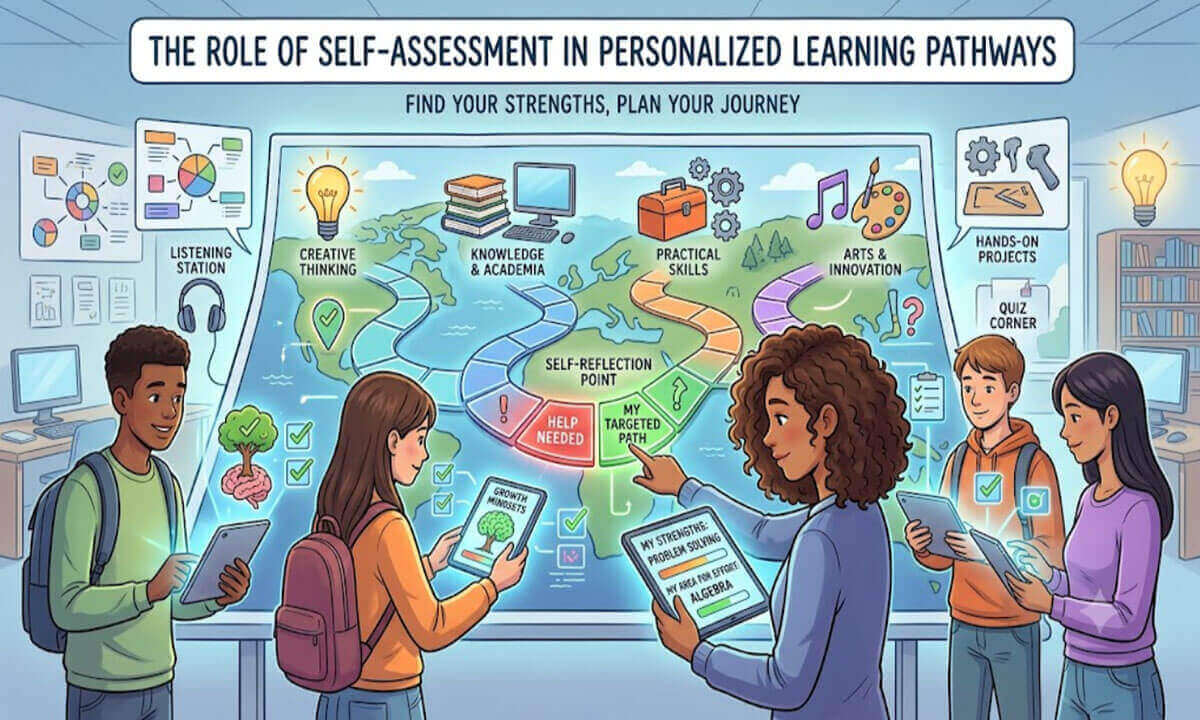
The Role of Self-Assessment in Personalized Learning Pathways:
Learning is not a one-size-fits-all experience. Some people grasp concepts best through visual diagrams, others learn by doing, and many thrive through interactive discussions. This reality is why personalized learning pathways have gained so much momentum in modern education. However, to design a customized learning journey that genuinely works, learners first need a way to understand where they stand. That is where self-assessment plays a vital role. Self-assessment acts like a mirror for your learning habits. It helps you recognize your strengths, discover areas where you need extra effort, and guide your educational journey with purpose. In this article, we will explore the role of self-assessment in personalized learning pathways.
What is Self-Assessment?
At its core, self-assessment is the process of evaluating your own learning, understanding, and progress. It goes beyond checking off completed tasks; it requires honest reflection on what you have mastered and where you are still struggling.
Think of self-assessment as a GPS for learning. Without it, you might spend hours studying without making real progress toward your goals.
Common Types of Self-Assessment Tools:
- Checklists and Rubrics: Clear criteria that help learners grade their own work and measure understanding.
- Reflective Journals: Written notes where students document what was easy, what was difficult, and how they felt during the lesson.
- Practice Quizzes: Quick self-tests that provide immediate data on concept mastery.
- Goal Trackers: Visual logs that allow learners to monitor progress toward specific milestones over time.
Understanding Personalized Learning Pathways:
Personalized learning pathways are changing how we think about education. For decades, traditional schooling followed a standard model: every student in the same grade sat in the same room, read the same textbook, completed the same assignments, and took the same test at the same time.
While that system was easy to manage, it ignored a fundamental truth: people do not all learn in the exact same way or at the exact same speed.
A personalized learning pathway strips away the one-size-fits-all model. Instead, it creates a flexible, customized route through education designed around an individual learner’s unique strengths, needs, interests, and background.
What Exactly Is a Personalized Learning Pathway?
Think of traditional education like a fixed bus route. The bus stops at predetermined stations at fixed times, and every passenger goes to the same destination regardless of what they actually need.
A personalized learning pathway is more like a GPS navigation app. You still have a final destination (mastering a subject or skill), but the route adapts to you:
- If you hit a roadblock, the system recalculates and gives you extra practice.
- If the road is clear, you can cruise ahead without waiting for everyone else.
- If you prefer a scenic, hands-on route over a theoretical one, you can choose materials that suit your preferred style.
In simple terms, it is an educational plan where the pace, content, and teaching methods are adjusted to fit the individual student.
Core Elements of Personalized Learning:
To truly understand how personalized pathways work, it helps to break down the four main pillars that support them:
1. Student Agency (Voice and Choice): In a personalized system, students are active co-pilots in their education rather than passive listeners. They get a say in how they learn and how they demonstrate what they know. For example, to demonstrate understanding of a historical event, one student might write an essay, another might record a podcast, and a third might build a detailed digital timeline.
2. Flexible Pacing and Mastery-Based Progression: In a conventional classroom, if a student gets a 60% on a math test, the class still moves on to the next chapter the following Monday. This leaves the student with foundational gaps that make future topics harder.
Personalized pathways rely on mastery-based learning:
- Students move forward only after they truly understand a concept.
- Fast learners can accelerate without getting bored.
- Learners who need extra time get targeted support without feeling rushed or left behind.
3. Tailored and Adaptive Content: Not everyone absorbs information the same way. Personalized pathways leverage varied resources:
- Visual learners get diagrams, videos, and infographics.
- Auditory learners listen to lectures, audiobooks, and discussions.
- Kinesthetic learners work with hands-on projects, simulations, and real-world applications.
4. Continuous, Real-Time Feedback: Instead of waiting weeks for a final exam grade, students in personalized pathways receive ongoing feedback. Short check-ins, practice quizzes, and reflections help both the teacher and the student spot confusion early, allowing for immediate course corrections.
How It Works in Practice: A Quick Comparison
| Feature | Traditional Learning | Personalized Learning Pathway |
| Pacing | Fixed speed set by the teacher | Flexible speed set by student mastery |
| Student Role | Receives information passively | Directs learning actively with guidance |
| Assessment | One big exam for everyone | Multiple ways to demonstrate understanding |
| Focus | Covering the curriculum on schedule | Truly mastering skills and knowledge |
Why Personalized Pathways Matter:
When learning is tailored to the individual, the benefits extend far beyond better test scores:
- Boosts Motivation and Engagement: When students study topics that align with their personal interests and learning styles, curiosity naturally replaces boredom.
- Builds Confidence: Moving at a speed that matches your ability prevents the anxiety of falling behind and the frustration of waiting around.
- Encourages Lifelong Learning: By learning how they learn best, students develop the self-awareness, discipline, and problem-solving skills needed to pick up new skills throughout their adult lives and careers.
Why Self-Assessment Drives Personalized Learning:
If personalized learning pathways are the engine of modern education, self-assessment is the driver steering the vehicle. Without self-assessment, a personalized learning plan is just a fancy idea. For learning to actually adapt to a student’s unique needs, the student needs to know where they currently stand, what they are struggling with, and where they need to go next. Here is a brief look at why self-assessment is the secret ingredient that makes personalized learning actually work.
1. It Creates True Self-Awareness: Before you can fix a problem, you have to know it exists. In traditional classrooms, students often find out they don’t understand a topic only after they fail a major test. By then, the class has already moved on.
Self-assessment flips this dynamic. It encourages learners to pause and regularly ask themselves simple, honest questions:
- What part of this lesson makes complete sense to me?
- Where did I start getting confused?
- Did I study effectively, or was I just going through the motions?
When students regularly check in on their own progress, they build metacognition, which is just a fancy word for “thinking about how you think.” This self-awareness allows them to catch knowledge gaps early, long before an official exam.
2. It Shifts the Mindset from “Grades” to “Growth”: In a traditional setup, grades often feel like a final judgment. Getting a C or a D on a paper can make a student feel like they simply “aren’t smart enough” for that subject.
Self-assessment changes how students view their own ability by fostering a growth mindset:
- Traditional Thinking: “I failed the quiz. I am terrible at science.”
- Self-Assessed Thinking: “I missed 4 questions on photosynthesis. I need to review plant cell structures again before tomorrow.”
Instead of viewing a mistake as a dead end, self-assessment reframes it as useful data. It helps students realize that intelligence isn’t fixed; it’s a muscle that grows with targeted effort.
3. It Gives Students Real Ownership of Their Learning: One of the major goals of personalized learning is to give students agency; meaning they have a say in their own educational journey. But you can’t have agency if you are always waiting for someone else to tell you what to do.
When students assess their own work using clear rubrics or checklists:
- They stop relying on the teacher as the sole source of approval.
- They learn to judge the quality of their own work before turning it in.
- They take pride in their progress because they were the ones who spotted their errors and fixed them.
This shift turns passive listeners into active drivers of their own education.
4. It Makes Goal-Setting Realistic and Actionable: Setting a goal like “I want to get better at math” is too vague to be helpful. Self-assessment breaks big goals down into clear, manageable steps.
Because self-assessment gives students clear data on their current skill level, their goals naturally become specific:
- Instead of “I will study history,” the self-aware student says, “I know the main causes of the war, but I keep forgetting the key timeline dates. I’ll spend 15 minutes reviewing flashcards.“
When goals are specific and realistic, students are far more likely to stick with them and achieve real progress.
5. It Fuels the Feedback Loop in Real Time: Personalized learning relies heavily on immediate, ongoing feedback. A teacher managing 25 or 30 students cannot give instant, 1-on-1 feedback every single minute of the day.
Self-assessment bridges that gap:
- Immediate Check-Ins: Through quick self-tests, reflective journals, or confidence ratings (like rating understanding from 1 to 5), students get immediate feedback on their performance.
- Teacher Insights: When students share their self-assessments with teachers, the teacher instantly sees who needs help and what specific topic needs re-teaching.
This creates a continuous feedback loop that keeps the personalized learning pathway moving smoothly.
Practical Ways Teachers Can Integrate Self-Assessment:
It is one thing to know that self-assessment is beneficial, but actually getting students to reflect on their work in a busy classroom is a different challenge altogether. Many students aren’t used to thinking about how they learn; they are used to finishing a worksheet, turning it in, and waiting for a grade.
If you are a teacher looking to bring self-assessment into your routine, it doesn’t need to involve massive lesson plans or complicated systems. The goal is simply to make reflection a natural, daily habit. Here are practical ways to integrate self-assessment into your classroom without overwhelming yourself or your students.
1. Use Simple “Temperature Checks” Daily: You don’t need a lengthy survey to gauge where students stand. Quick, low-stakes reflection techniques take less than two minutes and give both you and your students instant feedback.
- Fist-to-Five: At the end of a lesson, ask students to hold up fingers to show their confidence level:
- 1 Finger: “I am completely lost.”
- 3 Fingers: “I get the basics, but I need practice.”
- 5 Fingers: “I could explain this to someone else!”
- Color-Coded Sticky Notes / Exit Tickets: Have students leave a sticky note on the door on their way out:
- Green: I mastered today’s goal.
- Yellow: I need a little more time or help.
- Red: I am stuck and need assistance.
These quick methods teach students to pause and evaluate their understanding before moving on to the next topic.
2. Introduce Transparent Rubrics Before Work Begins: Self-assessment fails when students are guessing what a “good” assignment looks like. Give them clear criteria right from the start so they can evaluate their own work as they create it.
- Self-Scoring Prior to Submission: Before students hand in an essay or project, have them fill out the project rubric themselves using a different color pen.
- Co-Create Rubrics with the Class: Involve students in deciding what success looks like. Ask: “What makes a great oral presentation?” List their answers on the board to form the criteria. When students help build the standards, they understand and use them far more effectively.
3. Implement “My Favorite No” for Error Analysis: One of the hardest parts of self-assessment is helping students feel comfortable analyzing their own mistakes. An activity called “My Favorite No” normalizes errors and builds critical thinking.
- Give the class a warm-up problem on an index card.
- Collect the cards and quickly find an incorrect response that contains a common, valuable misconception.
- Write the wrong work on the board anonymously.
- Lead a quick discussion: “What did this student do right, and where did the thinking go off track?”
This teaches students to look at errors objectively and spot similar mistakes in their own work.
4. Use Reflective Journals and Prompts: Reflection needs structure, especially for younger or less experienced learners. Generic prompts like “What did you learn today?” often yield short, unhelpful answers like “Math.”
Instead, provide specific, guided prompts at the end of a unit or project:
| Type of Question | Example Prompt |
| Effort & Strategy | What study strategy helped you most on this quiz? |
| Identifying Roadblocks | At what exact step in the problem did you feel confused? |
| Future Action | If you could re-do this project, what one thing would you do differently? |
5. Structured Peer Assessment (The Warm-up for Self-Assessment): Evaluating one’s own work objectively is tough. Often, it is easier for students to practice evaluating someone else’s work first before applying those same analytical skills to themselves.
To keep peer assessment constructive and friendly, use structured frameworks:
- Two Stars and a Wish: Students give a peer two specific compliments (“stars”) and one actionable area for improvement (“wish”).
- Glow and Grow: Students highlight one area where their peer shone (“glow”) and one area where they can develop further (“grow”).
Once students learn how to give helpful, non-judgmental feedback to classmates, they start using that exact same lens on their own work.
6. Leverage Digital Tools for Instant Feedback: Technology can automate much of the administrative side of self-assessment while giving students instant visual data about their progress.
- Interactive Quizzes: Tools like Quizizz, Kahoot!, or Google Forms allow students to take short practice quizzes where they immediately see which questions they missed and why.
- Digital Portfolios: Apps like Seesaw or Google Sites allow students to upload work over time and record quick audio or video reflections explaining why they chose a piece and how they have improved since the start of the year.
Making It Stick (A Few Golden Rules for Teachers):
- Keep it Low-Stakes: Never grade a student’s self-assessment based on how high or low they rate themselves. If rating themselves as “confused” lowers their grade, they will lie to protect their marks.
- Model it Yourself: Point out your own mistakes. If you make an error on the board, say: “Wait, let me self-assess here. That doesn’t look right. Where did my calculation go off?”
- Praise the Process, Not Just the Score: Celebrate when a student accurately identifies a mistake and fixes it, not just when they get 100% on the first try.
Integrating self-assessment isn’t about adding another heavy task to your daily load. It is about shifting the classroom culture so that reflection becomes a natural part of how learning happens every single day.
Long-Term Benefits Beyond the Classroom:
The benefits of self-assessment extend far beyond school. Developing the habit of reflecting on one’s performance creates adaptable, lifelong learners. In the professional world, employees who can accurately evaluate their work, accept feedback, and adjust their strategies are positioned for continuous career growth.
A Helpful Analogy: Think of learning as baking a cake. Following a recipe and gathering ingredients are necessary steps, but if you never taste the batter or check the oven, the result might disappoint. Self-assessment is that essential taste test along the way; it allows you to adjust the recipe before it is too late.
In Conclusion, self-assessment is not merely an optional addition to modern education; it is a fundamental engine driving personalized learning pathways. By encouraging self-reflection, ownership, and goal-oriented planning, self-assessment transforms passive students into proactive, independent learners. Whether you are an educator aiming to empower your classroom or a learner seeking to master a new skill, incorporating regular self-assessment is one of the most effective steps you can take toward meaningful personal and academic growth.

is an experienced educator and academic currently serving as a Lecturer at Nurul Amin Degree College. With a career dedicated to student development and institutional excellence, he brings a wealth of classroom expertise and pedagogical knowledge to his current role. Before joining the faculty, he served as an Assistant Teacher at Zinzira PM Pilot School and College.