How Peer Learning is Transforming the Modern Classroom:
The image of a traditional classroom (a teacher standing at the front lecturing for an hour while students quietly take notes) is rapidly changing. Across schools and universities around the world, educators are shifting toward a more dynamic, interactive model known as peer learning. By encouraging students to share knowledge, discuss ideas, and solve problems together, peer learning turns passive listeners into active participants. In the rest of this article, we will explore how peer learning is transforming the modern classroom, including what peer learning is, why it works so well, and how it is reshaping modern education.
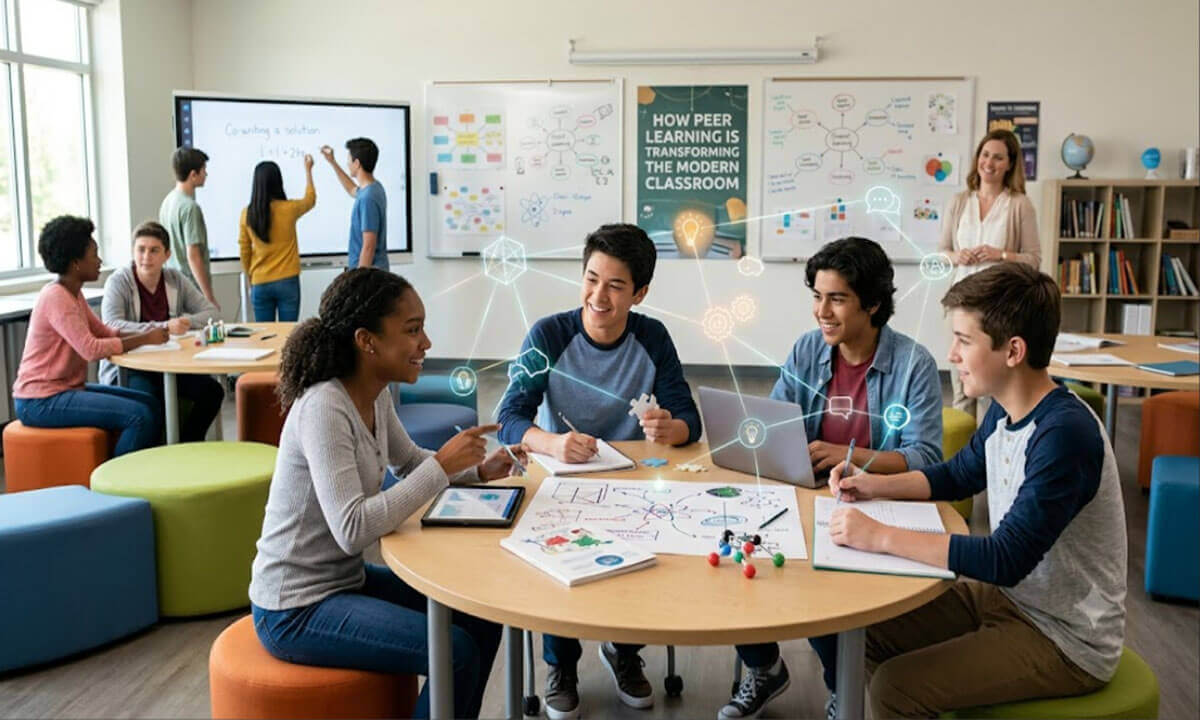
What is Peer Learning?
At its core, peer learning is an educational approach where students learn from and with one another. Instead of relying solely on the teacher to deliver information, students take turns explaining concepts, providing feedback, and collaborating on tasks.
In a peer-learning environment:
- The Teacher’s Role Shifts: Rather than being the sole authority (“the sage on the stage“), the teacher acts as a facilitator (“the guide on the side“) who structures activities and steps in when guidance is needed.
- Learning Becomes Active: Students engage directly with the material by verbalizing their thoughts, asking questions, and listening to different perspectives.
- Concepts Become Relatable: Students often explain ideas using shared language and examples that make complex topics easier for their classmates to digest.
The Key Benefits of Peer Learning:
Research and classroom experience show that learning collaboratively delivers several distinct advantages for students:
1. You Master Concepts by Teaching Them: There’s a well-known saying in education: “If you want to truly master a topic, teach it.”
When you explain a topic to a classmate in your own words, your brain has to do extra work. You can’t just rely on memorized terms; you have to break down complex ideas, organize your thoughts, and find simple ways to explain them.
During this process, you quickly spot gaps in your own understanding. If you struggle to explain a step in a math problem or a historical event, you realize right away what you need to review. Research consistently shows that students retain far more information when they explain concepts to others than when they simply read or hear about them.
2. Peers “Speak the Same Language”: Even the best teachers can sometimes explain things in ways that feel distant or overly academic. Peers, on the other hand, share the same perspective, learning level, and everyday language.
When a classmate explains a tricky concept, they often use relatable examples, modern analogies, or plain English that cuts through the confusion. Hearing an idea phrased slightly differently by a friend can make a lightbulb go off in a way an official textbook explanation never did.
3. It Builds Long-Term Confidence: Speaking up in front of an entire class or raising your hand to answer a teacher’s question can feel intimidating. Many students stay silent out of fear of being wrong.
Peer learning changes this dynamic by breaking the class into smaller, lower-stakes groups. In a pair or a small group of three, students feel much safer sharing unfinished thoughts, making mistakes, and asking “silly” questions. As students realize their ideas have value and that their peers respect their input, their self-esteem grows. Gradually, this small-group confidence translates into greater confidence in larger settings.
4. It Teaches Essential “Soft Skills” for Real Life: In the real world (whether at university, in an office, or on a project team) success rarely happens in isolation. Knowing the facts is only half the battle; being able to work well with others is the other half.
Peer learning acts as a natural training ground for crucial life skills:
- Active Listening: Learning to give others your full attention and truly digest what they are saying before responding.
- Clear Communication: Finding ways to express your thoughts clearly so others can follow your logic.
- Constructive Feedback: Learning how to point out errors or suggest improvements politely without making the other person defensive.
- Adaptability: Working with different personality types and learning styles.
5. It Sparks Deeper Critical Thinking: When you learn alone, it’s easy to accept information at face value without digging deeper. But when you learn in a group, peers naturally ask questions: “Why did you choose that formula?” or “What makes you see it that way?”
These questions force you to justify your thinking, examine your assumptions, and look at problems from multiple viewpoints. Instead of just memorizing the “right” answer to pass a test, students begin to analyze why an answer is correct and explore alternative ways to solve a problem.
6. It Creates an Inclusive Classroom Environment: Every classroom has a mix of introverts, extroverts, fast readers, and visual thinkers. Traditional lecture-style teaching often favors outgoing students who raise their hands quickly, leaving quieter or slower-processing students behind.
Peer learning levels the playing field. In structured peer activities (like pairs or small working teams), every single student has a dedicated turn to speak, contribute, and be heard. It ensures that no one gets lost in the crowd and helps build a sense of community where students support one another rather than compete against each other.
Summary Table:
| Key Benefit | What It Actually Means for the Student |
| Deeper Retention | Teaching others forces your brain to organize and lock in knowledge. |
| Relatable Explanations | Classmates use simple, everyday language that makes hard concepts click. |
| Higher Confidence | Small groups offer a safe environment to speak up without fear of judgment. |
| Real-World Skills | Students naturally practice teamwork, communication, and active listening. |
| Critical Thinking | Group discussions encourage students to question assumptions and defend their logic. |
| Inclusivity | Gives quiet or hesitant students a clear, comfortable voice in the classroom. |
Practical Ways Peer Learning is Used in the Classroom:
Peer learning isn’t just unstructured group talk; it relies on clear strategies to be effective. Some of the most common methods include:
1. Think-Pair-Share: This is one of the simplest and most effective techniques, used in everything from elementary schools to university lecture halls.
How it works:
- Think: The teacher asks a thought-provoking question or presents a problem. Students are given a minute or two to think about their answers silently (and sometimes write them down).
- Pair: Students turn to a classmate sitting next to them and discuss their ideas together.
- Share: The teacher invites a few pairs to share their combined thoughts with the entire class.
Why it works: It removes the fear of speaking up. Instead of raising a hand immediately, students get a chance to “test” their answers on a peer first. Even shy students feel much more comfortable speaking to the whole class when they can say, “My partner and I discussed…”
2. The Jigsaw Technique: Imagine a puzzle where every piece is essential to see the full picture. That is exactly how the Jigsaw method functions.
How it works:
- The teacher divides a large topic into smaller sub-topics (for example, four different causes of World War I).
- The class is split into home groups of four. Each student in the group is assigned one specific sub-topic.
- Students temporarily leave their home groups to join an “Expert Group”—a temporary group made of classmates who were assigned the exact same sub-topic. Together, they read, analyze, and master their assigned piece of information.
- Finally, students return to their original home groups. Each “expert” takes turns teaching their section to their teammates until everyone understands the complete topic.
Why it works: Every single student is holding a unique piece of information. Because their teammates are relying on them to learn that part, every student feels responsible, needed, and engaged.
3. Structured Peer Tutoring: Peer tutoring pairs students up so they can support each other academically, often in subjects like reading, foreign languages, or math.
How it works: Teachers set up pairs in one of two main ways:
- Same-Age Tutoring: Classmates take turns playing the role of tutor and tutee. For example, Student A helps Student B with math facts for 10 minutes, and then they swap roles for the next 10 minutes.
- Cross-Age Tutoring: Older students (like 8th graders) are paired with younger students (like 3rd graders) for regular reading sessions or skill practice.
Why it works: Tutees get personalized, one-on-one attention without feeling self-conscious. At the same time, the tutors sharpen their own understanding and build empathy and leadership skills.
4. Two Stars and a Wish (Peer Assessment): Giving feedback is a crucial part of learning, but students often don’t know how to critique a classmate’s work constructively. “Two Stars and a Wish” provides a simple formula.
How it works: After completing an essay, science lab report, or art project, students swap work with a partner. Before handing it back, each reviewer must write down:
- Two Stars: Two specific things the author did really well (e.g., “Your introductory paragraph grabbed my attention immediately” or “Your chart is very clear and easy to read“).
- One Wish: One specific suggestion for improvement (e.g., “I wish you would explain step 3 in more detail“).
Why it works: It stops peer feedback from feeling like a harsh critique. It teaches students how to recognize good work while giving actionable, polite suggestions for growth.
5. Peer Instruction with “Concept Tests”: Popularized by physics professor Eric Mazur at Harvard University, this method is widely used in high school and college science and math classes.
How it works:
- The teacher gives a brief 10-minute mini-lecture on a tricky concept.
- The teacher displays a multiple-choice question on the board that tests conceptual understanding (not just memory).
- Students vote individually on their phones, clickers, or with paper cards
- If a lot of students choose the wrong answer, the teacher stops and says: “Find a classmate who chose a different answer than you and convince them why you are right.”
- Students talk, debate, and re-explain the concept to one another for 2–3 minutes.
- The teacher opens the vote a second time. Almost always, the percentage of correct answers jumps dramatically.
Why it works: It turns passive lectures into active debates. Students naturally use logic and simple analogies that make immediate sense to their classmates.
6. Digital Collaboration Boards & Peer Review: Peer learning isn’t restricted to physical classrooms—digital tools allow it to happen asynchronously and online.
How it works: Teachers use shared digital workspaces (like Google Docs, Padlet, or discussion forums). Students post draft essays, code, or design ideas, and their peers leave comments, suggest edits, or add resources directly on the document.
Why it works: It gives thoughtful or introverted students time to process information and write well-considered responses at their own pace, rather than having to answer instantly in front of a live group.
Quick Comparison of Strategies:
| Technique | Best Used For | Primary Student Benefit |
| Think-Pair-Share | Quick checks during lectures | Builds confidence before speaking to the whole class |
| Jigsaw Technique | Breaking down large, complex topics | Makes every student an essential, responsible teacher |
| Peer Tutoring | Skill practice (Math, Reading) | Provides personalized, one-on-one support |
| Two Stars & a Wish | Writing, art, or project feedback | Teaches constructive criticism and evaluation |
| Peer Instruction | Science, logic, and problem-solving | Encourages active debate and conceptual understanding |
| Digital Reviews | Homework, essays, and online classes | Gives time for quiet reflection and thoughtful feedback |
Challenges and How to Overcome Them:
While peer learning offers immense benefits, it requires thoughtful execution to prevent common pitfalls:
1. Uneven Participation (“Free-Riders” vs. “Workhorses”):
The Challenge: In almost any random group, there is a risk that one confident student takes over and does all the work, while quieter or less motivated students sit back and let them. The eager student feels overwhelmed and resentful, while the passive students learn almost nothing.
How to Overcome It:
- Assign Clear Roles: Instead of vague group work, give every student a specific job title. For example:
- The Facilitator: Keeps the group on task and makes sure everyone speaks.
- The Scribe: Writes down the group’s final ideas.
- The Timekeeper: Ensures the team finishes on schedule.
- The Presenter: Shares the group’s work with the rest of the class.
- Individual Accountability: Structure the assignment so that each student must submit their own individual component alongside the group’s final result.
2. Spreading Misinformation:
The Challenge: When students learn from each other, there is a genuine risk that a classmate explains a concept incorrectly. If left uncorrected, an entire group can memorize the wrong formula, misinterpret a historical event, or learn a flawed method.
How to Overcome It:
- The “Guide on the Side” Approach: Teachers don’t sit back during group time. They actively circulate around the room, listening in on conversations, checking notes, and catching misconceptions before they spread.
- Provide Checklists or Answer Keys: Give groups clear rubrics or step-by-step verification cards so they can self-check their work as they go.
- Classroom Debriefs: Always end a peer-learning session with a 5-minute whole-class review. The teacher highlights common mistakes they overheard and confirms the correct key takeaways.
3. Noise Levels and Off-Topic Conversations:
The Challenge: A room full of 30 students talking at once can quickly spiral into chaos. Discussion about a history assignment can turn into a chat about weekend plans within seconds, and the noise level can make it hard for students to concentrate.
How to Overcome It:
- Strict Time Limits: Use short, timed bursts rather than open-ended work sessions. Telling a group “You have exactly 3 minutes to answer question #2” creates a sense of urgency that keeps students focused.
- Visual Sound Meters: Many modern classrooms use sound-monitoring apps displayed on the board. If the room gets too loud, the screen changes color or triggers a gentle visual warning.
- Non-Verbal Attention Signals: Establish clear signals to pause discussion instantly (like a hand raise, a chime, or a rhythmic clap); so the teacher can regain total control of the room in seconds without yelling.
4. Group Conflict and Personality Clashes:
The Challenge: Not all students get along. Personality clashes, friendship drama, or differences in learning paces can cause tension. Strong-willed students might argue over who is right, while shy or anxious students might feel intimidated.
How to Overcome It:
- Strategic Grouping: Teachers rarely let students pick their own groups for serious assignments (which leads to cliquey or unbalanced teams). Instead, they intentionally form groups based on mixed skill levels, personalities, and strengths.
- Set Clear Social Norms: Before starting group work, establish ground rules for respectful discussion. Teach explicit phrases for disagreeing politely, such as: “I see your point, but have you considered…” instead of “That’s wrong.”
- Group Rotations: Keep group memberships temporary. Rotating pairs or teams every week prevents conflict from festering and ensures students learn to collaborate with all kinds of personalities.
5. Anxiety for Introverted or Struggling Students:
The Challenge: For shy students, social anxiety can make small-group work intimidating. For students who struggle academically, the fear of “looking dumb” in front of peers can cause them to shut down entirely.
How to Overcome It:
- The “Think” in Think-Pair-Share: Always give students 1–2 minutes of silent individual thinking or writing time before asking them to speak to a peer. This gives slow processors and anxious students time to gather their thoughts so they feel prepared.
- Low-Stakes Dynamics: Start with simple, low-risk pairs (two people) before moving to larger groups of four or five. Partnering with just one classmate feels far safer than speaking up in a big group.
- Anonymized Digital Tools: Use digital platforms where students can post questions or feedback anonymously to ease social pressure.
Summary Matrix:
| Challenge | Root Cause | Best Solution |
| Uneven Workload | Lack of individual responsibility | Assign specific roles (Scribe, Presenter, etc.) and grade individual contributions. |
| Misinformation | Peers lack full expertise | Circulate the room actively and end sessions with a whole-class summary. |
| Classroom Noise | Lack of structure | Use strict countdown timers and clear visual sound monitors. |
| Personality Clashes | Social friction | Intentionally mix groups and teach explicit sentence starters for polite disagreement. |
| Student Anxiety | Fear of judgment | Provide quiet individual prep time before discussions begin. |
In conclusion, peer learning is far more than a passing classroom trend; it reflects a fundamental shift toward collaborative, student-centered education. By empowering students to teach, question, and support one another, classrooms become lively communities where learning is shared rather than forced. As workplaces increasingly value teamwork, adaptability, and clear communication, peer learning ensures that students gain not only academic knowledge, but also the practical life skills needed to succeed in an interconnected world.

is an experienced educator and academic currently serving as a Lecturer at Nurul Amin Degree College. With a career dedicated to student development and institutional excellence, he brings a wealth of classroom expertise and pedagogical knowledge to his current role. Before joining the faculty, he served as an Assistant Teacher at Zinzira PM Pilot School and College.