How to Convert Your Thesis into a Research Paper:
Completing a thesis is a fundamental academic achievement, but its value multiplies when it is transformed into a publishable research paper. While a thesis is typically comprehensive, detailed, and often lengthy, a research paper must be concise, focused, and tailored to the expectations of a specific academic journal. This transformation is not simply a matter of shortening the document; it involves rethinking structure, refining arguments, and aligning the work with scholarly communication standards. Converting a thesis into a research article allows researchers to disseminate their findings more effectively, contribute to their field, and engage with the wider academic community. In the rest of this article, we are going to learn how to convert your thesis into a research paper.
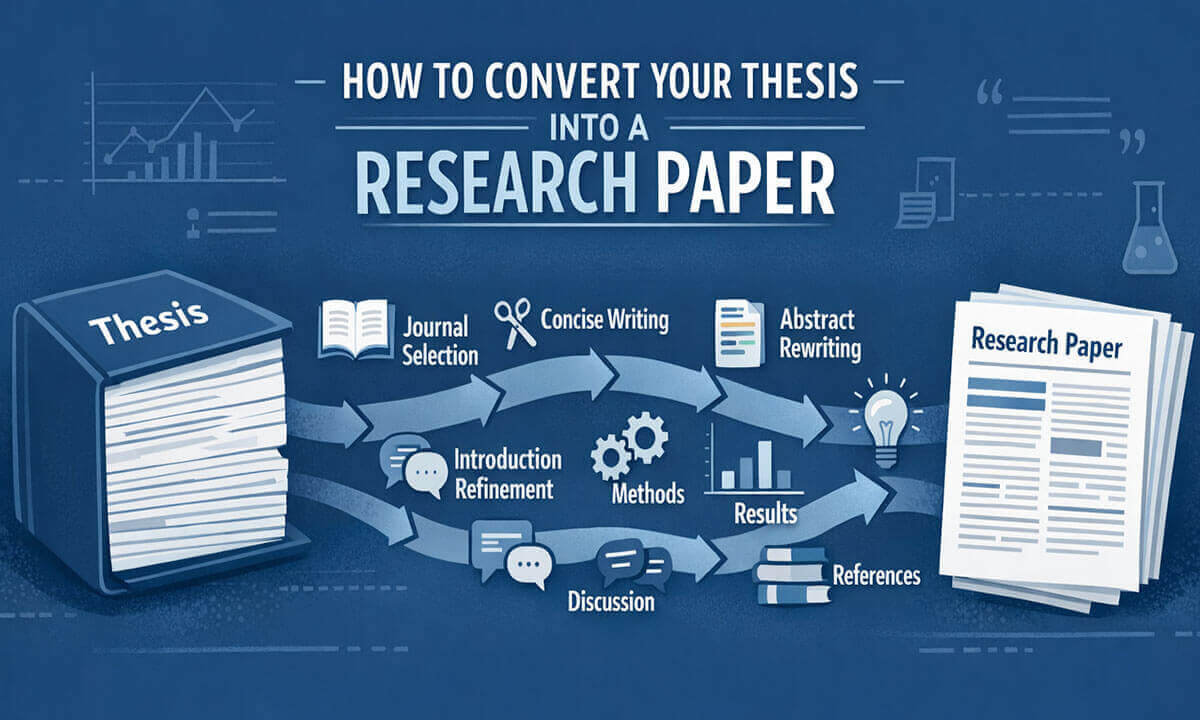
1. Choose an Appropriate Journal: Selecting the right journal is not a superficial step; it is a strategic decision that can determine whether your paper is accepted or rejected. Every academic journal operates within a clearly defined scope, meaning it publishes research only in particular subject areas or methodological traditions. Therefore, your first task is to identify journals that align closely with your thesis topic, research design, and theoretical framework.
Begin by reviewing journals where the studies you cited in your thesis were published. This gives you a realistic sense of where your work fits within ongoing scholarly conversations. Carefully read the “Aims and Scope” section of each journal, and examine recently published articles to understand the type of research they prioritize. If your work is interdisciplinary, consider journals that welcome cross-disciplinary contributions.
Another essential factor is the journal’s audience. Some journals target highly specialized researchers, while others aim at a broader academic readership. You should ask yourself: Who would benefit most from my findings? Aligning your paper with the right audience increases its relevance and impact.
You must also pay close attention to practical requirements such as:
- Word limits
- Formatting style (e.g., APA, MLA)
- Structure guidelines
- Submission procedures
Ignoring these requirements often leads to immediate rejection without review. Additionally, consider whether the journal is open access or subscription-based, as this affects the visibility and accessibility of your research.
So, it is wise to evaluate the journal’s credibility and review process. Reputable journals typically use peer review, ensuring the quality and integrity of published work. As Belcher (2019) emphasizes, targeting a journal early allows you to shape your paper according to its expectations, significantly improving your chances of publication.
2. Make Your Thesis Paper Concise: One of the most challenging aspects of converting a thesis into a research paper is reducing its length while preserving its intellectual value. A thesis is designed to demonstrate comprehensive knowledge, often including extensive literature reviews, theoretical discussions, and methodological details. In contrast, a research paper demands precision, clarity, and focus.
The first step is to identify the core message of your research. Ask yourself: What is the single most important contribution of my study? This central idea should guide all decisions about what to include and what to remove.
Next, streamline your content by:
- Eliminating repetitive explanations
- Condensing long theoretical discussions
- Removing background information that is not directly relevant
- Focusing only on key arguments and findings
Instead of presenting multiple research questions (as often done in a thesis), a research paper usually emphasizes one primary question or a tightly connected set of objectives. This sharp focus helps maintain coherence and readability.
It is also important to rethink how you present your literature review. In a thesis, this section may span several chapters, but in a research paper, it should be integrated into the introduction or presented briefly to highlight the research gap.
Conciseness does not mean oversimplification. Rather, it involves expressing complex ideas in a clear and efficient manner. According to Day and Gastel (2012), effective scientific writing prioritizes clarity and brevity, ensuring that readers can quickly grasp the significance of the research without being overwhelmed by unnecessary detail.
3. Rewrite Your Abstract: The abstract is arguably the most important part of your research paper because it serves as a gateway to your work. In academic databases and journal platforms, the abstract is often the only section freely accessible to readers. A poorly written abstract can discourage readers from engaging with the full paper, regardless of its quality.
When converting a thesis into a research paper, the original abstract must be completely rewritten. Thesis abstracts are often longer and more descriptive, whereas research paper abstracts must be concise, focused, and highly informative.
A strong abstract typically includes four essential components:
- Background/Problem Statement – What issue does your research address?
- Methodology – How was the study conducted?
- Results – What are the key findings?
- Conclusion/Implications – Why do these findings matter?
Each sentence in the abstract should serve a clear purpose. Avoid vague statements, unnecessary background information, or overly technical language that may confuse readers outside your immediate field.
Another necessary aspect is alignment. The abstract must accurately reflect the content of your paper. Any mismatch between the abstract and the main text can mislead readers and reviewers.
In terms of length, most journals require abstracts between 150 and 250 words, so precision is indispensable. The American Psychological Association (2020) emphasizes that an effective abstract should be self-contained, meaning readers should understand the essence of the study without needing to read the full paper.
Eventually, a well-crafted abstract not only summarizes your research but also persuades readers that your study is worth their attention.
4. Re-establish Your Introduction: When transforming a thesis into a research paper, the introduction requires substantial restructuring. In a thesis, the introduction is often extensive, sometimes spanning an entire chapter with detailed background, theoretical frameworks, and literature discussions. However, in a research paper, the introduction must be concise, focused, and engaging.
The primary goal of the introduction is to quickly orient the reader and establish the importance of your study. Begin with a brief overview of the research problem, ensuring that it is clearly defined and relevant to current academic discussions. Avoid lengthy historical background unless it directly contributes to understanding the issue.
Next, identify the gap in the existing literature. This is a crucial element because it justifies why your study is necessary. Instead of reviewing a large number of sources, selectively cite the most relevant and recent studies to highlight what is missing or unresolved.
After establishing the gap, clearly state your research objectives, questions, or hypotheses. These should be precise and directly connected to the problem you introduced. A strong introduction also briefly indicates the significance of the study; why it matters and how it contributes to the field.
In many research papers, the introduction ends with a short roadmap of the paper’s structure, helping readers understand what to expect. According to Swales and Feak (2012), an effective introduction follows a “create a research space” approach: establishing context, identifying a gap, and then presenting the current study as a response to that gap.
5. Write Appropriate Methods: The methods section in a research paper must strike a careful balance: it should provide enough detail to ensure transparency and reproducibility, but it should not overwhelm the reader with excessive information as often seen in a thesis.
Start by clearly describing your research design (e.g., qualitative, quantitative, or mixed methods). This helps readers understand the overall approach and rationale behind your study. Then, provide essential details about your participants, sample, or data sources. Be concise but specific; include information such as sample size, selection criteria, and context.
Next, explain the instruments or tools used for data collection, such as surveys, interviews, or experimental measures. If you used established instruments, briefly mention their validity and reliability instead of providing lengthy explanations.
The procedure section should outline how the study was conducted step by step, but only include what is necessary for replication. Avoid unnecessary narrative detail that does not contribute to understanding the process.
Therefore, describe your data analysis techniques. Whether you used statistical analysis, thematic coding, or another method, explain it clearly so that readers can follow how you arrived at your results. Creswell and Creswell (2018) emphasize that clarity and logical organization are key in method sections, as they establish the credibility of the research.
Overall, the methods section should demonstrate rigor and transparency while maintaining brevity.
6. Present Research Results with Clarity: In a research paper, the results section is where your findings are presented in a structured and objective manner. Unlike a thesis, which may include extensive data and detailed explanations, a research paper requires you to focus only on the most relevant and significant results.
Begin by organizing your results in a logical sequence, often aligned with your research questions or hypotheses. This ensures coherence and makes it easier for readers to follow your findings.
Use tables, figures, and charts to present data efficiently. Visual elements can often communicate complex information more clearly than text alone. However, they should be used strategically; only include visuals that add value and avoid redundancy between text and tables.
When writing the text, highlight key findings without interpreting them in depth (interpretation belongs in the discussion section). Clearly state what the data shows, including significant patterns, trends, or relationships. Avoid overwhelming the reader with raw data or unnecessary statistical details.
Clarity is vital. Use straightforward language and avoid overly technical jargon unless necessary. Each paragraph should focus on a specific result, making the section easy to read and understand.
According to Day and Gastel (2012), effective results sections are precise, objective, and well-organized, allowing readers to grasp the main findings quickly without confusion.
7. Write a Clear and Concise Discussion: The discussion section is where your research begins to “speak.” While the results section presents what you found, the discussion explains what those findings actually mean. In converting a thesis into a research paper, this section must be refined to focus on interpretation rather than repetition.
Start by briefly summarizing your key findings, but avoid restating the results in detail. Instead, move directly into explaining their significance. What do your findings reveal about the research problem? How do they answer your research questions or support your hypotheses?
Next, connect your findings with existing literature. Compare your results with previous studies; do they support, extend, or contradict earlier research? This step is essential because it situates your work within the broader academic conversation. Use selective and relevant citations rather than extensive literature discussion.
You should also address the implications of your findings. These may be theoretical, practical, or policy-related, depending on your field. Clearly explain how your study contributes to knowledge and why it matters.
Another imperative element is acknowledging limitations. No study is perfect, and briefly discussing limitations demonstrates academic honesty and critical thinking. However, keep this section concise and avoid undermining your work.
Eventually, suggest directions for future research. Indicate what questions remain unanswered or what new areas your study opens up. According to Swales and Feak (2012), a strong discussion not only interprets findings but also shows their relevance and potential impact.
8. Include Relevant References: The reference section of a research paper must be carefully curated and precise. Unlike a thesis, which may include a very long list of sources, a research paper requires only the most relevant and impactful references.
Begin by selecting sources that are directly related to your research problem, methodology, and findings. Prioritize recent studies and key foundational works in your field. Avoid including sources that do not contribute meaningfully to your argument.
It is also important to ensure that your references are balanced. Include a mix of classic and contemporary studies where appropriate, and make sure your citations reflect the current state of research in your area.
Accuracy is decisive in referencing. Every in-text citation must match an entry in the reference list, and all details (such as author names, publication year, title, and journal) must be correct. Even small errors can reduce the credibility of your work.
You must also strictly follow the citation style required by your target journal, such as APA, MLA, Chicago, Turabian, IEEE, etc. The American Psychological Association (2020) emphasizes consistency and precision in citation formatting, as it ensures clarity and professionalism in academic writing.
Consequently, avoid over-citation. Including too many references can clutter your paper and distract from your main argument. Instead, focus on quality over quantity—each reference should serve a clear purpose in supporting your research.
A well-organized and accurate reference list not only strengthens your paper but also demonstrates your engagement with the scholarly community.
At the end of the day, we can say that transforming a thesis into a research paper is both a technical and intellectual process. It requires careful selection, shortening, and refinement of your original work to meet the expectations of scholarly publication. By choosing the right journal, focusing on clarity and conciseness, and restructuring key sections such as the abstract, introduction, methods, and discussion, you can effectively convert your thesis into a compelling research article. This process not only increases the visibility of your research but also contributes to the advancement of knowledge within your field. Finally, a well-crafted research paper ensures that the effort invested in your thesis reaches a broader audience and has a lasting academic impact.
Frequently Asked Questions (FAQs):
Can I publish my thesis directly as a research paper?
No, a thesis cannot usually be published directly as a research paper. A thesis is much longer and more detailed, while a research paper must be concise, focused, and aligned with a specific journal’s requirements. You need to revise, condense, and restructure your thesis before submission.
How long should a research paper be compared to a thesis?
A thesis can be tens of thousands of words long, whereas a research paper is typically between 4,000 and 8,000 words, depending on the journal. Always follow the word limit provided by your target journal.
How do I choose the best journal for my paper?
Select a journal that matches your research topic, methodology, and audience. Review the journal’s aims, scope, and recently published articles. Also consider factors like indexing, reputation, and submission guidelines.
Do I need to rewrite all sections of my thesis?
Not all sections need to be rewritten completely, but most require significant revision. The abstract, introduction, and discussion usually need major changes, while methods and results can often be adapted with careful editing.
How much of the literature review should I include?
Only include the most relevant and recent studies that directly support your research. Unlike a thesis, a research paper requires a brief and focused literature review integrated into the introduction.
Can I publish more than one paper from my thesis?
Yes, this is a common practice. A single thesis can often be divided into multiple research papers, each focusing on a specific research question or aspect of the study. However, avoid duplication and ensure each paper has a unique contribution.
What are the most common mistakes when converting a thesis into a paper?
Common mistakes include:
- Trying to include too much information
- Ignoring journal guidelines
- Writing a long and unfocused introduction
- Repeating results in the discussion
- Poorly structured abstract
How important is the abstract in a research paper?
The abstract is extremely important. It is often the first part readers see and determines whether they will read the full paper. A clear, concise, and informative abstract increases visibility and impact.
Do I need to change the title of my thesis?
Yes, in most cases. Thesis titles are often long and descriptive, while research paper titles should be shorter, more precise, and engaging.
How long does it take to convert a thesis into a research paper?
The time required varies depending on the complexity of your thesis and your writing skills. It may take anywhere from a few weeks to several months to properly revise and prepare a publishable paper.
Can I use the same data from my thesis in my paper?
Yes, you can use the same data, but you must present it in a refined and focused way. Ensure that the paper highlights specific findings rather than the entire dataset.
What should I do if my paper gets rejected?
Rejection is common in academic publishing. Carefully review the feedback, revise your paper accordingly, and submit it to another suitable journal. Persistence is a key part of the publication process.
References:
- American Psychological Association. (2020). Publication manual of the American Psychological Association (7th ed.). https://doi.org/10.1037/0000165-000
- Belcher, W. L. (2019). Writing your journal article in twelve weeks: A guide to academic publishing success (2nd ed.). University of Chicago Press.
- Creswell, J.W. and Creswell, J.D. (2018) Research Design: Qualitative, Quantitative, and Mixed Methods Approaches. Sage, Los Angeles.
- Day, R. A., & Gastel, B. (2012). How to write and publish a scientific paper (7th ed.). Cambridge University Press.
- Swales, J. M., & Feak, C. B. (2012). Academic writing for graduate students: Essential tasks and skills (3rd ed.). University of Michigan Press.

is an experienced educator and academic currently serving as a Lecturer at Nurul Amin Degree College. With a career dedicated to student development and institutional excellence, he brings a wealth of classroom expertise and pedagogical knowledge to his current role. Before joining the faculty, he served as an Assistant Teacher at Zinzira PM Pilot School and College.