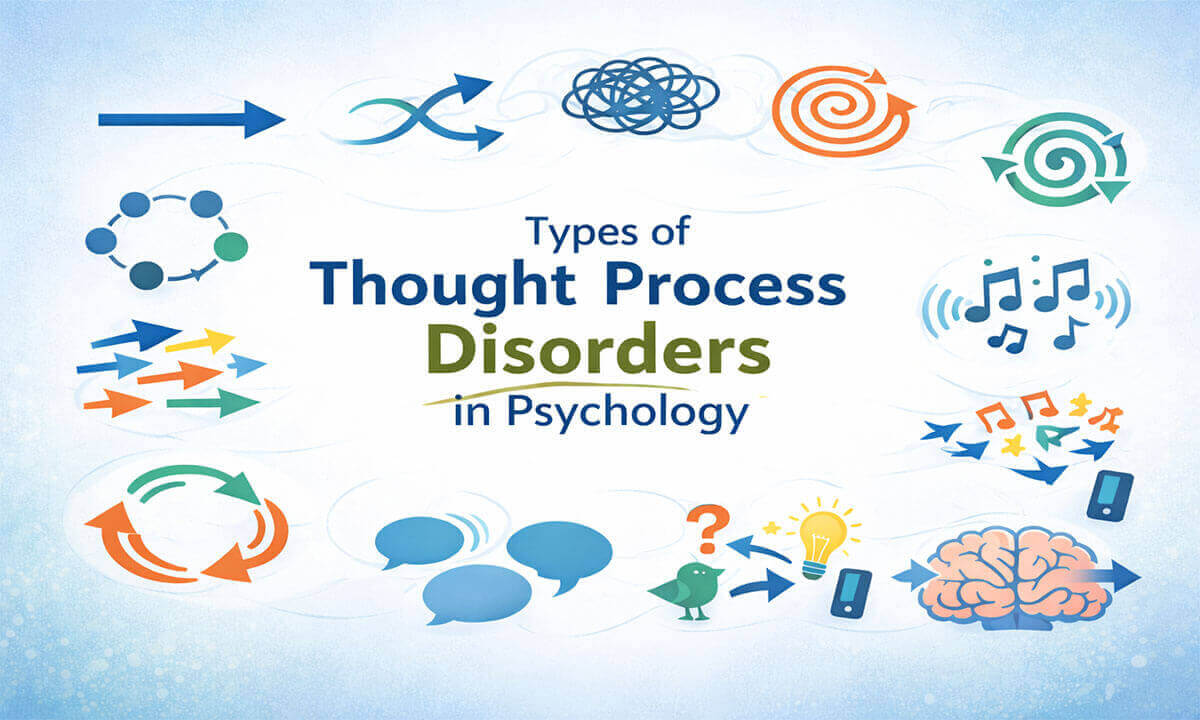
Types of Thought Process Disorders in Psychology:
Thought process disorders (also called formal thought disorders) refer to disturbances in the organization, flow, and expression of thinking. They are most commonly observed in conditions such as schizophrenia, bipolar disorder, and other psychiatric illnesses, where the normal logical connection between ideas becomes disrupted. In clinical psychology, thought processes are evaluated based on form (structure), stream (flow), and coherence of ideas, and abnormalities in any of these dimensions can result in distinct types of thought disorders. Here are the common types of thought process disorders in psychology.
1. Linear (Logical / Goal-Directed) Thought Process: A linear or goal-directed thought process represents the normal organization of thinking, in which ideas flow logically, coherently, and sequentially toward a clear objective. This form of thinking reflects intact executive functioning, including planning, attention, and cognitive control—primarily mediated by the prefrontal cortex (Goldstein & Naglieri, 2014; Barch et al., 2024).
In clinical assessment, particularly during the mental status examination (MSE), linear thinking is considered the baseline of normal cognition, allowing clinicians to detect deviations such as disorganization or derailment (Trzepacz & Baker, 1993; APA, 2022).
Research emphasized that goal-directed thinking depends on cognitive control networks, which regulate the selection and maintenance of relevant information while suppressing distractions (Barch et al., 2024). When these systems are disrupted (as seen in schizophrenia) thought processes lose coherence and direction.
Key Characteristics:
- Logical, step-by-step progression
- Clear connection between ideas
- Focused and relevant responses
- Efficient problem-solving
Clinical Insight: Impairments in linear thinking are often early indicators of neurocognitive dysfunction, especially in psychotic and mood disorders (APA, 2022).
2. Tangential Thought Process: A tangential thought process occurs when an individual deviates from the topic and fails to return to the original point, resulting in responses that are irrelevant or only loosely connected to the question. This pattern reflects a breakdown in goal-directed thinking and is a recognized form of formal thought disorder (Andreasen, 1979; APA, 2022).
Modern cognitive research links tangentiality to deficits in executive control and semantic network regulation, where irrelevant associations are activated but not properly filtered (Barch & Sheffield, 2014; Minor et al., 2015). As a result, the person’s speech may appear coherent at a surface level but lacks meaningful direction.
Key Characteristics:
- Drifting away from the main topic
- Failure to answer the question
- Lack of purposeful conclusion
- Poor conversational structure
Example:
- Question: “How are you feeling today?”
- Answer: “Feelings are interesting… people feel things differently… I once met someone who…”
Clinical Significance: Tangential thinking is commonly observed in:
- Schizophrenia spectrum disorders
- Severe mood disorders with psychotic features
It is diagnostically important because it signals impaired cognitive organization and reduced goal maintenance (APA, 2022; Minor et al., 2015).
3. Circumstantial Thought Process: A circumstantial thought process is characterized by overinclusion of excessive, unnecessary details, while still eventually reaching the intended point. Unlike tangentiality, the goal is preserved, but the communication is inefficient and indirect.
This pattern is associated with deficits in cognitive inhibition, where individuals struggle to suppress irrelevant information during speech production (Goldstein & Naglieri, 2014; Burghart et al., 2024). As a result, their responses become overly elaborate and time-consuming.
Key Characteristics:
- Excessive detail and digression
- Delayed but accurate response
- Logical structure remains intact
- Difficulty prioritizing relevant information
Example:
- Question: “What did you do this morning?”
- Answer: “I woke up at 7… actually I usually wake up at 6… my alarm didn’t ring… I bought that alarm last year… anyway, I went to work.”
Clinical Associations: Circumstantiality is often observed in:
- Anxiety disorders
- Obsessive-compulsive disorder (OCD)
- Certain personality traits or styles
Studies suggest that this pattern reflects inefficient information filtering rather than a loss of coherence, distinguishing it from more severe thought disorders (Burghart et al., 2024).
4. Disorganized Thought Process: A disorganized thought process is a severe disturbance in which logical connections between ideas break down, leading to fragmented, incoherent, or nonsensical thinking. It is one of the core symptoms of psychotic disorders, particularly schizophrenia (APA, 2022).
According to the DSM-5-TR, disorganized thinking is typically inferred from disorganized speech, including derailment, incoherence, and illogicality (APA, 2022). Neurocognitive research indicates that this disruption is linked to abnormal connectivity in brain networks, especially those involved in language processing and executive control (Barch & Sheffield, 2014; Palaniyappan et al., 2019).
Key Characteristics:
- Fragmented or incoherent speech
- Illogical or contradictory ideas
- Breakdown of meaningful communication
- Difficulty maintaining a coherent narrative
Example:
- “I went outside because numbers are flying and the sky is talking to shoes.”
Clinical Significance:
- Hallmark feature of schizophrenia
- Strongly associated with functional impairment
- Predicts poor social and occupational outcomes
Research highlighted that disorganized thought is not just a language issue but reflects widespread cognitive dysconnectivity, affecting attention, memory, and reasoning (Palaniyappan et al., 2019).
5. Loose Associations (Derailment): Loose associations, also known as derailment, refer to a thought process in which ideas shift from one topic to another with little or no logical connection. Unlike tangential thinking, where the person drifts away but may still have some indirect relation, derailment involves a more abrupt and illogical transition between ideas.
This disturbance reflects a breakdown in the brain’s ability to maintain semantic coherence, meaning that the connections between thoughts are weak or absent (Andreasen, 1979; Barch & Sheffield, 2014).
Key Characteristics:
- Sudden topic shifts
- Illogical or unclear connections between ideas
- Speech may appear disjointed
- Listener struggles to follow meaning
Example:
- “I enjoy reading books… books are made of paper… paper comes from trees… trees are green… green is my favorite food.”
Underlying Mechanism: Research suggested that loose associations arise from disruptions in semantic network activation and executive control, leading to the activation of irrelevant or weakly related concepts (Minor et al., 2015).
Clinical Significance:
- Common in schizophrenia spectrum disorders
- Considered a core feature of formal thought disorder
- Strongly associated with impaired communication and social functioning (APA, 2022)
6. Flight of Ideas: Flight of ideas is a thought process characterized by rapid, continuous shifting from one idea to another, where the connections between ideas are superficial but still somewhat understandable. Unlike loose associations, there is usually a discernible (though weak) link between thoughts.
This pattern is most commonly associated with mania, particularly in bipolar disorder, and reflects heightened cognitive and emotional activation (APA, 2022).
Key Characteristics:
- Rapid, pressured speech
- Frequent topic changes
- Superficial connections (e.g., rhymes, associations)
- Difficult to interrupt
Example:
- “I feel great today! Great things happen in spring, spring flowers bloom, bloom like success, success is what I want…”
Neurocognitive Basis: Flight of ideas is linked to increased dopaminergic activity and reduced inhibitory control, leading to accelerated thought production and decreased filtering of irrelevant associations (Barch & Sheffield, 2014; Burghart et al., 2024).
Clinical Significance:
- Hallmark symptom of manic episodes
- Seen in bipolar disorder and sometimes in stimulant intoxication
- Indicates heightened arousal and reduced cognitive regulation
7. Thought Blocking: Thought blocking refers to a sudden interruption in the flow of thought, where an individual abruptly stops speaking and may be unable to recall what they were saying. After the pause, they may either change the topic or remain silent.
This phenomenon reflects a disruption in the continuity of cognitive processing, possibly due to interference in working memory or attentional systems (Barch & Sheffield, 2014).
Key Characteristics:
- Sudden pauses באמצ sentence
- Loss of train of thought
- Inability to resume the original idea
- May appear confused or blank
Example:
- “I was going to the market and then… (long pause)… I forgot what I was saying.”
Clinical Associations: Thought blocking is frequently observed in:
- Schizophrenia
- Severe anxiety or trauma-related states
Theoretical Insight: Some models suggest that thought blocking may be linked to intrusive internal stimuli or disruptions in neural connectivity affecting attention and memory (Minor et al., 2015).
Clinical Importance:
- Considered a significant indicator of psychotic thought disruption
- May be associated with distress and functional impairment (APA, 2022)
8. Clang Associations: Clang associations occur when speech is driven by the sound of words (rhymes, puns, or phonetic similarities) rather than their meaning. This results in a pattern where form overrides content, leading to speech that may sound rhythmic but lacks logical coherence.
Key Characteristics:
- Rhyming or pun-based speech
- Word choice influenced by sound rather than meaning
- Reduced semantic coherence
- Often accompanied by rapid speech
Example:
- “Time, rhyme, climb, slime, I feel fine all the time.”
Neurocognitive Explanation: Clang associations are thought to result from overactivation of phonological processing pathways combined with reduced executive control over language output (Burghart et al., 2024).
Clinical Associations:
- Mania (bipolar disorder)
- Schizophrenia and other psychotic disorders
Clinical Significance: This pattern indicates a shift from meaningful language processing to superficial linguistic features, which is a hallmark of more severe thought disorganization (APA, 2022).
9. Perseveration: Perseveration refers to the persistent repetition of a word, phrase, idea, or response, even when it is no longer relevant to the context. The individual becomes “stuck” on a particular thought and has difficulty shifting to new ideas.
This pattern reflects a deficit in cognitive flexibility, which is a key component of executive functioning (Goldstein & Naglieri, 2014; Burghart et al., 2024).
Key Characteristics:
- Repetition of responses despite changing questions
- Inability to shift topics
- Rigid thinking pattern
Example:
- Question: “What is your name?”
- Answer: “John.”
- Question: “Where do you live?”
- Answer: “John.”
Neurocognitive Basis: Perseveration is linked to frontal lobe dysfunction, particularly involving the prefrontal cortex, which is responsible for set-shifting and inhibitory control (Burghart et al., 2024).
Clinical Associations:
- Schizophrenia
- Autism spectrum disorder
- Brain injury and neurocognitive disorders
Clinical Significance: It indicates impaired cognitive flexibility and difficulty adapting to new information, which can significantly affect communication and daily functioning.
10. Neologism: Neologism is the creation of new, idiosyncratic words or phrases that have meaning only to the individual. These words are not part of the standard language and often reflect severely disorganized thinking.
Key Characteristics:
- Invented or distorted words
- Meaning understood only by the speaker
- Disruption in language coherence
Example:
- “I feel very glorptastic today.”
Underlying Mechanism: Neologisms are thought to arise from disruptions in semantic processing and language production systems, leading to abnormal word formation (Andreasen, 1979; Barch & Sheffield, 2014).
Clinical Associations:
- Schizophrenia
- Severe psychotic disorders
Clinical Significance: Neologisms are considered a marker of advanced thought disorder, indicating profound impairment in communication (APA, 2022).
11. Word Salad (Incoherence): Word salad, or incoherent speech, represents one of the most severe forms of thought disorder, where words are randomly combined without logical or grammatical structure. The resulting speech is essentially unintelligible.
Key Characteristics:
- Complete loss of meaning
- Disorganized grammar and syntax
- No understandable connection between words
Example:
- “Blue runs quickly table sky laughing green.”
Neurocognitive Explanation: This condition reflects extreme disruption in language organization and cognitive integration, often due to widespread neural dysfunction (Palaniyappan et al., 2019).
Clinical Associations:
- Severe schizophrenia
- Advanced psychotic states
Clinical Significance: Word salad indicates a breakdown of both thought and language systems, making effective communication nearly impossible (APA, 2022).
12. Echolalia: Echolalia is the automatic repetition of words or phrases spoken by another person, rather than generating an original response. It can be immediate or delayed.
Key Characteristics:
- Repetition of others’ speech
- Lack of spontaneous verbal response
- May mimic tone and rhythm
Example:
- Clinician: “How are you feeling?”
- Patient: “How are you feeling?”
Underlying Mechanism: Echolalia is associated with impaired language generation and increased reliance on imitation, often linked to dysfunction in language and social communication networks (APA, 2022).
Clinical Associations:
- Autism spectrum disorder
- Schizophrenia
- Neurological conditions (e.g., dementia)
Clinical Significance: While echolalia may serve as a developmental or coping mechanism in some contexts, in adults it often indicates pathological thought and language processing.
13. Alogia (Poverty of Thought): Alogia, or poverty of thought, refers to a reduction in the quantity and content of speech, reflecting diminished thinking. It is classified as a negative symptom of schizophrenia.
Key Characteristics:
- Brief, minimal responses
- Lack of spontaneous speech
- Reduced content of ideas
Example:
- Question: “What did you do today?”
- Answer: “Nothing.”
Neurocognitive Basis: Alogia is linked to reduced activation in brain regions involved in language and executive functioning, leading to decreased idea generation (Barch & Sheffield, 2014).
Clinical Associations:
- Schizophrenia (negative symptoms)
- Severe depression
Clinical Significance: Alogia reflects impaired cognitive productivity, which significantly affects social interaction and functional outcomes (APA, 2022).
14. Distractible Thought Process: A distractible thought process occurs when an individual is unable to maintain focus on a topic, frequently shifting attention due to external or internal stimuli.
Key Characteristics:
- Frequent interruptions in speech
- Shifting topics due to distractions
- Difficulty maintaining a coherent line of thought
Example:
- “I was talking about my job—oh, that bird outside is loud—anyway, jobs are important…”
Underlying Mechanism: This pattern is associated with deficits in attention and inhibitory control, often linked to dysfunction in attentional networks (Burghart et al., 2024).
Clinical Associations:
- Mania (bipolar disorder)
- Attention-deficit/hyperactivity disorder (ADHD)
Clinical Significance: Distractibility reflects impaired attentional regulation, which disrupts coherent thinking and communication.
15. Illogical Thinking: Illogical thinking involves drawing conclusions that do not logically follow from the premises, even when the individual’s reasoning appears structured.
Key Characteristics:
- Faulty reasoning
- Conclusions not supported by evidence
- Misinterpretation of cause and effect
Example:
- “I didn’t sleep well, so the government must be controlling my mind.”
Clinical Associations:
- Schizophrenia
- Delusional disorders
Clinical Significance: Illogical thinking reflects distorted reasoning processes, often contributing to the development of delusions (APA, 2022).
16. Thought Insertion / Withdrawal: These are disturbances in the experience of thought ownership, where individuals believe that thoughts are being inserted into or removed from their minds by external forces.
Key Characteristics:
- Loss of sense of control over thoughts
- Belief in external influence on thinking
- Often accompanied by delusions
Example:
- “Someone is putting thoughts into my head.”
Underlying Mechanism: These experiences are linked to disturbances in self-monitoring and agency, involving dysfunction in brain networks responsible for distinguishing internal from external experiences (Barch & Sheffield, 2014).
Clinical Associations:
- Schizophrenia
- Psychotic disorders
Clinical Significance: These symptoms are considered first-rank symptoms of schizophrenia and indicate severe disruption in the sense of self (APA, 2022).
In conclusion, thought process disorders represent a spectrum of disruptions in the organization, flow, and coherence of thinking, ranging from mild circumstantiality to severe disorganization such as word salad. While occasional lapses in thinking are normal, persistent disturbances significantly impair communication and functioning and are key indicators of underlying mental illness. Understanding these types is essential for clinical diagnosis, mental status examination, and effective psychological intervention, as each pattern provides insight into specific cognitive and neurological dysfunctions.
References:
- American Psychiatric Association. (2022). Diagnostic and statistical manual of mental disorders (5th ed., text rev.). https://doi.org/10.1176/appi.books.9780890425787
- Andreasen N. C. (1979). Thought, language, and communication disorders. I. Clinical assessment, definition of terms, and evaluation of their reliability. Archives of general psychiatry, 36(12), 1315–1321. https://doi.org/10.1001/archpsyc.1979.01780120045006
- Barch, D. M., & Sheffield, J. M. (2014). Cognitive impairments in psychotic disorders: common mechanisms and measurement. World psychiatry : official journal of the World Psychiatric Association (WPA), 13(3), 224–232. https://doi.org/10.1002/wps.20145
- Barch, D. M., Culbreth, A. J., & Sheffield, J. M. (2024). Cognitive Control in Schizophrenia: Advances in Computational Approaches. Current directions in psychological science, 33(1), 35–42. https://doi.org/10.1177/09637214231205220
- Burghart, M., Schmidt, S., & Mier, D. (2024). Executive functions in psychopathy: A meta-analysis of inhibition, planning, shifting, and working memory performance. Psychological Medicine, 54(11), 2823–2837. https://doi.org/10.1017/S0033291724001259
- Goldstein, S., & Naglieri, J. A. (Eds.). (2014). Handbook of executive functioning. Springer Science+Business Media. https://doi.org/10.1007/978-1-4614-8106-5
- Minor, K. S., Marggraf, M. P., Davis, B. J., Luther, L., Vohs, J. L., Buck, K. D., & Lysaker, P. H. (2015). Conceptual disorganization weakens links in cognitive pathways: Disentangling neurocognition, social cognition, and metacognition in schizophrenia. Schizophrenia research, 169(1-3), 153–158. https://doi.org/10.1016/j.schres.2015.09.026
- Palaniyappan, L., Mota, N. B., Oowise, S., Balain, V., Copelli, M., Ribeiro, S., & Liddle, P. F. (2019). Speech structure links the neural and socio-behavioural correlates of psychotic disorders. Progress in neuro-psychopharmacology & biological psychiatry, 88, 112–120. https://doi.org/10.1016/j.pnpbp.2018.07.007
- Trzepacz, P. T., & Baker, R. W. (1993). The psychiatric mental status examination. Oxford University Press.

is an experienced educator and academic currently serving as a Lecturer at Nurul Amin Degree College. With a career dedicated to student development and institutional excellence, he brings a wealth of classroom expertise and pedagogical knowledge to his current role. Before joining the faculty, he served as an Assistant Teacher at Zinzira PM Pilot School and College.