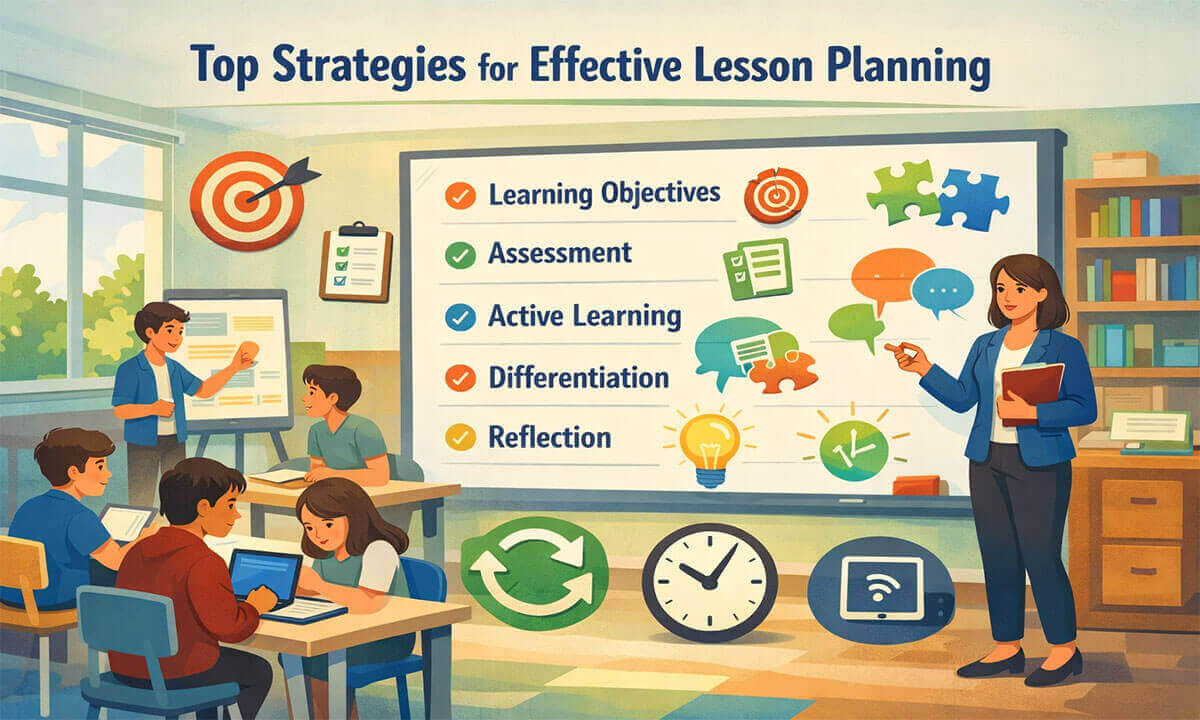
Top Strategies for Effective Lesson Planning:
Effective lesson planning is at the heart of high-quality teaching. A well-structured lesson does more than organize classroom activities; it clarifies learning goals, aligns instruction with assessment, anticipates student needs, and creates meaningful learning experiences. Research consistently shows that deliberate instructional planning enhances student achievement, engagement, and long-term retention. Lesson planning is not simply a procedural requirement; it is a reflective and strategic process. It requires teachers to consider curriculum standards, student readiness, differentiation, assessment, and classroom dynamics. In the rest of this article, we will explore top strategies for effective lesson planning.
1. Begin with Clear Learning Objectives: Clear learning objectives are the intellectual backbone of effective lesson planning. They guide instructional decisions, determine assessment strategies, and communicate expectations to students. Without clearly articulated objectives, lessons risk becoming activity-driven rather than outcome-driven.
Anderson and Krathwohl’s (2001) revision of Bloom’s Taxonomy provides a structured framework for writing measurable objectives across cognitive levels: remembering, understanding, applying, analyzing, evaluating, and creating.
Effective objectives include three essential components:
- Condition – Under what circumstances will the student perform?
- Behavior – What observable action will the student demonstrate?
- Criterion – How well must the student perform?
For example, instead of writing, “Students will understand photosynthesis,” a more effective objective would be:
“Students will be able to explain the process of photosynthesis and illustrate it using a labeled diagram.”
The shift from vague verbs (e.g., “know,” “understand”) to measurable verbs (e.g., “compare,” “design,” “evaluate”) improves instructional clarity and assessment precision.
Marzano (2007) emphasizes that setting and communicating learning goals has a strong positive effect on student achievement. When students clearly understand the target, they are more likely to monitor their progress and take ownership of their learning. This practice also supports metacognition, as learners can reflect on whether they have met the objective.
Furthermore, clearly defined objectives promote instructional coherence. They ensure that:
- Teaching activities are purposeful.
- Classroom discussions remain focused.
- Assessments measure intended outcomes.
- Feedback aligns with expectations.
So, well-crafted objectives transform lessons from loosely structured sessions into intentional learning experiences grounded in measurable growth.
2. Align Instruction with Backward Design: Backward design, introduced by Wiggins and McTighe (2005), represents a paradigm shift in lesson planning. Rather than beginning with textbooks or activities, teachers begin with the end in mind: What should students ultimately understand and be able to do?
The backward design framework unfolds in three deliberate stages:
Stage 1: Identify Desired Results: Teachers first clarify:
- What essential knowledge and skills must students acquire?
- What enduring understandings should remain long after the lesson ends?
- What essential questions will stimulate deep thinking?
This stage encourages educators to prioritize conceptual understanding over surface-level memorization.
Stage 2: Determine Acceptable Evidence: Once outcomes are clear, teachers decide how students will demonstrate mastery. Assessment is not an afterthought but an integral part of planning. Evidence may include:
- Performance tasks
- Projects
- Essays
- Presentations
- Quizzes or tests
By planning assessments first, teachers avoid misalignment between instruction and evaluation.
Stage 3: Plan Learning Experiences and Instruction: Only after clarifying outcomes and evidence do teachers design activities that lead students toward mastery.
Wiggins and McTighe (2005) argue that backward design prevents “coverage teaching,” where instructors rush through content without ensuring understanding. Instead, it promotes intentional alignment between objectives, instruction, and assessment.
Research on instructional coherence supports this approach. When curriculum, assessment, and instruction are aligned, student achievement increases because learners encounter consistent expectations and structured progression (Darling-Hammond et al., 2020).
Backward design also enhances teacher reflection. By beginning with clear outcomes, educators can continually ask:
- Is this activity helping students achieve the goal?
- Does this assessment truly measure deep understanding?
This intentional alignment transforms lesson planning into a strategic and evidence-based process rather than a routine preparation task.
3. Incorporate Active Learning Strategies: Active learning shifts the classroom from teacher-centered delivery to student-centered engagement. Instead of passively listening, students actively process, discuss, apply, and construct knowledge.
Freeman et al. (2014), in a large meta-analysis of STEM courses, found that students in active learning environments performed significantly better and had lower failure rates compared to those in traditional lecture-based settings. This research provides strong empirical support for integrating active learning into lesson plans.
Active learning is grounded in constructivist theory, which suggests that learners build knowledge through experience and interaction (Bransford et al., 2000). According to cognitive science, meaningful learning occurs when students:
- Connect new information to prior knowledge.
- Engage in problem-solving.
- Discuss ideas with peers.
- Apply concepts in authentic contexts.
Effective lesson planning therefore embeds structured engagement opportunities such as:
- Collaborative Learning: Students work in small groups to analyze case studies, debate issues, or solve problems. Collaboration fosters deeper understanding and strengthens communication skills.
- Inquiry-Based Learning: Students explore questions, investigate problems, and construct explanations. This method encourages critical thinking and curiosity.
- Problem-Based Learning: Real-world problems drive learning. Students must apply concepts to authentic situations, enhancing transfer of knowledge.
- Peer Instruction: Students explain concepts to one another, reinforcing understanding through teaching.
Active learning also increases attention and motivation. Research in cognitive psychology shows that sustained attention declines during passive listening, whereas interactive tasks re-engage learners cognitively (Bransford et al., 2000).
However, effective active learning requires careful planning. Activities must be:
- Structured with clear instructions.
- Purposefully aligned with objectives.
- Supported with guidance and feedback.
When thoughtfully integrated, active learning strategies transform classrooms into dynamic environments where students are intellectually invested and actively constructing meaning.
4. Differentiate Instruction to Meet Diverse Needs: Effective lesson planning recognizes that students differ in readiness levels, background knowledge, language proficiency, interests, and learning profiles. A “one-size-fits-all” lesson rarely ensures equitable learning outcomes. Differentiation is therefore not optional; it is essential.
Tomlinson (2014) defines differentiation as proactively modifying instruction in four key areas:
- Content – What students learn
- Process – How students engage with the material
- Product – How students demonstrate learning
- Learning environment – The classroom context and climate
Rather than lowering expectations, differentiation maintains high standards while providing varied pathways to reach them.
Vygotsky’s (1978) concept of the Zone of Proximal Development (ZPD) provides a theoretical foundation for differentiation. The ZPD represents the gap between what learners can accomplish independently and what they can achieve with guidance. Effective lesson planning targets this zone by providing scaffolds such as:
- Guided practice before independent work
- Modeling and think-aloud strategies
- Graphic organizers
- Sentence starters
- Gradual release of responsibility
When instruction consistently falls below a learner’s level, boredom results. When it exceeds readiness without support, frustration emerges. Differentiation helps balance challenge and support, promoting optimal cognitive growth.
Additionally, differentiation supports inclusive education by ensuring that students with varying needs (including English language learners and students with disabilities) can meaningfully participate. Darling-Hammond et al. (2020) emphasize that equitable teaching practices are central to fostering deeper learning and developmental growth.
Effective lesson planning therefore anticipates diversity and intentionally includes flexible grouping, tiered assignments, and choice-based activities. These strategies not only improve access but also enhance student agency and engagement.
5. Integrate Formative Assessment: Formative assessment is one of the most powerful tools available to teachers. Unlike summative assessment, which evaluates learning at the end of instruction, formative assessment is ongoing and informs instructional adjustments in real time.
Black and Wiliam (1998) demonstrated that formative assessment significantly improves student achievement, particularly for lower-performing students. Their research underscores that assessment is most effective when used to guide learning rather than merely measure it.
Hattie (2009) further identifies feedback as one of the highest-impact influences on student achievement. However, not all feedback is equally effective. High-quality feedback should:
- Clarify learning goals
- Identify gaps between current performance and the target
- Provide actionable next steps
- Encourage self-regulation
In lesson planning, formative assessment can be embedded through:
- Exit tickets
- Quick concept checks
- Think-pair-share summaries
- Polling or digital quizzes
- Observation and questioning
Importantly, formative assessment is not limited to teacher feedback. Peer assessment and self-assessment also promote metacognition. When students evaluate their own work against clear criteria, they develop greater ownership and awareness of their learning process.
Marzano (2007) emphasizes that tracking student progress relative to learning goals enhances motivation and achievement. Lesson plans should therefore include explicit checkpoints that allow teachers to adjust pacing, reteach concepts, or extend learning as needed.
Thus, formative assessment transforms teaching into a responsive, adaptive process rather than a fixed delivery of content.
6. Plan for Engagement and Motivation: Even the most carefully structured lesson will fail if students are not engaged. Motivation is a central factor influencing effort, persistence, and depth of learning.
Deci and Ryan’s (2000) Self-Determination Theory identifies three psychological needs that foster intrinsic motivation:
- Autonomy – Feeling a sense of choice and control
- Competence – Feeling capable of success
- Relatedness – Feeling connected to others
Effective lesson planning intentionally supports these needs.
- Supporting Autonomy: Teachers can provide structured choices, such as allowing students to select project formats, research topics, or collaborative roles. Even small choices increase ownership and engagement.
- Building Competence: Tasks should be challenging yet achievable. When students experience incremental success, confidence grows. Clear rubrics and exemplars help students understand expectations, reinforcing competence (Marzano, 2007).
- Fostering Relatedness: Collaborative activities, respectful classroom dialogue, and culturally relevant examples help students feel valued and connected. Darling-Hammond et al. (2020) emphasize that supportive relationships significantly enhance academic engagement and developmental growth.
Active learning also contributes to engagement. Freeman et al. (2014) found that interactive instructional approaches increase participation and reduce disengagement compared to passive lectures.
Moreover, connecting lessons to real-world contexts increases relevance. When students see how content applies beyond the classroom, intrinsic motivation strengthens. Bransford et al. (2000) note that meaningful learning occurs when knowledge is applied in authentic contexts rather than isolated drills.
Effective lesson planning therefore integrates motivational principles deliberately rather than leaving engagement to chance. It blends challenge, relevance, autonomy, and supportive relationships to create a learning environment where students are not only present but also invested.
7. Incorporate Reflection and Closure: Effective lessons do not simply end when time runs out; they conclude with intentional reflection and consolidation. Reflection helps students integrate new knowledge with prior understanding and strengthens long-term retention.
Schön (1983) describes reflective practice as essential for deep learning, both for practitioners and learners. When students are given structured opportunities to reflect, they move beyond surface-level comprehension toward metacognitive awareness (thinking about their own thinking).
Reflection during lesson closure can take several forms:
- Summarization activities (e.g., “Write three key takeaways.”)
- One-minute papers explaining the most important concept learned
- Concept maps showing relationships between ideas
- Peer explanations to reinforce understanding
- Self-assessment against learning objectives
Hattie (2009) emphasizes that visible learning occurs when students understand the goals of learning and can evaluate their progress toward those goals. Structured reflection makes learning visible.
From a cognitive perspective, Bransford et al. (2000) highlight that retention improves when learners actively process and organize information. Closure activities allow students to rehearse and synthesize content, strengthening neural connections.
Reflection is equally important for teachers. After each lesson, educators should ask:
- Which objectives were achieved?
- Where did students struggle?
- Were the activities aligned with the intended outcomes?
- How can instruction be improved next time?
This practice aligns with Schön’s (1983) concept of the “reflective practitioner,” who continually refines instruction through thoughtful analysis. Effective lesson planning, therefore, includes not only student reflection but also teacher self-reflection as part of ongoing professional growth.
8. Use Flexible and Strategic Time Management: Time is one of the most valuable yet limited classroom resources. Effective lesson planning requires strategic allocation of time to ensure that instructional priorities are met without unnecessary rush or wasted minutes.
Marzano (2007) notes that maximizing engaged learning time significantly influences student achievement. Lessons that lose time to disorganization, unclear instructions, or prolonged transitions reduce opportunities for meaningful learning.
Strategic time management involves:
- Allocating time proportionally to learning objectives
- Building in buffer time for questions and clarification
- Planning smooth transitions between activities
- Preparing extension or reinforcement tasks
Additionally, lesson pacing should reflect cognitive load considerations. Bransford et al. (2000) explain that learners need time to process and apply information. Overloading a lesson with excessive content may hinder deep understanding.
Flexible time management also allows responsiveness to formative assessment. If students demonstrate misunderstanding during a concept check, teachers may need to slow down and reteach. Conversely, if mastery is evident, the lesson can extend into enrichment activities.
Darling-Hammond et al. (2020) emphasize the importance of adaptive teaching practices that respond to student development. Rigid adherence to a lesson script can undermine learning if it ignores real-time student needs.
Therefore, effective lesson planning balances structure with adaptability. A well-planned timeline provides direction, but flexibility ensures responsiveness.
9. Integrate Technology Thoughtfully and Purposefully: Technology integration can significantly enhance learning when aligned with pedagogical goals rather than used as a novelty. The key principle is intentionality: technology should support deeper understanding, collaboration, or assessment; not merely digitize traditional tasks.
Darling-Hammond et al. (2020) emphasize that digital tools are most effective when they promote active engagement, feedback, and higher-order thinking. For example:
- Interactive simulations can deepen conceptual understanding.
- Collaborative platforms can facilitate peer learning.
- Digital formative assessment tools can provide immediate feedback.
- Multimedia projects can support creativity and authentic demonstration of learning.
Technology integration also complements active learning approaches. Freeman et al. (2014) demonstrate that interactive methods improve performance; digital tools can amplify these methods through dynamic participation and instant feedback mechanisms.
However, effective integration requires alignment with learning objectives (Wiggins & McTighe, 2005). Teachers should ask:
- Does this technology enhance understanding or simply replace paper?
- Does it promote higher-order thinking (Anderson & Krathwohl, 2001)?
- Does it provide meaningful feedback (Hattie, 2009)?
Technology should also support differentiation. Digital platforms often allow varied pacing, multimodal resources, and personalized pathways—aligning with Tomlinson’s (2014) principles of differentiated instruction.
Ultimately, technology is a tool, not a goal. When thoughtfully embedded in lesson planning, it can foster collaboration, creativity, and deeper engagement. When misaligned, it risks distraction. Effective educators therefore integrate technology strategically, guided by pedagogy and purpose.
10. Anticipate Challenges and Plan Scaffolds: One of the distinguishing features of expert lesson planning is anticipation. Skilled educators do not simply plan what they will teach; they anticipate how students might misunderstand, struggle, or misinterpret the content. Proactively addressing potential obstacles increases instructional clarity and prevents learning gaps from widening.
Bransford, Brown, and Cocking (2000) emphasize that learners enter the classroom with prior knowledge, beliefs, and misconceptions. These preconceptions can either support or hinder new learning. If misconceptions are not explicitly addressed, they may persist despite instruction. Effective lesson planning therefore includes identifying likely areas of confusion and designing strategies to confront them constructively.
For example, in science education, students may hold intuitive but scientifically inaccurate beliefs about physical processes. In mathematics, procedural fluency may mask conceptual misunderstandings. Anticipating such issues allows teachers to:
- Prepare guiding questions that surface misconceptions
- Use diagnostic formative assessments (Black & Wiliam, 1998)
- Provide concrete examples before abstract explanations
- Incorporate visual representations or models
- Sequence tasks from simple to complex
This anticipatory approach aligns with Vygotsky’s (1978) theory of scaffolding within the Zone of Proximal Development (ZPD). Scaffolding involves structured support that gradually decreases as competence increases. It may include modeling, think-aloud demonstrations, guided practice, and structured prompts. Over time, responsibility shifts from teacher to learner.
Hattie (2009) notes that clarity and structured guidance significantly influence student achievement. When teachers clearly explain processes, model expectations, and provide step-by-step support, cognitive overload is reduced and comprehension improves.
Furthermore, backward design (Wiggins & McTighe, 2005) strengthens this strategy by encouraging teachers to examine potential barriers before instruction begins. By asking, “What might prevent students from demonstrating mastery?” educators can proactively design supports aligned with assessment criteria.
Scaffolding also connects to differentiation (Tomlinson, 2014). While all students may pursue the same core objective, the level and type of support may vary. Some students may require graphic organizers or sentence frames, while others benefit from enrichment tasks that extend conceptual depth.
Finally, anticipation extends beyond academic challenges to classroom management and engagement concerns. Planning transitions, preparing materials in advance, and establishing clear procedures minimize disruptions and maximize instructional time (Marzano, 2007).
In conclusion, effective lesson planning is a dynamic, reflective, and research-informed process. It requires clear objectives, alignment through backward design, active engagement strategies, differentiation, formative assessment, and structured reflection. When teachers intentionally integrate these strategies, lessons become coherent, inclusive, and impactful. Research consistently affirms that deliberate planning improves both teaching quality and student outcomes. Ultimately, effective lesson planning is not about rigidly following a script but about thoughtfully designing meaningful learning experiences that respond to student needs while achieving curricular goals. For educators committed to excellence, lesson planning remains one of the most powerful tools for fostering deep understanding, critical thinking, and lifelong learning.
Frequently Asked Questions (FAQs):
What is the most important element of effective lesson planning?
The most important element is having clear and measurable learning objectives. Objectives guide instruction, assessment, and classroom activities. Without clearly defined outcomes, lessons may become activity-focused rather than learning-focused.
How long should a lesson plan be?
There is no fixed length. A lesson plan should be detailed enough to provide clarity and structure but flexible enough to adapt to classroom realities. New teachers may write more detailed plans, while experienced educators often use concise outlines supported by professional judgment.
What is backward design in lesson planning?
Backward design is a planning approach where teachers begin by identifying desired learning outcomes, then determine how students will demonstrate mastery, and finally design instructional activities. This ensures alignment between objectives, teaching, and assessment.
How can I differentiate instruction in a mixed-ability classroom?
You can differentiate by adjusting:
- The difficulty level of tasks
- The type of learning materials
- The way students demonstrate understanding
- The level of support provided
Flexible grouping, tiered assignments, and student choice are effective strategies.
Why is formative assessment important in lesson planning?
Formative assessment allows teachers to monitor student understanding during the lesson. It helps identify misconceptions early and provides opportunities to adjust instruction before moving forward. This improves overall learning outcomes.
How can I keep students engaged throughout a lesson?
Engagement increases when lessons include:
- Interactive activities
- Real-world connections
- Opportunities for collaboration
- Student choice
- Clear goals and feedback
Active learning strategies significantly enhance participation and motivation.
How much technology should be included in a lesson plan?
Technology should be used purposefully, not excessively. It should enhance learning, improve feedback, or promote deeper thinking. If it does not clearly support the learning objective, it may not be necessary.
What should I do if a lesson does not go as planned?
Flexibility is part of effective teaching. Reflect on what worked and what did not, identify possible causes, and revise the lesson for future use. Responsive adjustment during the lesson is also essential.
How can I improve my lesson planning skills over time?
Improvement comes through:
- Reflective practice
- Seeking feedback from colleagues
- Reviewing student performance data
- Studying research-based instructional strategies
- Continuously refining objectives and assessments
Experience combined with reflection leads to stronger planning.
Is it necessary to write a lesson plan for every class?
While detailed written plans may not always be required, structured preparation is essential. Even experienced teachers benefit from outlining objectives, activities, and assessments to ensure clarity and alignment.
References:
- Anderson, L. W., & Krathwohl, D. R. (Eds.) (2001). A taxonomy for Learning, teaching, and assessing: A revision of Bloom’s taxonomy of educational objectives. New York: Addison Wesley Longman.
- Black, P., & William, D. (1998). Assessment and Classroom Learning. Assessment in Education, 5, 7-74. https://doi.org/10.1080/0969595980050102
- Bransford, J. D., Brown, A. L., & Cocking, R. R. (2000). How People Learn: Brain, Mind, Experience, and School. Washington DC: National Academy Press.
- Darling-Hammond, L., Flook, L., Cook-Harvey, C., Barron, B., & Osher, D. (2020). Implications for Educational Practice of the Science of Learning and Development. Applied Developmental Science, 24, 97-140. https://doi.org/10.1080/10888691.2018.1537791
- Deci, E. L., & Ryan, R. M. (2000). The “what” and “why” of goal pursuits: Human needs and the self-determination of behavior. Psychological Inquiry, 11(4), 227–268. https://doi.org/10.1207/S15327965PLI1104_01
- Freeman, S., Eddy, S. L., McDonough, M., Smith, M. K., Okoroafor, N., Jordt, H., & Wenderoth, M. P. (2014). Active learning increases student performance in science, engineering, and mathematics. PNAS Proceedings of the National Academy of Sciences of the United States of America, 111(23), 8410–8415. https://doi.org/10.1073/pnas.1319030111
- Hattie, J. (2009). Visible learning: A synthesis of over 800 meta-ana lyses related to achievement. London: Routledge.
- Marzano, R. J. (2007). The Art and Science of Teaching. Alexandria, VA: ASCD.
- Schon, D. A. (1983). The Reflective Practitioner: How Professionals Think in Action. Basic Books.
- Tomlinson, C.A. (2014). The Differentiated Classroom: Responding to the Needs of All Learners. 2nd Edition, ASCD, Alexandria.
- Vygotsky, L. S. (1978). Mind in society. The development of higher psychological processes. Cambridge: Harvard University Press.
- Wiggins, G., & McTighe, J. (2005). Understanding by design, expanded (2nd ed.). Alexandria VA: Association for Supervision and Curriculum Development.

Library Lecturer at Nurul Amin Degree College