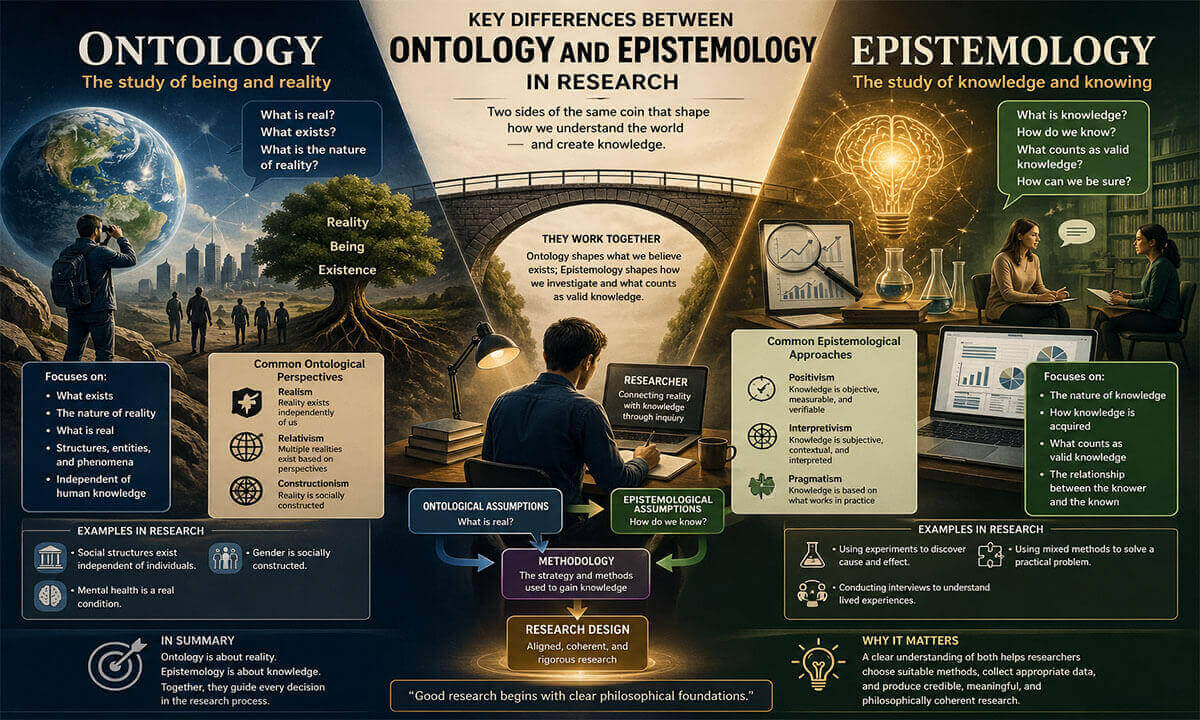
Key Differences Between Ontology and Epistemology in Research:
Students beginning dissertations or research projects often encounter the terms ontology and epistemology and quickly feel overwhelmed by the philosophical language surrounding them. Yet these concepts are not merely abstract philosophical debates; they form the foundation of every research project. Whether a researcher is conducting interviews in psychology, analyzing educational practices, or examining social behavior, assumptions about reality and knowledge shape every stage of the study, from the formulation of research questions to the interpretation of findings. At its core, ontology concerns the nature of reality: What exists? What is real? Epistemology, by contrast, concerns the nature of knowledge: How do we know what we know? What counts as valid knowledge? These philosophical positions influence methodological decisions, data collection strategies, and interpretations of evidence (Crotty, 1998). In social science research especially, ontology and epistemology help researchers justify why they chose specific methods and why they believe their findings are meaningful. Understanding the key differences between ontology and epistemology in research is fundamentally a process of creating knowledge. Researchers must therefore clarify both what they believe exists in the world and how they believe knowledge about that world can be obtained. This article explores the meaning of ontology and epistemology, their major differences, their relationship to research methodology, and their practical application in academic research.
Understanding Ontology:
Ontology refers to the philosophical study of being, existence, and reality. In research, ontology addresses assumptions about the nature of the world and what can be considered real (Blaikie & Priest, 2019). Researchers adopting different ontological positions may study the same phenomenon but interpret it in radically different ways.
For example, in educational research, one researcher may believe that intelligence is an objective, measurable reality that exists independently of social context. Another researcher may argue that intelligence is socially constructed and shaped by cultural expectations and institutional definitions. These differing assumptions reflect different ontological positions.
Ontology asks questions such as:
- What exists in the social world?
- Is reality objective or subjective?
- Are social phenomena independent of human perception?
- Do multiple realities exist depending on individual experience?
Philosophers and researchers commonly distinguish between several major ontological perspectives.
- Realism: Realism assumes that reality exists independently of human perception. From this perspective, social structures, psychological processes, or physical phenomena exist whether or not humans observe them (Bhaskar, 1978). Researchers working from a realist ontology often seek objective truths through systematic observation and measurement.
For instance, a clinical psychologist studying depression from a realist perspective may assume depression is a genuine mental health condition with measurable biological and behavioral indicators.
- Relativism: Relativism argues that reality is socially constructed and varies across individuals, cultures, and historical contexts (Lincoln et al., 2005). According to this view, there is no single objective reality; instead, multiple realities coexist.
A relativist researcher studying classroom behavior may focus on how students and teachers interpret learning differently based on personal experiences and cultural backgrounds.
- Constructionism: Constructionism emphasizes that meanings and realities are created through social interaction and language (Crotty, 1998). Social categories such as gender, leadership, or intelligence are understood not as fixed entities but as socially negotiated concepts.
For example, leadership may be viewed differently across organizations and societies, meaning that “leadership reality” emerges through shared social understanding rather than existing independently.
Understanding Epistemology:
Epistemology concerns the nature, sources, and limits of knowledge. It examines how humans acquire knowledge and determine whether that knowledge is valid or trustworthy (Audi, 2010). In research, epistemology shapes how investigators gather evidence, evaluate truth claims, and justify conclusions.
Epistemological questions include:
- What counts as knowledge?
- How can knowledge be obtained?
- What methods produce trustworthy evidence?
- Can researchers remain objective?
- Is knowledge discovered or constructed?
Different epistemological approaches lead researchers toward different methodologies and methods.
- Positivism: Positivism assumes that knowledge can be obtained objectively through observation and measurement. It is closely associated with scientific methods, hypothesis testing, and quantitative research (Creswell & Creswell, 2018).
Positivist researchers seek generalizable laws and causal explanations. For example, a researcher studying anxiety may use standardized psychological scales and statistical analyses to identify measurable relationships between variables.
- Interpretivism: Interpretivism argues that knowledge is created through understanding human experiences, meanings, and interpretations (Schwandt, 2015). Researchers using this approach emphasize context and subjective experience.
For example, instead of measuring anxiety numerically, an interpretivist psychologist may conduct interviews to explore how individuals personally experience anxiety in daily life.
- Pragmatism: Pragmatism focuses on practical outcomes and problem-solving rather than strict philosophical commitments (Morgan, 2014). Pragmatic researchers often combine qualitative and quantitative methods depending on what best addresses the research question.
In educational research, a pragmatist may use surveys to identify broad trends while also conducting interviews to understand participant experiences in depth.
Key Differences Between Ontology and Epistemology:
Although ontology and epistemology are closely related, they address different philosophical concerns. Ontology focuses on reality, whereas epistemology focuses on knowledge about that reality.
1. Central Focus: The most fundamental difference lies in their primary concern.
-
- Ontology asks: What is real?
- Epistemology asks: How do we know what is real?
Ontology concerns existence itself, while epistemology concerns understanding and knowledge acquisition.
For example, a researcher studying stress may ontologically assume that stress is either an objective biological phenomenon or a subjective social experience. Epistemologically, the researcher must then decide how knowledge about stress can be obtained through physiological measurements, interviews, observations, or mixed methods.
2. Nature of Inquiry: Ontology investigates the nature of existence and reality. Epistemology investigates the relationship between the knower and what can be known (Guba & Lincoln, 1994).
Ontology asks:
- Does a single reality exist?
- Are realities socially constructed?
Epistemology asks:
- Can researchers objectively know reality?
- Does knowledge depend on interpretation?
Thus, ontology is concerned with being, while epistemology is concerned with knowing.
3. Influence on Research Design: Ontology influences what researchers choose to study, whereas epistemology influences how they study it.
For instance:
- A realist ontology may encourage quantitative measurement of objective variables.
- A constructivist ontology may encourage qualitative exploration of lived experiences.
Similarly:
- A positivist epistemology may support experiments and statistical testing.
- An interpretivist epistemology may support interviews and thematic analysis.
These philosophical assumptions shape every methodological decision in the research process (Saunders et al., 2019).
4. Relationship to Methodology: Ontology and epistemology together inform methodology, but they contribute differently.
Ontology determines assumptions about the nature of the phenomenon under investigation. Epistemology determines acceptable methods for generating knowledge about that phenomenon.
For example:
- If researchers believe reality is objective and measurable, they may adopt experimental methods.
- If they believe reality is socially constructed, they may favor ethnography or phenomenology.
Consequently, philosophical coherence between ontology, epistemology, and methodology is essential for rigorous research design.
5. Objectivity Versus Subjectivity: Ontology addresses whether reality itself is objective or subjective, while epistemology addresses whether knowledge can be objective or whether it is inherently shaped by human interpretation.
A positivist researcher may assume:
- Reality exists independently.
- Objective knowledge is possible.
An interpretivist researcher may assume:
- Multiple realities exist.
- Knowledge is shaped by social interaction and interpretation.
This distinction significantly affects data collection, analysis, and interpretation practices.
The Relationship Between Ontology and Epistemology:
Ontology and epistemology are deeply interconnected. A researcher’s ontological assumptions typically influence epistemological choices (Crotty, 1998). If someone believes there is a single objective reality, they are more likely to adopt epistemological approaches emphasizing measurement and objectivity. Conversely, if someone believes realities are socially constructed, they are more likely to emphasize interpretation and contextual understanding.
For example:
|
Ontological Position |
Epistemological Approach |
Common Methodology |
|
Realism |
Positivism | Quantitative research |
|
Relativism |
Interpretivism | Qualitative research |
| Constructionism | Constructivism |
Phenomenology, ethnography |
| Pragmatism | Pragmatism |
Mixed methods |
However, researchers are not always confined to strict philosophical categories. Contemporary research increasingly embraces methodological pluralism, recognizing that different methods may provide complementary insights into complex phenomena (Tashakkori & Teddlie, 2010).
Why Ontology and Epistemology Matter in Research:
Understanding ontology and epistemology is important because these frameworks strengthen the coherence and credibility of research.
- Clarifying Research Questions: Philosophical assumptions help researchers define what kinds of questions are meaningful. Questions about measurable variables often emerge from realist and positivist assumptions, while questions about lived experience emerge from constructivist perspectives.
- Guiding Methodological Choices: Research methods should align with philosophical assumptions. A mismatch between ontology, epistemology, and methodology can weaken a study’s validity.
For example, a researcher claiming that reality is socially constructed but relying exclusively on rigid experimental measurement may create philosophical inconsistency.
- Enhancing Reflexivity: Awareness of epistemological and ontological assumptions encourages reflexivity; the process of critically examining how researchers’ beliefs influence the research process (Finlay, 2002). Reflexivity is particularly important in qualitative research, where interpretation plays a central role.
- Supporting Academic Rigor: Explicitly discussing ontology and epistemology demonstrates scholarly rigor and transparency. Examiners and readers can better understand how researchers approached their study and why particular methods were chosen.
Applying Ontology and Epistemology in Dissertation Research:
Students often struggle to identify their philosophical position. One practical strategy is to begin with the research question itself.
Researchers should ask:
- What kind of reality am I studying?
- Do I believe this phenomenon exists independently of human interpretation?
- What type of knowledge am I trying to generate?
- How can that knowledge best be obtained?
For example, an educator studying classroom engagement may:
- Use a positivist approach if seeking measurable patterns in student participation.
- Use an interpretivist approach if exploring students’ personal experiences of engagement.
- Use pragmatism if combining surveys and interviews to gain broader insight.
Reviewing published dissertations within one’s discipline can also help students understand how ontology and epistemology are commonly framed in their field.
Common Misunderstandings:
Many novice researchers mistakenly believe ontology and epistemology are irrelevant philosophical jargon. In reality, every research project implicitly contains assumptions about reality and knowledge, whether acknowledged or not.
Another common misunderstanding is assuming there is a “correct” philosophical position. Different ontological and epistemological approaches are appropriate for different research goals. The key issue is coherence and alignment rather than choosing a universally superior perspective.
Students also frequently confuse methodology with epistemology. Methodology refers to the strategy or design of research, whereas epistemology concerns the theory of knowledge underlying that strategy.
In conclusion, ontology and epistemology are foundational concepts that shape every aspect of research. Ontology asks what is real and what exists, while epistemology asks what knowledge is and how it can be acquired. Together, these philosophical perspectives guide researchers in defining research questions, selecting methodologies, interpreting evidence, and justifying conclusions. Although these concepts initially appear abstract, they become highly practical when applied to real research problems. Ontological assumptions influence what researchers consider worthy of investigation, while epistemological assumptions determine how researchers seek knowledge about those phenomena. Understanding both concepts enables researchers to create more coherent, rigorous, and transparent studies. Finally, ontology and epistemology are not simply philosophical exercises reserved for academics; they are essential tools for building meaningful research. By becoming aware of these underlying assumptions, students and scholars can design studies that are methodologically sound, intellectually consistent, and better suited to answering the complex questions that drive scholarly inquiry.
Frequently Asked Questions (FAQs):
What is the main difference between ontology and epistemology?
The main difference is that ontology concerns reality, while epistemology concerns knowledge. Ontology asks questions such as “What exists?” and “What is real?” Epistemology asks “How do we know what is real?” and “What counts as valid knowledge?” In research, ontology shapes what researchers believe can be studied, whereas epistemology shapes how they investigate and justify knowledge claims (Crotty, 1998).
Why are ontology and epistemology important in research?
Ontology and epistemology are important because they provide the philosophical foundation for research design. They influence:
- the research question,
- methodology,
- data collection methods,
- interpretation of findings, and
- definitions of valid evidence.
Without a clear philosophical foundation, research may become inconsistent or methodologically weak (Saunders et al., 2019).
Can a researcher conduct research without understanding ontology and epistemology?
Technically, yes—but every researcher still operates from implicit philosophical assumptions. Even if researchers do not explicitly discuss ontology and epistemology, their beliefs about reality and knowledge still shape their study design and interpretation. Understanding these concepts helps researchers become more reflective, coherent, and academically rigorous (Guba & Lincoln, 1994).
Is ontology more important than epistemology?
Neither is more important; they are interconnected. Ontology defines what researchers believe exists, while epistemology explains how knowledge about that reality can be obtained. Together, they guide the entire research process. A strong study requires alignment between both philosophical positions and the chosen methodology.
What is an example of ontology in research?
Suppose a psychologist studies anxiety. A realist ontological position would assume anxiety exists as an objective psychological condition that can be measured scientifically. A constructivist ontological position, however, may argue that anxiety is shaped by culture, language, and personal interpretation. These differing assumptions influence how the research is conducted.
What is an example of epistemology in research?
A positivist epistemology may lead researchers to measure anxiety using surveys, experiments, and statistical analysis. An interpretivist epistemology may instead involve interviews or narrative analysis to understand how individuals personally experience anxiety. The epistemological stance determines how knowledge is gathered and evaluated.
What are the major ontological perspectives?
Common ontological perspectives include:
- Realism: Reality exists independently of human perception.
- Relativism: Multiple realities exist depending on social and cultural interpretation.
- Constructionism: Reality is socially constructed through interaction and language.
Each perspective influences how researchers define the phenomena they study (Lincoln et al., 2005).
What are the major epistemological approaches?
Major epistemological approaches include:
- Positivism: Knowledge is objective and measurable.
- Interpretivism: Knowledge is subjective and shaped by meaning and experience.
- Pragmatism: Knowledge is evaluated based on practical usefulness and problem-solving.
These approaches influence methodological choices in research (Creswell & Creswell, 2018).
How do ontology and epistemology influence methodology?
Ontology influences what researchers believe can be studied, while epistemology influences how researchers study it. Together, they shape methodology. For example:
- A realist ontology combined with positivism often leads to quantitative research.
- A constructivist ontology combined with interpretivism often leads to qualitative research.
Thus, methodology emerges from the interaction between ontological and epistemological assumptions.
Are ontology and epistemology only relevant in qualitative research?
No, both quantitative and qualitative research rely on ontological and epistemological assumptions. Quantitative research often draws from realist and positivist traditions, while qualitative research commonly aligns with constructivist and interpretivist perspectives. Mixed-methods research may combine multiple philosophical assumptions depending on the study goals (Tashakkori & Teddlie, 2010).
How can students identify their own epistemological position?
Students can begin by asking:
- What type of knowledge am I trying to create?
- Do I believe knowledge can be objective?
- Am I more interested in measurable facts or lived experiences?
- What methods best answer my research question?
Reading existing dissertations and methodological literature within one’s field can also help clarify philosophical alignment.
What happens if ontology, epistemology, and methodology do not align?
Misalignment can create confusion and weaken research credibility. For example, claiming that reality is socially constructed while using rigid experimental methods aimed at discovering objective truths may create philosophical inconsistency. Strong research requires coherence between philosophical assumptions and methodological choices.
Is there a “best” ontology or epistemology?
No single ontology or epistemology is universally superior. Different research questions require different philosophical approaches. The best choice depends on:
- the nature of the research problem,
- the goals of the study,
- the discipline, and
- the type of knowledge being sought.
The key is selecting an approach that fits the research purpose and applying it consistently.
Why do dissertations often include ontology and epistemology sections?
Dissertations include these sections to demonstrate philosophical clarity and methodological rigor. Examiners expect researchers to explain:
- their assumptions about reality,
- their understanding of knowledge,
- why certain methods were selected, and
- how conclusions are justified.
These sections help establish transparency and scholarly credibility.
How are ontology and epistemology connected to paradigm choice?
Research paradigms are broader philosophical frameworks that combine ontological and epistemological assumptions. For example:
- Positivism combines realist ontology with objective epistemology.
- Constructivism combines relativist ontology with interpretivist epistemology.
- Pragmatism focuses on practical solutions rather than strict philosophical boundaries.
Paradigms therefore shape the overall worldview guiding the research process.
References:
- Audi, R. (2010). Epistemology: A contemporary introduction to the theory of knowledge (3rd ed.). Routledge.
- Bhaskar, R. (1978). A Realist Theory of Science. Harvester Press.
- Blaikie, N., & Priest, J. (2019). Designing social research (3rd ed.). Polity Press.
- Creswell, J. W., & Creswell, J. D. (2018). Research design: Qualitative, quantitative, and mixed methods approaches (5th ed.). Sage.
- Crotty, M. (1998). The foundations of social research: Meaning and perspective in the research process. Sage.
- Finlay, L. (2002). “Outing” the researcher: The provenance, process, and practice of reflexivity. Qualitative Health Research, 12(4), 531–545. https://doi.org/10.1177/104973202129120052
- Guba, E. G., & Lincoln, Y. S. (1994). Competing paradigms in qualitative research. In N. K. Denzin & Y. S. Lincoln (Eds.), Handbook of qualitative research (pp. 105–117). Sage Publications, Inc.
- Lincoln, Y. S., & Guba, E. G. (2005). Paradigmatic Controversies, Contradictions, and Emerging Confluences, Revisited. In N. K. Denzin, & Y. S. Lincoln (Eds.), The Sage Handbook of Qualitative Research (pp. 191-215). Sage Publications.
- Morgan, D. L. (2014). Pragmatism as a paradigm for social research. Qualitative Inquiry, 20(8), 1045–1053. https://doi.org/10.1177/1077800413513733
- Saunders, M., Lewis, P., & Thornhill, A. (2019). Research methods for business students (8th ed.). Pearson.
- Schwandt, T. (2015). The Sage dictionary of qualitative inquiry (Fourth Edition ed., Vol. 0, pp. 1-16). SAGE Publications, Inc., https://doi.org/10.4135/9781483398969.n1
- Tashakkori, A., & Teddlie, C. (2010). Sage handbook of mixed methods in social & behavioral research (2nd ed.). Sage. https://doi.org/10.4135/9781506335193

is an experienced educator and academic currently serving as a Lecturer at Nurul Amin Degree College. With a career dedicated to student development and institutional excellence, he brings a wealth of classroom expertise and pedagogical knowledge to his current role. Before joining the faculty, he served as an Assistant Teacher at Zinzira PM Pilot School and College.