Key Stages of Qualitative Analysis:
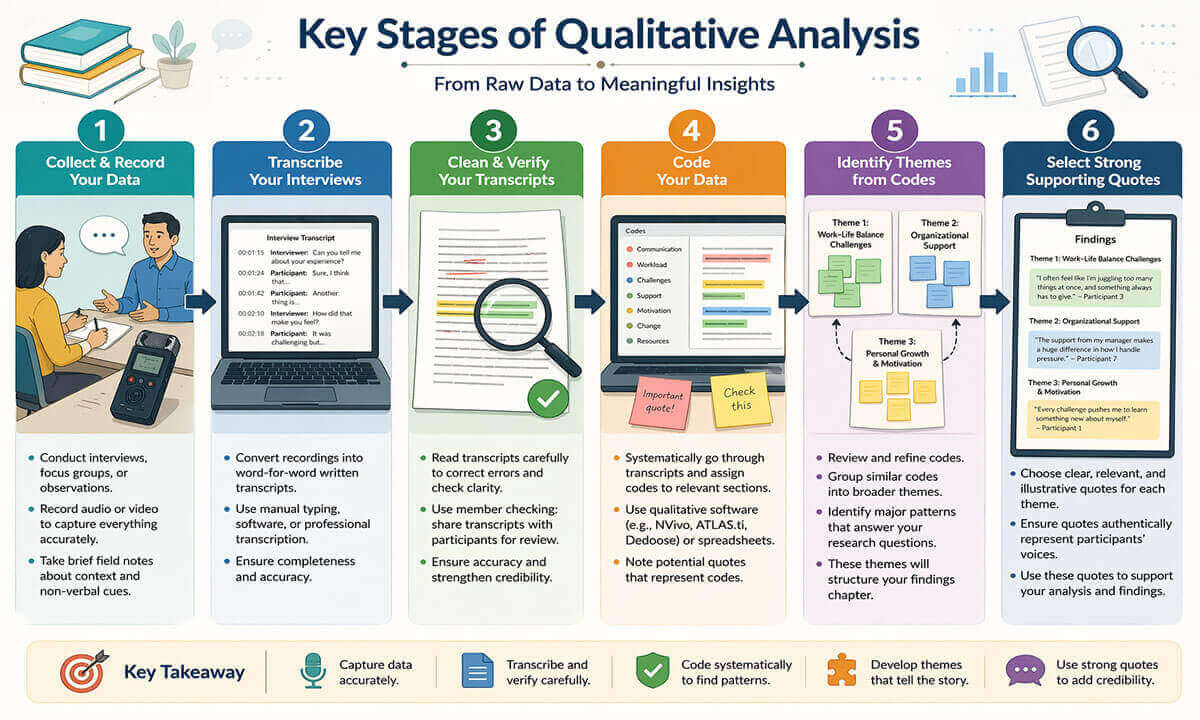
Qualitative research is widely valued in the social sciences, education, and information studies for its ability to capture rich, contextual, and nuanced human experiences. Unlike quantitative methods, which focus on numerical data and statistical relationships, qualitative analysis seeks to interpret meanings, perspectives, and patterns embedded within textual or visual data (Creswell & Poth, 2018). However, for many students and early-career researchers, the journey from raw interview recordings to a coherent findings chapter can feel complex and overwhelming. The key to managing this complexity lies in understanding that qualitative analysis follows a structured, systematic process. By breaking it down into clear stages (data collection, transcription, verification, coding, theme development, and the selection of supporting evidence), researchers can transform unstructured data into meaningful insights. In the rest of this article, we will explore the key stages of qualitative analysis.
Stage 1: Collecting and Recording Data:
The first stage of qualitative analysis begins with data collection, most commonly through interviews, focus groups, or observations. Among these, interviews are widely regarded as the primary method because they allow researchers to explore participants’ lived experiences, beliefs, and perspectives in depth. Unlike structured quantitative tools, qualitative interviews are often flexible (particularly in semi-structured or unstructured formats) enabling participants to express themselves freely and contribute meaningfully to the research process (Neupane et al., 2026).
A central aspect of this stage is the accurate recording of data. Audio or video recording is strongly recommended because qualitative research typically generates large volumes of detailed and nuanced information that cannot be fully captured through memory or brief notes. Recordings ensure that the researcher preserves participants’ exact words, tone, and emotional expressions, all of which are crucial for interpretation (Sutton & Austin, 2015).
Furthermore, recording allows researchers to remain fully engaged during the interview, fostering better communication and deeper probing of responses. In addition to recordings, researchers often maintain field notes to capture contextual elements such as body language or environmental factors that may not be evident in audio data alone. Together, these practices enhance the richness and completeness of qualitative data, forming a strong foundation for subsequent analysis.
Stage 2: Transcribing the Data:
After data collection, the next essential step is transcription, the process of converting recorded audio or video into written text. This stage is essential because qualitative analysis is primarily conducted on textual data rather than raw recordings. Verbatim transcription, where every spoken word is documented, is considered best practice as it preserves the authenticity and integrity of participants’ responses (Sutton & Austin, 2015).
Transcription plays a dual role in qualitative research. First, it transforms complex, unstructured audio data into a format that is easier to organize, search, and analyze. Researchers can annotate transcripts, highlight key passages, and systematically examine patterns across different participants. Second, the process of transcribing itself immerses the researcher in the data, fostering familiarity and early analytical insight.
However, transcription is often time-intensive. For instance, a single 45-minute interview may take several hours to transcribe and can produce dozens of pages of text (Sutton & Austin, 2015). Despite this challenge, the benefits of having a clear, accessible dataset far outweigh the effort involved. Accurate transcription ensures that no important detail is overlooked and enables rigorous, transparent analysis in later stages.
Stage 3: Cleaning and Verifying Transcripts:
Once transcripts are prepared, they must be carefully reviewed and refined before formal analysis begins. This stage involves cleaning the data by correcting transcription errors, clarifying ambiguous phrases, and ensuring consistency in formatting. Errors may arise from automated transcription tools or human oversight, making this verification step essential for maintaining data quality.
A key component of this stage is participant validation, often referred to as member checking. This process involves sharing transcripts with participants and asking them to confirm whether the content accurately reflects their views. Participants may suggest corrections, clarify meanings, or expand on their responses. This not only improves accuracy but also enhances the credibility and trustworthiness of the research (Neupane et al., 2026).
Additionally, reviewing transcripts allows researchers to begin familiarizing themselves with the data in a deeper way. Reading through the text multiple times helps identify initial impressions, recurring ideas, and potential patterns. This early engagement with the data is crucial, as qualitative analysis is iterative and interpretive in nature.
Generally, cleaning and verifying transcripts serve as a quality control mechanism. By ensuring that the data is accurate, complete, and trustworthy, researchers lay a solid groundwork for coding and thematic analysis in the subsequent stages.
Stage 4: Coding the Data:
Coding is widely considered the central analytical step in qualitative research because it is through coding that raw textual data begins to take on structure and meaning. At this stage, researchers systematically examine transcripts and assign labels (known as codes) to specific segments of text that represent important ideas, concepts, or patterns. These codes act as building blocks for later interpretation and theory development.
Coding can be conducted in different ways. An inductive approach allows codes to emerge directly from the data without predefined categories, while a deductive approach uses existing theories or frameworks to guide the coding process. In practice, many researchers adopt a hybrid strategy, combining both approaches to ensure depth and relevance (Braun & Clarke, 2021).
To manage coding effectively, researchers often use qualitative data analysis software such as NVivo or ATLAS.ti, although spreadsheets or manual methods can also be used. The key requirement is consistency; similar pieces of data should be coded in similar ways to maintain analytical rigor. Coding is also iterative; as researchers progress, they may refine, merge, or redefine codes as new insights emerge. This iterative engagement with the data deepens understanding and helps reveal patterns across participants (Saldaña, 2021).
Importantly, coding is not merely a mechanical process. It requires interpretive judgment, critical thinking, and sensitivity to context. Researchers must constantly ask themselves what the data means and how different pieces relate to each other.
Stage 5: Developing Themes:
Once coding is complete, the next step is to organize these codes into broader patterns known as themes. Themes represent significant, recurring ideas that capture something important about the data in relation to the research question.
Theme development involves reviewing all codes and identifying relationships among them. Codes that share similar meanings or address related issues are grouped together to form overarching categories. For example, codes such as “stress from deadlines,” “lack of personal time,” and “overwork” may be combined into a theme like “Work-Life Balance Challenges.”
According to Braun and Clarke (2021), thematic analysis is not simply about grouping codes but about interpreting their broader significance. Researchers must evaluate which themes are meaningful, how they relate to each other, and how well they represent the dataset as a whole. This often involves multiple rounds of revision, where themes are refined, split, combined, or discarded.
Themes ultimately provide the structure for the findings chapter. Each theme typically becomes a section or subheading, under which the researcher presents relevant data and interpretation. Well-developed themes ensure that the analysis is coherent, focused, and directly aligned with the research objectives.
Stage 6: Selecting Supporting Quotes:
The final stage of qualitative analysis involves selecting strong supporting quotes from the data. These quotes serve as direct evidence for the themes identified and play a crucial role in demonstrating the credibility and authenticity of the research findings.
In qualitative research, it is not enough to simply state interpretations; researchers must show how those interpretations are grounded in participants’ actual words. Including verbatim quotes allows readers to see the connection between the data and the conclusions being drawn. This transparency enhances the trustworthiness of the study (Creswell & Poth, 2018).
Effective quotes should be clear, concise, and representative of the theme they support. Researchers should aim to select excerpts that vividly illustrate key points without overwhelming the reader with excessive detail. At the same time, it is important to maintain participants’ original meanings and avoid taking statements out of context.
Best practice suggests identifying and organizing supporting quotes during the coding and theme development stages rather than waiting until the writing phase. This ensures that evidence is readily available and aligned with each theme, making the writing process more efficient and coherent (Saldaña, 2021).
Additionally, researchers should ensure ethical considerations when presenting quotes, such as anonymizing participant identities and avoiding any potentially sensitive disclosures.
Key Takeaways:
- Recording interviews ensures accuracy and captures nuanced details.
- Transcription transforms audio data into a manageable, analyzable format.
- Cleaning and member checking enhance the validity of the data.
- Coding helps identify patterns and organize data systematically.
- Themes provide structure and meaning to the analysis.
- Supporting quotes strengthen credibility and illustrate findings.
In conclusion, qualitative data analysis is both an art and a science. While it requires interpretive thinking and sensitivity to context, it also follows a clear and systematic process that ensures rigor and credibility. By moving step-by-step (from data collection to theme development and evidence selection), researchers can transform raw interview data into meaningful, insightful findings. For students and novice researchers, understanding these stages reduces confusion and builds confidence. Rather than being overwhelmed by the volume and complexity of qualitative data, they can approach analysis as a structured journey. Eventually, mastering this process enables researchers to produce work that is not only methodologically sound but also rich in human insight and real-world relevance.
Frequently Asked Questions (FAQs):
What is qualitative data analysis in simple terms?
Qualitative data analysis is the process of examining non-numerical data (such as interview transcripts, observations, or open-ended responses) to understand meanings, experiences, and patterns. Instead of focusing on numbers, it aims to explore how people think, feel, and interpret their world.
Why is recording interviews important in qualitative research?
Recording interviews ensures that every detail is captured accurately, including words, tone, pauses, and emotions. It also allows the researcher to stay focused on the conversation rather than taking extensive notes and makes it easier to revisit the data later.
Is transcription always necessary?
In most cases yes, transcription converts audio or video recordings into written text, which is much easier to organize, read, and analyze. It also helps researchers work more efficiently and ensures that important details are not overlooked.
What is coding, and why does it matter?
Coding is the process of labeling parts of the data with meaningful tags or categories. It helps researchers organize large amounts of information and identify patterns. Without coding, it would be difficult to make sense of complex qualitative data.
What is the difference between codes and themes?
Codes are small labels assigned to specific pieces of data, while themes are broader ideas that group several related codes together. In simple terms, codes are the building blocks, and themes are the bigger picture.
How do researchers ensure the accuracy of their data?
Researchers ensure accuracy by carefully reviewing transcripts and sometimes asking participants to check and confirm what they said. This helps correct errors and ensures that the data truly reflects participants’ views.
What makes a good supporting quote?
A good supporting quote is clear, relevant, and directly connected to the theme being discussed. It should represent the participant’s voice authentically and help illustrate the researcher’s findings.
Can qualitative data analysis be subjective?
Yes, qualitative analysis involves interpretation, which means some level of subjectivity is inevitable. However, researchers maintain reliability by following systematic steps, being consistent, and clearly linking their interpretations to the data.
What tools are commonly used for qualitative analysis?
Researchers often use software like NVivo, ATLAS.ti, or MAXQDA to organize and analyze data. However, simpler tools like spreadsheets or even manual methods can also be effective, depending on the size of the project.
How long does qualitative data analysis take?
The time required depends on the amount of data and the depth of analysis. Transcribing interviews, coding data, and developing themes can take days, weeks, or even months. Following a structured process helps make the work more manageable.
References:
- Braun, V., & Clarke, V. (2021). Thematic analysis: A practical guide. Sage Publications.
- Creswell, J. W., & Poth, C. N. (2018). Qualitative inquiry and research design: Choosing among five approaches (4th ed.). Sage Publications.
- Neupane, B. P., Dahal, N. D., Dhakal, R. K., Hasan, M. K., Villarama, J. A., & Fabros, B. G. (2026). Data collection methods in qualitative research: Researchers’ reflections. Frontiers in Research Metrics and Analytics, 11. https://doi.org/10.3389/frma.2026.1778160
- Saldaña, J. (2021). The coding manual for qualitative researchers (4th ed.). Sage Publications.
- Sutton, J., & Austin, Z. (2015). Qualitative research: Data collection, analysis, and management. Canadian Journal of Hospital Pharmacy, 68(3), 226–231. https://doi.org/10.4212/cjhp.v68i3.1456

is an experienced educator and academic currently serving as a Lecturer at Nurul Amin Degree College. With a career dedicated to student development and institutional excellence, he brings a wealth of classroom expertise and pedagogical knowledge to his current role. Before joining the faculty, he served as an Assistant Teacher at Zinzira PM Pilot School and College.