Book Reservation Systems in the Library:
Libraries have always been essential institutions for knowledge sharing, learning, and research. However, with increasing demand for limited resources, especially popular books, managing fair and efficient access has become a challenge. This is where book reservation systems play a crucial role. A book reservation system is a structured method that allows library users to place holds on books that are currently unavailable, ensuring they receive the materials once they are returned. In modern libraries (particularly academic and public libraries), these systems are often automated and integrated into digital library management software. They not only improve user satisfaction but also enhance the overall efficiency of library operations. In the rest of this article, we will explore book reservation systems in the library.
Concept of Book Reservation Systems:
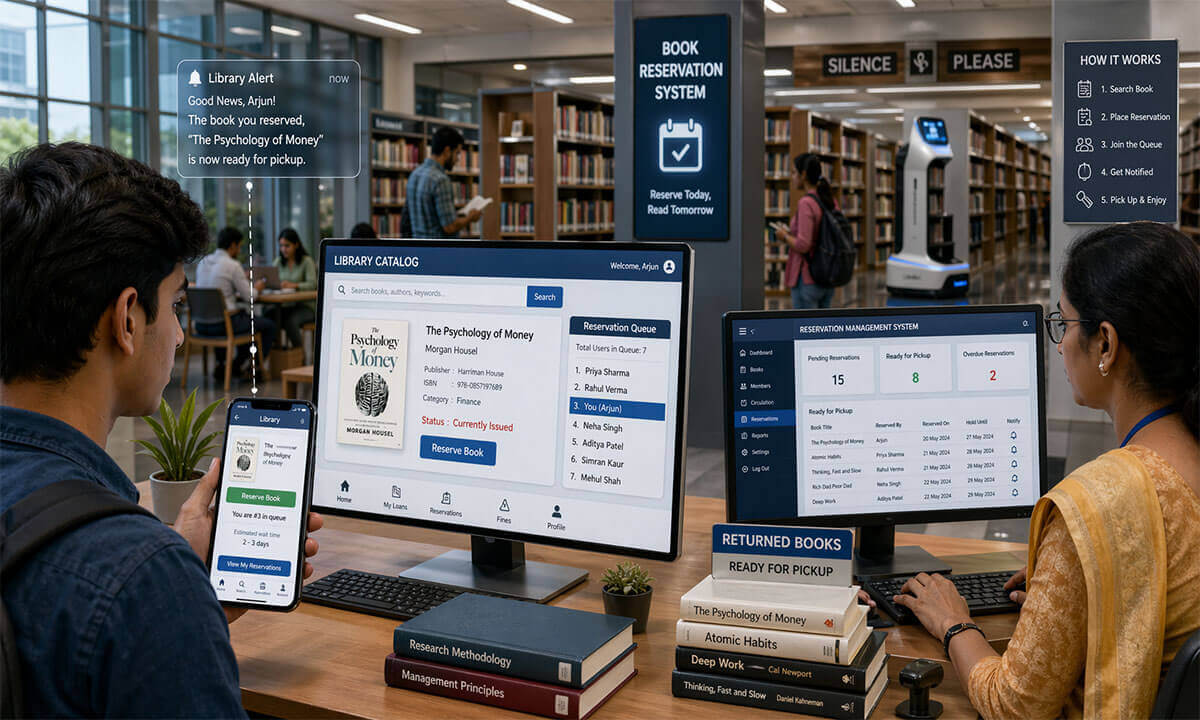
A book reservation system is designed to manage the demand for library materials that are already issued to other users. Instead of requiring patrons to repeatedly check availability, the system allows them to “reserve” a book in advance. Once the book is returned, it is automatically assigned to the next user in the queue.
Traditionally, reservations were handled manually through card catalogs or written registers. Today, most libraries use computerized systems that are part of an integrated library management system (ILMS), allowing real-time tracking of availability, due dates, and reservation queues.
How Book Reservation Systems Work:
The working mechanism of a book reservation system is relatively straightforward but highly effective:
1. Searching and Identifying the Book: The process begins when a user searches for a specific book using the library’s catalog system. In modern libraries, this is usually done through an Online Public Access Catalogue (OPAC) or a digital library portal. The system displays key information such as availability status, location, and due date if the book is already issued.
If the book is available on the shelf, the user can directly borrow it. However, if it is currently checked out by another reader, the system provides an option to place a reservation or “hold request.”
2. Placing a Reservation Request: When the user selects the reservation option, they are required to log into their library account. After confirmation, the system records the request and associates it with the user’s profile.
At this stage, the system checks important conditions such as:
- Whether the user has any overdue books or fines
- Whether the user has reached the maximum number of allowed reservations
- Whether the item is eligible for reservation (some libraries restrict reference-only materials)
Once validated, the reservation is officially registered in the system.
3. Queue Formation and Priority Management: After a reservation is placed, the system adds the user to a waiting list or queue for that specific book. This queue is typically arranged on a first-come, first-served basis.
However, many libraries also apply priority rules depending on institutional policies. For example:
- Faculty members may receive higher priority than students
- Research scholars may be prioritized for academic materials
- Some systems may allow emergency or special reservations for specific cases
The system continuously updates the queue as new requests are added or existing ones are fulfilled.
4. Monitoring Book Status: While the book is issued to another user, the reservation system continuously tracks its status. It monitors:
- Due date of the book
- Renewal requests (if any)
- Overdue alerts
In advanced systems, users can also view their position in the reservation queue through their online accounts, giving them a clear idea of how long they may need to wait.
5. Return and Automatic Allocation: Once the current borrower returns the book, the system immediately updates its status to “available for reservation.” At this point, the reservation engine automatically assigns the book to the next user in the queue.
This automation eliminates manual intervention and ensures that the process is fast and error-free. The library staff is usually notified as well, so they can prepare the book for the next borrower.
6. Notification to the Reserved User: After allocation, the system sends an automatic notification to the user at the top of the queue. Notifications are typically delivered through:
- SMS alerts
- Mobile app notifications
- Library portal messages
The notification informs the user that the reserved book is ready for pickup and specifies a time limit within which they must collect it.
7. Pickup and Expiry of Reservation: The reserved user must visit the library and collect the book within the given holding period, which may range from 24 hours to several days depending on library policy.
If the user fails to collect the book within this timeframe, the reservation is either:
- Automatically canceled, or
- Passed on to the next user in the queue
This ensures that books circulate efficiently and are not held unnecessarily.
8. System Updates and Record Maintenance: Finally, once the book is issued to the reserved user, the system updates all records, including:
- Borrowing history
- Reservation logs
- Queue status
These records help libraries analyze usage patterns, manage demand, and improve future resource planning.
Key Features of Modern Reservation Systems:
Modern library reservation systems are more advanced and user-friendly compared to traditional methods. Some of their key features include:
1. Online and Remote Accessibility: One of the most important features of modern reservation systems is remote access. Users no longer need to physically visit the library to check availability or place holds. Instead, they can log into an online catalog system from anywhere using a computer or smartphone.
Through these platforms, users can:
- Search for books in real time
- Check availability status instantly
- Place reservation requests remotely
- Monitor the status of their requests
This feature is especially valuable for academic institutions where students and researchers may be off-campus or engaged in fieldwork.
2. Real-Time Book Availability Updates: Modern systems are connected directly to the library database, allowing real-time updates of book status. As soon as a book is issued, returned, or renewed, the system reflects the change immediately.
This real-time synchronization helps users avoid confusion and ensures that:
- Availability information is always accurate
- Duplicate reservations are minimized
- Users can make informed decisions quickly
It also reduces the workload of library staff who previously had to manually update records.
3. Automated Queue and Priority Management: Another key feature is automated queue handling. When multiple users reserve the same book, the system automatically creates a waiting list based on predefined rules.
These rules may include:
- First-come, first-served ordering
- Priority for faculty, researchers, or premium members
- Special institutional policies (e.g., course-related priority)
The system manages this queue without manual intervention, ensuring fairness and consistency in book allocation.
4. Instant Notifications and Alerts: Modern reservation systems use automated communication tools to keep users informed. Once a reserved book becomes available, the system sends instant notifications through multiple channels such as:
- Email alerts
- SMS messages
- Mobile app notifications
- Dashboard alerts within the library portal
These notifications reduce the chances of missed pickups and improve overall efficiency in book circulation.
5. User Account Management and Self-Service Options: Each user typically has a personal library account where they can manage all their activities. This self-service feature allows users to:
- View current loans and due dates
- Track reservation status and queue position
- Cancel or modify reservation requests
- Renew borrowed books (if allowed)
This reduces dependency on library staff and empowers users to manage their own library interactions.
6. Integration with Library Management Systems: Modern reservation systems are not standalone tools; they are fully integrated into broader library management platforms. This integration allows seamless coordination between different functions such as:
- Cataloging
- Circulation (borrowing and returning)
- Inventory management
- User authentication
Because of this integration, any change in one module automatically reflects across the entire system, maintaining consistency and accuracy.
7. Reservation Limits and Policy Control: Libraries often set specific rules regarding reservations, and modern systems are designed to enforce these automatically. Common controls include:
- Maximum number of active reservations per user
- Restrictions on rare or reference-only materials
- Penalties for repeated no-shows or late pickups
These policies help maintain balance in resource distribution and prevent misuse of the reservation system.
8. Mobile-Friendly Interfaces and Apps: With increasing smartphone usage, many library systems now offer mobile applications or responsive web designs. These mobile-friendly platforms allow users to:
- Search and reserve books on the go
- Receive push notifications instantly
- Scan QR codes for quick access to book details
- Manage accounts without visiting a desktop system
This enhances convenience and aligns library services with modern digital habits.
9. Data Tracking and Usage Analytics: Modern reservation systems also collect and analyze usage data. Libraries can generate reports on:
- Most frequently reserved books
- Peak usage times
- Average waiting periods
- User demand patterns
This data is valuable for decision-making, such as purchasing new books, removing outdated materials, or improving resource allocation strategies.
Benefits of Book Reservation Systems:
The benefits extend to both library users and library staff, making the entire system more efficient and reliable.
1. Improved Access to High-Demand Materials: One of the most imperative benefits of a book reservation system is that it ensures fair access to popular or frequently used books. In many libraries, certain titles (such as textbooks, research materials, or exam guides) are in high demand and often unavailable.
With a reservation system in place:
- Users can secure their place in line for a book
- They do not need to repeatedly check availability
- Access becomes more predictable and organized
This is especially valuable in academic libraries where multiple students may need the same resource for assignments or research.
2. Fair and Transparent Allocation of Resources: Reservation systems promote fairness by ensuring that books are distributed based on a clear and consistent rule, usually a first-come, first-served basis. This removes favoritism and manual bias from the process.
Key advantages include:
- Equal opportunity for all users
- Transparent queue system visible to users
- Reduced conflicts over book access
Because the process is automated, users can trust that the system is impartial.
3. Time Efficiency for Users and Staff: Book reservation systems save a significant amount of time for both library users and librarians. Without a reservation system, users often have to physically visit the library multiple times to check if a book is available.
With automation:
- Users can reserve books online in seconds
- Librarians do not need to manually manage waiting lists
- Book circulation becomes faster and more organized
This efficiency allows library staff to focus on more important tasks such as cataloging and user support.
4. Better Utilization of Library Resources: Libraries aim to maximize the use of their collections, and reservation systems help achieve this goal. Instead of books sitting idle or being underutilized, they circulate more frequently among users.
This leads to:
- Higher circulation rates of available books
- Reduced idle time for high-demand materials
- Improved return on investment for library collections
As a result, libraries can ensure that their resources are being used to their full potential.
5. Enhanced User Convenience and Satisfaction: Modern users expect convenience and speed, and reservation systems directly address these expectations. Users can manage their reading needs without unnecessary delays or physical effort.
Benefits for users include:
- Ability to reserve books from home or anywhere
- Instant updates on availability
- Reduced waiting uncertainty
- Easier planning for study and research activities
This improved convenience leads to higher user satisfaction and greater engagement with library services.
6. Reduced Physical Congestion in Libraries: In traditional systems, users often visit libraries frequently just to check availability, which can lead to crowding at circulation desks. Reservation systems reduce this unnecessary foot traffic.
As a result:
- Libraries become less crowded
- Staff can serve users more efficiently
- Physical space is used more effectively
This is particularly important in large academic institutions with heavy daily usage.
7. Improved Inventory and Resource Management: Book reservation systems also help librarians manage collections more effectively. By tracking reservation patterns, libraries gain insights into which books are in high demand.
This supports:
- Smarter book purchasing decisions
- Better collection development strategies
- Identification of outdated or underused materials
Over time, this leads to a more relevant and updated library collection.
8. Support for Academic and Research Activities: In academic environments, timely access to books is critical for research and learning. Reservation systems ensure that students, researchers, and faculty members can plan their work more effectively.
This is beneficial because:
- Research deadlines can be met more easily
- Course materials are accessible when needed
- Academic productivity is improved
It creates a more supportive environment for education and knowledge development.
Challenges and Limitations of Book Reservation Systems:
Although book reservation systems have greatly improved library services, they are not without problems. Like any technology-driven system, they come with operational, technical, and user-related challenges that can affect their overall efficiency. Understanding these limitations is important for improving system design and ensuring smoother library operations.
1. Technical Issues and System Failures: One of the most common challenges is technical malfunction. Since modern reservation systems depend heavily on software and internet connectivity, any system failure can disrupt the entire process.
Typical issues include:
- Server downtime or crashes
- Slow system response during peak hours
- Software bugs causing incorrect reservation status
- Database synchronization errors
When such problems occur, users may experience delays, confusion, or even loss of reservation records, which reduces trust in the system.
2. Dependence on Internet and Digital Infrastructure: Book reservation systems rely on stable internet access and digital devices. In regions or institutions where digital infrastructure is weak, this becomes a major limitation.
This leads to:
- Difficulty for users with limited internet access
- Inequality between tech-savvy and non-tech users
- Reduced usability in rural or underdeveloped areas
- Dependency on institutional IT support
As a result, not all users benefit equally from the system.
3. Delays Due to Late Returns: The efficiency of a reservation system depends on users returning books on time. However, when borrowers fail to return books promptly, the entire reservation queue is affected.
This causes:
- Longer waiting periods for other users
- Disruption of scheduled reservations
- Reduced availability of high-demand books
Even though libraries impose fines or penalties, late returns still remain a persistent issue.
4. High Demand and Long Waiting Lists: Popular books, especially academic textbooks or exam-related materials, often have very long reservation queues. In such cases, even an automated system cannot eliminate waiting time.
Challenges include:
- Users waiting for extended periods
- Frustration among students during exam seasons
- Unequal access when demand exceeds supply
This limitation highlights the shortage of multiple copies for high-demand titles.
5. User Errors and Misunderstanding of the System: Not all users are familiar with digital systems. Some may accidentally cancel reservations, misunderstand queue positions, or fail to collect books on time.
Common user-related issues include:
- Incorrect reservation requests
- Ignoring notification messages
- Not checking system updates regularly
- Difficulty navigating online interfaces
These errors can reduce the effectiveness of the system and lead to missed opportunities.
6. Limited Flexibility in Reservation Policies: Most reservation systems follow strict rules, such as fixed queue order and limited holding time. While this ensures fairness, it can also reduce flexibility.
For example:
- Users cannot easily extend reservation periods
- Priority rules may not satisfy all users
- Restrictions on number of reservations can feel limiting
These rigid policies may sometimes inconvenience genuine users.
7. Digital Divide and Accessibility Issues: Not all users have equal access to digital tools or the skills required to use them effectively. This creates a gap between different user groups.
This issue is especially relevant for:
- Elderly users who are less familiar with technology
- First-time library users
- Users without smartphones or computers
As a result, some users may still depend on manual assistance, reducing the efficiency gains of automation.
8. Security and Privacy Concerns: Since reservation systems store personal data and usage history, they are also vulnerable to security risks.
Potential concerns include:
- Unauthorized access to user accounts
- Data breaches or leaks
- Misuse of borrowing history information
Libraries must invest in strong cybersecurity measures to protect user data.
Role of Book Reservation Systems in Modern Library Management:
1. Supporting Automated Library Operations: Modern library management relies heavily on automation to reduce manual workload and improve accuracy. Book reservation systems are a key component of this automation process.
They help libraries to:
- Automatically manage hold requests without manual intervention
- Update book status in real time
- Reduce paperwork and administrative tasks
- Streamline circulation workflows
This automation allows library staff to focus more on user support, research assistance, and collection development rather than routine tracking tasks.
2. Enhancing Resource Allocation Efficiency: Efficient resource management is a core goal of library administration. Reservation systems ensure that books are allocated based on actual demand rather than random access.
In practical terms, this means:
- High-demand books are circulated fairly among users
- Idle time of books is minimized
- Library collections are used more productively
- Demand trends can be identified and addressed
This leads to a more balanced and efficient use of limited library resources.
3. Improving User-Centered Service Delivery: Modern libraries aim to provide services that are centered around user needs. Book reservation systems contribute significantly to this goal by offering personalized and flexible access to materials.
They enable:
- Personalized reservation queues for users
- Convenient remote access to services
- Transparent tracking of book availability
- Reduced waiting uncertainty for users
As a result, users experience a more organized and predictable library service.
4. Integration with Digital Library Systems: Book reservation systems are not isolated tools; they are integrated into broader Library Management Systems (LMS) and digital library platforms.
This integration allows:
- Seamless coordination between cataloging, circulation, and reservation modules
- Real-time synchronization of data across departments
- Unified user accounts for multiple library services
- Efficient management of physical and digital resources
Such integration is essential for creating a fully connected and intelligent library ecosystem.
5. Data-Driven Decision Making: Another important role of reservation systems in modern library management is their contribution to data collection and analysis. Every reservation, cancellation, and borrowing action generates valuable data.
Libraries use this data to:
- Identify most in-demand books and subjects
- Understand user behavior and reading patterns
- Improve collection development strategies
- Plan future acquisitions and budget allocation
This data-driven approach makes library management more strategic and evidence-based.
6. Strengthening Academic and Research Support: In academic libraries, book reservation systems are essential for supporting teaching, learning, and research activities. They ensure that critical academic resources are accessible when needed.
This role includes:
- Prioritizing access to textbooks and research materials
- Supporting timely completion of assignments and projects
- Assisting faculty and researchers with resource planning
- Reducing delays in academic workflows
By ensuring timely access to knowledge resources, reservation systems directly contribute to academic success.
7. Bridging Physical and Digital Library Services: Modern libraries operate in a hybrid environment where physical books and digital resources coexist. Reservation systems help bridge this gap by linking physical circulation with digital access platforms.
This allows:
- Unified search across print and electronic resources
- Integrated user experience across platforms
- Easy transition between digital catalogs and physical borrowing
- Better coordination of library services
This hybrid integration reflects the future direction of modern libraries.
In conclusion, book reservation systems have transformed the way libraries operate by introducing structure, fairness, and efficiency into the borrowing process. They eliminate many of the limitations of manual systems and enhance user satisfaction through automation and convenience. Although challenges such as technical issues and high demand still exist, continuous improvements in library technology are addressing these concerns. Ultimately, book reservation systems represent an essential step toward modern, smart libraries that are responsive to the needs of today’s information-driven society.
Frequently Asked Questions (FAQs):
What is a book reservation system in a library?
A book reservation system is a facility that allows library users to place a hold on books that are currently issued to someone else. Once the book is returned, it is allocated to the next user in the reservation queue.
How does a book reservation system work?
It works through a simple process: users search for a book, place a reservation if it is unavailable, join a waiting queue, and receive a notification when the book is ready for pickup after return by the previous borrower.
Can I reserve books online in modern libraries?
Yes, most modern libraries provide online reservation services through their library websites, mobile apps, or Integrated Library Management Systems (ILMS), allowing users to reserve books remotely.
Is there a limit on how many books I can reserve?
Yes, many libraries set a limit on the number of active reservations per user. This policy helps ensure fair access to resources for all members.
How will I know when my reserved book is available?
Libraries usually notify users through email, SMS, mobile app alerts, or notifications in their library account dashboard when a reserved book becomes available.
What happens if I do not collect a reserved book on time?
If you fail to collect the book within the given time period, the reservation is usually canceled or passed to the next person in the queue, depending on library policy.
Can I cancel a book reservation after placing it?
Yes, in most modern systems, users can cancel their reservation anytime before the book is allocated to them through their online library account.
Why do I still have to wait even after reserving a book?
Waiting occurs because other users may already be ahead of you in the queue. Reservation systems follow a first-come, first-served policy to ensure fairness.
Do all books in the library support reservation?
No, some materials such as reference books, rare collections, or special items may not be available for reservation and can only be used within the library.
What are the main benefits of using a book reservation system?
The main benefits include fair access to books, reduced waiting confusion, improved efficiency, time savings, and better organization of library resources.

is an experienced educator and academic currently serving as a Lecturer at Nurul Amin Degree College. With a career dedicated to student development and institutional excellence, he brings a wealth of classroom expertise and pedagogical knowledge to his current role. Before joining the faculty, he served as an Assistant Teacher at Zinzira PM Pilot School and College.