How Cognitive Science Can Enhance Language Learning:
Have you ever wondered why some people seem to learn a new language quickly while others struggle to remember basic words and phrases? The difference is not always natural ability, intelligence, or the amount of time spent studying. The way people learn, remember, practice, and use a language also plays an important role.
Learning a new language involves much more than memorizing vocabulary and studying grammar rules. It requires the brain to recognize sounds, understand meaning, remember information, build sentences, and communicate with other people. These processes are closely connected to cognitive science, which explores how the human mind learns, thinks, remembers, and solves problems.
Cognitive science offers useful insights into how language learning works. It helps learners understand why some study methods are more effective than others and how to make better use of their time. For example, reviewing vocabulary at regular intervals, practicing active recall, getting enough sleep, and using a new language in real conversations can support learning and memory.
This article explains how cognitive science can enhance language learning, explores the main principles behind effective learning, and provides practical strategies that students, teachers, and independent learners can use to improve their language skills.
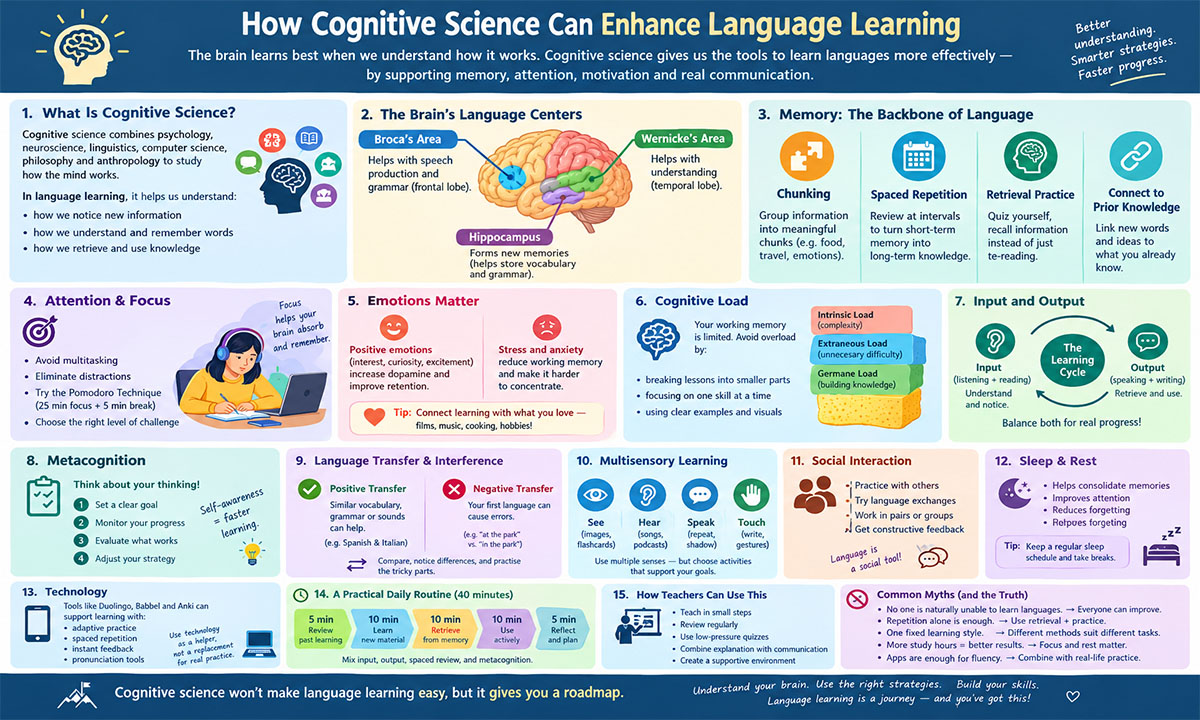
1. Understanding Cognitive Science and Language Learning:
Cognitive science is an interdisciplinary field that studies the processes involved in human thinking and learning. It brings together several areas, including psychology, neuroscience, linguistics, computer science, philosophy, and anthropology.
In language learning, cognitive science examines how people notice new information, understand words, recognize grammatical patterns, store knowledge in memory, and retrieve that knowledge when communicating.
For example, when a learner hears a new English word, several mental processes may take place. The learner recognizes the sound, connects it with a meaning, relates it to existing knowledge, and attempts to remember it for future use. Repeated encounters with the word can make recognition and recall easier.
Understanding these processes can help learners move away from ineffective study habits. Instead of reading vocabulary lists repeatedly, they can practise recalling words, use them in sentences, and review them over time.
Cognitive science does not provide one universal method that works equally well for everyone. However, research on memory, attention, motivation, and learning provides a strong foundation for choosing effective learning strategies.
2. How the Brain Processes Language:
The human brain uses several interconnected networks to understand and produce language. Some brain regions have received particular attention in language research, although language processing does not depend on isolated areas working independently.
2.1 Broca’s area and speech production: Broca’s area, located in the left frontal region of the brain in most people, is associated with speech production, grammatical processing, and aspects of language planning.
When learners try to form sentences in a new language, they must select words, organize them according to grammatical rules, and prepare the movements needed for speech. These processes become more efficient with experience and practice.
For example, a beginner might need considerable time to construct the sentence, “I went to the market yesterday.” With repeated use, the learner may eventually produce similar sentences more naturally.
Speaking practice is therefore important because it allows learners to practise retrieving vocabulary and organizing sentences in real time.
2.2 Wernicke’s area and language comprehension: Wernicke’s area is traditionally associated with language comprehension and is located in the left temporal region. Modern neuroscience shows that understanding language involves a broader network of brain regions rather than one single comprehension center.
When learners listen to a conversation, they must identify speech sounds, recognize words, understand sentence structure, and connect the message with its context.
Listening to short conversations, reading accessible texts, and discussing familiar subjects can help learners develop these skills.
2.3 The hippocampus and memory: The hippocampus plays an important role in forming and consolidating new memories. It helps learners establish memories of new words, expressions, and experiences.
However, long-term language knowledge depends on wider brain networks. Vocabulary and grammatical patterns become easier to use when learners encounter them repeatedly and retrieve them in different situations.
For example, learning the word “generous” from a vocabulary list is a useful beginning. Encountering it in a story, using it in a conversation, and recalling it several days later can create stronger and more flexible knowledge.
The essential lesson is that language learning involves connected mental processes. Effective practice should therefore combine understanding, memory, and actual language use.
3. The Role of Memory in Language Learning:
Memory is one of the most significant parts of language learning. Learners need to remember vocabulary, pronunciation, grammatical structures, expressions, and information about how words are used.
Cognitive science identifies several practical ways to make learning more effective.
3.1 Chunking information: Chunking means organizing separate pieces of information into meaningful groups. It reduces the effort needed to process information and helps learners recognize useful patterns.
For example, memorizing the individual words “make,” “a,” “decision” may be less useful than learning the complete expression “make a decision.”
Similarly, learners can organize vocabulary into categories such as food, travel, education, health, and emotions.
Learning common phrases and word combinations is particularly helpful because language is often used in meaningful groups rather than as isolated words.
Instead of memorizing only the verb “look,” learners might practice expressions such as “look after,” “look for,” and “look forward to.” They should also study an example sentence for each expression to understand how it works.
Practical strategy: Create small vocabulary groups and include example sentences. Review the groups regularly, but practice using the words in different contexts rather than memorizing lists alone.
3.2 Spaced repetition: Spaced repetition involves reviewing information across several learning sessions instead of studying everything in one sitting.
Suppose a student learns 15 new words on Monday. Reviewing them several times immediately may produce a feeling of familiarity, but that does not guarantee that the student will remember them next week.
A better approach is to review the words after a period of time, test recall again later, and revisit difficult items more frequently.
A simple schedule might include reviewing new words on the day they are learned, the following day, several days later, and again after one or two weeks. The exact schedule can vary according to the difficulty of the material and how well the learner remembers it.
Spaced practice helps strengthen long-term retention and reduces the need to relearn forgotten information.
Flashcard applications such as Anki and other vocabulary tools can help organize these reviews. However, paper flashcards and a simple notebook can work well too.
3.3 Retrieval practice: Retrieval practice means actively bringing information to mind without immediately looking at the answer.
Many learners spend hours rereading textbooks or highlighting vocabulary. These activities can support understanding, but they may create a false sense of confidence because the information remains visible.
Retrieval practice requires learners to produce the information themselves.
For example, after studying ten new words, close the book and try to write their meanings. Listen to a familiar sentence and repeat it without reading the transcript. Read a short passage and explain its main idea from memory.
Language learners can also practice recalling grammatical structures by creating their own sentences instead of copying examples.
The process may feel difficult, but that effort can improve later recall when the practice is successful and followed by feedback.
3.4 Connecting new information with existing knowledge: New information is often easier to learn when it connects with something the learner already knows.
A learner who understands the word “help” may find it easier to learn “helpful,” “helpless,” and “helpfulness” by noticing how these words are related.
Likewise, learners can connect new expressions with familiar experiences, images, stories, or personal interests.
For example, someone who enjoys football can learn language related to matches, training, teamwork, and sports interviews. These familiar contexts give new vocabulary a meaningful place in memory.
The goal is not simply to collect more words. It is to build connections that make words easier to understand, remember, and use.
4. Attention and Focus (Why Multitasking Can Slow Learning):
Attention determines which information receives enough mental processing to be learned. When learners study a new language while checking social media, watching unrelated videos, and responding to messages, their attention repeatedly shifts between activities.
These interruptions can make it harder to understand difficult material and remember it later.
Language learning often requires learners to notice small differences. For example, the English words “ship” and “sheep” differ mainly in vowel sounds. Recognizing that difference requires careful listening, especially for beginners.
Focused practice gives learners more opportunities to notice such details.
How to improve concentration:
First, choose one clear learning goal for each session. Instead of trying to study every aspect of English at once, focus on one task, such as understanding a short conversation or practicing the past tense.
Second, reduce unnecessary distractions. Put your phone away or silence notifications when possible.
Third, divide longer sessions into manageable periods. The Pomodoro Technique, for example, commonly uses 25 minutes of focused work followed by a five-minute break. This is one possible structure, not a scientifically established requirement for every learner.
Finally, choose material that is challenging enough to encourage learning without making comprehension impossible.
Focused study does not necessarily mean studying for many hours. A shorter session with a clear purpose can be more useful than a longer session filled with distractions.
5. How Emotions Influence Language Learning:
Language learning involves emotional experiences as well as mental processes. Learners may feel excited when they understand a conversation, embarrassed when they make mistakes, or frustrated when they cannot remember a word.
These feelings can influence attention, motivation, and willingness to practice.
5.1 Positive emotions and motivation: Interest and curiosity can encourage learners to explore a language and spend more time using it. Enjoyable activities can also make practice easier to maintain over time.
For example, a learner who enjoys music may study song lyrics, listen for familiar expressions, and investigate unfamiliar vocabulary. Someone interested in films may watch short scenes and practice repeating the dialogue.
The activity provides language exposure while giving the learner a personal reason to continue.
However, positive emotions do not automatically guarantee better learning. Enjoyment works best when the activity also requires meaningful attention and practice.
5.2 Stress and language anxiety: Anxiety can make language learning more difficult, particularly when learners must speak in front of others or answer questions under pressure.
A student may know the correct word but struggle to recall it during an examination or conversation. Stress can interfere with attention and working memory, making it harder to use knowledge effectively.
Teachers can help by creating supportive classrooms where mistakes are treated as a normal part of learning. They can allow students to practise in pairs before speaking to the whole class and provide constructive feedback without unnecessary embarrassment.
Learners can also begin with low-pressure activities, such as recording themselves, speaking with a trusted partner, or rehearsing a short conversation before using it in public.
The aim is not to eliminate every mistake or feeling of nervousness. It is to create conditions in which learners feel able to practice, receive feedback, and improve.
6. Cognitive Load (Avoid Overloading Working Memory):
Working memory is the mental system that temporarily holds and processes information while a person performs a task. It is limited, so trying to manage too many unfamiliar details at once can make learning difficult.
Imagine a beginner who is trying to understand a fast conversation, learn unfamiliar vocabulary, identify verb tenses, follow pronunciation, and translate every sentence into their first language. The combined demands may become overwhelming.
Cognitive load theory helps explain why organizing lessons and reducing unnecessary complexity can support learning.
6.1 Intrinsic, extraneous, and germane cognitive load: Cognitive load theory commonly distinguishes between three types of load.
Intrinsic cognitive load comes from the complexity of the material itself. A sentence containing several unfamiliar grammatical structures may be difficult because the learner must understand many connected elements.
Extraneous cognitive load comes from unnecessary difficulty in how information is presented. Confusing instructions, cluttered slides, and poorly organised explanations can consume attention without helping learners understand the language.
Germane cognitive load is a term traditionally used for the mental effort involved in building useful knowledge structures. Contemporary discussions of the theory often treat this concept as part of the broader management of working memory resources rather than as a separate independent load.
6.2 Ways to manage cognitive load: Learners can break difficult lessons into smaller parts, practice one main skill at a time, and use clear examples before attempting more complicated tasks.
Teachers can introduce new grammar through short explanations followed by guided practice. Visual aids can help when they clarify meaning, show relationships, or provide useful context.
For example, a beginner learning the present perfect may benefit from several clear examples and opportunities to compare them with the simple past. Introducing too many unrelated grammar rules in the same lesson may make the task harder.
The objective is not to remove all difficulty. Learning requires effort. The objective is to remove unnecessary complexity so that learners can focus on the most important information.
7. Balancing Language Input and Output:
Language development requires both exposure to language and opportunities to use it.
Input includes listening and reading. Output includes speaking and writing. Both contribute to learning, but they serve different purposes.
7.1 The importance of comprehensible input: Learners need to encounter language they can understand at least in part. Context, pictures, familiar vocabulary, gestures, and explanations can help make unfamiliar material understandable.
For example, an English learner can listen to a short news report designed for beginners before moving to faster and more complex material.
Reading graded readers, listening to accessible podcasts, and watching videos with suitable subtitles can provide repeated exposure to words and grammatical patterns.
The best materials are not necessarily the most advanced. They are materials that offer useful new information while allowing learners to understand enough to follow the message.
7.2 Why output matters: Speaking and writing require learners to retrieve words, construct sentences, and communicate meaning.
A learner may understand a grammatical structure while reading but struggle to use it during a conversation. Producing language reveals this gap between recognition and independent use.
Output can also help learners notice what they do not yet know. When they cannot express an idea, they may recognize the need to learn a particular word or structure.
For example, a learner who regularly listens to English conversations can improve further by summarizing them aloud, answering questions, or writing a short response.
7.3 How to combine input and output: A useful learning cycle is to listen to a short conversation, identify several useful expressions, repeat the sentences, and then use the expressions in a new conversation.
For reading, learners can read a short article, summarize the main points, and write their own opinion about the topic.
These activities connect comprehension with production and help learners practice using language for real purposes.
Speaking from the beginning can be helpful, but learners do not need to produce long or complicated sentences immediately. Short, manageable attempts are a sensible starting point.
8. Metacognition (Learning How to Learn):
Metacognition refers to thinking about and monitoring one’s own thinking and learning. It helps learners plan their study, check their understanding, identify difficulties, and adjust their strategies.
Without reflection, learners may repeat the same activities even when those activities are not helping them make progress.
8.1 Planning: Before studying, identify a specific goal. For example, instead of saying, “I will improve my English,” choose a measurable task such as learning to describe daily routines using the present simple tense.
A clear goal makes it easier to select suitable learning materials and assess progress.
8.2 Monitoring: During a learning session, check whether you can understand and use the material without looking at the answer.
If you can recognize a word when reading but cannot remember it during a conversation, you may need more retrieval practice and speaking activities.
If you understand written English but struggle with listening, use shorter audio recordings and repeat them with different levels of support.
8.3 Evaluating: After studying, consider what worked and what needs improvement.
Ask yourself the following questions:
- What did I learn today?
- Which words or structures can I remember without help?
- What mistakes did I make?
- Which activity helped me most?
- What should I practice next?
Keeping a simple learning journal can make these reflections easier.
Metacognition is not about finding one perfect learning style. Evidence does not support the idea that everyone learns best when teaching is matched to a fixed category such as visual, auditory, or kinaesthetic. Instead, learners should select methods that suit the task and use feedback to judge whether those methods are effective.
9. Language Transfer and Interference:
People do not learn a new language from a completely empty starting point. They already have knowledge of their first language, and that knowledge can influence how they understand and produce another language. This influence is known as language transfer.
9.1 Positive transfer: Positive transfer occurs when knowledge of one language helps a learner understand another.
Languages may share vocabulary, grammatical patterns, or similar sounds. Recognizing these similarities can make some aspects of learning easier.
For example, English and French share a number of words because of their historical relationship. Learners who recognize these connections may find some vocabulary easier to understand, although the words may differ in pronunciation or meaning.
9.2 Negative transfer: Negative transfer occurs when a pattern from the first language leads to an error in the new language.
For example, languages differ in word order, articles, prepositions, and verb forms. A learner may apply the rules of their first language when constructing a sentence in English.
Such errors are a normal part of language development. They can provide useful information about which patterns need more practice.
9.3 How cognitive science can help: Learners can compare the two languages, identify common differences, and practice difficult structures in meaningful contexts.
Teachers can use contrastive examples to explain why a sentence sounds natural in one language but not another.
Instead of simply correcting an error, a teacher can explain the underlying pattern and provide several opportunities to use the correct form.
This approach helps learners develop a clearer understanding of the new language rather than relying on direct translation for every sentence.
10. Multisensory Learning and Language Development:
Multisensory learning involves using more than one form of information or activity to support learning. Language study naturally offers opportunities to combine listening, reading, speaking, writing, images, and movement.
For example, a learner can look at a picture of a kitchen, listen to the names of common objects, repeat the words, and write a few sentences describing the scene.
This activity connects words with visual information, sound, and meaningful language use.
10.1 Visual learning activities: Pictures, diagrams, labeled images, and mind maps can help explain vocabulary and show relationships between ideas.
A mind map about travel might include transport, accommodation, directions, and useful questions. These categories provide an organized structure for learning related expressions.
10.2 Listening and speaking activities: Songs, dialogues, podcasts, and recorded conversations allow learners to hear pronunciation, rhythm, stress, and intonation.
Shadowing is one useful activity. Learners listen to a short recording and repeat the speech as closely as possible, paying attention to timing and pronunciation.
The activity should use material at a suitable level. Very fast or unfamiliar recordings may be frustrating for beginners.
10.3 Writing and movement: Writing words by hand can provide additional practice with spelling and letter formation. Gestures can also help communicate meaning, particularly when learners are practicing action verbs or giving directions.
However, using more senses does not automatically improve memory. Activities should be selected because they help learners understand, retrieve, or use the target language. Adding unnecessary images, sounds, and decorations may distract rather than help.
11. Social Interaction and Collaborative Learning:
Language is a tool for communication, so social interaction plays an important role in learning.
Conversations require learners to understand other people, respond appropriately, clarify meaning, and adjust their language according to the situation.
These experiences provide opportunities to practice skills that cannot be fully developed through memorization alone.
11.1 Language exchange and conversation practice: Learners can practice with classmates, teachers, conversation partners, or speakers of the target language.
A beginner might start with a simple exchange about family, hobbies, food, or daily routines. As confidence develops, the conversations can become longer and more complex.
11.2 Collaborative tasks: Pair work and group activities can provide opportunities for learners to share knowledge and receive feedback.
For example, students can work together to plan a journey in English. They must discuss destinations, compare prices, ask questions, and agree on a final plan.
The activity requires them to use vocabulary and grammar for a meaningful purpose.
11.3 Feedback and correction: Feedback helps learners identify errors and discover more appropriate ways to express their ideas.
Effective feedback is clear, specific, and suitable for the learner’s level. Correcting every mistake during every conversation can interrupt communication and reduce confidence.
Teachers can focus on errors that affect meaning or relate to the lesson’s main objective. They can also encourage learners to notice and correct some of their own mistakes.
Social interaction is especially valuable when learners receive enough support to participate actively rather than simply listen to more advanced speakers.
12. Sleep, Rest, and Memory Consolidation:
Sleep is an important part of learning because the brain continues processing and consolidating memories after a study session.
Memory consolidation helps stabilize newly learned information and integrate it with existing knowledge. Sleep supports this process, although the exact effects depend on the type of information and the learning conditions.
A student who studies vocabulary late at night and then sleeps adequately may be better prepared to remember the words than a student who repeatedly sacrifices sleep to continue studying.
Insufficient sleep can affect attention, working memory, and the ability to retrieve information. It may therefore reduce the quality of later study sessions.
Practical ways to support learning through sleep:
Try to maintain a regular sleep schedule and avoid making late-night cramming a routine.
Review important vocabulary during the day, then return to it after sleeping. This provides another opportunity to retrieve and strengthen the information.
Take short breaks when concentration begins to decline. Breaks can help learners return to a task with better attention, although their ideal length depends on the person and the activity.
Sleep is not a replacement for practice. It supports the learning process, while repeated meaningful use helps build language knowledge.
13. How Technology Can Support Cognitive Science-Based Learning:
Digital tools can make language learning more accessible by providing practice, feedback, recordings, and ways to track progress.
Applications such as Duolingo, Babbel, and Anki offer different features, and their usefulness depends on how learners use them.
13.1 Adaptive practice and spaced repetition: Some learning tools adjust review schedules according to learners’ previous responses. This can help them spend more time on difficult words and less time on material they already remember well.
Digital flashcards can also support retrieval practice by asking learners to produce an answer before revealing it.
13.2 Immediate feedback: Quizzes and interactive exercises can show learners whether an answer is correct and help them identify misunderstandings.
However, feedback should explain the reason for an error when possible. Simply seeing a red mark may not be enough to help a learner understand a grammatical rule.
13.3 Audio and pronunciation tools: Recording tools allow learners to compare their pronunciation with a model and identify areas that need attention.
Speech recognition features can provide additional practice, but automated feedback is not always accurate. Learners should not treat every application’s assessment as definitive.
13.4 The importance of balance: Technology can support learning, but it cannot replace every form of practice.
A learner may complete hundreds of vocabulary exercises and still struggle to maintain a conversation. To develop communication skills, that learner needs opportunities to listen, respond, ask questions, and express ideas.
The most useful approach combines digital practice with reading, writing, listening, speaking, and interaction with other people.
14. Practical Ways to Apply Cognitive Science to Daily Language Learning:
Understanding cognitive science is useful, but applying its principles consistently is what makes the difference. Learners can build a manageable routine that combines several effective strategies.
Here is an example of a 40-minute English learning session.
First 5 minutes: Review previous learning.
Recall vocabulary from earlier sessions without immediately checking your notes. Mark the words that remain difficult.
Next 10 minutes: Learn new material.
Read a short text or listen to a brief conversation. Select a small number of useful words and expressions. Study their meanings and examples.
Next 10 minutes: Practice retrieval.
Close the text and recall the new expressions. Write sentences from memory or answer questions about the material.
Next 10 minutes: Use the language actively.
Summarize the text aloud, write a short paragraph, or practice a conversation using the new expressions.
Final 5 minutes: Reflect and plan.
Check your answers, identify mistakes, and decide what to review in the next session.
This routine combines attention, spaced review, retrieval, input, output, and metacognition. It can be adjusted according to a learner’s goals, current ability, and available time.
Consistency is more important than following a rigid schedule. Someone with only 15 minutes available can still use the same principles in a shorter session.
15. How Teachers Can Use Cognitive Science in Language Classrooms:
Cognitive science is valuable not only for independent learners but also for language teachers.
Teachers can use research on memory and attention to design lessons that make important information easier to understand and remember.
First, they can introduce new material in manageable steps. Instead of presenting a long list of grammatical rules, they can explain one pattern, provide examples, and allow students to practice before moving forward.
Second, teachers can revisit important vocabulary and grammar throughout a course. Reviewing previously taught material helps students retain knowledge rather than forgetting it after a test.
Third, they can use low-pressure quizzes and short recall activities. These give students regular opportunities to retrieve information and allow teachers to identify areas that require further instruction.
Fourth, teachers can combine explanations with meaningful communication. Role plays, interviews, discussions, and collaborative projects encourage students to apply what they learn.
Finally, teachers can provide a supportive environment in which mistakes are treated as part of learning. Students who feel safe enough to participate have more opportunities to practice and receive useful feedback.
These approaches can make language lessons more organised, interactive, and responsive to students’ needs.
16. Common Myths About Cognitive Science and Language Learning:
Although cognitive science provides valuable insights, some popular claims about learning are oversimplified.
Myth 1: Some people are naturally unable to learn languages: People differ in their language learning experiences, prior knowledge, motivation, and learning conditions. These differences can affect how quickly they progress, but difficulty at the beginning does not mean someone is incapable of learning a language.
Appropriate practice, useful feedback, and consistent exposure can help learners develop their skills.
Myth 2: Repetition alone guarantees learning: Repeating information can help, but passive repetition does not always lead to lasting knowledge.
Learners should combine repetition with retrieval, meaningful use, feedback, and review over time.
Myth 3: Everyone has one fixed learning style: The idea that each learner has a fixed visual, auditory, or kinaesthetic learning style that determines the best teaching method is not supported by strong evidence.
Different activities suit different tasks. Listening is essential for developing listening comprehension, while writing practice is useful for improving written expression.
Learners should select strategies according to their goals and evaluate whether those strategies are working.
Myth 4: More study hours always produce better results: Longer study sessions can be useful, but their value depends on attention, task difficulty, practice quality, and rest.
Regular, focused sessions with spaced review may produce better retention than spending the same total time in one exhausting session.
Myth 5: Language apps are enough for fluency: Apps can support vocabulary, grammar, listening, and pronunciation practice. However, fluency also requires experience understanding different speakers and communicating in varied situations.
Learners should combine applications with real reading, listening, speaking, and writing activities.
In conclusion, cognitive science helps explain why language learning can be challenging and how learners can make the process more effective. By understanding attention, memory, emotion, cognitive load, and language processing, learners can choose strategies that support lasting knowledge rather than relying entirely on memorization.
Spaced repetition helps learners revisit information over time. Retrieval practice encourages them to recall vocabulary and grammar independently. Focused study reduces unnecessary distractions, while manageable lessons prevent working memory from becoming overloaded. Meaningful input and active output help learners connect understanding with communication. Metacognition allows them to evaluate their progress and adjust their methods.
Other factors matter too. Supportive social interaction provides opportunities to use language, and adequate sleep helps the brain consolidate what has been learned. Technology can support these activities when it is used thoughtfully.
There is no single technique that guarantees fluency, and language development takes time. Learners may progress at different rates, make repeated mistakes, or struggle with particular skills. These experiences are normal parts of the process.
The key is to practice consistently, use methods supported by learning research, and remain willing to adjust your approach. Instead of asking whether you are naturally gifted at languages, ask what you can do today to understand, remember, and use a little more of the language.
With focused practice, useful feedback, and patience, language learning can become a more organized and rewarding experience.

is an experienced educator and academic currently serving as a Lecturer at Nurul Amin Degree College. With a career dedicated to student development and institutional excellence, he brings a wealth of classroom expertise and pedagogical knowledge to his current role. Before joining the faculty, he served as an Assistant Teacher at Zinzira PM Pilot School and College.