Personalized Learning Through Self-Assessment: A Roadmap for Students
Education is changing. Instead of treating every student in exactly the same way, many educators now recognize that students have different abilities, interests, backgrounds, learning needs, and levels of prior knowledge. A teaching method that works well for one student may not work equally well for another. This is why personalized learning has become an important approach in modern education.
Personalized learning focuses on adapting learning experiences to individual students. It can involve changes in learning materials, pace, activities, support, and learning goals. However, personalization becomes much more meaningful when students understand their own progress. This is where self-assessment becomes important.
Self-assessment allows students to examine their own work, identify strengths and weaknesses, reflect on their learning, and decide what they need to improve. When combined with personalized learning, it can help students become more active and responsible participants in education.
Personalized learning through self-assessment is therefore more than a classroom technique. It can help students develop self-awareness, critical thinking, motivation, independence, and the ability to continue learning throughout life.
What Is Personalized Learning?
Personalized learning is an approach that adapts education to the individual needs of students. Rather than assuming that every student should learn the same material in exactly the same way and at exactly the same speed, it recognizes differences among learners.
For example, one student may understand mathematics quickly through practical problems, while another may need visual explanations and additional practice. A third student may already understand the basic concept and be ready for more challenging work.
Personalized learning can respond to these differences by providing:
- Different learning resources
- Flexible learning activities
- Individual learning goals
- Different levels of difficulty
- Additional support when needed
- Opportunities for students to make choices
- Flexible pacing
The purpose is not to give every student a completely separate education. Instead, it is to make learning more responsive to individual needs while still working toward meaningful educational goals.
Understanding Self-Assessment:
Self-assessment is the process through which students examine and judge their own learning, performance, or progress.
It involves questions such as:
- What do I understand?
- What do I find difficult?
- What have I improved?
- Where am I making mistakes?
- What should I practice next?
- Which learning strategy is working for me?
Self-assessment is different from simply giving yourself a grade. Its main purpose is reflection and improvement.
For example, after writing an essay, a student might review the work and notice that the ideas are clear, but the evidence is weak. Instead of waiting for the teacher to identify the problem, the student can recognize it independently and decide to work on using stronger evidence in the next assignment.
This process gradually develops the student’s ability to monitor and manage learning.
Why Self-Assessment Is Important for Personalized Learning:
Personalized learning requires information about the learner. Students and teachers need to understand what the student already knows, what remains difficult, and what kind of support may be useful.
Self-assessment provides an important source of this information.
Think of learning as a journey. Before deciding where to go next, you need to know where you are now. Self-assessment helps students identify their current position.
For example, a student preparing for a mathematics examination might assess different skills:
|
Skill |
Current Understanding |
| Basic algebra | Strong |
| Equations | Good |
| Graphs | Moderate |
| Word problems | Needs practice |
| Algebraic applications | Needs significant practice |
This simple assessment can help the student create a more focused study plan. Instead of spending equal time on every topic, the student can give additional attention to areas that need improvement.
Benefits of Personalized Learning Through Self-Assessment:
When you learn how to self-assess and personalize your learning, the benefits don’t just show up in grades—they show up in life. Here’s what you build:
- Greater Self-Awareness: Self-assessment encourages students to understand their own learning. They begin to recognize their strengths, weaknesses, habits, and areas of difficulty. This awareness can help students make better decisions about how they study.
- Increased Responsibility: Students become more responsible for their progress when they regularly examine their own learning. Instead of thinking, “My teacher will tell me what I need to improve,” they begin to think, “I need to understand what I should improve.” This shift can encourage greater independence.
- More Meaningful Goal Setting: Self-assessment can make academic goals more realistic. A student who simply says, “I want to become better at English” has a broad goal. After self-assessment, the student might discover that vocabulary is strong but writing organization is weak. The goal can then become more specific, such as improving paragraph structure through regular writing practice.
- Better Study Strategies: Students do not always learn effectively with the same method. Through self-assessment, students can examine whether their study strategies are actually helping. For example, a student may discover that rereading notes repeatedly does not lead to strong recall. The student might then try practice questions, summaries, teaching the material to someone else, or spaced review.
- Stronger Motivation: When students can see their own progress, learning can become more meaningful. Small improvements can provide encouragement. A student who previously struggled with ten mathematics problems but can now solve seven independently has evidence of progress. Recognizing progress can help students remain engaged.
- Development of Critical Thinking: Self-assessment requires students to analyze their own performance. They must examine evidence, identify problems, consider possible solutions, and make decisions about improvement. These are important elements of critical thinking.
Practical Methods of Student Self-Assessment:
There are many ways students can evaluate their own learning.
1. Reflective Journaling: Students can maintain a learning journal and write short reflections after lessons or study sessions.
They might answer three simple questions:
- What did I learn?
- What was difficult?
- What will I do differently next time?
The process does not need to take a long time. Even a few minutes of honest reflection can reveal useful information.
2. Rubrics and Checklists: Rubrics describe the criteria used to evaluate a piece of work. Students can use the same criteria before submitting an assignment.
For example, a writing rubric might include organization, evidence, grammar, clarity, and referencing.
A checklist can also help students confirm that important tasks have been completed.
3. Learning Logs: A learning log can record goals, activities, progress, and difficulties.
For example:
- Weekly goal: Complete three mathematics practice sets.
- Progress: Completed two.
- Problem: Spent too much time on difficult questions.
- Next step: Ask the teacher for help and schedule additional practice.
This turns reflection into action.
4. Peer Feedback: Self-assessment does not mean learning completely alone. Feedback from classmates can help students notice things they may have missed.
Students can first assess their own work and then compare their assessment with peer feedback. This comparison can improve their understanding of quality and performance.
5. Digital Portfolios: A digital portfolio is a collection of a student’s work over time.
It might include essays, projects, presentations, artwork, videos, research assignments, or other learning products.
Reviewing older work alongside newer work can help students see development that may not be obvious from a single assignment.
The Role of Teachers:
Although self-assessment gives students greater responsibility, teachers remain extremely important.
Students may initially struggle to evaluate their own work accurately. Some may be too critical, while others may overestimate their performance.
Teachers can support the process by:
- Explaining clear learning objectives
- Providing understandable success criteria
- Showing examples of strong work
- Demonstrating how to evaluate an assignment
- Giving students regular reflection opportunities
- Providing constructive feedback
- Encouraging students to learn from mistakes
- Creating a classroom environment where honest reflection is safe
Teachers can also compare student self-assessments with their own observations. This creates opportunities for meaningful conversations about learning.
Challenges of Self-Assessment:
Self-assessment is useful, but it is not always easy.
One common challenge is inaccurate self-judgment. A student may believe that an assignment is excellent without recognizing important weaknesses. Another student may have strong work but underestimate their ability.
Students may also lack experience with reflection. Simply telling students to “assess yourself” is not always enough. They need clear criteria and practice.
Another challenge is emotional. Students may feel disappointed when they discover weaknesses. Teachers can help by presenting mistakes as information rather than failure.
The goal of self-assessment is not to prove that a student is good or bad at something. The goal is to identify the next step in learning.
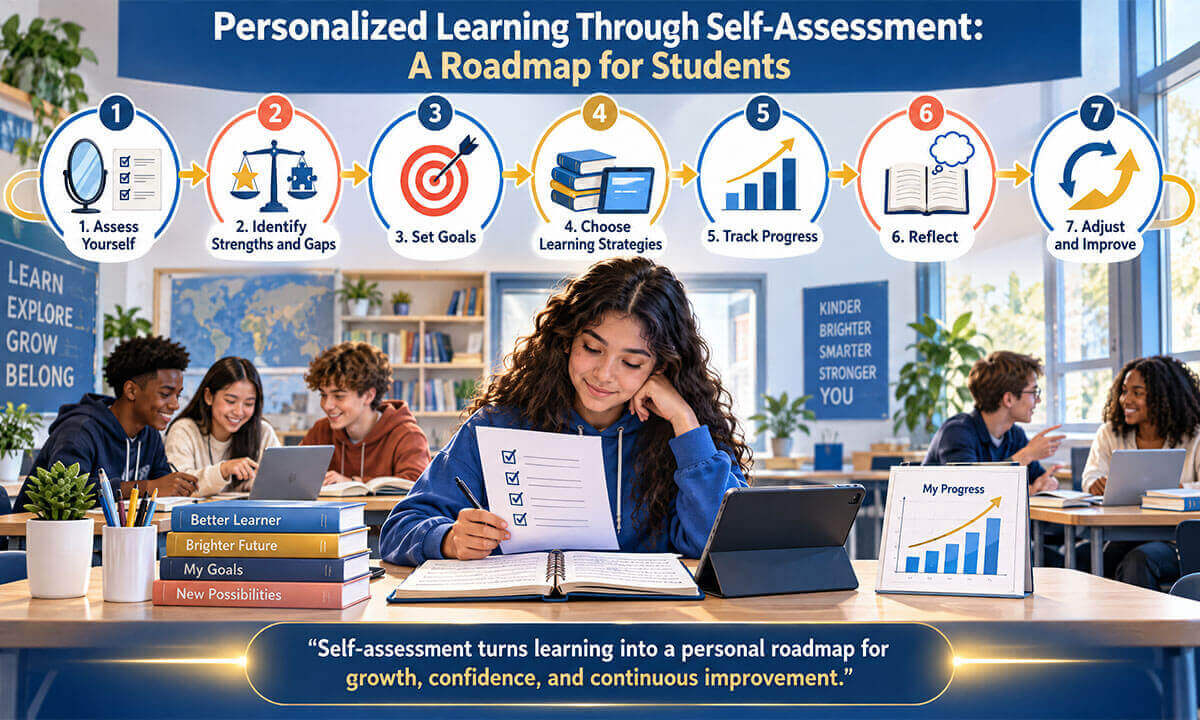
How Students Can Build a Personalized Learning Roadmap:
Students can turn self-assessment into a practical learning process.
Step 1: Identify Your Current Level: Begin by asking what you already know. Use previous assignments, practice tests, teacher feedback, or personal reflection.
Step 2: Identify Strengths and Gaps: Separate areas of confidence from areas that require more work.
Step 3: Set Specific Goals: Create goals that are clear and realistic. Instead of saying “I will improve science,” choose a specific target such as completing a certain number of practice questions or improving understanding of a particular topic.
Step 4: Choose Suitable Strategies: Select learning methods that match your needs. These might include practice questions, reading, discussion, demonstrations, projects, videos, or collaborative learning.
Step 5: Monitor Progress: Check your progress regularly. Do not wait until the final examination to discover that a strategy is not working.
Step 6: Adjust Your Approach: If something is not working, change it. Personalized learning requires flexibility.
Step 7: Reflect and Repeat: After completing a learning cycle, assess the results and begin the process again.
This creates a continuous cycle:
Assess → Set goals → Learn → Monitor → Reflect → Adjust → Assess again
Building Lifelong Learning Skills:
The significance of self-assessment extends beyond school and university.
People continue learning throughout their professional and personal lives. Workers need to identify skills they need to develop. Professionals need to update their knowledge. Entrepreneurs need to examine their decisions. Even everyday life requires people to reflect on what works and what needs to change.
Students who practice self-assessment can therefore develop habits that remain useful after formal education ends.
They learn that improvement does not happen simply by completing a task. It happens through observation, reflection, action, and adjustment.
In conclusion, personalized learning through self-assessment gives students a more active role in their education. Instead of simply receiving information, completing assignments, and waiting for grades, students can learn to understand their own progress and make informed decisions about what to do next.
Self-assessment helps students identify strengths, recognize learning gaps, set meaningful goals, choose appropriate strategies, and monitor improvement. Teachers remain essential because they provide guidance, clear expectations, feedback, and support. When students and teachers work together, self-assessment can become a practical part of everyday learning.
Most importantly, personalized learning is not about finding one perfect learning method. It is about developing the ability to understand what you need, evaluate what is working, and make thoughtful adjustments.
When students learn to assess themselves honestly and use that information to guide their learning, they gain more than better academic performance. They develop self-awareness, independence, critical thinking, motivation, and resilience. These skills can support them not only in the classroom but throughout their lives.

is an experienced educator and academic currently serving as a Lecturer at Nurul Amin Degree College. With a career dedicated to student development and institutional excellence, he brings a wealth of classroom expertise and pedagogical knowledge to his current role. Before joining the faculty, he served as an Assistant Teacher at Zinzira PM Pilot School and College.