Open Educational Resources and the Role of Collaborative Learning:
Education is changing quickly. Learning is no longer limited to classrooms, printed textbooks, or expensive educational materials. Students can now access lessons, books, videos, courses, and other learning materials from almost anywhere. At the same time, learning is becoming more social. Students are increasingly working together to discuss ideas, solve problems, complete projects, and create knowledge.
Two necessary approaches supporting this change are Open Educational Resources (OER) and collaborative learning. OER provides learners and educators with free educational materials that can often be reused, adapted, and shared. Collaborative learning, meanwhile, encourages students to learn through interaction and cooperation with others.
When these two approaches are used together, they can make education more accessible, flexible, interactive, and meaningful. Students can access the same learning materials, discuss them with their peers, adapt them to their needs, and contribute their own ideas. This article explores the meaning of OER and collaborative learning, their benefits, how they work together, practical examples, challenges, and their future role in education.
What Are Open Educational Resources?
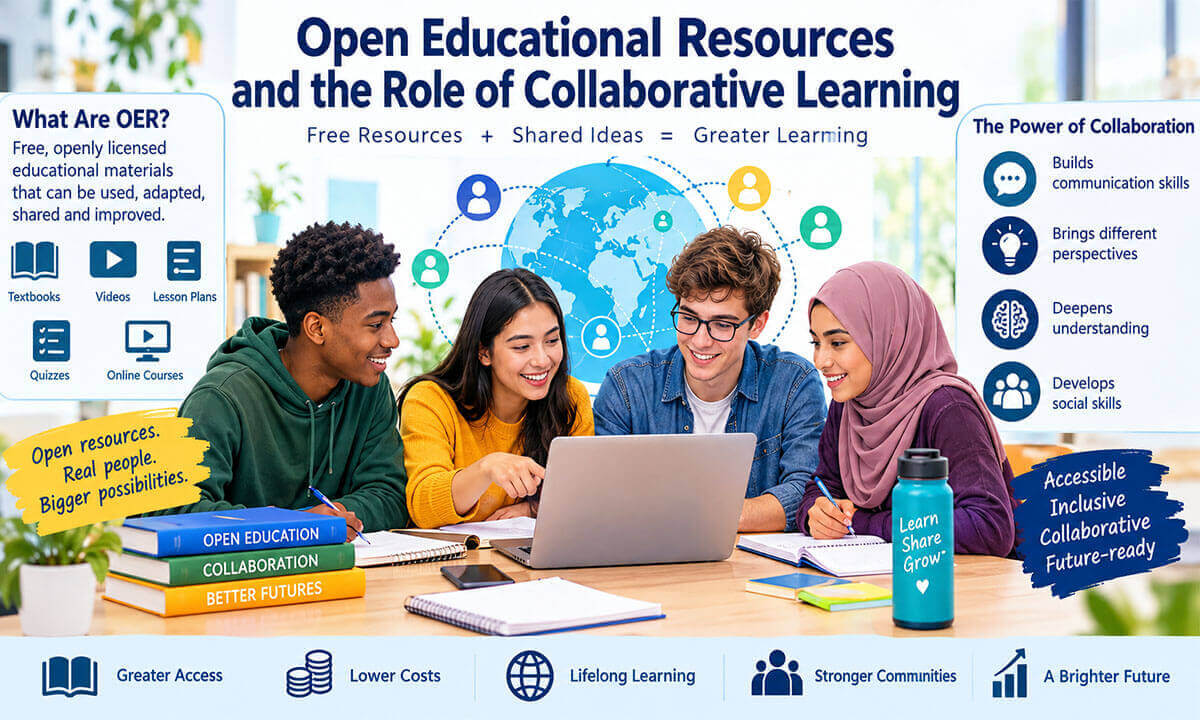
Open Educational Resources are teaching, learning, and research materials that are available for free use and are usually released under an open license. These resources can include textbooks, lecture notes, lesson plans, videos, presentations, assignments, quizzes, images, and complete courses.
The most essential feature of OER is not simply that the materials are free to access. Their open licensing can also give users permission to reuse, revise, remix, retain, and redistribute the materials, depending on the specific license.
For example, a teacher may find an open textbook online, adapt some of its examples for local students, translate sections into another language, and share the improved version with other teachers.
This makes OER different from many traditional educational resources. Traditional textbooks may be protected by copyright in ways that restrict copying, modification, or redistribution. OER is designed to give educators and learners greater freedom.
Why Does Openness Matter?
The idea of openness can make education more accessible in several ways.
- Greater Access to Learning Materials: Students do not always have the money to purchase expensive textbooks and learning materials. OER can reduce this financial barrier by providing free access to educational content. This is particularly important for students from low income backgrounds and communities where educational resources are limited.
- Freedom to Adapt Materials: Teachers have different students, teaching environments, languages, and cultural contexts. A single textbook may not meet all of these needs. Openly licensed resources can often be adapted. Teachers can change examples, update information, translate content, or reorganize lessons to make them more suitable for their students.
- Easier Sharing: OER can also support the sharing of knowledge. Teachers can exchange useful resources with colleagues, and students can share learning materials with their peers. This creates a culture in which educational knowledge is treated as something that can be shared and improved rather than simply purchased.
The Global Impact of OER:
OER has the potential to influence education at local, national, and international levels.
- Supporting Education in Developing Communities: In areas where educational resources are limited, OER can provide teachers and students with access to materials that may otherwise be difficult to obtain. Local educators can also adapt resources to their own languages and cultural contexts. This makes learning materials more relevant to local communities. However, access to OER still depends on factors such as internet availability, digital devices, electricity, and digital skills. OER can help reduce educational inequality, but it cannot solve every barrier by itself.
- Reducing Educational Costs: One of the most visible benefits of OER is the potential to reduce the cost of learning materials. When students do not need to purchase expensive textbooks, they can use their limited financial resources for other educational needs. Institutions can also reduce some material costs while continuing to provide students with learning resources.
- Supporting Lifelong Learning: OER is not limited to formal education. Working professionals, independent learners, parents, career changers, and curious individuals can use open resources to develop new knowledge and skills. This supports the idea that learning can continue throughout life rather than ending after graduation.
What Is Collaborative Learning?
Collaborative learning is an educational approach in which learners work together to achieve shared learning goals. Instead of simply receiving information from a teacher, students participate actively in discussions, problem-solving, peer teaching, group projects, research, and other activities.
For example, a group of students might read the same open textbook chapter and then work together to identify its main ideas. They may discuss different interpretations, solve related problems, and present their conclusions to the class.
Collaborative learning can take place inside or outside the classroom. It can also happen online through discussion forums, shared documents, virtual classrooms, and other digital platforms.
Benefits of Collaborative Learning:
Let’s face it—learning alone can be isolating. Collaborative learning brings people together and boosts the experience in tons of ways.
- Improved Communication Skills: Working with others requires students to explain their ideas, listen carefully, ask questions, and respond to different opinions. These communication skills are useful not only in education but also in professional and personal life.
- Learning From Different Perspectives: Every learner brings different experiences and ways of thinking to a group. When students discuss a topic together, they may discover perspectives that they had not considered before. One student’s question can also help another student understand a difficult concept.
- Deeper Understanding: Explaining an idea to another person often requires a deeper understanding of that idea. Students must organize their thoughts, provide reasons, answer questions, and sometimes defend their conclusions. This process can move learning beyond simple memorization.
- Development of Social Skills: Collaborative learning can help students develop skills such as cooperation, responsibility, negotiation, and respectful disagreement. These skills are increasingly important in workplaces where people often need to work as part of a team.
How OER Supports Collaborative Learning:
OER and collaborative learning can complement each other very effectively.
- Equal Access to Shared Materials: Collaboration becomes easier when students can access the same learning materials. For example, a teacher can provide an open textbook to an entire class. Students can then use the same material when participating in group discussions, assignments, and projects. Students are less likely to be excluded because they cannot afford a required textbook.
- OER Encourages Students to Become Creators: OER is not only about consuming information. Students can also participate in creating and improving educational resources. A group might take an existing open resource, add examples, correct unclear explanations, create illustrations, or translate parts of the material. They can then share their improved version with others when the license allows it. This changes the role of students from passive consumers to active contributors.
- Supporting Peer Learning: Students can use OER as a common foundation for peer learning. For example, one student might understand a particular topic well and explain it to classmates. Another student might contribute a useful example or find additional open resources. Through these interactions, students learn from both the resource and each other.
- Supporting Group Projects: Open resources can provide the foundation for collaborative assignments. Students can research a topic using open textbooks, articles, videos, datasets, and other materials. They can then work together to produce presentations, reports, websites, educational guides, or other projects.
Examples of OER and Collaborative Learning in Practice:
Several initiatives demonstrate how open education can support wider participation in learning.
- BCcampus: BCcampus in Canada has supported the development and use of open textbooks and other open educational resources. These resources have helped institutions reduce textbook costs while giving educators opportunities to adapt materials for their teaching needs.
- African Storybook: The African Storybook initiative provides openly licensed children’s storybooks in African languages. Teachers and communities can participate in translating, adapting, and creating stories. This demonstrates how openness can support both education and local cultural representation.
- MIT OpenCourseWare: MIT OpenCourseWare provides free access to course materials from the Massachusetts Institute of Technology. Learners around the world can use these materials for independent study or as a foundation for group learning.
These examples show that open education can reach far beyond a traditional classroom.
Tools That Can Support OER and Collaboration:
Many digital platforms can support the use of OER and collaborative learning.
OER Commons provides a collection of open educational materials that educators can discover and use.
WikiEducator supports collaborative development of open educational content.
Google Workspace for Education can support group writing, presentations, spreadsheets, and other collaborative activities.
Discussion forums and learning management systems can help students exchange ideas and provide peer feedback.
Video conferencing platforms can allow students from different locations to participate in group discussions and projects.
The most important factor is not the technology itself. What matters is how teachers and learners use these tools to support meaningful learning.
Challenges of OER and Collaborative Learning:
Although OER and collaborative learning offer many benefits, they also have challenges.
- Limited Internet Access: Not every learner has reliable internet access, a suitable device, or enough digital skills to use online resources effectively. Offline versions, downloadable materials, printed resources, and low-bandwidth content can help address this problem.
- Quality Concerns: Because OER can be created and shared by many different people and organizations, the quality of resources can vary. Teachers should evaluate resources carefully by checking the accuracy, relevance, authorship, licensing information, currency, and educational value of the material.
- Teacher Preparation: Teachers may need training to find, evaluate, adapt, and create OER. They may also need support in designing effective collaborative activities. Simply placing students into groups does not automatically create successful collaborative learning.
- Unequal Participation: Group work can sometimes create problems when some students participate more than others. Teachers need to establish clear responsibilities, provide appropriate guidance, and use assessment methods that recognize both individual and group contributions.
- Copyright and Licensing: Not every free resource is an OER. A resource may be free to read but still have restrictions on copying, modifying, or redistributing it. Teachers and students therefore need basic knowledge of copyright and open licenses before adapting or sharing educational materials.
The Future of OER and Collaborative Learning:
The future of education is likely to become increasingly connected, flexible, and collaborative. Digital technologies, artificial intelligence, online learning platforms, and open educational practices can create new opportunities for students and educators.
OER can provide the foundation for shared knowledge, while collaborative learning can turn that knowledge into an active learning experience.
Future classrooms may involve students from different locations working together on common projects, adapting open resources for local communities, and contributing new materials to global learning networks.
However, technology alone will not improve education. Effective teaching, thoughtful instructional design, teacher support, digital inclusion, and meaningful interaction will remain essential.
In conclusion, Open Educational Resources and collaborative learning offer two powerful ways to make education more accessible and participatory. OER can reduce the cost of learning materials, increase access to knowledge, and give educators greater freedom to adapt content. Collaborative learning can help students communicate, exchange perspectives, solve problems, and develop a deeper understanding of what they study.
When these approaches are combined, their benefits can become even stronger. Students can work from shared resources, learn from one another, adapt educational content, and contribute their own knowledge. Teachers can create more flexible learning experiences while communities can participate in the development and sharing of educational materials.
There are still challenges, including unequal internet access, resource quality, teacher preparation, participation problems, and copyright concerns. These challenges require careful planning and continued support.
Ultimately, OER and collaborative learning encourage a broader view of education. Learning does not have to be limited by the price of a textbook or the walls of a classroom. With open resources and meaningful collaboration, learners can become active participants in a shared learning environment where knowledge is accessed, discussed, improved, and shared with others.

is an experienced educator and academic currently serving as a Lecturer at Nurul Amin Degree College. With a career dedicated to student development and institutional excellence, he brings a wealth of classroom expertise and pedagogical knowledge to his current role. Before joining the faculty, he served as an Assistant Teacher at Zinzira PM Pilot School and College.