Five Things That Make You Look Smarter:
Being smart is not only about having a high level of knowledge. It is also about how you communicate, how you respond to others, and how you handle situations. Sometimes, people who know a lot do not appear intelligent because they speak too much, pretend to know everything, or fail to communicate their ideas clearly. The good news is that you do not need to prove how intelligent you are. Certain simple habits can naturally make you appear more thoughtful, confident, and intelligent. Here are five things that can make you look smarter in everyday life.
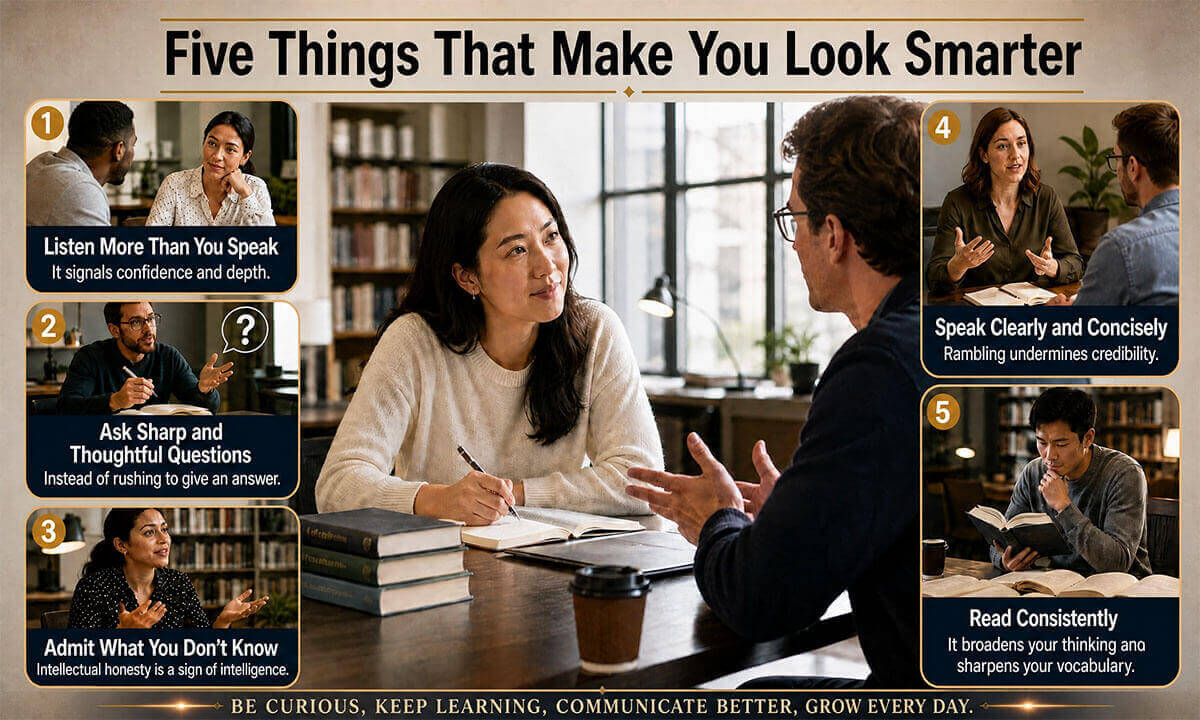
1. Listen More Than You Speak:
One of the simplest ways to appear intelligent is to become a good listener. People often feel that someone is wise when that person pays close attention instead of constantly trying to speak.
Listening shows that you are interested in understanding the situation before giving your opinion. It also gives you time to think about what the other person is saying.
For example, imagine you are in a meeting and someone presents a new idea. Instead of immediately saying, “That will never work,” you listen carefully and consider the idea. When you finally speak, you can give a more useful response because you understand the situation better.
Good listening can also help you learn from people. You may discover new information, different opinions, or better ways of doing things.
Being quiet does not mean you have nothing to say. Sometimes, it shows that you are thinking before you speak.
2. Ask Sharp and Thoughtful Questions:
Intelligent people do not always try to provide answers. They also know how to ask good questions.
A thoughtful question shows that you are paying attention and trying to understand something deeply. It can also move a conversation in a more useful direction.
For example, instead of asking, “What is the problem?” you could ask, “What caused the problem, and what can we do to prevent it from happening again?”
The second question shows deeper thinking. It looks beyond the immediate problem and focuses on its cause and possible solution.
In a workplace, classroom, or social conversation, asking the right question can often be more valuable than giving a quick answer.
However, asking questions does not mean asking questions just to sound intelligent. Your questions should be genuine, relevant, and useful.
3. Admit What You Do Not Know:
You do not need to know everything to look intelligent. In fact, admitting that you do not know something can make you appear more trustworthy and mature.
Some people are afraid to say, “I don’t know.” They may give an incorrect answer because they want others to think they are knowledgeable. This can damage their credibility when the truth becomes clear.
A more intelligent response is to be honest.
For example, if someone asks you about a subject you have never studied, you can simply say, “I am not familiar with that topic, but I would like to learn more about it.”
This shows intellectual honesty and a willingness to learn.
Admitting what you do not know also creates an opportunity for growth. Once you recognize a gap in your knowledge, you can take steps to fill it.
You do not look weak when you admit that you do not know something. You look confident enough to be honest.
4. Speak Clearly and Concisely:
The way you communicate can strongly influence how intelligent people think you are. A person may have excellent ideas, but if those ideas are buried under unnecessary words, others may struggle to understand them.
Speaking clearly means expressing your ideas in a simple and organized way. Speaking concisely means avoiding unnecessary explanations when a few clear sentences are enough.
For example, instead of spending five minutes explaining why you are late, you could simply say, “I am sorry I am late. There was a major traffic delay, and I could not arrive on time.”
Clear communication makes your message easier to understand.
This does not mean you should speak very little all the time. Some topics require detailed explanations. The goal is to make sure every word has a purpose.
Before speaking, take a moment to organize your thoughts. Know what you want to say, then say it clearly.
5. Read Consistently:
Reading is one of the best long-term habits for developing your mind. Regular reading exposes you to new ideas, different perspectives, useful information, and new vocabulary.
You do not need to read hundreds of pages every day. Even reading for 15 or 20 minutes consistently can make a difference over time.
For example, you might read a book about personal finance to understand money management. You might read history to understand how societies developed. You might read psychology to better understand human behavior.
Reading also improves your ability to express yourself. The more good writing you read, the more naturally you learn how to organize your own thoughts and choose better words.
The important thing is consistency. Reading one book and then stopping for six months is less useful than making reading a regular part of your life.
Intelligence Is More Than Showing Knowledge:
Looking smart is not about using complicated words, correcting everyone, or trying to win every argument. Real intelligence is often visible through simple behaviors.
A person who listens carefully shows patience. A person who asks thoughtful questions shows curiosity. A person who admits what they do not know shows honesty. A person who communicates clearly shows discipline. A person who reads regularly shows a commitment to learning.
These habits also do more than make you look smarter. They can actually help you become smarter because they encourage you to listen, think, learn, and communicate better.
In conclusion, you do not have to prove your intelligence to everyone around you. Instead, develop habits that naturally demonstrate good thinking.
Listen more than you speak. Ask meaningful questions. Be honest about what you do not know. Speak clearly and avoid unnecessary words. Most importantly, keep reading and learning.
Gradually, these simple habits can improve not only how others see you but also how you think, communicate, and handle everyday life. True intelligence is not about knowing everything. It is about being willing to understand, learn, and grow.

is an experienced educator and academic currently serving as a Lecturer at Nurul Amin Degree College. With a career dedicated to student development and institutional excellence, he brings a wealth of classroom expertise and pedagogical knowledge to his current role. Before joining the faculty, he served as an Assistant Teacher at Zinzira PM Pilot School and College.