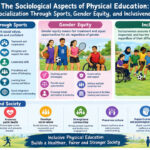
The Sociological Aspects of Physical Education: Socialization Through Sports, Gender Equity, and Inclusiveness
Physical education is not only concerned with physical fitness, exercise, and the development of motor skills. It also plays an important role in shaping social relationships, cultural understanding, and personal behavior. It helps individuals learn how to cooperate with others, respect rules, accept differences, and become responsible members of society. From a sociological perspective, physical education is closely connected with family, culture, gender, social class, community, and educational institutions.
The sociological aspects of physical education explain how society influences participation in sports and physical activities. They also examine how sports can reduce social barriers, promote gender equity, and create inclusive environments. By understanding these aspects, teachers, coaches, and policymakers can develop physical education programs that meet the needs of different learners and contribute to a healthier and more equitable society.
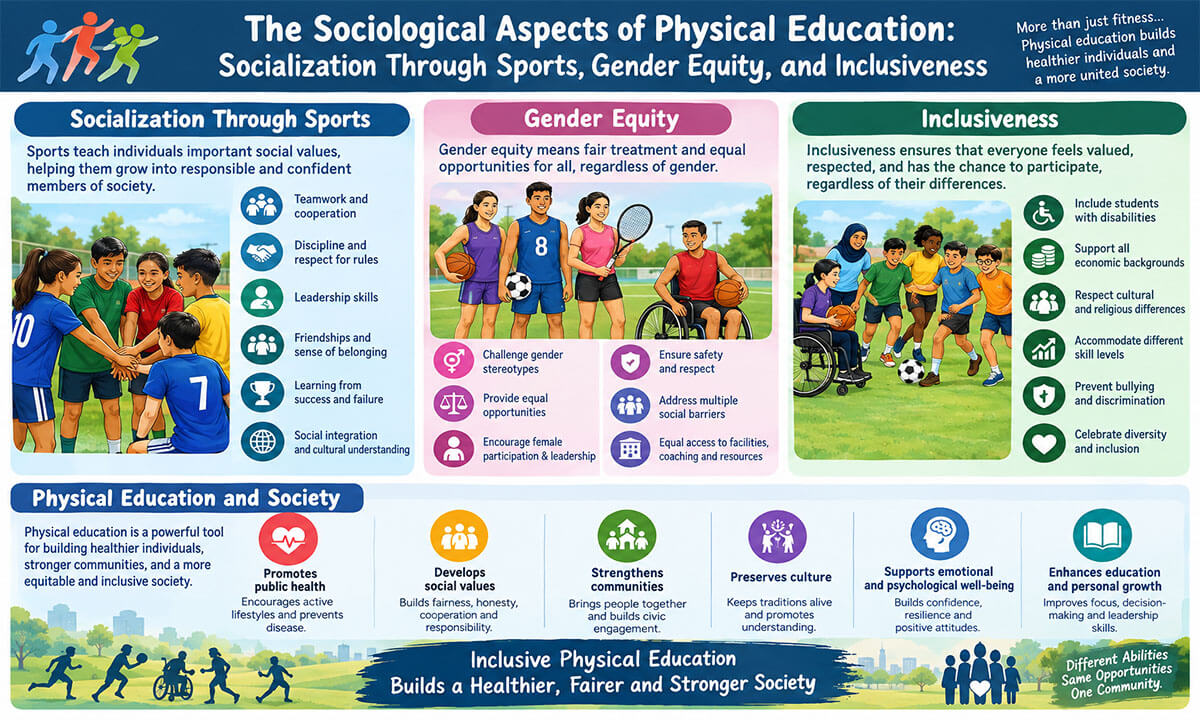
1. Meaning of the Sociological Aspects of Physical Education:
The sociological aspects of physical education refer to the relationship between physical activity, sports, and society. They examine how social values, cultural traditions, economic conditions, gender expectations, and group relationships influence people’s participation in physical activities.
For example, children may develop an interest in sports because their parents encourage them, their friends participate, or their schools provide suitable facilities. In contrast, some individuals may face barriers because of financial difficulties, cultural restrictions, discrimination, or a lack of accessible facilities.
Sociology helps us understand these differences and identify ways to make physical education more accessible. It also explains how sports can influence social behavior, strengthen community relationships, and promote respect among people from different backgrounds.
The major sociological aspects of physical education include socialization through sports, gender equity, inclusiveness, cultural understanding, social integration, and the relationship between physical education and society.
2. Socialization Through Sports:
Socialization through sports is the process by which individuals learn social values, rules, attitudes, and behaviors through participation in sports and physical activities. Sports provide opportunities for people to interact, develop relationships, and learn how to work with others.
Children and young people often develop important social skills through school sports, recreational games, and organized competitions. These experiences help them understand their responsibilities and learn how to behave in different social situations.
2.1 Development of Teamwork and Cooperation: Teamwork is one of the most important lessons people learn through sports. Games such as football, basketball, volleyball, and cricket require players to cooperate to achieve a common goal.
Players must communicate, support one another, and understand their individual responsibilities. They also learn that personal success often depends on the contribution of the entire team.
These lessons are useful beyond the sports field. Students can apply teamwork and cooperation in classroom activities, group assignments, workplaces, and community projects.
2.2 Learning Discipline and Respect for Rules: Sports require participants to follow rules, respect decisions, and maintain appropriate behavior. Athletes learn to arrive on time, practice regularly, listen to instructions, and accept the authority of coaches and officials.
These experiences help develop self-discipline and responsibility. Students also learn to respect opponents, teammates, referees, and teachers.
When physical education teachers encourage fair play, students understand that winning is not the only purpose of sports. Honesty, respect, and responsible behavior are equally important.
2.3 Development of Leadership Skills: Sports provide opportunities for individuals to develop leadership abilities. Team captains, for example, learn to make decisions, motivate teammates, solve problems, and take responsibility for group performance.
Leadership is not limited to students who hold formal positions. Any participant can demonstrate leadership by helping others, encouraging struggling teammates, or showing a positive attitude during difficult situations.
These experiences help students develop confidence and prepare them for leadership roles in education, employment, and community life.
2.4 Building Friendships and a Sense of Belonging: Participation in sports helps individuals develop friendships and feel connected to a group. Being part of a team or sports club provides opportunities to meet people, share experiences, and build mutual trust.
This sense of belonging can be particularly valuable for students who feel isolated or have difficulty forming social relationships. Positive interactions with teammates and coaches can help them develop communication skills and self-confidence.
Sports can also bring together people from different cultural, ethnic, and economic backgrounds. Shared activities and common goals can encourage mutual understanding and reduce social divisions.
2.5 Learning to Accept Success and Failure: Sports teach individuals how to respond to both success and disappointment. Winning can encourage confidence, while losing can provide opportunities to learn from mistakes and improve performance.
Students who receive appropriate guidance can develop patience, resilience, emotional control, and determination. They learn to congratulate successful opponents and continue working toward their goals after setbacks.
However, these benefits are not automatic. Coaches and teachers must discourage bullying, excessive aggression, and unhealthy competition. A supportive sports environment helps participants develop positive social behavior.
2.6 Sports as a Tool for Social Integration: Sports can help connect people who might otherwise have limited opportunities to interact. Community tournaments, school competitions, and recreational programs allow individuals from different backgrounds to participate in shared activities.
These experiences can challenge stereotypes and encourage respect for cultural differences. Sports can also support community development by creating opportunities for cooperation and peaceful interaction.
Therefore, socialization through sports contributes to physical development as well as social, emotional, and personal growth.
3. Gender Equity in Physical Education:
Gender equity refers to fairness in the distribution of opportunities, resources, support, and participation among people of different genders. In physical education, it means ensuring that students can participate in physical activities without facing unfair restrictions or discrimination based on gender.
Although participation in sports has expanded in many societies, gender based barriers continue to affect access to training, facilities, leadership opportunities, and competitive activities. Physical education can help challenge these barriers and promote fair treatment.
3.1 Challenging Gender Stereotypes: Gender stereotypes are beliefs about the abilities, interests, and expected behaviors of people based on their gender. For example, some people believe that football and weightlifting are suitable mainly for boys, while dance and certain recreational activities are more appropriate for girls.
Such beliefs can discourage students from exploring their interests and developing their abilities.
Physical education teachers should encourage all students to participate in a wide range of activities according to their interests and abilities. Boys and girls should have opportunities to learn football, athletics, swimming, gymnastics, dance, and other activities without unnecessary gender restrictions.
3.2 Providing Equal Opportunities: Gender equity requires fair access to sports equipment, playing areas, coaching, competitions, and training time.
Schools should ensure that students receive comparable opportunities to participate and develop their skills. Girls should not be given fewer opportunities simply because of traditional expectations or assumptions about their physical abilities.
Teachers should also consider whether school rules, uniforms, facilities, and schedules create unnecessary barriers for particular students.
Fair opportunities allow students to develop their abilities and build confidence through participation.
3.3 Encouraging Female Participation and Leadership: Girls and women may face barriers such as limited family support, safety concerns, inadequate facilities, and a lack of female coaches or role models.
Schools and sports organizations can address these barriers by providing safe playing environments, supportive coaching, appropriate facilities, and opportunities for girls to take leadership roles.
Female coaches, athletes, and sports leaders can also help challenge stereotypes and demonstrate that sports are open to everyone.
Encouraging girls to become team captains, coaches, officials, and sports organizers supports leadership development and wider social participation.
3.4 Promoting Safety and Respect: Gender equity also requires protection from harassment, discrimination, and inappropriate behavior. Students should be able to participate in physical education without fear of humiliation, intimidation, or abuse.
Schools should establish clear behavioral expectations, provide appropriate supervision, and create safe ways to report concerns.
Teachers must treat students fairly and avoid comments or practices that reinforce negative stereotypes about body shape, strength, appearance, or athletic ability.
A respectful environment allows everyone to participate with confidence.
3.5 Understanding Different Social Barriers: Gender does not operate independently of other social factors. Economic background, disability, location, culture, and access to education can influence an individual’s opportunities.
For example, a girl from a low-income rural household may experience several barriers at the same time, including the cost of sports equipment, limited transport, and family restrictions.
Physical education programs should recognize these different circumstances and develop practical solutions. Providing affordable equipment, accessible facilities, suitable schedules, and community support can help reduce participation gaps.
Gender equity is therefore an important part of creating a fair and supportive physical education system.
4. Inclusiveness in Physical Education:
Inclusiveness means creating an environment where all individuals feel respected, valued, and able to participate meaningfully. In physical education, it involves adapting activities and removing barriers so that students with different abilities, backgrounds, and needs can take part.
An inclusive approach recognizes that students differ in physical ability, learning needs, confidence, culture, economic circumstances, and previous experience with sports.
The goal is not to make every student perform in exactly the same way. Instead, the goal is to provide fair opportunities for learning, participation, and development.
4.1 Inclusion of Students with Disabilities: Students with disabilities should have opportunities to participate in physical education according to their abilities, interests, and support needs.
Teachers can adapt games, modify rules, provide suitable equipment, and adjust activity spaces to improve access. For example, a ball with sound can support some students with visual impairments, while a larger or lighter ball may make an activity easier for students with particular motor difficulties.
Adapted physical education can help students develop movement skills, confidence, independence, and social relationships.
Teachers should focus on what students can do rather than making assumptions about their limitations. When necessary, they should work with students, families, and relevant specialists to identify suitable adaptations.
4.2 Inclusion Regardless of Economic Background: Economic differences can affect participation in sports. Some students can afford sportswear, equipment, coaching, and travel to competitions, while others cannot.
Schools can reduce these barriers by providing shared equipment, affordable activities, suitable sports clothing options, and opportunities to participate without expensive fees.
Teachers should avoid making students feel embarrassed because they cannot afford particular items. Physical education should be accessible to students from all economic backgrounds.
4.3 Respecting Cultural and Religious Differences: Students may have different cultural traditions, religious practices, clothing preferences, and expectations regarding physical activity.
Inclusive physical education respects these differences while maintaining safety and meaningful participation. Teachers can provide suitable uniform options, consider privacy needs, and communicate with families when cultural concerns arise.
They can also introduce traditional games and physical activities from different communities. This helps students learn about one another’s cultures and develop mutual respect.
Cultural sensitivity should not become a reason to exclude students. Instead, it should guide teachers in finding practical ways to support participation.
4.4 Supporting Students with Different Skill Levels: Students enter physical education classes with different levels of fitness, coordination, confidence, and sports experience.
If teachers focus only on highly skilled performers, beginners may feel discouraged and avoid participation. An inclusive program provides activities at different difficulty levels and gives students opportunities to improve at their own pace.
Teachers can use small group activities, modified games, individual goals, and positive feedback to support learning.
Assessment should consider effort, progress, cooperation, and personal development rather than relying only on athletic performance.
4.5 Preventing Bullying and Discrimination: Bullying, teasing, body shaming, and exclusion can prevent students from participating confidently in sports.
Teachers should establish clear rules against discriminatory behavior and respond promptly when problems occur. They should also encourage students to support teammates, respect differences, and resolve conflicts peacefully.
An inclusive environment allows students to make mistakes without fear of humiliation. This helps create a positive learning experience and strengthens relationships among classmates.
4.6 Benefits of Inclusive Physical Education: Inclusive physical education benefits individuals and the wider school community. It can improve physical fitness, confidence, communication, and social participation.
When students learn alongside people with different abilities and backgrounds, they develop empathy, patience, and respect for diversity. These lessons can influence their behavior outside school and contribute to a more inclusive society.
5. Relationship Between Physical Education and Society:
Physical education and society influence each other in several ways. Social values and cultural expectations shape the way physical education is organized, while physical education can influence people’s attitudes, behaviors, and relationships.
Its contribution extends beyond individual fitness to public health, education, community development, cultural understanding, and social responsibility.
5.1 Promotion of Public Health: Regular physical activity supports physical fitness and overall well-being. Physical education helps students understand the importance of movement, exercise, healthy habits, and active living.
Schools provide structured opportunities for students to engage in physical activity and learn how to maintain an active lifestyle beyond childhood.
Regular physical activity can reduce the risk of several noncommunicable diseases, including type 2 diabetes and cardiovascular disease. It can also support mental well-being and help reduce stress.
By encouraging lifelong physical activity, physical education contributes to healthier communities.
5.2 Development of Social Values: Physical education provides opportunities to practice fairness, honesty, cooperation, respect, and responsibility.
Students learn that rules protect participants and help make competition fair. They also learn to recognize the contributions of others and accept different opinions.
These values are important in families, schools, workplaces, and communities. When teachers model respectful behavior and encourage fair play, physical education becomes a practical way to support positive social development.
5.3 Strengthening Community Relationships: Community sports programs, school tournaments, recreational clubs, and public fitness activities bring people together.
Such activities create opportunities for interaction among individuals of different ages, occupations, and backgrounds. They can strengthen community relationships and encourage participation in shared activities.
Sports events may also create opportunities for volunteering, local leadership, and cooperation between schools and community organizations.
However, the positive effects depend on how these activities are organized. Programs should remain accessible and avoid discrimination, excessive competition, and exclusion.
5.4 Cultural Preservation and Understanding: Physical activities often reflect the traditions and identities of particular communities. Traditional games, folk dances, martial arts, and regional sports can preserve cultural knowledge and pass it from one generation to another.
Including these activities in physical education can help students appreciate their own heritage and learn about other cultures.
Teachers can use traditional games to encourage cultural exchange and demonstrate that physical education includes more than internationally popular sports.
5.5 Support for Emotional and Psychological Development: Physical education provides opportunities for students to develop self-confidence, emotional control, resilience, and a positive attitude toward challenges.
Exercise can support mental well-being, while group activities can create opportunities for friendship and social support.
Students also learn how to manage frustration, respond to feedback, and set realistic goals. These skills can help them handle challenges in academic and personal life.
Teachers should create a supportive atmosphere in which students feel encouraged rather than constantly judged by their performance.
5.6 Contribution to Education and Personal Development: Physical education supports the development of the whole person. It provides learning experiences that complement classroom instruction.
Students can develop concentration, decision-making, problem-solving, communication, and leadership through movement-based activities.
When physical education is properly integrated into the school curriculum, it supports students’ physical, social, emotional, and cognitive development.
Its educational value should therefore be recognized alongside other academic subjects.
6. Challenges in the Sociological Development of Physical Education:
Despite its many benefits, physical education faces several social and institutional challenges.
- Gender discrimination: Traditional beliefs and unequal opportunities may discourage girls and other underrepresented groups from participating.
- Economic inequality: Limited access to equipment, facilities, transport, and coaching can prevent students from joining sports activities.
- Cultural restrictions: Some cultural expectations may limit participation, especially when schools do not provide suitable arrangements.
- Disability related barriers: Inaccessible playing areas, unsuitable equipment, and insufficient teacher training can exclude students with disabilities.
- Bullying and social exclusion: Teasing, discrimination, and unhealthy competition may reduce confidence and discourage participation.
- Limited facilities and resources: Some schools lack adequate playing areas, trained teachers, equipment, or financial support.
- Negative social attitudes: The belief that sports are less important than academic subjects can lead schools and families to give physical education insufficient attention.
Addressing these challenges requires cooperation among teachers, school administrators, parents, policymakers, and community organizations. Adequate funding, teacher training, inclusive policies, and regular evaluation can help create more effective programs.
7. Ways to Improve the Sociological Aspects of Physical Education:
Several measures can strengthen the social contribution of physical education.
- Ensure equal opportunities: Schools should provide fair access to activities, equipment, coaching, and competitions for all students.
- Develop inclusive teaching methods: Teachers should adapt rules, equipment, and activities to accommodate different abilities and learning needs.
- Promote positive social values: Teamwork, respect, cooperation, fairness, and responsibility should be included in everyday teaching.
- Challenge gender stereotypes: Students should be encouraged to explore different sports without restrictions based on traditional gender expectations.
- Prevent bullying and discrimination: Schools should establish clear behavioral standards and respond appropriately to exclusion or harassment.
- Improve facilities and resources: Schools and communities should work to provide safe playing areas, suitable equipment, and accessible facilities.
- Encourage family and community participation: Parents and local organizations can support school sports, recreational programs, and community fitness activities.
- Include cultural diversity: Traditional games and activities from different communities should be recognized and incorporated where appropriate.
- Train physical education teachers: Professional development should help teachers understand inclusion, gender equity, social relationships, and the needs of diverse learners.
- Evaluate participation and progress: Schools should examine who participates, who faces barriers, and whether programs provide meaningful opportunities for everyone.
These measures can help make physical education a more effective tool for personal development and social progress.
Final Thoughts:
The sociological aspects of physical education demonstrate that sports and physical activities have an important role in shaping individuals and society. Physical education provides opportunities for socialization, teamwork, leadership, discipline, and the development of positive relationships. It also helps students learn how to manage success and failure, respect rules, and cooperate with people from different backgrounds.
Gender equity and inclusiveness are essential parts of this process. Every student should have a fair opportunity to participate, learn, and develop without discrimination based on gender, disability, economic background, culture, or ability. Teachers and educational institutions must identify barriers and create environments that respect diversity and support meaningful participation.
Physical education also contributes to public health, cultural understanding, community development, and emotional well-being. Its benefits extend beyond the school environment and influence how people interact throughout their lives.
Finally, physical education should be understood as both a physical and social educational process. By promoting socialization through sports, gender equity, and inclusiveness, it can help develop healthier individuals, stronger communities, and a more respectful and equitable society.

is an experienced educator and academic currently serving as a Lecturer at Nurul Amin Degree College. With a career dedicated to student development and institutional excellence, he brings a wealth of classroom expertise and pedagogical knowledge to his current role. Before joining the faculty, he served as an Assistant Teacher at Zinzira PM Pilot School and College.