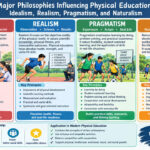
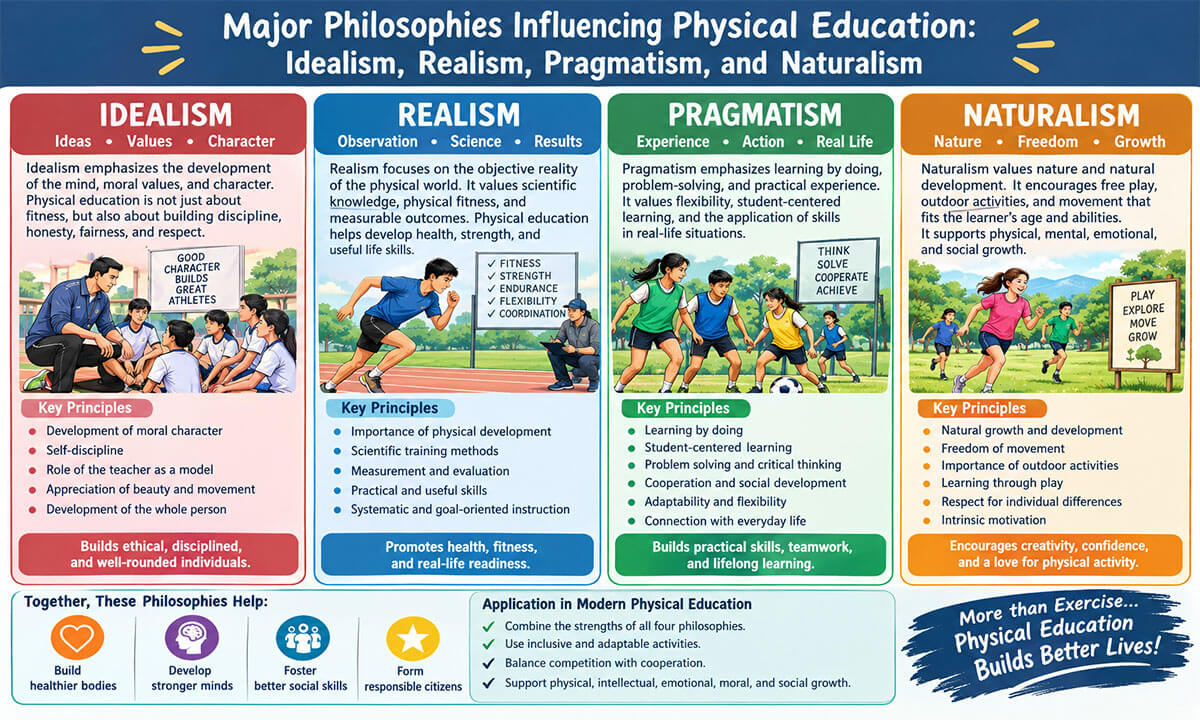
Major Philosophies Influencing Physical Education: Idealism, Realism, Pragmatism, and Naturalism
Philosophy plays a vital role in shaping the aims, principles, and methods of physical education. It helps educators understand why physical activities are important and how they contribute to the overall development of individuals. Physical education is not limited to improving physical fitness, strength, and sports skills. It also helps students develop discipline, confidence, cooperation, leadership, and moral values.
Different philosophical approaches have influenced the development of physical education. Among them, idealism, realism, pragmatism, and naturalism are four major philosophies. Each philosophy offers a different perspective on human development, learning, physical activity, and the role of teachers.
Understanding these philosophies helps physical education teachers select suitable activities, design effective lessons, and meet the different needs of learners. It also ensures that physical education contributes to the physical, mental, emotional, moral, and social development of students.
1. Idealism in Physical Education:
Meaning of Idealism: Idealism is a philosophical approach that emphasizes ideas, knowledge, moral values, and the development of the mind. It is associated with the ancient Greek philosopher Plato and later thinkers such as Immanuel Kant. According to idealism, education should help individuals develop their intellectual abilities, moral character, and understanding of important values.
In physical education, idealism emphasizes that physical activities should contribute to the development of a person’s character and personality. Sports and games are not considered important only because they improve physical fitness. They are also valuable because they teach discipline, honesty, fairness, courage, and respect for others.
Main Principles of Idealism in Physical Education:
- Development of moral character: Idealism gives great importance to moral values. Physical activities provide opportunities for students to practice honesty, fairness, respect, and responsibility. For example, a student who accepts a referee’s decision learns to respect rules and authority.
- Development of self-discipline: Idealism encourages students to control their behavior and work toward personal improvement. Regular exercise, sports training, and participation in organized games help students develop patience, determination, and self-control.
- Importance of the teacher: The teacher plays an important role as a guide and role model. A physical education teacher should demonstrate good behavior, fairness, discipline, and respect. Students can learn these qualities by observing the teacher’s actions.
- Appreciation of beauty and movement: Idealism recognizes the value of beauty, harmony, and excellence. Activities such as gymnastics, dance, and martial arts can help students appreciate the quality, coordination, and grace of human movement.
- Development of the whole person: Idealism aims to develop the intellectual, moral, and spiritual dimensions of the individual alongside physical abilities. It encourages students to become responsible individuals who value both personal achievement and the well-being of others.
Role of Idealism in Physical Education:
An idealist physical education teacher emphasizes good character, sportsmanship, discipline, and ethical behavior. Lessons are planned to help students understand the importance of cooperation, fair play, and respect for opponents.
For example, a teacher may organize a team game and encourage students to accept both victory and defeat with dignity. The purpose is not simply to win the game but also to develop patience, humility, and respect.
Importance of Idealism:
Idealism helps physical education become a means of character development. It reminds teachers that students should learn important values through sports and physical activities. However, teachers should also consider individual differences and practical learning needs when applying this philosophy.
2. Realism in Physical Education:
Meaning of Realism: Realism is a philosophical approach that emphasizes the existence of an objective world that can be understood through observation, experience, and scientific investigation. Aristotle is one of the major historical figures associated with realism. Later thinkers also contributed to the development of observation-based and scientific approaches to knowledge.
In physical education, realism emphasizes the importance of the human body, physical health, scientific knowledge, and measurable performance. It encourages teachers to understand how the body works and how physical activities affect strength, endurance, flexibility, coordination, and overall health.
Main Principles of Realism in Physical Education:
- Importance of physical development: Realism recognizes the body as an essential part of human life. Physical education should therefore help students improve their fitness, motor skills, strength, and physical abilities.
- Scientific approach to training: Realism encourages the use of scientific knowledge in planning physical activities. Teachers can use principles from anatomy, physiology, biomechanics, and exercise science to select appropriate exercises and training methods.
- Measurement and evaluation: Realism supports objective assessment of physical performance. Teachers may evaluate students’ endurance, flexibility, balance, speed, and coordination to understand their progress and identify areas for improvement.
- Practical knowledge and useful skills: Physical education should develop skills that students can apply in everyday life. Swimming, walking, running, cycling, and basic self-protection skills can help individuals maintain their health and respond to practical situations.
- Systematic teaching methods: Realism supports organized lessons with clear objectives. Teachers should select suitable activities, provide accurate instructions, monitor progress, and adjust exercises according to students’ abilities and safety requirements.
Role of Realism in Physical Education:
A realist physical education teacher uses scientific information and practical evidence to guide instruction. The teacher may assess students’ fitness levels, explain the benefits of warm up exercises, demonstrate correct movement techniques, and monitor improvements over time.
For example, a teacher may use a simple endurance test to assess students’ aerobic fitness. Based on the results, the teacher can recommend appropriate activities and gradually increase the level of exercise according to each student’s ability.
Assessment should be fair and should consider differences in age, health, disability, and physical development. Students should not be judged only by their performance compared with others.
Importance of Realism:
Realism helps physical education become more systematic, evidence-based, and practical. It connects physical activity with scientific knowledge and health education. It also helps students understand the relationship between regular exercise, physical fitness, and healthy living.
3. Pragmatism in Physical Education:
Meaning of Pragmatism: Pragmatism is a philosophical approach that emphasizes experience, practical action, experimentation, and problem-solving. Important philosophers associated with pragmatism include Charles Sanders Peirce, William James, and John Dewey.
In education, pragmatism supports learning through experience. It suggests that students learn effectively when they actively participate in activities, solve problems, reflect on their experiences, and apply what they have learned to real situations.
In physical education, pragmatism emphasizes practical learning, active participation, cooperation, and the development of skills that are useful in everyday life.
Main Principles of Pragmatism in Physical Education:
- Learning by doing: Pragmatism encourages students to learn through direct participation. Instead of relying only on explanations, teachers provide opportunities for students to practice movements, play games, and develop skills through experience.
- Student-centered learning: Students have different abilities, interests, and learning needs. Pragmatism encourages teachers to select activities that suit these differences and allow students to take an active role in their learning.
- Problem solving and critical thinking: Physical activities often require quick decisions and creative solutions. Students learn to analyze situations, identify problems, and choose suitable actions. For example, during a team game, students may need to decide how to defend an opponent or create an effective attacking strategy.
- Cooperation and social development: Pragmatism emphasizes learning through social interaction. Team games and group activities help students develop communication, leadership, cooperation, and conflict resolution skills.
- Adaptability and flexibility: Pragmatism supports adjusting teaching methods according to students’ needs and the learning environment. Teachers may modify game rules, equipment, or playing areas to encourage participation and make activities more accessible.
- Connection with everyday life: Physical education should prepare students for practical situations. Activities such as fitness planning, outdoor recreation, basic first aid education, and stress management can help students develop useful life skills.
Role of Pragmatism in Physical Education:
A pragmatic teacher acts as a facilitator who encourages students to participate, explore, and learn from experience. The teacher provides guidance, organizes activities, and helps students reflect on their performance.
For example, a teacher may divide students into groups and ask them to create a simple game using limited equipment. Students must discuss the rules, cooperate with teammates, solve problems, and test their ideas. Through this process, they develop physical, social, and thinking skills.
Importance of Pragmatism:
Pragmatism makes physical education active, flexible, and relevant to real life. It encourages students to take responsibility for their learning and helps them develop practical skills. It also promotes creativity, teamwork, independent thinking, and lifelong participation in physical activity.
4. Naturalism in Physical Education:
Meaning of Naturalism: Naturalism is a philosophical approach that emphasizes nature, natural development, and learning through direct experience. Jean Jacques Rousseau is one of the most influential thinkers associated with naturalism in education. His ideas encouraged educators to respect children’s natural development and provide opportunities for learning through exploration.
In physical education, naturalism emphasizes free play, outdoor activities, natural movement, and activities suited to the developmental needs of learners. It recognizes that children can learn many important skills by exploring their surroundings and participating in enjoyable physical activities.
Main Principles of Naturalism in Physical Education:
- Natural growth and development: Naturalism recognizes that children develop at different rates. Physical education activities should match their age, abilities, interests, and stages of physical development.
- Freedom of movement: Naturalism encourages children to move freely and explore their physical abilities. Running, jumping, climbing, throwing, and balancing allow children to develop coordination, strength, confidence, and body awareness.
- Importance of outdoor activities: Natural environments provide valuable opportunities for physical learning. Activities in parks, playgrounds, open fields, and other suitable outdoor spaces can encourage movement, curiosity, and an appreciation of nature.
- Learning through play: Naturalism considers play an important part of childhood development. Through games and spontaneous activities, children can develop physical skills, imagination, social understanding, and emotional control.
- Individual differences: Every child has different strengths, interests, and abilities. Naturalism encourages teachers to respect these differences and provide opportunities for individual growth instead of forcing every student to achieve the same results in the same way.
- Intrinsic motivation: Naturalism values enjoyment and personal interest. Students are more likely to develop positive attitudes toward physical activity when they find activities enjoyable and meaningful.
Role of Naturalism in Physical Education:
A naturalistic physical education teacher acts mainly as a guide and facilitator. The teacher provides a safe environment, observes students, encourages exploration, and offers support when needed.
For example, a teacher may organize an outdoor movement session where children can choose from several activities, such as running, jumping, balancing, and simple obstacle courses. Students can explore their abilities while the teacher ensures that the activities remain safe and appropriate.
Naturalism does not mean that teachers should avoid instruction or rules completely. Clear safety guidance, suitable boundaries, and supportive supervision remain essential, especially when children use playground equipment or participate in challenging activities.
Importance of Naturalism:
Naturalism supports the natural development of children through movement, exploration, and play. It can help develop physical fitness, creativity, independence, confidence, and social skills. It also encourages students to view physical activity as an enjoyable part of everyday life rather than only as a formal school requirement.
Comparison of the Four Philosophies:
Although idealism, realism, pragmatism, and naturalism all contribute to physical education, they differ in their main priorities.
| Philosophy | Main focus | Teaching approach | Main contribution |
| Idealism | Ideas, values, and character | Moral guidance and role modeling | Discipline, honesty, and sportsmanship |
| Realism | Physical reality and scientific knowledge | Structured instruction and assessment | Fitness, health, and measurable improvement |
| Pragmatism | Experience and practical learning | Learning by doing and problem solving | Cooperation, adaptability, and life skills |
| Naturalism | Nature and natural development | Free play and guided exploration | Creativity, independence, and enjoyment |
These philosophies do not have to be used separately. A physical education teacher can combine their strengths to create a balanced learning environment.
For example, a teacher may use idealism to encourage fair play, realism to monitor fitness, pragmatism to develop teamwork through problem-solving, and naturalism to provide enjoyable outdoor activities.
Application of These Philosophies in Modern Physical Education:
Modern physical education benefits from a balanced approach that recognizes the different needs of students. No single philosophy can address every educational goal equally well. Teachers can use the principles of all four philosophies when planning lessons and evaluating learning outcomes.
Idealism can guide the development of values and ethical behavior. Realism can help teachers use scientific knowledge to improve health and physical performance. Pragmatism can encourage students to learn through practical experience and collaborative activities. Naturalism can support age-appropriate movement, outdoor learning, and freedom to explore.
These approaches are especially useful when teachers work with students who have different levels of fitness, interests, confidence, and physical abilities. Activities should be inclusive and adaptable so that every student has a meaningful opportunity to participate.
Modern physical education should also balance competition with cooperation. Competitive sports can teach determination and respect, while cooperative games can help students build relationships and support one another. Fitness activities can improve health, while recreational movement can encourage lifelong participation.
By combining these philosophical perspectives, teachers can create programs that develop physical competence alongside intellectual, emotional, moral, and social growth.
In conclusion, Idealism, realism, pragmatism, and naturalism have made important contributions to the development of physical education. Each philosophy provides a different way of understanding the purpose of physical activity and its role in human development.
Idealism emphasizes character, discipline, and moral values. Realism focuses on physical development, scientific knowledge, and measurable outcomes. Pragmatism promotes learning through experience, practical skills, and problem-solving. Naturalism highlights natural growth, freedom of movement, outdoor activities, and learning through play.
Together, these philosophies show that physical education is much more than exercise and sports. It is an important part of education that can help students become healthier, more responsible, confident, and socially aware individuals.
Physical education teachers should understand these philosophies and apply their principles according to the needs of their students. A balanced approach can make physical education more meaningful, inclusive, and effective while encouraging students to maintain an active and healthy lifestyle throughout their lives.

is an experienced educator and academic currently serving as a Lecturer at Nurul Amin Degree College. With a career dedicated to student development and institutional excellence, he brings a wealth of classroom expertise and pedagogical knowledge to his current role. Before joining the faculty, he served as an Assistant Teacher at Zinzira PM Pilot School and College.