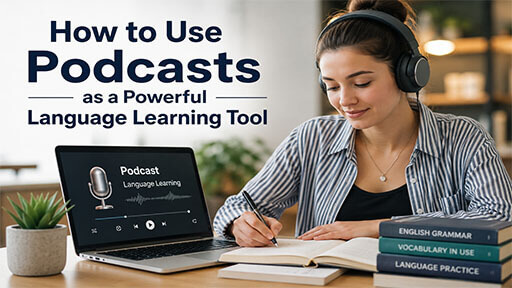
How to Use Podcasts as a Powerful Language Learning Tool:
Learning a new language often feels like a massive hill to climb—endless vocabulary lists, confusing grammar rules, and expensive textbooks. But what if you could make real progress while commuting, cooking dinner, or going for a walk? That is where podcasts come in. Once viewed purely as entertainment, podcasts have evolved into one of the most practical, flexible, and enjoyable tools for mastering a new language. They bring native speakers directly to your headphones, turning your daily downtime into productive learning moments. In the rest of this article, we will explore how to use podcasts as a powerful language learning tool.
Why Podcasts Work So Well for Language Learning:
If you have ever tried to learn a new language, you probably started with grammar guides or mobile apps. While those are helpful for building basic vocabulary, they often fail when it comes to actual, real-world communication. You might know 500 words on paper, but the moment a native speaker opens their mouth, everything sounds like a fast blur.
“Active listening with headphones bridges the gap between study time and natural conversation.”
That is precisely why podcasts are such a game-changer. They fill the gap between textbook exercises and real-life conversations. Here is a brief look at why they work so exceptionally well:
1. They Provide Full Conversational Immersion: Textbooks teach you “book language”—stiff, formal sentences that nobody actually uses in casual conversation. Podcasts, on the other hand, expose you to natural flow.
When you listen to hosts chat, you hear:
- Natural Speed and Rhythm: How words blend together when spoken quickly (like how “going to” turns into “gonna” in English).
- Pronunciation and Accent Variety: Real people speak with different tones, regional accents, and speeds. Hearing this range trains your brain not to freak out when someone doesn’t sound like a textbook recording.
- Slang and Filler Words: Real conversations are full of idioms, casual phrases, and natural pauses (like “um,” “well,” or “you know”). Podcasts teach you these subtle linguistic glue words that make you sound far more natural.
2. They Effortlessly Fit into “Dead Time”: The biggest barrier to learning a language is finding time. Very few adults have two hours every evening to sit at a desk with flashcards.
Podcasts solve this by turning idle, unproductive moments into learning opportunities:
- Walking the dog
- Commuting in heavy traffic
- Doing household chores like washing dishes or folding laundry
- Exercising at the gym
Because listening is hands-free, you can easily rack up 30 to 60 minutes of daily practice without changing your schedule or sacrificing your free time.
3. They Retain Knowledge Through Context (Not Rote Memorization): Trying to memorize isolated words from a list is exhausting, and most of it disappears from memory within a week. Podcasts teach you vocabulary in context.
When you hear a new word embedded in a story or an interesting conversation, your brain creates a mental picture. You instantly understand how the word is used, which prepositions go with it, and what tone it carries. Because the word is tied to a real topic or narrative, your brain retains it much longer.
4. You Have Complete Control Over the Pacing: When you are talking to someone face-to-face in a new language, asking them to repeat themselves five times can feel embarrassing. Podcasts remove that social pressure completely.
You are in total control of the experience:
- Speed adjustment: You can slow down the playback speed (to 0.75x or 0.8x) until your ear gets used to the sounds.
- Rewind instantly: Missed a tricky sentence? You can hit the 10-second rewind button as many times as you need.
- Use transcripts: Many educational podcasts provide transcripts, allowing you to read along with your eyes while training your ears.
5. High Engagement Prevents Burnout: Consistency is the single most important factor in language learning. If your routine feels like boring homework, you will eventually quit.
Podcasts keep you coming back because you can choose content based on what you genuinely enjoy, rather than what a textbook assigns. If you love true crime, sports, pop culture, history, or cooking, there are thousands of podcasts dedicated to those exact topics in your target language. When you care about the topic, your brain focuses on understanding the message rather than worrying about grammar rules.
How to Pick the Right Podcasts:
With millions of podcasts available on Spotify, Apple Podcasts, and YouTube, finding the right show can feel overwhelming. If you pick a podcast that is way too advanced, you will get frustrated and quit. If you pick one that is too easy or boring, your mind will wander off.
“Finding the right podcast comes down to matching your skill level and personal interests.”
Choosing the right podcast is all about finding your personal sweet spot. Here is a clear, step-by-step guide to picking shows that will actually help you learn:
1. Match the Show to Your Current Skill Level: The golden rule of language learning is comprehensible input. This means listening to content where you understand roughly 70% to 80% of what is being said. That way, your brain understands the overall context while easily picking up the remaining 20% to 30% of new words.
- For Complete Beginners (A1–A2): Stick strictly to podcasts made specifically for learners (like Coffee Break, Duolingo Podcasts, or LanguagePod101). These hosts speak slowly, enunciate clearly, and often explain tricky vocabulary in English before playing a dialogue.
- For Intermediate Learners (B1–B2): Look for “slow news” shows (like News in Slow Spanish or News in Slow French) or conversational shows aimed at intermediate students. Hosts talk about real-world topics using simpler sentence structures and clearer pronunciation.
- For Advanced Learners (C1–C2): Jump straight into podcasts made by native speakers, for native speakers. You will encounter rapid speech, overlapping voices, slang, and cultural jokes—which is exactly what you need to reach full fluency.
2. Pick Topics You Genuinely Enjoy: Do not listen to a podcast about economic policy or ancient history just because someone recommended it; unless you are genuinely interested in those topics!
If you would not listen to a show in your native language, do not force yourself to listen to it in your target language.
- If you love gaming: Search for video game review podcasts in your target language.
- If you love crime stories: Look up true crime shows hosted by native creators.
- If you love self-improvement: Find personal development or wellness podcasts.
When you care about the topic, your brain works harder to follow the story, and learning happens naturally without feeling like study time.
3. Look for Shows with Transcripts or Show Notes: When you are starting out, having text to look at is a game-changer.
- Full Transcripts: Many top educational podcasts provide complete written scripts of every episode on their website or Patreon. You can read along while listening, highlight unknown words, or read the transcript after listening to check how much you understood.
- Show Notes & Vocabulary Lists: Even if a full transcript is not available, look for shows that include key vocabulary lists or episode summaries in the description. It saves you from having to pause every minute to look up words in a dictionary.
4. Test the Audio Quality and Host Voices: Audio quality matters far more than people realize. If a podcast has poor microphone quality, background noise, or muffled audio, your brain has to work twice as hard just to figure out the basic sounds.
Before subscribing to a show, do a 2-minute test run:
- Is the audio clear? High-quality recording makes a massive difference when learning subtle sounds.
- Is the host’s voice pleasant to you? You will be spending hours listening to this person. If their voice annoys you or they speak with a heavy background noise, move on to another show.
- How many speakers are there? Solo hosts or two co-hosts are ideal for beginners. Group podcasts with four or five people talking over each other are usually too chaotic until you reach an advanced level.
5. Keep Episodes Short to Build a Habit: Long, two-hour podcast episodes can feel daunting. If you see a massive audio file, you might put off listening to it until you have “enough free time”—which usually means you won’t listen at all.
When starting out, aim for episodes that are 10 to 20 minutes long. Short episodes are easy to finish during a quick commute or coffee break. Finishing an entire episode gives you a quick win and builds momentum, making it much easier to stay consistent every day.
Practical Tips to Maximize Your Learning:
Finding great podcasts is only half the battle. The real magic happens in how you listen to them.
“Engaging actively with what you hear turns passive background noise into measurable language growth.”
If you just play an episode in the background while doing complicated work, your brain will filter it out as noise. To turn podcasts into a serious language-learning machine, you need a mix of smart strategies and practical habits. Here is a step-by-step guide to squeezing the maximum value out of every single episode:
1. Shift from Passive Listening to Active Listening: There is a time for passive listening (like having a podcast on while cleaning), but active listening is where actual learning happens.
Set aside just 10 or 15 minutes a day where you do nothing else except focus on the audio:
- Keep a notepad handy: Write down 3 to 5 interesting words or phrases you hear. Don’t write down every unknown word—just the ones that pop up frequently or sound useful.
- Visualize the story: Try to picture what the host is describing in your mind instead of translating their words into English first.
- Summarize out loud: Once the episode ends, spend one minute talking to yourself in your target language, summarizing what the episode was about in 2 or 3 simple sentences.
2. Use the “3-Pass” Repetition Method: Listening to an episode once gives you the basic idea, but listening to it multiple times unlocks deep learning. A simple 3-pass method works wonders:
- First Pass (The Big Picture): Listen to the episode without pausing or looking at notes. Your only goal here is to grasp the main topic and general story.
- Second Pass (The Deep Dive): Listen again, but this time pause when you hit tricky sections. Look up key vocabulary words, check the transcript if you have one, or slow down the playback speed.
- Third Pass (Fluency Check): Listen to the episode one last time at normal speed without stopping. You will be amazed at how much easier it feels to understand, which gives your confidence a huge boost.
3. Practice “Shadowing” to Fix Your Accent: Shadowing is a technique used by professional interpreters to build rapid fluency, and podcasts are the perfect tool for it.
How to do it:
- Pick a 30-second audio clip from your favorite podcast.
- Play the clip, and repeat the words out loud at the exact same time as the speaker (or just a split-second behind them).
- Match their pitch, pauses, emotion, and emphasis.
It feels a bit strange at first, but shadowing trains your mouth muscles to produce foreign sounds naturally and helps destroy flat, robotic accents.
4. Adjust the Playback Speed Strategically: Most podcast apps allow you to change the playback speed from 0.5x all the way up to 2.0x. Use this tool intentionally:
- Slow it down (0.8x to 0.9x): If a native speaker talks too fast, dropping the speed slightly gives your brain those extra milliseconds needed to process word boundaries without making the audio sound unnaturally distorted.
- Speed it up (1.1x to 1.2x): Once you become comfortable with an intermediate show, nudge the speed up slightly. This forces your brain to stay sharp and prepares you for real-world native speakers who talk quickly.
5. Build Small, Atomic Habits: The biggest mistake learners make is trying to listen to two hours of podcasts on Sunday afternoon and then doing nothing for the rest of the week.
Your brain learns through daily exposure:
- Anchor it to a daily trigger: Tie podcast time to an existing daily habit. For example: “As soon as I step into my car for my morning commute, I hit play on my Spanish podcast.”
- Set low minimum goals: Aim for just 10 minutes a day. It is easy enough that you won’t make excuses, but consistent enough to build real momentum over weeks and months.
In conclusion, podcasts bridge the gap between classroom theory and real-world conversation. By picking topics you love and practicing active listening habits, you can turn small moments throughout your day into steady progress. Grab a pair of headphones, find an episode that sparks your curiosity, and enjoy the journey to fluency!

is an experienced educator and academic currently serving as a Lecturer at Nurul Amin Degree College. With a career dedicated to student development and institutional excellence, he brings a wealth of classroom expertise and pedagogical knowledge to his current role. Before joining the faculty, he served as an Assistant Teacher at Zinzira PM Pilot School and College.