Meaning and Importance of Philosophy in Physical Education:
Physical education is a vital part of the educational system. It helps students develop physical fitness, motor skills, mental strength, emotional balance, and social skills through physical activities, games, and sports. However, physical education is not limited to exercise or athletic performance. It also plays an important role in developing discipline, confidence, cooperation, and good character. Philosophy provides the foundation for understanding these broader purposes of physical education.
The philosophy of physical education helps teachers understand why physical activities are important, what students should learn, and how physical education can contribute to the overall development of individuals. It guides the selection of activities, teaching methods, curriculum planning, assessment, and professional responsibilities. Understanding the meaning and importance of philosophy allows physical educators to create meaningful learning experiences that support both personal development and lifelong health.
Meaning of Philosophy in Physical Education:
Philosophy is the study of fundamental questions about knowledge, reality, existence, values, and human life. It encourages people to think critically, examine their beliefs, and search for meaningful answers to important questions. In education, philosophy provides a foundation for determining the aims, principles, and methods of teaching and learning.
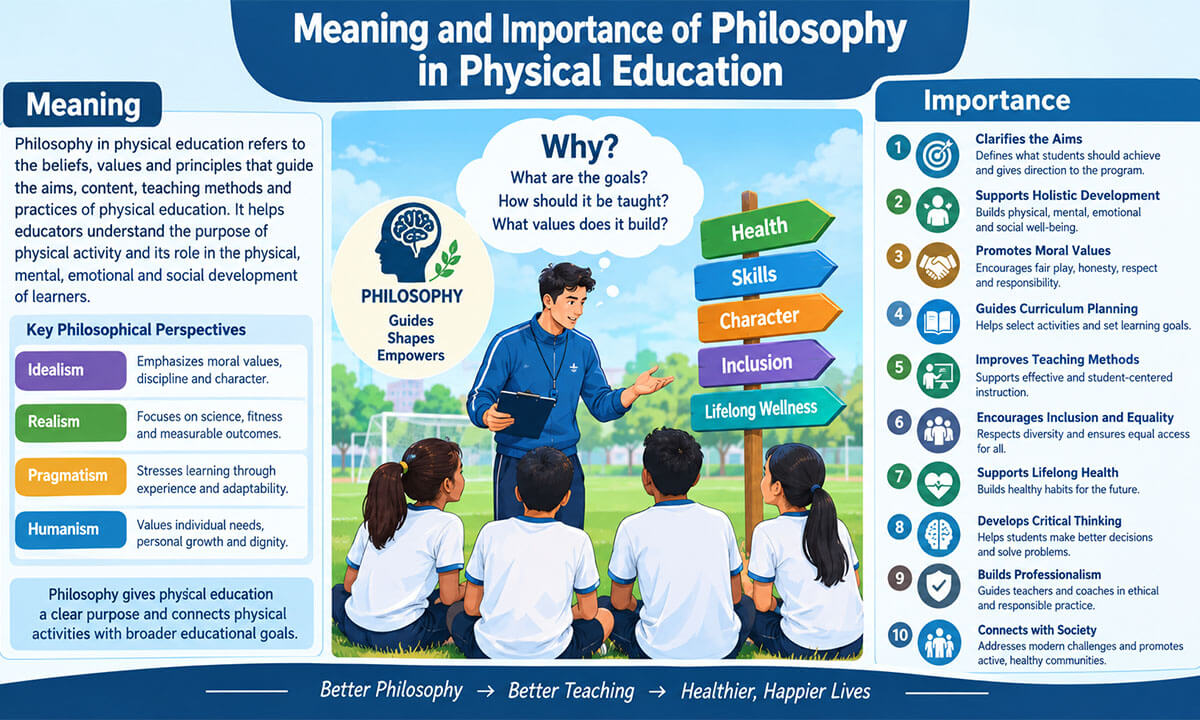
Philosophy in physical education refers to the beliefs, values, and principles that guide the aims, content, teaching methods, and practices of physical education. It explains the purpose of physical activity and its role in the physical, mental, emotional, and social development of learners.
Philosophy encourages physical educators to consider several important questions. Why should physical education be included in the school curriculum? What knowledge and skills should students gain from sports and exercise? How can physical activities develop discipline and cooperation? How should teachers support students with different abilities and interests? These questions help educators understand the purpose of their work and make appropriate decisions.
Philosophical perspectives also influence the way physical education is taught. For example, idealism emphasizes moral values, discipline, and character development through sports. Realism gives importance to the physical world, scientific knowledge, fitness, and measurable learning outcomes. Pragmatism focuses on practical experience, problem solving, and learning through participation. Humanism emphasizes individual needs, personal growth, dignity, and the development of every learner.
These perspectives show that physical education involves more than improving physical performance. It also provides opportunities to develop knowledge, values, attitudes, and habits that are useful in everyday life.
A sound philosophy of physical education supports the idea of educating the whole person. It recognizes that the body and mind are closely connected and that physical activity can contribute to emotional well-being, social relationships, self-confidence, and personal responsibility. Therefore, philosophy gives physical education a clear purpose and connects physical activities with broader educational goals.
Importance of Philosophy in Physical Education:
Philosophy is important in physical education because it provides direction, establishes educational values, and helps teachers make informed decisions. Its major contributions are explained below:
1. Clarifies the Aims of Physical Education: One of the most essential functions of philosophy is to define the aims and objectives of physical education. Without a clear philosophy, physical education may become limited to playing games, conducting fitness tests, or preparing students for competitions.
A well-developed philosophy helps educators identify the outcomes they want students to achieve. These may include physical fitness, motor skill development, teamwork, emotional control, leadership, and healthy lifestyle habits.
For example, a teacher may organize a football activity not only to improve students’ playing skills but also to teach cooperation, communication, discipline, and respect for others. In this way, physical activities become purposeful educational experiences.
2. Promotes the Holistic Development of Students: Physical education contributes to the development of the whole person. Philosophy helps teachers recognize that students need opportunities to grow physically, mentally, emotionally, and socially.
Regular physical activity can improve fitness, coordination, and movement skills. Participation in games can also help students develop confidence, patience, decision-making, and emotional control. Team activities provide opportunities to build friendships and understand different perspectives.
A philosophical approach encourages teachers to consider all these areas rather than focusing only on athletic ability or physical strength. It helps ensure that physical education supports the overall growth of every student.
3. Develops Moral Values and Good Character: Sports and physical activities provide many opportunities to teach moral values. Students learn to follow rules, accept decisions, respect opponents, cooperate with teammates, and take responsibility for their actions.
Philosophy helps teachers understand the importance of these values and include them in their teaching practices. It encourages educators to focus on how students participate, not only on whether they win or lose.
For example, a student who admits a mistake during a game demonstrates honesty and responsibility. A player who respects an opponent after losing demonstrates maturity and sportsmanship.
These experiences can help students develop values that are useful in school, at work, and in society.
4. Guides Curriculum Planning: Philosophy provides a foundation for designing an effective physical education curriculum. It helps educators decide which activities should be included, what skills students should learn, and how learning objectives should be organized.
A balanced curriculum may include games, athletics, gymnastics, dance, fitness exercises, outdoor activities, and health education. The selection of these activities should reflect students’ ages, interests, abilities, and educational needs.
For example, a school that values lifelong wellness may include activities such as walking, swimming, cycling, and recreational games alongside competitive sports. This approach helps students discover enjoyable forms of physical activity that they can continue throughout their lives.
5. Improves Teaching Methods: Philosophy influences how teachers organize lessons and interact with students. It encourages educators to select teaching methods that support their educational goals.
Some activities may require direct instruction and demonstration, while others may benefit from group discussion, guided practice, cooperative learning, or problem solving. Teachers should choose methods that are appropriate for the activity and the needs of their students.
A pragmatist approach, for example, emphasizes learning through experience. Students can learn teamwork by participating in team games and develop decision-making by solving problems during physical activities.
Philosophical reflection also helps teachers evaluate their methods and make changes when students are not learning effectively.
6. Encourages Inclusion and Equality: Students differ in physical ability, confidence, interests, gender, cultural background, and previous experience. Philosophy encourages teachers to recognize these differences and treat every learner with dignity and respect.
An inclusive philosophy supports equal opportunities for participation. Teachers can modify rules, equipment, activity levels, and learning tasks to make activities accessible to students with different abilities, including students with disabilities.
For example, a teacher may use a lighter ball, reduce the playing area, or adjust the rules of a game to help more students participate successfully.
Such practices promote fairness, belonging, and mutual respect. They also help prevent discrimination and unnecessary competition among students.
7. Supports Lifelong Health and Physical Activity: Physical education can help students develop habits that influence their health throughout life. Philosophy encourages educators to look beyond short-term fitness results and consider the long-term benefits of physical activity.
Students should understand the importance of regular exercise, balanced nutrition, adequate rest, personal hygiene, and responsible health choices. They should also have opportunities to discover activities they enjoy.
When students develop positive attitudes toward movement and exercise, they may be more likely to remain physically active as adults. This is especially important in a society where sedentary lifestyles and excessive screen time can reduce daily physical activity.
A philosophy that values lifelong wellness helps make physical education relevant to students’ present needs and future lives.
8. Develops Critical Thinking and Decision Making: Physical education often requires students to make quick decisions, solve problems, and respond to changing situations. Philosophy strengthens these learning opportunities by encouraging reflection and thoughtful judgment.
Students can examine why rules are necessary, how fair decisions should be made, and why cooperation is important during competition. They can also reflect on their performance and identify ways to improve.
For example, after a basketball game, a teacher may ask students to discuss how communication affected their teamwork and what they could do differently in the next game.
These activities develop critical thinking and help students become more independent and responsible learners.
9. Improves Professionalism Among Physical Educators: Philosophy helps physical education teachers understand their responsibilities and develop a consistent approach to teaching. It provides a basis for making decisions about student safety, assessment, discipline, inclusion, and fair treatment.
Teachers often face situations that require professional judgment. They may need to balance competitive goals with students’ well-being, encourage participation without placing unnecessary pressure on learners, or resolve disagreements between team members.
A clear educational philosophy helps teachers respond to such situations fairly and responsibly. It also encourages professional reflection, continuous learning, and improvement in teaching practices.
Coaches and physical educators should recognize that student safety, dignity, and development are more important than winning at any cost.
10. Connects Physical Education with Society: Physical education has an important role in addressing social and health-related challenges. Philosophy helps educators consider how their work can contribute to a healthier and more responsible society.
Physical activities can bring people together, strengthen community relationships, and encourage respect among individuals from different backgrounds. School sports can also provide opportunities to discuss equality, cooperation, leadership, and responsible behavior.
Furthermore, physical education can respond to concerns about inactivity, social isolation, and poor health habits by encouraging active lifestyles and positive social interaction.
A socially responsible philosophy ensures that physical education remains relevant to the needs of individuals and communities.
11. Supports Fair Assessment and Evaluation: Assessment is an essential part of physical education. Philosophy helps teachers determine what should be evaluated and how students’ progress should be measured.
If assessment focuses only on speed, strength, or competitive results, students with different physical abilities may be unfairly disadvantaged. A broader approach considers individual improvement, effort, skill development, cooperation, understanding of rules, and participation.
For example, a student who improves their running time through regular practice should receive recognition for progress, even if they are not the fastest runner in the class.
Fair assessment encourages motivation and helps students understand that learning and personal improvement are important parts of physical education.
12. Encourages Ethical and Responsible Competition: Competition is a common part of sports and physical education. It can motivate students to improve their skills and work toward goals. However, excessive pressure to win may encourage cheating, aggression, or disrespectful behavior.
Philosophy helps teachers establish a healthy balance between competition and cooperation. It encourages students to respect rules, accept results, support teammates, and treat opponents fairly.
Responsible competition teaches students that achievement is valuable when it is pursued with honesty, effort, and respect. These principles help create a positive sporting environment in which students can enjoy competition while learning important life lessons.
In conclusion, philosophy is an essential foundation of physical education because it explains its purpose, guides its practices, and connects physical activity with broader educational values. It helps teachers design meaningful curricula, select suitable teaching methods, assess students fairly, promote inclusion, and encourage ethical behavior.
The importance of philosophy extends beyond physical fitness and sports performance. It supports the development of confidence, discipline, teamwork, critical thinking, emotional balance, and personal responsibility. It also encourages students to adopt healthy habits and remain physically active throughout their lives.
A strong philosophy of physical education recognizes that every student deserves an opportunity to participate, learn, and improve. By applying clear educational principles and professional values, physical educators can create safe, inclusive, and effective learning environments. Ultimately, philosophy helps transform physical education from a simple program of exercise and games into a meaningful educational process that supports individual growth and contributes to a healthier society.

is an experienced educator and academic currently serving as a Lecturer at Nurul Amin Degree College. With a career dedicated to student development and institutional excellence, he brings a wealth of classroom expertise and pedagogical knowledge to his current role. Before joining the faculty, he served as an Assistant Teacher at Zinzira PM Pilot School and College.