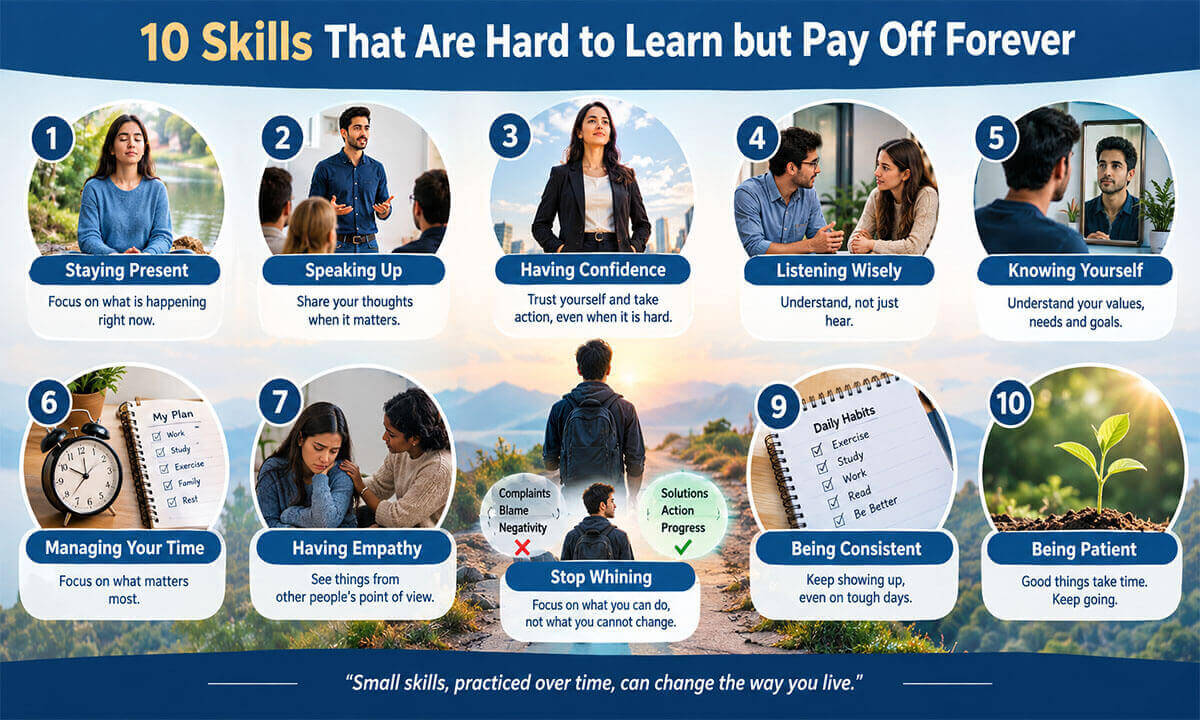
10 Skills That Are Hard to Learn but Pay Off Forever:
Some skills are easy to learn. Others take years. The hardest skills are often not technical skills. They are personal skills that change how we think, speak, work, and deal with other people.
Learning these skills takes time because they require practice and self-awareness. You may fail many times before they become natural. But once you develop them, they can help you in almost every part of life.
You become better at handling pressure. You communicate more clearly. You understand yourself better. You build stronger relationships. You also become more reliable and patient.
Here are 10 skills that are difficult to learn but can benefit you for the rest of your life.
1. Staying Present in the Moment:
Many people spend too much time thinking about the past or worrying about the future. As a result, they miss what is happening right now.
Staying present means giving your attention to the current moment. When someone is talking to you, listen instead of thinking about what you will say next. When you are working, focus on the task instead of checking your phone every few minutes.
Being present can improve your relationships and your work. It also helps you notice your thoughts and emotions before they control your actions.
You do not need to be present every second. Start with small moments. Eat without looking at your phone. Listen carefully during a conversation. Take a few minutes to focus on your surroundings.
Gradually, your ability to stay present becomes stronger.
2. Speaking Up:
Speaking up can be difficult, especially when you are afraid of being judged.
Some people stay silent because they do not want to create conflict. Others worry that their opinion is not important. But staying quiet all the time can create its own problems.
Speaking up does not mean talking all the time. It means expressing your thoughts when they matter.
You may need to ask a question at work. You may need to disagree with someone. You may need to tell another person that their behavior has affected you.
The goal is not to win every argument. The goal is to communicate clearly and respectfully.
You can start by saying what you think without attacking the other person. Use simple statements such as, “I see it differently,” or “I am not comfortable with this.”
The more you practice, the easier it becomes.
3. Having Confidence:
Confidence is not believing that you are better than everyone else. Real confidence means trusting yourself enough to act even when you are uncertain.
Confident people still make mistakes. They still feel nervous. They still have doubts. The difference is that they do not let those feelings stop them from trying.
Confidence grows through action. If you keep waiting until you feel completely ready, you may wait forever.
Start with small challenges. Speak in a meeting. Apply for a job. Learn a new skill. Ask for help when you need it.
Every time you handle something difficult, you learn that you can deal with challenges.
That experience builds confidence.
4. Listening Wisely:
Hearing someone is not the same as listening to them.
Good listening requires attention. You need to understand what the other person is saying instead of preparing your next response.
Wise listening also means noticing emotions and context. Sometimes people say one thing but feel something else.
For example, someone may say, “I’m fine,” while their tone suggests that something is wrong. A good listener does not immediately assume what happened. They may simply ask, “Are you sure you’re okay?”
Listening also means allowing people to finish their thoughts. You do not always need to give advice.
Sometimes people just want to be understood.
When people feel heard, trust becomes easier to build. This makes listening an important skill in friendships, relationships, family life, and work.
5. Knowing the Real You:
Understanding yourself is harder than it sounds.
Many people know what they want others to see. But they may not understand their own values, fears, habits, strengths, and weaknesses.
Knowing the real you means asking honest questions.
- What matters to you?
- What kind of life do you actually want?
- What makes you uncomfortable?
- What habits keep holding you back?
What are you doing because you want to do it, and what are you doing because you want other people to approve of you?
Self-knowledge takes time. You may discover things about yourself that you do not like.
But that honesty is useful.
When you understand yourself better, you can make decisions that fit your values. You also become less dependent on other people’s opinions.
6. Managing Your Time:
Everyone has the same number of hours in a day. But people use those hours differently.
Time management is not about filling every minute with work. It is about deciding what deserves your attention.
Start by identifying your most important tasks. Do those tasks before spending too much time on less important activities.
It also helps to recognize where your time goes. Social media, unnecessary conversations, constant notifications, and poor planning can take hours without you noticing.
Good time management also requires learning to say no.
You cannot do everything. If you say yes to every request, you may have little time for your own priorities.
Managing your time well gives you more control over your day. It can also reduce stress and help you make steady progress toward your goals.
7. Having Empathy:
Empathy means trying to understand another person’s feelings and point of view.
It does not mean that you must agree with everyone.
You can disagree with someone and still understand why they feel the way they do.
Empathy requires you to look beyond your own experience. People have different backgrounds, problems, fears, and expectations. What seems small to you may be serious to someone else.
Before judging someone, try to understand their situation.
Ask questions. Listen. Avoid making quick assumptions.
Empathy can improve relationships because people feel respected and understood. It also helps during disagreements because you are more likely to respond thoughtfully instead of reacting immediately.
8. Stop Whining:
Complaining is normal sometimes. Everyone has bad days.
The problem begins when complaining becomes a habit.
Constant whining keeps your attention on what is wrong without helping you deal with the problem. It can also affect the people around you.
Instead of asking only, “Why is this happening to me?” ask, “What can I do about it?”
You may not be able to change the situation. But you may be able to change your response.
If you cannot change something, learn to accept it. If you can change it, take a small step.
This does not mean ignoring real problems. Speaking about serious problems is important. The difference is between talking about a problem to find a solution and repeating the same complaint without taking action.
Learning this difference can make you more responsible and emotionally stronger.
9. Being Consistent:
Starting something is usually easier than continuing it.
Many people feel motivated when they begin a new goal. They make plans and feel excited. But after a few weeks, the motivation disappears.
Consistency matters because progress usually comes from repeated effort.
You do not need to do something perfectly. You need to keep doing it.
If you want to exercise, you do not need to train for hours every day. If you want to learn a language, you do not need to study all day. A small amount of regular effort can be more useful than occasional periods of intense effort.
Consistency also builds trust.
When people see that you keep your promises and complete your responsibilities, they learn that they can depend on you.
The key is to create habits that you can maintain. Do not build a routine that is so difficult that you quit after a short time.
10. Being Patient:
Patience is difficult because we often want immediate results.
We want to improve quickly. We want problems to disappear quickly. We want other people to change quickly.
But many important things take time.
Learning a skill takes practice. Building trust takes repeated experiences. Developing a career takes years. Personal growth also takes time.
Patience does not mean doing nothing. It means continuing to work while accepting that results may take longer than you want.
You also need patience with yourself.
You will make mistakes. You will have bad days. Sometimes you will move backward before moving forward again.
Do not use one bad day as proof that you cannot improve.
Keep going.
How These Skills Work Together:
These skills are connected.
Staying present helps you listen better. Listening helps you develop empathy. Empathy can improve your relationships.
Knowing yourself can improve your confidence. Confidence can help you speak up.
Time management helps you stay consistent. Consistency and patience help you make progress over time.
Stopping constant complaining can also change how you approach problems. Instead of spending all your energy on what went wrong, you can focus on what you can control.
You do not need to master all 10 skills at once.
Choose one.
Work on it for a few weeks. Notice where you struggle. Make small changes. Then move to the next skill.
Real growth usually happens through small actions repeated over time.
In conclusion, the most useful skills are not always the easiest ones to learn.
Staying present, speaking up, building confidence, listening wisely, knowing yourself, managing your time, showing empathy, stopping constant complaining, staying consistent, and being patient all require practice.
You will not master them overnight.
But you do not need to.
Each small improvement can change how you handle your work, relationships, decisions, and personal challenges.
These skills may take years to develop. But the effort can stay with you for the rest of your life.

is an experienced educator and academic currently serving as a Lecturer at Nurul Amin Degree College. With a career dedicated to student development and institutional excellence, he brings a wealth of classroom expertise and pedagogical knowledge to his current role. Before joining the faculty, he served as an Assistant Teacher at Zinzira PM Pilot School and College.