The Importance of Feedback in Second Language Learning:
Learning a second language is not always easy. Learners need to remember new words, understand grammar, improve pronunciation, and learn how to use the language in real situations. Mistakes are a normal part of this process. However, learners may not always know when they are making mistakes or how to correct them. This is where feedback becomes important. Feedback gives learners information about their language use. It can show them what they are doing well and what they need to improve. A teacher may correct a grammar mistake, suggest a better word, point out a pronunciation problem, or explain why a sentence is unclear. Feedback can also come from classmates, learning materials, language apps, or the learners themselves.
Good feedback does more than identify mistakes. It helps learners understand their progress and make better choices in future language use. It can also improve motivation and confidence when it is given in a respectful and useful way.
For these reasons, feedback is an important part of second language learning. It helps learners notice problems, understand their strengths and weaknesses, and gradually improve their ability to communicate.
Why Feedback Matters in Second Language Learning:
Second language learning requires regular practice. Learners need opportunities to speak, listen, read, and write. But practice alone does not always lead to improvement. If learners repeatedly use an incorrect form without noticing it, the mistake may become a habit.
Feedback helps prevent this problem. It gives learners information that they may not be able to get from practice alone.
1. Feedback Helps Learners Notice Their Errors: One of the main purposes of feedback is to help learners notice mistakes.
Learners do not always recognize their own errors. They may understand what they want to say but use the wrong grammar, pronunciation, or vocabulary. A teacher or another learner can draw attention to the problem.
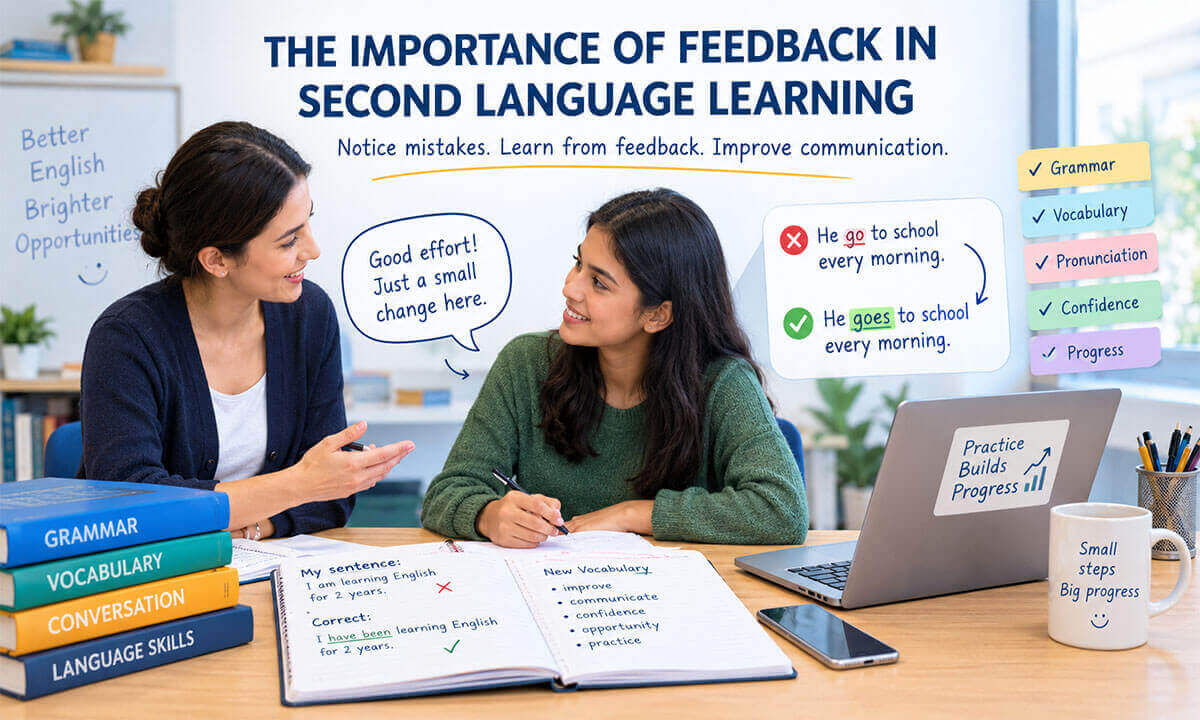
For example, a learner might say: “He go to school every morning.”
A teacher could respond: “He goes to school every morning.”
The learner can then notice that the verb needs to change when the subject is “he.”
This process is important because noticing is closely connected with language development. Once learners become aware of a problem, they can pay more attention to it and try to use the correct form.
2. Feedback Helps Learners Correct Mistakes: Identifying an error is only the first step. Learners also need to understand how to correct it.
Useful feedback provides information about the correct form. It may explain a grammar rule, give a better word choice, or demonstrate correct pronunciation.
For example, if a learner says: “Yesterday I go to the market.”
A teacher might explain that the sentence refers to the past and that “went” is the correct form.
The learner can then understand both the mistake and the correction.
3. Feedback Shows Learners What They Are Doing Well: Feedback is not only about correcting mistakes. It should also recognize successful language use.
For example, a teacher might say: “Your use of linking words made your paragraph easier to follow.”
This tells the learner exactly what worked well.
Specific positive feedback can help learners understand which behaviors they should continue. It can also give them a clearer picture of their progress.
4. Feedback Can Build Confidence: Language learners often feel nervous about making mistakes. This is especially common when speaking in front of others.
Helpful feedback can reduce some of this anxiety. When learners receive respectful correction, they may become more comfortable with the idea that mistakes are part of learning.
For example, saying “Your answer was clear. Now work on the verb tense” is more useful than simply saying “Wrong.”
The first response recognizes success while also showing the learner what needs attention.
5. Feedback Supports Individual Learning Needs: Learners do not have the same strengths and weaknesses.
One learner may have good grammar but weak pronunciation. Another may speak confidently but struggle with writing. Someone else may know many words but have difficulty using them in conversations.
Feedback helps teachers identify these differences. They can then provide support based on the learner’s specific needs.
This makes language learning more focused and useful.
Types of Feedback in Second Language Learning:
There are several types of feedback. Each type has a different purpose.
1. Corrective Feedback: Corrective feedback focuses on language errors. It can involve grammar, pronunciation, vocabulary, spelling, or sentence structure.
There are different ways to provide corrective feedback.
- Explicit Corrective Feedback: With explicit feedback, the teacher directly identifies the mistake and provides the correct form.
For example:
Learner: “I goed to the library.”
Teacher: “The correct form is ‘went.’ You should say, ‘I went to the library.'”
This approach is clear. The learner does not have to guess what the problem was.
Explicit correction can be especially useful when learners are dealing with a new or difficult language rule.
- Implicit Corrective Feedback: With implicit feedback, the teacher does not directly say that the learner has made a mistake. Instead, the teacher provides the correct form naturally.
For example:
Learner: “She don’t like coffee.”
Teacher: “Oh, she doesn’t like coffee?”
The teacher has provided the correct form without directly interrupting the learner with a correction.
This approach can make communication feel more natural. It may also encourage learners to notice the difference between their own language and the teacher’s response.
2. Evaluative Feedback: Evaluative feedback gives learners a general judgment about their performance.
Examples include:
- “Good job.”
- “Excellent.”
- “Needs improvement.”
- “A grade of 80 percent.”
This type of feedback can help learners understand their overall performance. Positive evaluation can also encourage them.
However, evaluative feedback does not always explain what the learner did well or what needs to change. A statement such as “Good work” may feel positive, but it gives little information about how to improve.
For this reason, evaluative feedback is often more useful when combined with specific comments.
3. Descriptive Feedback: Descriptive feedback explains what the learner did well and what could be improved.
For example, instead of saying: “Good paragraph.”
A teacher could say: “Your main idea is clear, and your examples support it well. Try using more linking words between the second and third sentences.”
This gives the learner useful information.
Descriptive feedback can help learners understand their performance and decide what to do next.
4. Peer Feedback: Peer feedback occurs when learners give feedback to one another.
For example, students may exchange written assignments and comment on grammar, organization, vocabulary, or clarity.
Peer feedback has several benefits. It encourages learners to think carefully about language. It also helps them notice mistakes in other people’s work, which may make them more aware of similar problems in their own work.
However, learners need guidance. They should understand how to give respectful and useful feedback. Teachers can provide simple guidelines or checklists to make peer feedback more effective.
5. Self-Feedback: Learners can also evaluate their own language use.
They can record themselves speaking and listen to the recording later. They can review a piece of writing and look for repeated mistakes. They can also keep a record of new vocabulary or grammar problems.
Self-feedback encourages learners to become more independent. Over time, they may become better at noticing their own strengths and weaknesses.
The Timing of Feedback:
The timing of feedback can affect how useful it is.
- Immediate Feedback: Immediate feedback is given soon after an error occurs.
It can be useful during controlled practice, grammar exercises, pronunciation activities, and drills.
For example, if a learner is practicing past tense verbs and makes a mistake, the teacher can correct it immediately. The learner can then repeat the correct form.
However, immediate correction is not always suitable for every speaking activity. If a teacher interrupts every sentence, the learner may become nervous and focus more on avoiding mistakes than communicating.
- Delayed Feedback: Delayed feedback is given after the activity has finished.
This can work well during conversations, presentations, group discussions, and writing tasks.
For example, a teacher may listen to a student’s presentation and take notes without interrupting. After the presentation, the teacher can discuss several important language points.
Delayed feedback allows communication to continue naturally. It also gives learners a chance to complete their ideas without constant interruption.
- Choosing the Right Timing: There is no single timing method that works for every situation.
Teachers should consider the purpose of the activity. If the goal is accuracy, immediate correction may be useful. If the goal is fluency and communication, delayed feedback may be more appropriate.
The important point is to support learning without making learners afraid to communicate.
The Role of Feedback in Motivation:
Feedback can have a strong effect on learner motivation.
Learning a second language takes time. Learners may become frustrated when they do not see quick results. They may also compare themselves with people who seem more fluent.
Useful feedback can help learners see their progress.
For example: “Your pronunciation of these words is clearer than it was last month.”
This type of comment connects feedback with improvement. The learner can see that effort is producing results.
Encouragement Can Support Persistence:
Encouraging feedback can help learners continue when learning becomes difficult.
A teacher does not need to praise everything. Feedback should remain honest and specific.
Instead of saying: “Everything is perfect.”
A teacher can say: “Your vocabulary has improved. You still need to work on verb agreement.”
This is encouraging while remaining realistic.
Feedback and Confidence:
Confidence is important in language learning. Learners need to feel comfortable enough to use the language even when they are not sure about every sentence.
Harsh correction can make learners afraid of making mistakes. They may speak less, avoid difficult structures, or stop participating in class.
Respectful feedback creates a safer learning environment.
Teachers can focus on the behavior rather than the person.
Instead of saying: “You are bad at grammar.”
They can say: “This sentence needs a different verb form.”
The second approach is more specific and gives the learner something they can work on.
Feedback and a Growth Mindset:
Feedback can also help learners develop a more positive view of learning.
Language ability is not fixed. Learners can improve through practice, study, and continued use of the language.
A learner who receives useful feedback may begin to think: “I made a mistake, but now I know what to work on.”
This is more productive than thinking: “I am not good at languages.”
The focus moves from personal ability to learning and improvement.
How Teachers Can Provide Effective Feedback:
Teachers have an essential role in making feedback useful.
1. Be Specific: General comments do not always help learners.
“Good work” is positive, but it does not explain why the work was good.
A more useful comment might be: “Your introduction clearly presents the main idea.”
Specific feedback gives learners something they can understand and use.
2. Focus on Important Problems: Teachers do not need to correct every mistake.
Too many corrections can overwhelm learners. It may also interrupt communication.
Teachers can focus on the errors that are most important for the learning goal.
For example, during a speaking activity focused on past tense, the teacher may pay particular attention to past tense forms rather than correcting every vocabulary choice.
3. Keep the Tone Respectful: The way feedback is delivered matters.
Learners should feel that correction is part of learning rather than a form of punishment.
Teachers can correct errors calmly and respectfully. They can also recognize what the learner has done well.
4. Give Learners Time to Respond: Feedback should not always be a one-way process.
After identifying an error, teachers can give learners time to correct it themselves.
For example:
Teacher: “Yesterday I go to the market?”
The learner may recognize the problem and respond: “Yesterday I went to the market.”
This gives the learner an active role in the correction process.
5. Encourage Questions: Learners may not understand why something is incorrect.
Teachers should allow them to ask questions. A short explanation can sometimes help learners understand a problem much better.
6. Use Different Feedback Methods: One type of feedback may not work equally well for every learner or every task.
Teachers can use direct correction, questions, comments, peer feedback, written notes, and self-assessment.
Using different methods can make feedback more useful and engaging.
What Learners Can Do With Feedback:
Receiving feedback is only one part of the process. Learners also need to use it.
1. Think About the Feedback: Learners should take time to understand what the feedback means.
If a teacher points out a grammar mistake, the learner can ask:
- What was the mistake?
- Why was it incorrect?
- What is the correct form?
- How can I use the correct form in another sentence?
This turns feedback into a learning activity.
2. Keep a Record of Common Mistakes: A simple notebook can be useful.
Learners can write:
- My sentence: He go to school.
- Correct sentence: He goes to school.
- Problem: Subject and verb agreement.
Reviewing these notes regularly can help learners notice repeated problems.
3. Ask Questions: Learners should not be afraid to ask for clarification.
If feedback is unclear, asking a question can prevent confusion.
For example:
“Can you explain why this tense is better?”
This can lead to a deeper understanding of the language.
4. Apply the Feedback: The best way to use feedback is to practice the corrected form.
If a learner receives feedback about past tense, they can create several new sentences using past tense verbs.
If the problem is pronunciation, they can practice the difficult sounds.
Feedback becomes more useful when it leads to action.
5. Look for Patterns: One mistake may not be very serious. Repeated mistakes are more useful to study.
For example, if a learner repeatedly forgets the third-person singular “s,” this becomes an area for focused practice.
Finding patterns can help learners use their study time more effectively.
Feedback in Traditional Classrooms:
Traditional classrooms allow teachers and learners to interact directly.
Teachers can correct pronunciation, ask questions, observe body language, and respond immediately. Learners can also ask questions as soon as they receive feedback.
Face-to-face interaction can make feedback easier to understand because learners can hear the teacher’s tone and see their expressions.
However, classroom feedback can sometimes be difficult when there are many students. A teacher may not have enough time to give detailed feedback to everyone.
Feedback in Online Language Learning:
Online learning has changed how feedback is provided.
Teachers may use written comments, voice messages, recorded lessons, video calls, online quizzes, and shared documents.
Written feedback has one useful advantage. Learners can return to it later.
Audio and video feedback can also provide a more personal experience. A teacher can explain pronunciation or demonstrate how a sentence should sound.
Learners can make better use of online feedback by reviewing comments regularly, asking questions, and practicing corrections after each lesson.
The Role of Technology in Feedback:
Technology can provide additional ways to receive feedback.
Language learning platforms can check spelling, grammar, pronunciation, and vocabulary. Some tools provide immediate responses after an exercise.
However, technology should not completely replace human feedback.
Automated tools can identify certain errors, but they may not always understand the learner’s purpose or the context of communication. Teachers can provide explanations, encouragement, and guidance that automated systems may not provide well.
Technology is most useful when it supports learning rather than replacing thoughtful teaching.
Common Problems With Feedback:
Feedback is useful, but it can also create problems when it is poorly handled.
- Too Much Correction: Correcting every small mistake can make learners feel frustrated.
Teachers should consider which errors are important for the current learning goal.
- Feedback That Is Too General: Comments such as “Improve your grammar” do not give learners enough information.
It is better to identify the specific problem.
- Feedback That Comes Too Late: If feedback is given long after the activity, learners may not remember the original problem.
Feedback should be provided at a time when learners can still connect it with their language use.
- Negative or Embarrassing Feedback: Publicly embarrassing learners can damage confidence.
Correction should be respectful and focused on learning.
- Ignoring Positive Progress: If feedback only focuses on mistakes, learners may feel that they are making no progress.
Teachers should also point out genuine improvements.
Creating a Healthy Feedback Culture:
A good learning environment treats feedback as a normal part of learning.
Teachers can explain that mistakes are expected. Learners can be encouraged to see correction as information rather than punishment.
Students can also learn how to give feedback to one another. They should focus on the work rather than attacking the person.
For example, instead of saying: “Your English is bad.”
A learner could say: “This sentence may be clearer if you change the verb tense.”
This creates a more respectful learning environment.
In conclusion, feedback is a main part of second language learning. It helps learners notice mistakes, understand correct language forms, recognize their progress, and identify areas that need more practice.
Good feedback is not simply about telling learners that they are right or wrong. It explains what happened and gives them useful information about what to do next. It can be explicit or implicit, immediate or delayed, teacher-based or peer-based. The best approach depends on the learner, the activity, and the purpose of the lesson.
Feedback can also affect motivation and confidence. When it is clear, respectful, and balanced, it can help learners see that mistakes are a normal part of learning. It can encourage them to keep practicing instead of giving up.
Learners also have a significant role. They need to reflect on feedback, ask questions, record repeated mistakes, and use corrections in future language activities.
In the end, feedback works best when it becomes part of an ongoing learning process. Learners make mistakes, receive information, practice again, and gradually improve. That process helps turn practice into real progress. For anyone learning a second language, useful feedback is not just helpful. It is an important part of learning how to use the language with greater accuracy and confidence.

is an experienced educator and academic currently serving as a Lecturer at Nurul Amin Degree College. With a career dedicated to student development and institutional excellence, he brings a wealth of classroom expertise and pedagogical knowledge to his current role. Before joining the faculty, he served as an Assistant Teacher at Zinzira PM Pilot School and College.