5 Key Signs & Symptoms of Severe Anxiety:
Anxiety is a natural part of being human. It sharpens our awareness before an exam, keeps us alert in unfamiliar situations, and motivates us to prepare for important events. In healthy amounts, anxiety serves a protective purpose; activating our body’s fight-or-flight response when we perceive a threat. But when anxiety becomes intense, persistent, and overwhelming, it can move beyond a helpful signal and turn into something far more disruptive. Severe anxiety is not simply “worrying too much.” It is a condition that can deeply affect how a person thinks, feels, behaves, and functions in daily life. Tasks that once felt manageable (going to work, attending class, maintaining relationships, or even leaving the house) can begin to feel exhausting or frightening. Recognizing the signs and symptoms of severe anxiety is an essential first step toward healing. Many people struggle in silence, unsure whether what they are experiencing is “normal” stress or something more serious. Understanding the difference empowers individuals to seek appropriate support, whether through coping strategies, therapy, lifestyle adjustments, or medical treatment. The encouraging truth is that severe anxiety is treatable. With early awareness and the right interventions, even the most overwhelming symptoms can be managed effectively. In the rest of this article, we will explore five key signs and symptoms of severe anxiety and provide guidance on when it may be time to seek professional help.
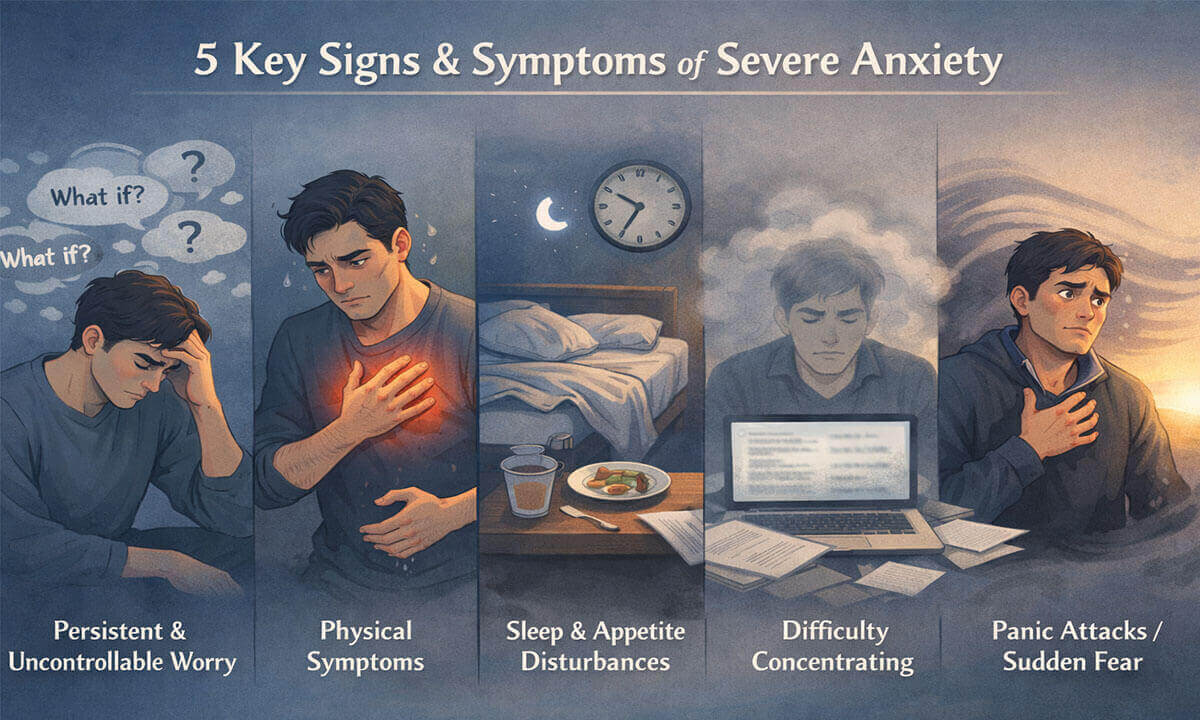
5 Key Signs & Symptoms of Severe Anxiety:
Here, we turn our focus to how severe anxiety actually shows up in daily life. While symptoms can vary from person to person, individuals experiencing severe anxiety often report several of the following signs occurring together. When anxiety becomes intense, persistent, and disruptive, it moves beyond ordinary stress and begins to significantly impair emotional, physical, and cognitive functioning.
1. Persistent and Uncontrollable Worry: One of the most defining features of severe anxiety is persistent, uncontrollable worry. This is not the occasional concern about a deadline or a family issue; it is a near-constant mental state of apprehension that feels difficult, if not impossible, to turn off.
People often describe it as a “mental loop” that replays past conversations, anticipates worst-case scenarios, or magnifies minor issues into major threats. Even when reassurance is offered, the relief is temporary. The mind quickly shifts to a new “what if.” Over time, this constant scanning for danger leaves individuals feeling mentally exhausted, emotionally drained, and physically tense.
This persistent worry frequently disrupts sleep, as the brain struggles to power down at night. Many individuals lie awake replaying the day’s events or anticipating problems that may never occur. The worry feels uncontrollable because the nervous system is operating in a heightened state of alertness. According to Barlow and Craske (2022), severe anxiety reflects dysregulation in fear-based neural systems rather than a flaw in character or willpower. Importantly, this means it is both understandable and treatable with appropriate interventions.
2. Physical Symptoms: Severe anxiety is not just “in the mind.” It manifests powerfully in the body. In fact, many people first notice anxiety through physical sensations that feel alarming or even frightening.
A racing heart is one of the most common symptoms. When the brain perceives danger (real or imagined), it signals the release of adrenaline, increasing heart rate to pump oxygen-rich blood to the muscles. Sweating may occur, even in cool environments, as the body prepares to regulate temperature during potential physical exertion. Trembling or shaking can follow as muscles tense in readiness for action.
While these reactions are part of the body’s natural fight-or-flight response, severe anxiety triggers them too frequently or in situations that do not involve actual danger. This mismatch between perceived and real threat can lead to secondary anxiety, fear of the symptoms themselves. Individuals may worry they are losing control, having a heart problem, or about to faint, which intensifies the cycle.
Understanding that these symptoms are protective rather than harmful can reduce fear. Interventions such as breathwork, grounding techniques, physical movement, and, in some cases, medication can calm the overactive stress response and provide relatively quick relief (Fletcher, 2019).
3. Sleep and Appetite Disturbances: When anxiety keeps the nervous system in overdrive, the body struggles to shift into “rest-and-digest” mode. As a result, sleep and appetite are often disrupted.
Many individuals with severe anxiety report difficulty falling asleep because their thoughts remain active long after bedtime. Others wake frequently throughout the night or rise early with racing thoughts. Even when sleep occurs, it may feel light or unrefreshing. Chronic sleep disruption can worsen irritability, lower frustration tolerance, and amplify anxious thinking.
Appetite changes are also common. Some people experience a loss of appetite due to stomach discomfort, nausea, or a persistent sense of tightness in the chest or abdomen. Others may turn to food for comfort, eating more than usual as a way to self-soothe. Both patterns reflect the body’s stress response and hormonal shifts associated with prolonged anxiety.
Over time, disrupted sleep and irregular eating patterns can intensify anxiety symptoms, creating a self-perpetuating cycle. Recognizing this connection is critical. As Antony and Norton (2015) explain, restoring healthy routines around sleep and nutrition can significantly support anxiety recovery and improve overall emotional regulation.
4. Difficulty Concentrating and Remembering Things: Severe anxiety often interferes with cognitive functioning. When the brain is preoccupied with perceived threats, it diverts resources away from concentration, memory, and decision-making.
Individuals may find themselves rereading the same paragraph repeatedly, losing track of conversations, misplacing everyday items, or struggling to make simple decisions. This mental fog can feel frustrating and discouraging, particularly for those who previously functioned well at work or school.
The explanation lies in the brain’s survival circuitry. In fight-or-flight mode, the brain prioritizes immediate safety over complex thinking. The prefrontal cortex, responsible for reasoning and focus, becomes less dominant, while survival-oriented systems take over. Pittman and Karle (2015) note that anxiety-related hyperarousal can impair short-term memory and executive functioning.
Importantly, these cognitive disruptions are not permanent. As anxiety decreases and the nervous system stabilizes, mental clarity typically returns. Therapy, stress-management techniques, and, when appropriate, medication can help restore cognitive balance.
5. Panic Attacks or Sudden Waves of Fear: For some individuals, severe anxiety escalates into panic attacks, intense episodes of fear that surge suddenly and peak within minutes. These episodes may appear without a clear trigger, leaving the individual confused and frightened.
During a panic attack, people often experience a rapid heartbeat, shortness of breath, chest tightness, dizziness, sweating, tingling sensations, or a feeling of detachment. The intensity can be so overwhelming that individuals fear they are having a heart attack or losing control.
Physiologically, a panic attack is a sudden and exaggerated activation of the body’s stress response. Adrenaline floods the system rapidly, preparing the body for immediate action. Although deeply uncomfortable, panic attacks are not dangerous and always subside. Understanding their biological basis can reduce the fear associated with them.
Welsh (2025) emphasizes that panic attacks are common and highly treatable. Cognitive-behavioral therapy, exposure-based strategies, relaxation training, and medication when necessary can significantly reduce their frequency and severity.
So, severe anxiety affects the whole person (mind, body, and daily functioning). Persistent worry, physical symptoms, disrupted sleep and appetite, cognitive difficulties, and panic attacks are not signs of weakness. They are indicators of a nervous system that has become overstimulated and stuck in survival mode.
The encouraging reality is that severe anxiety is highly treatable. With early recognition, professional support, evidence-based therapy, and appropriate coping strategies, individuals can regain balance, clarity, and a renewed sense of safety in their lives.
When to Seek Help:
Knowing when to seek help for severe anxiety can be challenging, especially because anxiety often builds gradually. Many people normalize their symptoms, telling themselves they are “just stressed” or that things will calm down on their own. While mild, temporary anxiety is a natural part of life, persistent and escalating symptoms deserve attention.
A key indicator that it may be time to seek professional support is when anxiety begins interfering with daily functioning. This can show up in different ways. You might struggle to fall or stay asleep because your mind won’t slow down. Your appetite may change significantly, either decreasing due to constant tension or increasing as a way to cope. Work performance or academic focus may decline because concentration feels impossible. Relationships can also suffer if irritability, avoidance, or emotional withdrawal become common. Even moments that should feel restful (such as weekends or quiet evenings) may feel overshadowed by a constant sense of unease.
Another important sign is feeling perpetually “on edge.” If your body feels tense most of the time, as though something bad is about to happen, your nervous system may be stuck in a heightened state of alert. Experiencing panic attacks (especially if they occur repeatedly or without a clear trigger) is also a strong signal that professional guidance could be helpful. When symptoms feel unpredictable, intense, or increasingly difficult to manage on your own, reaching out for support can prevent the cycle from worsening.
It is equally important to seek help if you begin avoiding places, situations, or responsibilities out of fear. Avoidance may provide short-term relief, but over time it can shrink your world and reinforce anxiety. Early intervention can help prevent this pattern from becoming deeply ingrained.
Reaching out to a doctor, therapist, or other qualified mental health professional is not a sign of weakness, it is an act of courage and self-respect. Severe anxiety reflects an overactive stress response, not a personal failure. As Barlow and Craske (2022) explain, anxiety disorders are rooted in dysregulated fear systems and are highly responsive to evidence-based treatments. Therapy, coping strategies, lifestyle adjustments; and when appropriate, medication, can significantly reduce symptoms and restore a sense of balance.
Seeking help is ultimately about reclaiming your quality of life. If anxiety is limiting your ability to rest, connect, work, or enjoy everyday experiences, support is available, and recovery is possible.
In conclusion, severe anxiety can quietly take over both the mind and body, turning ordinary days into exhausting battles with worry, tension, and fear. When the nervous system remains stuck in a constant state of high alert, even simple tasks can feel overwhelming. Yet it is important to remember that these symptoms (racing thoughts, physical discomfort, sleep disturbances, appetite changes, and difficulty concentrating) are not signs of weakness or personal failure. They are signals that your body and brain are trying, albeit imperfectly, to protect you.
Anxiety often develops gradually, shaped by accumulated stress, significant life transitions, past experiences, or biological vulnerability. Understanding this helps replace self-criticism with self-compassion. What you are experiencing is human, common, and treatable.
The hopeful reality is that improvement is possible. With professional guidance, supportive relationships, healthy coping strategies, and medication when appropriate, the nervous system can learn to settle. The mind can become clearer, the body calmer, and daily life more manageable again.
Reaching out for help is not a last resort; it is a proactive and courageous step toward healing. With the right support, it is entirely possible to move from feeling overwhelmed and on edge to feeling steady, safe, and back in control of your life.
Frequently Asked Questions (FAQs):
What is the difference between normal anxiety and severe anxiety?
Normal anxiety is temporary and usually linked to a specific situation, such as an exam, job interview, or important decision. It tends to fade once the situation passes. Severe anxiety, however, is persistent, intense, and often disproportionate to the actual circumstance. It interferes with daily functioning (affecting sleep, concentration, relationships, and overall well-being).
Can severe anxiety go away on its own?
Mild anxiety sometimes improves when stress decreases. However, severe anxiety often requires intentional support. Without treatment, symptoms may persist or even worsen over time. The good news is that severe anxiety responds very well to therapy, coping strategies, lifestyle adjustments, and sometimes medication.
Are physical symptoms of anxiety dangerous?
Although symptoms like a racing heart, sweating, dizziness, or trembling can feel frightening, they are usually not dangerous. They are part of the body’s natural fight-or-flight response. However, if you are unsure whether your symptoms are anxiety-related or medical, it is always wise to consult a healthcare professional for reassurance and proper evaluation.
What are panic attacks, and how long do they last?
Panic attacks are sudden, intense surges of fear that may include symptoms such as chest tightness, rapid heartbeat, shortness of breath, dizziness, or a feeling of losing control. They typically peak within minutes and gradually subside. While deeply uncomfortable, panic attacks are temporary and treatable.
When should I seek professional help?
You should consider seeking help if anxiety consistently interferes with your daily life such as disrupting sleep, affecting work or school performance, straining relationships, or causing frequent panic attacks. If you feel constantly on edge or unable to manage symptoms on your own, professional support can make a meaningful difference.
What treatments are most effective for severe anxiety?
Evidence-based treatments include cognitive-behavioral therapy (CBT), exposure therapy, mindfulness-based approaches, and in some cases, medication prescribed by a healthcare provider. Many people benefit from a combination of therapy, lifestyle changes, and stress-management techniques.
Is taking medication for anxiety a sign of weakness?
No, taking medication for anxiety is not a sign of weakness. For some individuals, medication helps regulate brain chemistry and reduce overwhelming symptoms, making it easier to engage in therapy and daily life. Treatment decisions should always be made in consultation with a qualified medical professional.
Can lifestyle changes really help severe anxiety?
Yes, regular exercise, consistent sleep routines, balanced nutrition, reduced caffeine intake, breathing exercises, and relaxation practices can significantly support recovery. While lifestyle changes alone may not resolve severe anxiety, they play a powerful role in calming the nervous system and improving overall resilience.
References:
- Antony, M. M., & Norton, P. J. (2015). The anti-anxiety workbook: Proven strategies to overcome worry, phobias, panic, and obsessions (2nd ed.). Guilford Press.
- Barlow, D. H., & Craske, M. G. (2022). Mastery of your anxiety and panic: Workbook. Oxford University Press.
- Bourne, E. J. (2015). The anxiety and phobia workbook (6th ed.). New Harbinger Publications.
- Fletcher, J. (2019). Anxiety: Practical about panic: A practical guide to understanding and overcoming anxiety disorder. John Murray One.
- Meares, K., & Freeston, M. (2015). Overcoming worry and generalised anxiety disorder: A self-help guide using cognitive behavioural techniques (2nd ed.). Robinson.
- Pittman, C. M., & Karle, E. M. (2015). Rewire your anxious brain: How to use the neuroscience of fear to end anxiety, panic, and worry. New Harbinger Publications.
- Welsh, E. (2025). The cognitive behavioral therapy workbook for panic attacks. Sourcebooks, Inc.

is an experienced educator and academic currently serving as a Lecturer at Nurul Amin Degree College. With a career dedicated to student development and institutional excellence, he brings a wealth of classroom expertise and pedagogical knowledge to his current role. Before joining the faculty at Nurul Amin Degree College, he served as an Assistant Teacher at Zinzira PM Pilot School and College.