How Experiential Learning Prepares Students for Real-World Success:
Traditional classroom learning is useful, but some skills are difficult to learn from books or presentations. Leadership and teamwork, for example, are better understood through real experience. Experiential learning means learning by doing. Students take part in practical activities and learn from their experiences. They do not simply memorize information for exams. Instead, they apply what they learn to real situations. This approach helps students develop practical skills, solve problems, work with others, and become more prepared for success in the real world. In the rest of this article, we will explore how experiential learning prepares students for real-world success.
What Is Experiential Learning?
Experiential learning is a way of learning through direct experience. Instead of only listening to lectures or reading textbooks, students take part in activities that help them understand ideas in a practical way. It is often described as “learning by doing.”
In traditional learning, students may learn about a topic by reading or listening to a teacher. In experiential learning, they get the chance to use that knowledge in real or realistic situations. This helps them understand not only what something means but also how it works in practice.
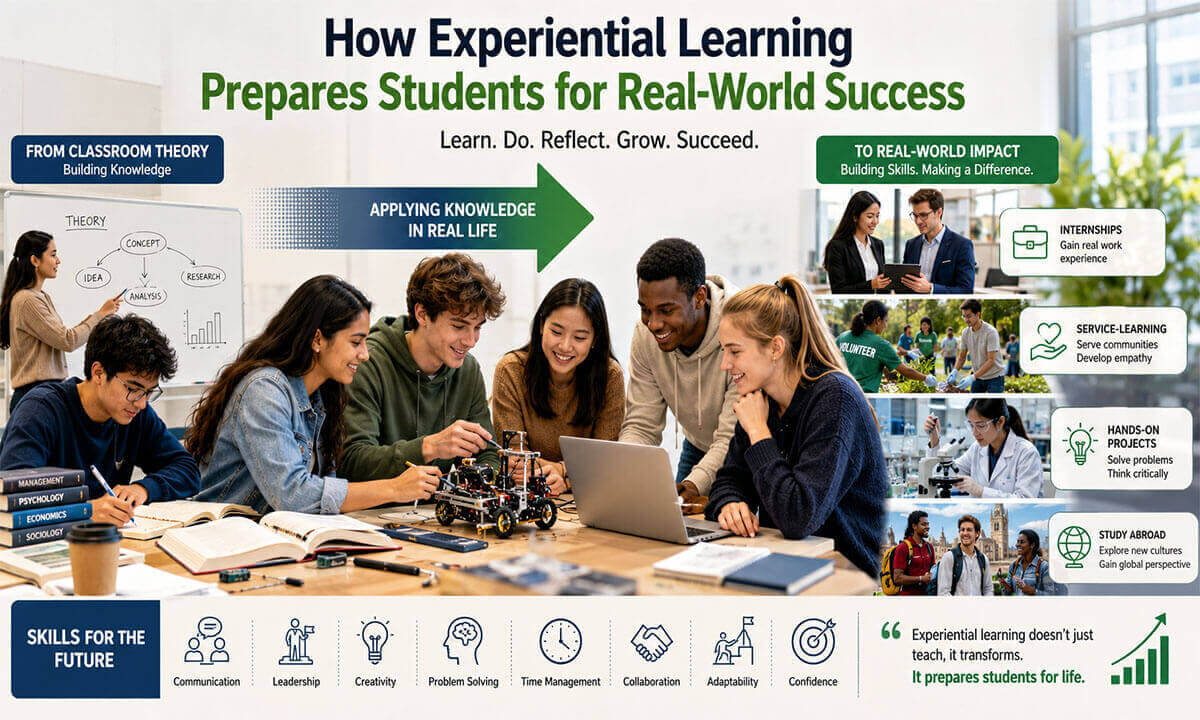
For example, students can learn through internships, laboratory experiments, simulations, group projects, role-playing, community service, and study abroad programs. These activities allow students to take an active role in their learning. They can try new things, make decisions, face challenges, and learn from their mistakes.
Experiential learning also helps students connect classroom knowledge with real life. A student may learn about teamwork from a textbook, but working with classmates on a real project can provide a deeper understanding of cooperation and communication. Similarly, students can learn about leadership by taking responsibility for a group activity.
Educational theorist David Kolb is closely associated with experiential learning. He explained that learning takes place when people create knowledge by transforming their experiences. In simple terms, students first have an experience, think about what happened, and then use what they have learned to improve their understanding and actions.
Therefore, experiential learning is not simply about making education more enjoyable. It is a meaningful approach that connects experience, reflection, knowledge, and action. By learning through real experiences, students can develop practical skills and become better prepared for challenges beyond the classroom.
Why Traditional Learning Can Fall Short:
Traditional learning is an important part of education. Textbooks, lectures, and classroom discussions help students build a strong foundation of knowledge. Students need to understand basic facts, theories, and concepts before they can use them in practical situations. Therefore, traditional learning should not be seen as useless or outdated.
However, traditional learning can sometimes have limitations when it focuses mainly on theory. Students may understand information for an examination but struggle to use that knowledge in real life. Knowing something in theory does not always mean knowing how to apply it in practice.
Consider learning how to swim. A student could read a detailed book about swimming and learn about different swimming techniques. The student might even answer every question correctly on a written test. However, this knowledge alone would not teach the student how to stay safe and move confidently in a swimming pool. Actual practice is necessary to develop that skill.
A similar situation can happen in education. Students may earn high grades and understand many academic concepts, but they may feel uncertain when they enter the workplace. They may not have enough experience with teamwork, communication, decision-making, problem-solving, or handling real challenges.
This is where experiential learning becomes valuable. It connects classroom knowledge with practical experience. Students get opportunities to use what they have learned in realistic situations. Through projects, internships, experiments, simulations, and other practical activities, they can develop skills that are difficult to gain from textbooks alone.
Experiential learning does not replace traditional education. Instead, the two approaches can work together. Traditional learning provides the knowledge and theories, while experiential learning gives students opportunities to apply that knowledge. Together, they can prepare students not only to understand what they have learned but also to use it effectively in the real world.
The Core Benefits of Experiential Learning:
Experiential learning offers several benefits for students. It helps them move beyond memorizing information and gives them opportunities to use their knowledge in practical situations. Through real experiences, students can develop useful skills, become more confident, and understand their subjects more deeply.
1. Builds Real-World Skills: One of the main benefits of experiential learning is that it helps students develop skills that are useful in everyday life and the workplace. Academic knowledge is important, but students also need to know how to use that knowledge effectively.
Through practical activities, students can develop skills such as:
- Communication
- Leadership
- Creativity
- Problem solving
- Time management
- Teamwork and collaboration
- Decision making
- Adaptability
For example, a group project can give students experience that is similar to a real workplace. Students may need to divide responsibilities, communicate with team members, manage deadlines, solve unexpected problems, and complete a common task. These experiences help students understand how to work effectively with others.
2. Increases Confidence and Independence: Experiential learning can also help students become more confident and independent. When students solve problems themselves, they begin to trust their own abilities.
Practical learning also gives students opportunities to make mistakes. Mistakes are not always failures. They can become useful learning experiences when students think about what went wrong and try again.
For example, learning to ride a bicycle usually requires several attempts. A person may lose balance and fall many times before learning how to ride properly. Each attempt provides useful information. Over time, practice builds confidence and skill.
In the same way, students can learn from their experiences in projects, experiments, internships, and other practical activities. This can make them more willing to face new challenges.
3. Develops Critical Thinking and Reflection: Experiential learning is not only about doing something. It is also about thinking carefully about what happened.
After completing an activity, students can reflect on their experience by asking questions such as:
- What went well?
- What problems did I face?
- What could I have done differently?
- What did I learn from this experience?
- How can I use this knowledge in another situation?
This process of reflection makes learning more meaningful. Students can understand their strengths and weaknesses and identify ways to improve. They also learn to think about different solutions instead of accepting the first answer they find.
Reflection is especially important because real life does not always provide simple answers. Students need to learn how to examine situations, learn from experience, and make better decisions in the future.
4. Connects Theory with Practice: Another key benefit of experiential learning is that it connects classroom knowledge with real life. Students often learn theories and concepts in class but may not immediately understand how those ideas can be used.
Experiential learning helps students make this connection.
For example, students studying economics might take part in a business simulation. They can use economic concepts to make decisions and observe the possible results. Similarly, biology students might take part in a field study and use their classroom knowledge to observe plants, animals, or environmental conditions.
These experiences help students understand why their subjects matter. Instead of simply asking, “When will I ever use this?” students can see how academic knowledge can be applied to real situations.
This connection can also make learning more interesting and meaningful. When students understand the purpose of what they are learning, they are more likely to remember it and use it effectively.
Types of Experiential Learning That Lead to Success:
Experiential learning can take many different forms. It is not limited to one type of activity. Students can learn through work experience, community service, cultural activities, simulations, and practical projects. Each type gives students an opportunity to apply knowledge, develop useful skills, and learn from real experiences.
1. Internships and Work-Based Learning: Internships and other forms of work-based learning give students direct experience in a professional environment. They allow students to see how the knowledge they learn in the classroom is used in real workplaces.
During an internship, students may work with professionals, complete assigned tasks, communicate with colleagues, and solve practical problems. They can also learn about the expectations and responsibilities of their chosen profession.
Work-based learning can help students develop professional skills and understand whether a particular career is suitable for them. It can also help them build professional relationships and gain experience that may be useful when applying for future jobs.
2. Service Learning Projects: Service learning combines academic learning with community service. Students use their knowledge and skills to work on real problems in their communities.
For example, students may participate in environmental projects, literacy programs, community health activities, or educational campaigns. While taking part in these activities, they can connect what they learn in class with real community needs.
Service learning can develop communication, teamwork, and problem-solving skills. It can also help students develop empathy, social responsibility, and an understanding of people from different backgrounds.
3. Study Abroad and Cultural Immersion: Study abroad programs give students opportunities to learn in a different country and experience a new culture. Students may have to communicate with people who have different languages, customs, and ways of life.
Living in a new environment can help students become more adaptable and independent. They may need to solve everyday problems, make decisions, and adjust to unfamiliar situations.
These experiences can improve communication skills and help students develop a broader understanding of the world. They can also teach students to respect cultural differences and appreciate different perspectives.
4. Simulations and Role-Playing: Simulations and role-playing allow students to practise real-world situations in a controlled learning environment. Students can take on different roles and make decisions without facing the full risks of real life.
For example, law students may participate in mock trials. Business students may take part in business strategy simulations. Medical students may practise responding to simulated patient situations.
These activities allow students to experiment, make decisions, solve problems, and learn from the results. If something goes wrong, students can discuss what happened and try a different approach. This makes simulations a useful way to prepare students for real situations.
5. Entrepreneurial Projects: Entrepreneurial projects give students opportunities to turn ideas into practical projects. They may develop a business idea, create a product, prepare a business plan, or present an idea to potential investors.
Activities such as startup projects, business competitions, innovation labs, and student enterprises can help students understand how businesses work. Students may learn about budgeting, marketing, planning, communication, and decision-making.
Entrepreneurial projects also teach students that success does not always come from the first attempt. Students may face problems, receive criticism, change their plans, and try again. These experiences can develop persistence, creativity, flexibility, and adaptability.
The Role of Educators in Experiential Learning:
Experiential learning requires active support from educators. Teachers and faculty members have an important role in creating meaningful learning experiences. Their role is not limited to giving lectures or providing information. They also act as facilitators, mentors, and guides.
Educators can design activities that allow students to participate actively in the learning process. These activities should have clear learning goals and should connect with the subject being studied.
Teachers can also encourage students to ask questions, explore ideas, solve problems, and reflect on their experiences. Instead of giving students every answer, educators can ask thoughtful questions that help students find answers themselves.
For example, after a group project, a teacher might ask students what they learned, what problems they faced, how they worked as a team, and what they would do differently next time. Such questions encourage students to think deeply about their experiences.
Good educators understand that students learn not only by receiving information but also by doing, thinking, discussing, and reflecting. When teachers create these opportunities, students can develop knowledge as well as practical skills.
How Schools and Colleges Can Support Experiential Learning:
Schools and colleges have an important role in making experiential learning a regular part of education. Students need opportunities to use their knowledge in practical situations. However, these opportunities are easier to provide when educational institutions actively support them. There are numerous ways schools and colleges can create a stronger environment for experiential learning. Some of them are being briefly:
1. Develop Partnerships With Organizations: Schools and colleges can work with local businesses, nonprofit organizations, government agencies, and startups. These partnerships can provide students with internships, work placements, field experiences, and practical projects.
For example, a business student might work with a local company, while a social science student might participate in a community project. Such partnerships allow students to experience real working environments and understand how their academic knowledge is used outside the classroom.
2. Include Experience-Based Assignments: Experiential learning can also be included directly in the curriculum. Teachers can design assignments that require students to apply what they have learned.
Instead of asking students only to write about a topic, teachers can ask them to complete a survey, conduct an interview, solve a practical problem, prepare a project, or study a real situation. These activities can make learning more active and meaningful.
3. Provide Useful Learning Resources: Educational institutions can provide facilities that support practical learning. These may include laboratories, computer facilities, libraries, maker spaces, technology centers, and innovation hubs.
Such resources give students places where they can experiment, create, test ideas, and develop practical skills. Access to appropriate resources can make it easier for students to turn theoretical knowledge into practical experience.
4. Encourage Interdisciplinary Projects: Many real-world problems cannot be solved using knowledge from only one subject. Schools and colleges can therefore encourage students from different departments to work together.
For example, an environmental project could involve students from biology, economics, sociology, and business. Each group could contribute different knowledge and skills.
Interdisciplinary projects help students understand different perspectives. They also improve communication, teamwork, creativity, and problem-solving.
5. Support Faculty Training: Teachers also need support when institutions introduce experiential learning. Teaching through practical activities can be different from traditional classroom teaching.
Schools and colleges can provide professional development and training programs to help teachers design practical activities, guide student projects, assess learning experiences, and use reflection effectively.
With proper training, educators can become more comfortable with their role as facilitators and mentors rather than simply providers of information.
When educational institutions invest in these areas, students receive more opportunities to learn through real experiences. They can develop practical skills, gain confidence, and become better prepared for further education, employment, and everyday life.
Real Students, Real Success Stories:
The value of experiential learning becomes clearer when we consider how students can use it in real situations. The following examples show how practical experiences can change the way students understand their subjects and themselves.
Example 1: Aisha and Community Service: Aisha is a political science student who takes part in a community outreach project as part of her service learning course. In the classroom, she studies government, public policy, and civic participation.
Instead of only reading about these topics, Aisha works with local community leaders on a project related to voter access. She talks with community members, identifies problems, and helps develop ideas for improving access to voting information and services.
Through this experience, Aisha gains a better understanding of how public policy affects people in everyday life. She also develops communication, teamwork, problem-solving, and leadership skills.
The experience helps her see political science as more than a subject in a textbook. She begins to understand how knowledge can be used to address real community problems.
Example 2: James and Sustainable Technology: James is an engineering student who completes an internship at a sustainable technology company. In his classes, he has learned about renewable energy and solar technology.
During his internship, he gets the opportunity to work on a practical project involving solar panels for communities that have limited access to electricity. He works with other team members to develop and test a prototype.
This experience allows James to apply his classroom knowledge to a real engineering problem. He also learns how to work with professionals, manage challenges, improve designs, and respond to feedback.
The experience gives him a deeper understanding of engineering and helps him become more confident in his abilities.
What These Experiences Teach Us: The experiences of students like Aisha and James show that experiential learning can provide much more than something to add to a resume. Practical experiences can change how students understand their subjects, their abilities, and their future careers.
When students work on real problems, they can discover their strengths and identify areas where they need to improve. They also learn that knowledge becomes more valuable when they know how to apply it.
In this way, experiential learning can help students become more confident, capable, responsible, and prepared for the real world.
Final Thoughts (Experiential Learning Prepares Students for Life):
In a rapidly changing world, students need more than facts and theories. They need to know how to adapt, solve problems, work with others, and handle unexpected situations.
Experiential learning helps students develop these important skills. It allows them to learn through real experiences and apply their knowledge in practical situations.
Experiential learning is not only about preparing students for future careers but also prepares them for everyday life by building confidence, independence, responsibility, and resilience.
For students, parents, and educators, creating more opportunities for practical learning can make education more meaningful and useful. Real-world success begins when students have the chance to learn from real-world experiences.

is an experienced educator and academic currently serving as a Lecturer at Nurul Amin Degree College. With a career dedicated to student development and institutional excellence, he brings a wealth of classroom expertise and pedagogical knowledge to his current role. Before joining the faculty at Nurul Amin Degree College, he served as an Assistant Teacher at Zinzira PM Pilot School and College.