How to Monetize Your Skills:
Everyone has skills that can create value for other people. Some people are good at writing, teaching, designing, coding, repairing things, selling, organizing, or communicating. However, having a skill is not enough. A skill becomes financially valuable when it solves a real problem for someone who is willing to pay for the solution.
Monetizing your skills means turning what you know or what you can do into a source of income. You do not always need a large business, expensive equipment, or a big investment to begin. You can start with the skills, knowledge, and resources you already have. With the right approach, a small skill can become a useful service, a product, or even a long-term career. Here are ten practical ways to monetize your skills.
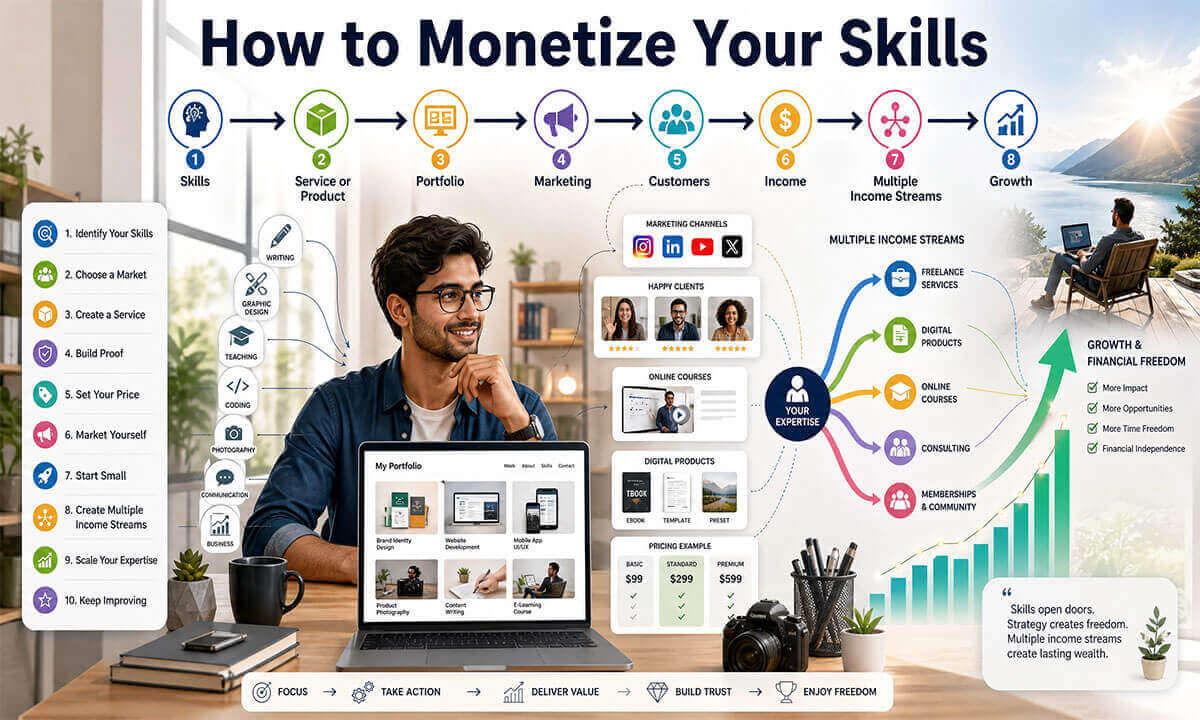
1. Identify Your Valuable Skills:
The first step is to understand what you can do well. Think about your education, work experience, hobbies, and personal interests. Some skills may seem ordinary to you because you have used them for years, but they may be valuable to someone else.
For example, if you are good at writing, you could offer blog writing or editing services. If you are good at Excel, you could help small businesses organize their financial records. If you are good at teaching, you could provide private tutoring or create online lessons.
Make a list of your strongest skills and ask yourself which ones solve problems for other people.
2. Choose a Specific Market:
Trying to sell your skills to everyone can make it difficult to find customers. It is usually better to choose a specific group of people who need your skill.
For example, instead of saying, “I provide writing services,” you could say, “I write website content for small businesses.” Instead of offering general tutoring, you could focus on helping secondary school students improve their English.
A specific market makes your message clearer. People can quickly understand who you help and what you can do for them.
3. Turn the Skill Into a Service or Product:
Once you know your skill and target market, turn that skill into something people can buy.
A service involves doing something for a customer. Examples include graphic design, tutoring, photography, bookkeeping, writing, website development, and consulting.
A product is something you create once and sell to many people. Examples include ebooks, templates, online courses, study materials, design assets, and digital guides.
For example, a person who is good at teaching mathematics could offer one-to-one tutoring, create a mathematics course, or sell practice worksheets.
The important thing is to make your skill easy for customers to understand and purchase.
4. Build Proof of Your Ability:
People are more likely to pay you when they can see evidence of your ability. This is why you need a portfolio or some other form of proof.
If you are a writer, create several good sample articles. If you are a designer, create sample designs. If you are a photographer, build a collection of your best photographs. If you are a tutor, collect feedback from students or create useful educational materials.
You do not need dozens of examples. A few strong examples can be enough when you are starting.
For instance, a new graphic designer could create five sample logos for imaginary businesses and use them as a portfolio. These examples can demonstrate ability even before the designer has many paying clients.
5. Set Your Price:
Pricing can be difficult when you are starting. Many beginners make the mistake of charging extremely low prices because they are afraid that nobody will hire them.
Your price should consider the value you provide, the time required, your experience, the complexity of the work, and the market you are serving.
For example, a simple proofreading job may have a different price from editing a detailed research paper. Similarly, creating a basic social media post is different from managing an entire social media account.
You can start with a reasonable price and increase it as your experience, reputation, and results improve.
6. Market Yourself:
Even if you are highly skilled, people cannot hire you if they do not know that you exist. Marketing helps you become visible to potential customers.
You can use social media, professional networks, personal websites, online communities, referrals, and direct communication with potential clients.
For example, a photographer can regularly share useful photography tips and examples of their work. A writer can publish helpful articles. A teacher can share educational videos or short lessons.
Good marketing is not simply telling people to buy from you. It is showing people how your skill can solve their problems.
7. Start With What You Have:
Do not wait until everything is perfect before starting. Many people delay monetizing their skills because they believe they need expensive equipment, a professional office, or a large audience.
In reality, you can often begin with simple resources.
A person who wants to become a freelance writer may only need a computer, an internet connection, and writing samples. Someone who wants to teach online may begin with a basic smartphone, a quiet room, and useful teaching materials.
Start small and improve your tools as your income grows.
8. Create Multiple Income Streams:
Depending on only one source of income can create financial pressure. Once you have established one income source, consider adding others that are connected to your skills.
For example, a writer could earn money from freelance writing, ebooks, online courses, affiliate content, and consulting. A teacher could combine private tutoring, digital courses, educational resources, and workshops.
The goal is not to create ten businesses at the same time. Start with one reliable income source and gradually add other sources.
Multiple income streams can also help you make better use of the same skill.
9. Scale Your Expertise:
After gaining experience, look for ways to earn more without simply working more hours.
You could increase your prices, work with better clients, create digital products, teach other people, develop a course, build a small team, or create systems that make your work more efficient.
For example, a freelance designer may initially work directly with individual clients. Later, the designer could create design templates and sell them online. The designer could also teach design to beginners.
This allows expertise to become more valuable over time.
10. Keep Improving:
Markets change, technology changes, and customer needs change. A skill that is valuable today may become less valuable if you stop learning.
Keep improving your knowledge and look for better ways to solve problems. Read books, take courses, study successful people in your field, practice regularly, and pay attention to customer feedback.
For example, a traditional writer can learn search engine optimization, content marketing, and artificial intelligence tools. These additional skills can make the writer more useful to modern clients.
Continuous learning keeps your skills relevant and creates new opportunities.
In conclusion, monetizing your skills does not happen overnight. It requires patience, practice, marketing, and a willingness to learn from mistakes. The most important step is to begin.
Identify what you are good at, find people who need that skill, turn it into a clear service or product, and show people what you can do. Start with the resources you already have and improve as you gain experience.
Your skill does not have to be extraordinary to make money. It simply needs to create value for someone. When you consistently solve problems, build trust, and improve your expertise, your skills can become a powerful source of income and long-term independence.

is an experienced educator and academic currently serving as a Lecturer at Nurul Amin Degree College. With a career dedicated to student development and institutional excellence, he brings a wealth of classroom expertise and pedagogical knowledge to his current role. Before joining the faculty, he served as an Assistant Teacher at Zinzira PM Pilot School and College.