The Benefits of Self-Evaluation in the Learning Process:
Have you ever completed an assignment, project, or exam and moved on without thinking about how you performed? Many students do this. However, taking time to evaluate your own work can help you learn from your experiences. Self-evaluation helps students understand their strengths, identify their weaknesses, and improve their learning. It also makes them more responsible and aware of their progress. This article explains the benefits of self-evaluation in the learning process.
What Is Self-Evaluation?
Self-evaluation means looking at your own performance, progress, and understanding of a subject or task. It is the process of thinking about what you have learned, how well you have performed, and what you can do to improve. Students can use self-evaluation after completing an assignment, project, exam, presentation, or other learning activity.
Self-evaluation is not about finding faults in yourself or judging yourself too harshly. Instead, it helps you understand your learning experience in an honest and balanced way. It gives you a chance to think about both your strengths and your weaknesses.
For example, after completing an assignment, you can ask yourself a few simple questions:
What did I do well?
Think about the parts of your work that were successful. You may have explained your ideas clearly, managed your time well, or used good sources.
Where did I struggle?
Identify the areas that were difficult for you. Perhaps you had trouble understanding a topic, organizing your ideas, or completing the work on time.
What can I do differently next time?
Think about practical ways to improve. You may need to study earlier, ask for help, practice more, or use a different learning method.
It is significant to understand that self-evaluation is different from self-criticism. Self-criticism focuses mainly on mistakes and can make a person feel discouraged. Self-evaluation focuses on learning from both success and mistakes. It helps students become more aware of their abilities and take responsibility for their own progress.
The main purpose of self-evaluation is growth and improvement. When students regularly reflect on their learning, they can understand what works for them, correct their mistakes, set better goals, and become more confident learners.
Why Traditional Learning Often Misses the Mark:
Traditional learning often focuses on listening to teachers, memorizing information, completing assignments, and preparing for exams. Students may learn many facts, but they do not always get enough time to think about what they have learned. They may finish one lesson and quickly move on to the next one without asking themselves whether they truly understood the topic.
This approach can make learning more passive. Students may simply receive information from teachers, books, or other learning materials. They may remember the information for an exam but forget it later because they did not have enough opportunity to connect it with their own experiences or ideas.
Reflection is an important part of meaningful learning. Students need time to think about questions such as, “What did I learn?” “What do I understand well?” and “Which areas are still difficult for me?” These questions help students become more aware of their learning process.
This is where self-evaluation becomes important. It gives students an opportunity to take an active role in their education. Instead of only receiving information, they begin to think about it, understand it, question it, and connect it with what they already know.
Self-evaluation can also help students discover better ways to learn. For example, a student may realize that reading alone is not enough to understand a difficult subject. The student may decide to take notes, practice more questions, discuss the topic with classmates, or ask the teacher for help.
In this way, self-evaluation changes students from passive learners into active participants. They become more aware of their strengths, weaknesses, progress, and learning needs. Rather than simply following the learning process, they begin to take greater responsibility for it.
Traditional learning can provide important knowledge and skills, but learning becomes more effective when students also have time to reflect on their own progress. Self-evaluation provides that opportunity and helps students become more thoughtful, independent, and responsible learners.
The Benefits of Self-Evaluation in the Learning Process:
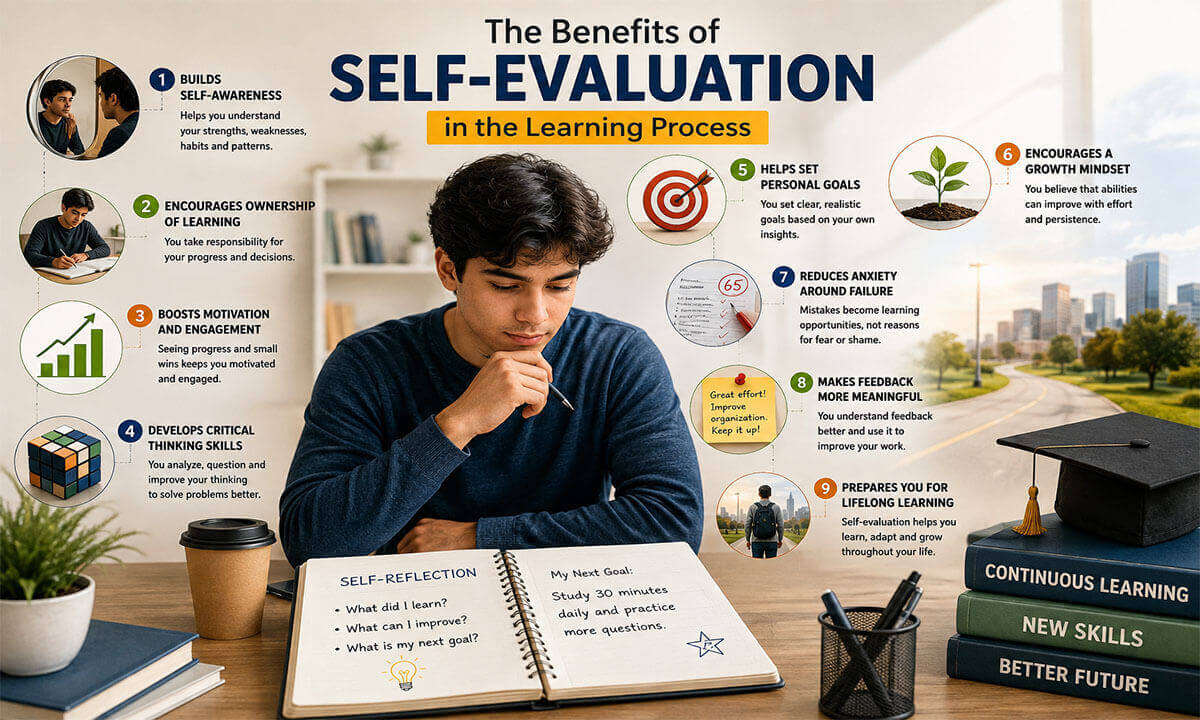
1. Builds Self-Awareness: One of the most imperative benefits of self-evaluation is that it helps students understand themselves as learners. When students regularly think about their learning, they begin to notice their strengths, weaknesses, habits, and common challenges.
For example, a student may realize that they understand lessons well but often leave assignments until the last minute. Another student may discover that they are good at remembering information but have difficulty applying what they have learned to practical situations.
Understanding these patterns is the first step toward improvement. When students know where they are doing well and where they need help, they can take suitable steps to improve. Self-awareness therefore helps students make better decisions about their learning.
2. Encourages Ownership of Learning: Self-evaluation encourages students to take responsibility for their own education. Instead of depending completely on teachers, parents, or grades to understand their progress, students begin to judge their own performance.
They can ask themselves simple questions such as:
- Did I give my best effort?
- What did I learn from this task?
- What do I need to improve?
- What can I do better next time?
These questions encourage students to become more independent. They begin to understand that their progress depends not only on what others teach them but also on the effort and choices they make. This sense of responsibility can build confidence and prepare students for future challenges.
3. Increases Motivation and Engagement: Students can sometimes lose interest in learning when they feel that they are not making progress. Self-evaluation can help solve this problem by allowing students to notice their own improvement.
For example, a student who struggled with mathematics at the beginning of the year may later notice that they can now solve problems that once seemed difficult. Recognizing this improvement can create a strong feeling of achievement.
Small improvements can increase motivation. When students see that their effort is producing results, they are more likely to continue working and take an active interest in their studies. Self-evaluation therefore helps students stay focused and engaged in the learning process.
4. Develops Critical Thinking Skills: Self-evaluation is closely connected with critical thinking. When students evaluate their own learning, they do not simply look at whether they received a good or bad result. They also think about why they achieved that result.
They may ask, “What worked well?” “What did not work?” and “Why did I make this mistake?” They then consider what they could change in the future.
This process teaches students to examine information, analyze problems, make decisions, and find better solutions. These skills are useful not only in education but also in professional and everyday life. Regular self-evaluation can therefore help students become more thoughtful and effective thinkers.
5. Helps Students Set Personal Goals: Self-evaluation naturally helps students set realistic and meaningful goals. After reviewing their performance, students can identify specific areas that need improvement and create goals based on their needs.
For example, instead of saying, “I need to study harder,” a student might decide, “I will study for 30 minutes every evening this week.” Another student may decide, “I will ask my teacher for help when I do not understand a topic instead of waiting until the exam.”
These goals are based on the student’s own experience. As a result, they are often more meaningful and easier to follow. Self-evaluation helps students understand where they are now, where they want to go, and what steps they need to take to get there.
6. Encourages a Growth Mindset: Self-evaluation can help students develop a growth mindset. A growth mindset means believing that abilities and skills can improve through effort, practice, learning, and persistence.
When students evaluate their progress, they can see that improvement is possible. They may notice that something they found difficult in the past has become easier after regular practice.
For example, instead of thinking, “I am not good at English,” a student may begin to think, “I am having difficulty with English now, but I can improve by reading, writing, and practicing regularly.”
This change in thinking can make students more willing to face challenges. They are less likely to give up after making mistakes because they understand that mistakes can be part of learning.
7. Reduces Fear of Failure: Failure can be difficult for students, especially when they believe that a poor result defines their ability. Self-evaluation can help students develop a healthier understanding of failure.
When students regularly reflect on their mistakes, they can begin to see them as useful information. A poor test result, for example, can show a student which topics need more attention. Instead of feeling that everything has gone wrong, the student can use the result to plan the next steps.
This way of thinking can reduce unnecessary fear and disappointment. Students learn that one mistake or one poor result does not decide their future. They can learn from the experience, make changes, and try again.
8. Makes Feedback More Meaningful: Teachers often provide feedback to help students improve. However, students may not always understand or use that feedback effectively. Self-evaluation can make feedback more useful because students have already thought about their own performance.
For example, a student may realize that their assignment was well researched but poorly organized. If the teacher gives similar feedback, the student is more likely to understand its importance and take action.
Self-evaluation therefore prepares students to receive feedback with an open mind. Instead of seeing feedback as criticism, they can see it as additional information that can help them improve their work.
9. Prepares Students for Lifelong Learning: Learning does not end when students leave school, college, or university. People continue to learn throughout their lives. They learn new skills at work, adapt to changes, solve personal problems, and develop new interests.
Self-evaluation is an important skill for lifelong learning because it teaches people to examine their own knowledge and abilities. A person who can identify what they know, what they do not know, and what they need to learn can continue improving without always depending on someone else.
For example, an employee may realize that they need to improve their computer skills to perform better at work. They can identify the skill they need, set a learning goal, find suitable resources, and check their progress.
In this way, self-evaluation becomes more than a school activity. It becomes a useful habit for personal and professional development. It helps people continue learning, adapting, and growing throughout life.
How to Practice Self-Evaluation Without Making It Complicated:
Self-evaluation does not have to be difficult or time-consuming. Students do not need special tools or complicated methods to evaluate their learning. A few minutes of honest reflection after an assignment, project, lesson, or exam can be very useful. The significant thing is to make self-evaluation a regular habit. Here are some simple ways students can practice it.
1. Ask Reflective Questions: After completing an assignment, project, or exam, take a few minutes to think about your performance. Ask yourself some simple questions.
- What did I do well?
- What parts were difficult for me?
- What mistakes did I make?
- What did I learn from this task?
- What can I do better next time?
These questions help students look at their work honestly. They can identify successful areas as well as areas that need improvement. There is no need to write a long answer. Even a few clear thoughts can be helpful.
For example, after completing a presentation, a student may realize that the information was well prepared but the delivery was not confident. The student can then work on speaking skills before the next presentation.
2. Keep a Learning Journal: A learning journal is another simple way to practice self-evaluation. Students can use a notebook, diary, or digital application to record their thoughts about their learning.
There is no need to write several pages every day. A few sentences are enough. Students can write what they learned, what they found difficult, and what they want to improve.
For example, a student might write, “Today I understood the main idea of the lesson, but I still have difficulty solving the practical questions. I will practice more questions tomorrow.”
Gradually, these short notes can help students see their progress. They may also notice repeated problems and develop better learning habits.
3. Use Rubrics or Checklists: Rubrics and checklists can make self-evaluation easier. A student can create a simple list of the things that are important for a particular task and then check each area honestly.
For example, before submitting an assignment, a student can ask:
- Did I answer all the questions?
- Did I explain my ideas clearly?
- Did I check for spelling and grammar mistakes?
- Did I use reliable sources?
- Did I complete the work on time?
Students can also give themselves a simple rating, such as excellent, good, satisfactory, or needs improvement. The purpose is not to give themselves a perfect score. The purpose is to understand their actual performance.
Using the same checklist regularly can also help students notice changes over time.
4. Talk About Your Learning: Sometimes it is easier to understand your thoughts by talking about them. Students can discuss their learning with a friend, classmate, teacher, tutor, or family member.
For example, a student can explain what they learned from a project and describe the problems they faced. During the conversation, the student may discover ideas that were not clear before.
Students can also record themselves speaking about their learning. Listening to the recording later can help them notice their strengths, weaknesses, and areas for improvement.
Talking about learning does not mean that someone else must evaluate the student. The main purpose is to organize thoughts and gain a clearer understanding of the learning experience.
5. Set Specific Goals: Self-evaluation should not end with identifying mistakes or weaknesses. Students should use what they have learned to decide what they will do next.
After evaluating their work, they can set a clear and realistic goal. The goal should be specific and possible to achieve.
For example, instead of saying, “I will study more,” a student can say, “I will review my class notes for 20 minutes every evening this week.”
Instead of saying, “I need to improve my writing,” the student can decide, “I will write one short paragraph every day and check my grammar before finishing.”
Specific goals give students a clear direction. They also make it easier to check whether progress has been made.
Make Self-Evaluation a Regular Habit:
The most necessary part of self-evaluation is consistency. Students do not need to spend a lot of time doing it. Even five or ten minutes of honest reflection can make a difference when it is done regularly.
The process is simple: reflect on what happened, identify what can be improved, decide what to change, and put the change into practice.
When students make this process part of their regular learning routine, they become more aware of their progress and more responsible for their own development. Self-evaluation then becomes a practical tool for continuous learning and improvement.
In conclusion, self-evaluation is a simple but powerful part of effective learning. It helps students understand their strengths, recognize their weaknesses, and take responsibility for their progress. It also helps them learn from mistakes, set clear goals, and stay motivated.
Self-evaluation does not require much time or special tools. A few minutes of honest reflection can make a real difference. By making self-evaluation a regular habit, students can become more confident, independent, and successful learners.

is an experienced educator and academic currently serving as a Lecturer at Nurul Amin Degree College. With a career dedicated to student development and institutional excellence, he brings a wealth of classroom expertise and pedagogical knowledge to his current role. Before joining the faculty at Nurul Amin Degree College, he served as an Assistant Teacher at Zinzira PM Pilot School and College.