How Project-Based Learning Is Shaping the Future of Education:
Education is changing with the needs of the modern world. Students now need more than memorized facts. They need practical skills, critical thinking, creativity, and problem-solving abilities. Project-Based Learning (PBL) helps students develop these skills through meaningful and hands-on projects. Instead of only listening to lessons, students learn by exploring ideas, working together, and solving real-world problems. For this reason, PBL is becoming a vital part of modern education and may play a major role in the future of learning.
What Is Project-Based Learning?
Project-Based Learning (PBL) is a teaching method in which students learn by working on meaningful projects. Instead of only listening to a teacher or memorizing information from textbooks, students take an active role in their learning. They explore topics, ask questions, collect information, work with others, solve problems, and create something based on what they have learned.
PBL often connects classroom learning with real life. For example, instead of only reading about environmental problems in a textbook, students might work together to create a recycling project for their school or local community. They may research the problem, identify possible solutions, prepare a plan, and present their ideas to others. Through this process, students learn subject knowledge while also developing practical skills.
PBL can make learning more interesting because students can see how their knowledge can be used outside the classroom. It also gives them opportunities to make decisions, take responsibility, share ideas, and learn from their mistakes. In this way, learning becomes more active, meaningful, and connected to real-world situations.
Why Traditional Learning Methods Are Losing Their Edge:
Traditional teaching methods have been useful for many years, but they do not always meet the needs of today’s students. In a traditional classroom, students may spend much of their time listening to lectures, reading textbooks, taking notes, and preparing for examinations. These activities can help students gain basic knowledge, but they may not provide enough opportunities to use that knowledge in practical situations.
There are several reasons why traditional learning methods may be less effective on their own.
- Lack of Engagement: Long lectures and memorization can make learning less interesting for some students. When students mainly listen to information without taking part in activities, they may lose interest or motivation. PBL encourages students to become active participants by giving them meaningful tasks and problems to solve.
- Limited Real-World Application: Memorizing information for an examination does not always mean that students know how to use it in real life. Students need opportunities to connect what they learn in class with practical situations. PBL provides these opportunities by allowing students to work on projects that reflect real-world problems and challenges.
- Less Collaboration: Traditional learning often places a strong focus on individual work and examination results. However, teamwork is an important skill in education, employment, and everyday life. PBL encourages students to work together, communicate their ideas, divide responsibilities, and respect different opinions.
- One Size Fits All Learning: Every student has different interests, abilities, experiences, and ways of learning. A single teaching method may not work equally well for everyone. PBL provides more flexibility because students can explore topics, choose different ways to complete tasks, and use their individual strengths while working on a project.
- Less Focus on Problem Solving: Modern society requires people who can think carefully and find solutions to problems. Traditional learning can sometimes focus more on remembering the correct answer than understanding how to find a solution. PBL gives students opportunities to identify problems, consider different ideas, test solutions, and learn from the results.
- The Need for a New Approach: The world is changing quickly because of technology, globalization, and new forms of work. Students need skills that go beyond remembering information. They need to know how to think, communicate, cooperate, create, and solve problems.
This does not mean that traditional teaching has no value. Teachers, textbooks, lectures, and examinations can still play an essential role in education. However, these methods can be strengthened by giving students more opportunities for active and practical learning. This is where Project-Based Learning becomes necessary. By combining knowledge with practical experience, PBL helps students understand what they are learning and why it matters. It prepares them to use their knowledge in real situations and encourages them to become more confident, responsible, and independent learners.
The Key Benefits of Project-Based Learning:
Project-Based Learning is not simply a way to make lessons more enjoyable. It provides students with valuable learning experiences and helps them develop skills that are useful in school, work, and everyday life. Through projects, students can use their knowledge, work with others, solve problems, and take greater responsibility for their learning.
- Improves Critical Thinking and Problem Solving Skills: PBL gives students regular opportunities to think carefully about problems and find possible solutions. Instead of simply receiving information, students have to understand a problem, collect information, compare different ideas, and decide what to do.
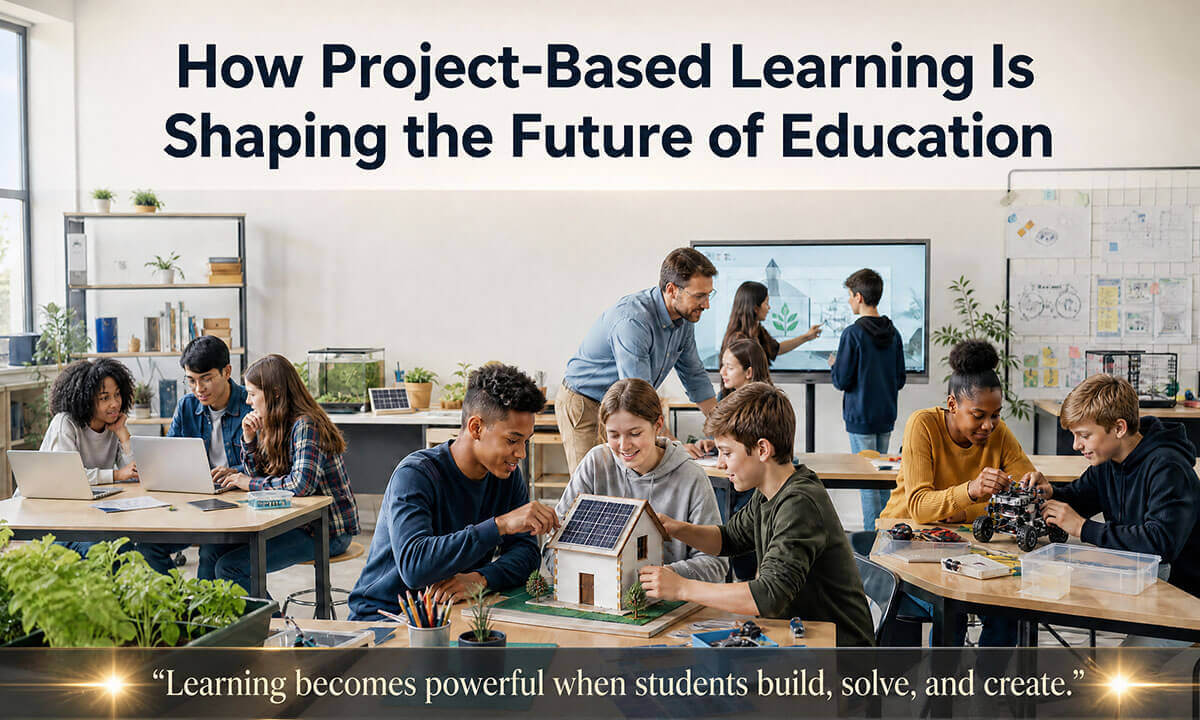
For example, students learning about renewable energy could design a simple model of a solar-powered house. They would need to understand how solar energy works, decide which materials to use, solve design problems, and improve their model. This helps them apply their classroom knowledge to a practical situation.
- Encourages Collaboration and Communication: Teamwork is an important skill in both education and the workplace. PBL gives students opportunities to work together toward a common goal. They learn how to share ideas, listen to others, divide responsibilities, discuss problems, and make decisions as a group.
For example, a group of students could work together to design a mobile application. One student might focus on the design, another might work on research, and another might organize the presentation. They must communicate clearly and support one another to complete the project successfully.
- Makes Learning More Meaningful and Engaging: Students often become more interested in learning when they understand how a topic connects to real life. PBL makes lessons more meaningful by giving students practical tasks and real problems to explore.
For example, instead of only reading about an important historical event, students could create a short documentary, prepare a presentation, or perform a play about that event. Such activities allow students to explore the subject in a creative way and can make the information easier to remember.
- Develops Independence and Self-Management: PBL encourages students to take greater responsibility for their own learning. Teachers provide guidance, but students often need to decide how they will complete different parts of a project.
Students may need to research information, make a plan, set goals, organize their work, and complete tasks within a specific time. These activities help them develop independence, responsibility, organization, and time management skills.
For example, a student working on a small business project may need to create a plan, research customers, manage deadlines, and prepare a final presentation. These experiences can help the student become more confident and organized.
- Prepares Students for Future Careers: The modern workplace requires more than academic knowledge. Employers often look for people who can communicate well, work in teams, solve problems, think creatively, and adapt to new situations.
PBL helps students develop many of these skills. Through project work, students can develop teamwork, leadership, creativity, problem-solving, communication, planning, and practical skills. These abilities can help them feel better prepared for higher education and future employment.
Real World Examples of Project-Based Learning:
Project-Based Learning is already being used in many educational settings. These examples show how students can learn through practical activities and real-world challenges.
- School Garden Projects: Students can create and maintain a garden at their school. Through this activity, they can learn about plants, biology, nutrition, the environment, and sustainability.
They may decide what to grow, prepare the soil, observe plant growth, record their findings, and discuss how healthy food can benefit people. This combines several areas of learning in one practical project.
- STEM Robotics Projects: Robotics projects are another good example of PBL. Students can design, build, and program robots to complete specific tasks or challenges.
While working on the project, students learn about science, technology, engineering, mathematics, coding, and problem-solving. They also learn how to test their ideas and improve their designs when something does not work.
- Social Entrepreneurship Projects: Some schools give students opportunities to develop projects that address problems in their communities. Students may identify a social problem and create a small business or community project to help solve it.
For example, students might develop an idea for reducing plastic waste or supporting local people in need. Through the project, they can learn about business, economics, planning, teamwork, and innovation.
These examples show that learning does not have to be limited to textbooks and classrooms. Students can learn by working with their environment, exploring real problems, and creating useful solutions.
How Schools and Teachers Can Implement PBL:
Introducing Project-Based Learning does not mean that schools need to change their entire education system at once. Teachers can begin with simple projects and gradually increase the use of PBL in their classrooms.
- Start With Small Projects: Teachers can begin with short and manageable projects. A project might take a few days or several weeks, depending on the subject and the age of the students.
Starting small allows teachers and students to become familiar with the process. As they gain experience, they can move toward larger and more complex projects.
- Encourage Questions and Curiosity: Teachers can encourage students to ask questions instead of always providing direct answers. Students can investigate topics that interest them and search for information on their own.
This approach can increase curiosity and motivation. It also helps students become more active in the learning process.
- Connect Lessons With Real-World Problems: Teachers can connect classroom topics with problems that students can see in their communities or in the wider world. Topics such as environmental protection, climate change, poverty, public health, technology, and community development can provide useful opportunities for project work.
When students understand why a topic matters, they may become more interested in learning about it.
- Promote Teamwork: Teachers can organize students into small groups and give them projects that require cooperation. Each student can have a specific responsibility, while the whole group works toward a shared goal.
Teachers should also help students learn how to communicate respectfully, listen to different opinions, manage disagreements, and support their team members.
- Use Technology to Support Learning: Technology can make project work more interesting and effective. Students can use computers, online resources, digital presentation tools, simulations, and other educational technologies to research information and present their work.
For example, students can explore virtual locations, analyze information, create digital presentations, or use educational tools to understand difficult topics. Technology should support the learning process rather than replace meaningful thinking and discussion.
The Overall Impact of PBL:
Project-Based Learning can change the way students experience education. It moves students from simply receiving information to actively using knowledge. Students learn to ask questions, explore ideas, work with others, solve problems, and create something meaningful.
For teachers, PBL also creates opportunities to understand students’ abilities in different ways. Instead of judging learning only through written examinations, teachers can observe students’ research, teamwork, creativity, communication, planning, and problem-solving.
When used properly, PBL can make education more practical, engaging, and connected to real life. It helps students develop not only academic knowledge but also the skills and confidence they need for the future.
In conclusion, project-Based Learning is an important approach to modern education. It helps students learn through practical activities, teamwork, creativity, and real-world problem-solving. It also prepares them for future study, work, and everyday life. Education should not only focus on passing exams. It should help students become confident, skilled, and responsible individuals. By using PBL, schools and teachers can make learning more active, meaningful, and useful for the future.

is an experienced educator and academic currently serving as a Lecturer at Nurul Amin Degree College. With a career dedicated to student development and institutional excellence, he brings a wealth of classroom expertise and pedagogical knowledge to his current role. Before joining the faculty at Nurul Amin Degree College, he served as an Assistant Teacher at Zinzira PM Pilot School and College.