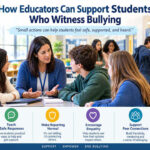
How Educators Can Support Students Who Witness Bullying:
Bullying is not only a problem between the student who bullies and the student who is targeted. It also affects the students who witness it.
A student may see someone being mocked in the classroom, pushed in the hallway, excluded from a group, or attacked through social media. They may know that what is happening is wrong, but they may not know what to do. Some students stay quiet because they are afraid of becoming the next target. Others may believe that an adult will handle the situation. Some may simply feel unsure about how to help.
These students are often called bystanders. They are an important part of the bullying situation because their reactions can influence what happens next.
Educators have an essential role in helping students understand how to respond safely and responsibly when they witness bullying. Teachers, school counselors, administrators, and other school staff can give students practical skills, encourage responsible reporting, and create an environment where students feel safe asking for help.
Supporting bystanders does not mean expecting children to confront bullies themselves. Instead, it means teaching them how to recognize bullying, how to respond safely, how to support students who are being targeted, and when to involve a trusted adult.
Understanding the Bystander Effect:
The bystander effect refers to a situation in which people are less likely to help when other people are also present. When several students witness an incident, each person may assume that someone else will take action.
For example, imagine a student being insulted in a crowded school hallway. Several students notice what is happening, but nobody says anything. One student may think, “The teacher will probably deal with it.” Another may think, “Someone else should say something.” Another may worry, “If I speak up, they might target me next.”
As a result, everyone remains silent.
This does not necessarily mean that students do not care. They may care deeply but lack confidence, knowledge, or a sense of personal responsibility.
Educators can help by teaching students that they have several ways to respond. Helping does not always mean confronting the person who is bullying. Sometimes the safest and most useful action is to get an adult, support the targeted student afterward, or report what happened.
Why Students May Be Afraid to Speak Up:
There are several reasons why students may remain silent when they witness bullying.
- Fear of Becoming the Next Target: Students may worry that speaking up will make them a target. This is especially common when the student who is bullying has social influence or a group of friends supporting them.
- Uncertainty About What to Do: A student may recognize that something is wrong but have no idea how to respond. They may fear that saying the wrong thing could make the situation worse.
- Pressure From Peers: Students sometimes worry about how their friends will react. They may believe that supporting a targeted student will make them look weak or unpopular.
- Assuming Someone Else Will Help: When several people witness bullying, students may expect a teacher, another student, or another adult to intervene.
- Believing Reporting Is Tattling: Some students have been taught, directly or indirectly, that reporting another student is wrong. They may therefore avoid telling an adult even when someone is being harmed.
Educators can address these concerns by creating clear expectations about reporting and showing students that asking for help is a responsible action.
How Educators Can Help Students Respond to Bullying:
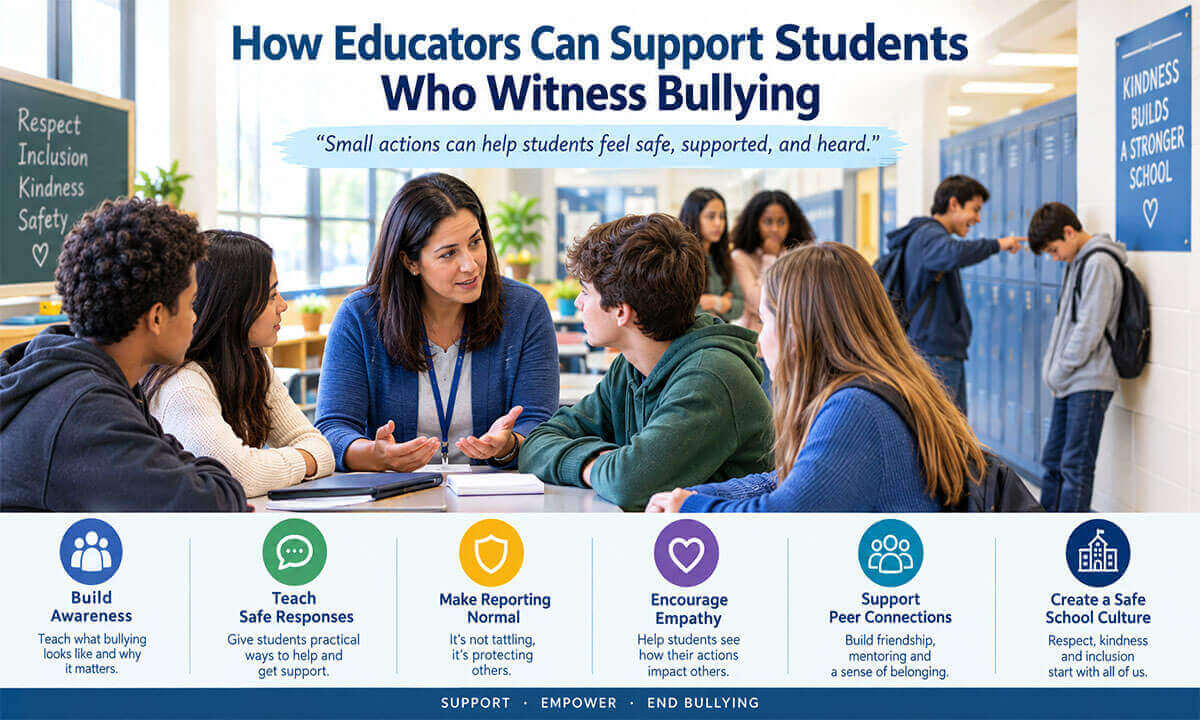
1. Teach Students That Their Actions Matter: Students should understand that their reactions can influence a bullying situation.
When students laugh, encourage the behavior, share harmful posts, or remain involved as an audience, the person doing the bullying may feel supported. On the other hand, students who refuse to participate, report the behavior, or support the targeted student can reduce the social support that bullying sometimes receives.
However, educators should avoid telling students that they are responsible for stopping bullying on their own.
The message should be simple: You do not have to solve the situation yourself, but you can take a safe action to help.
Students can:
- Tell a trusted adult.
- Refuse to laugh or join in.
- Move away from the situation.
- Support the targeted student afterward.
- Report harmful online content.
- Stay with the targeted student if doing so is safe.
Even small actions can communicate that bullying is not acceptable.
2. Teach Students When to Get Adult Help: One of the most significant lessons educators can provide is knowing when adult intervention is necessary.
Students should not be expected to physically intervene in dangerous situations. If someone is being threatened, physically harmed, seriously intimidated, or exposed to another immediate danger, students should seek help from a teacher, counselor, administrator, parent, or another trusted adult.
Educators can explain that asking for adult help is not a sign of weakness.
It is also useful to give students specific examples of who they can approach. A student may feel more comfortable talking to a classroom teacher, school counselor, librarian, coach, or another staff member.
The clearer the process is, the easier it becomes for students to use it.
3. Use Role-Playing to Build Confidence: Simply telling students to “speak up” is not enough.
Students need opportunities to practice what they can do in different situations. Role-playing can help them develop confidence and prepare for situations they may encounter.
For example, teachers can create simple scenarios involving:
- Verbal insults in the classroom.
- Social exclusion during lunch.
- Physical intimidation in the hallway.
- Hurtful messages in a group chat.
- A student being laughed at because of their appearance.
- A harmful rumor being spread around school.
Students can then discuss possible responses.
The goal is not to teach students to become heroes or confront someone aggressively. The goal is to help them identify safe and realistic choices.
For example, students can practice saying:
- “That is not okay.”
- “Let’s get a teacher.”
- “I don’t think we should be doing this.”
They can also practice indirect responses, such as changing the situation, moving away, finding an adult, or checking on the targeted student later.
4. Make Reporting Normal: Many students hesitate to report bullying because they are afraid of being called a snitch or tattletale.
Educators can change this attitude by explaining the difference between reporting harm and trying to get someone into trouble.
If a student tells an adult that another student is being repeatedly threatened, humiliated, excluded, or harmed, that information can help the school respond appropriately.
Schools can make reporting easier by providing several options.
These may include:
- Speaking directly with a teacher.
- Talking to a school counselor.
- Using an anonymous reporting system.
- Using a designated reporting box.
- Sending a message through an approved school platform.
- Telling a trusted staff member.
Students should also understand what may happen after they report something. When schools explain the process clearly, students may feel more confident about coming forward.
5. Create a Classroom Culture of Respect: The best response to bullying is not limited to what happens after an incident. Educators can also work to create classroom environments where respect and inclusion are part of everyday life.
Teachers can model respectful communication in their own behavior. They can listen to students, avoid humiliating students, and treat differences with respect.
Classroom discussions can also address topics such as:
- Empathy
- Respect
- Inclusion
- Friendship
- Conflict resolution
- Digital responsibility
- Respect for differences
- Responsible communication
Students can be encouraged to think about how their words and actions affect other people.
A positive classroom culture does not mean that conflict will disappear. Students will still disagree. The goal is to teach them how to handle disagreements without humiliation, intimidation, or cruelty.
6. Help Students Understand the Difference Between Conflict and Bullying: Not every disagreement between students is bullying.
Students can have arguments, misunderstand each other, or experience ordinary conflicts. Bullying generally involves harmful behavior that is repeated or has a serious power imbalance, although a single serious incident can also require immediate attention.
Educators can teach students to look at the nature of the behavior rather than labeling every disagreement as bullying.
For example, students can consider:
- What happened?
- Was someone being intentionally harmed?
- Has this happened before?
- Is there a power difference?
- Does the targeted student feel unable to protect themselves?
- Is there an immediate safety concern?
Understanding these differences can help students report concerns more accurately.
7. Teach Students How to Support the Targeted Student: Students who witness bullying can play an important role after the incident.
A targeted student may feel isolated, embarrassed, or afraid. A simple act of friendship can help them feel less alone.
Students can:
- Sit with them at lunch.
- Invite them to join an activity.
- Ask if they are okay.
- Walk with them to class.
- Listen without judging.
- Encourage them to speak with a trusted adult.
Students should also understand that they should not pressure someone to talk before they are ready.
A simple statement such as “I’m here if you want to talk” can be meaningful.
8. Encourage Positive Peer Support: Students often influence each other’s behavior. Schools can use this influence in positive ways through peer support programs.
Older students can sometimes serve as positive role models for younger students. Schools may create peer mentoring programs, student leadership groups, buddy systems, or supervised peer support activities.
These programs can help students develop:
- Communication skills
- Empathy
- Responsibility
- Leadership
- Conflict resolution skills
- A stronger sense of belonging
Peer support should be properly supervised. Students should not be expected to handle serious bullying cases by themselves.
Their role should be to provide encouragement and connect students with appropriate adults when necessary.
9. Address Cyberbullying: Bullying can continue outside school through phones, social media, messaging apps, online games, and other digital platforms.
Students who witness cyberbullying may feel uncertain about what they should do. They may also worry that reporting the content will make the situation worse.
Educators can teach students some basic digital safety practices.
They can encourage students to:
- Avoid joining harmful conversations.
- Avoid sharing or forwarding humiliating content.
- Save evidence when appropriate.
- Use platform reporting tools.
- Block or mute accounts when appropriate.
- Tell a trusted adult.
- Support the targeted student privately.
Students should understand that sharing harmful content can contribute to the problem even if they did not create it.
10. Train Teachers and School Staff: Educators also need support and training.
Schools should make sure teachers and staffs understand different forms of bullying, including physical, verbal, social, and cyberbullying.
Training can help staff recognize:
- Changes in student behavior.
- Social isolation.
- Repeated conflicts.
- Signs that a student may be afraid of another student.
- Online bullying that affects school life.
- The effects bullying can have on students who witness it.
Staff should also know how to respond when a student reports bullying.
A poor response can discourage students from reporting future incidents. For example, immediately dismissing a concern as “kids being kids” may make a student feel that adults will not take the problem seriously.
Schools need clear procedures that help staff respond consistently and fairly.
11. Give Bystanders a Safe Set of Choices: Not every student will feel comfortable speaking directly to someone who is bullying another student. That is okay.
Educators can teach a simple range of safe choices.
- Direct Action: If the situation is safe, a student might calmly say that the behavior is not acceptable.
- Get Help: The student can tell a teacher, counselor, parent, or another trusted adult.
- Distract: In some situations, changing the focus of the moment may help interrupt the behavior.
- Walk Away: A student can refuse to participate or leave the audience.
- Support: The student can check on the targeted person afterward.
- Report: The student can provide information about what happened through the school’s reporting process.
Giving students several options makes it easier for them to find an action that feels safe and realistic.
12. Follow-Up After a Bullying Incident: Supporting students should not end when the immediate incident is over.
Educators should follow-up with students involved in the situation. This can help determine whether the behavior has stopped and whether students need additional support.
Follow-up can include:
- Checking on the targeted student.
- Speaking with witnesses.
- Monitoring the situation.
- Communicating with parents or guardians when appropriate.
- Providing counseling or other support.
- Reviewing safety plans when necessary.
Follow-up also shows students that reporting a problem leads to meaningful attention rather than being ignored.
13. Avoid Putting the Responsibility on Bystanders: It is important to encourage students to act without making them feel responsible for solving bullying themselves.
A student may want to help but may also be frightened. If the person doing the bullying is physically aggressive or has a large group supporting them, direct intervention may not be safe.
Educators should therefore emphasize safety.
Students should know that they can help without putting themselves in danger.
The responsibility for addressing serious bullying belongs to adults and the school system. Students can contribute, but they should not be expected to manage dangerous situations alone.
The Role of School Leaders:
School leaders can support educators and students by creating clear policies and consistent procedures.
A school should have a clear understanding of:
- What behavior is considered bullying.
- How students can report concerns.
- How staff should respond.
- How parents or guardians may be involved.
- How incidents are documented.
- How student safety is protected.
- How follow-up is handled.
School leaders can also collect information about bullying patterns. If certain locations, times, or situations repeatedly become problem areas, the school can consider additional supervision or other preventive measures.
Creating a School Where Students Feel Safe to Speak:
Students are more likely to report bullying when they believe adults will listen and respond appropriately.
This requires trust.
Teachers can build trust by listening carefully, taking concerns seriously, protecting student privacy when possible, and explaining what they can and cannot do with the information provided.
Students should also know that they will not be blamed for someone else’s behavior.
A supportive school environment sends a clear message: If you see something harmful, you can ask for help.
That message can make a significant difference.
In conclusion, students who witness bullying should not be forgotten. They are often placed in difficult situations where they must decide whether to remain silent, help a classmate, or seek adult support.
Educators can make these decisions easier by teaching students what bullying looks like, explaining safe ways to respond, practicing responses through role-playing, making reporting normal, and creating a classroom culture based on respect and inclusion.
Schools should also support teachers and staff through proper training, clear reporting procedures, peer support programs, and regular follow-up.
Most importantly, students should understand that helping does not always mean confronting a bully. Sometimes helping means telling a trusted adult. Sometimes it means refusing to laugh. Sometimes it means sitting beside a student who feels alone.
Small actions can communicate a vital message: you are not alone, and what is happening to you matters.
When educators give students the knowledge and confidence to respond safely, bystanders can become active supporters. Over time, this can help create a school environment where students are more willing to speak up, support one another, and reject bullying behavior.

is an experienced educator and academic currently serving as a Lecturer at Nurul Amin Degree College. With a career dedicated to student development and institutional excellence, he brings a wealth of classroom expertise and pedagogical knowledge to his current role. Before joining the faculty, he served as an Assistant Teacher at Zinzira PM Pilot School and College.