Behavior Modification: Techniques, Uses, and Practical Applications
Human behavior is shaped by many things. Our experiences, surroundings, relationships, habits, rewards, and consequences can all influence the way we act. Sometimes these patterns develop without us even noticing them. For example, a student may study more often after receiving praise from a teacher, an employee may work harder after receiving recognition, or a person may exercise regularly after developing a habit of tracking daily steps.
Behavior modification is a psychological approach that uses these principles deliberately to change specific behaviors. Instead of simply hoping that a person will change, behavior modification focuses on identifying a behavior, observing it, and using appropriate consequences to increase or decrease its occurrence.
The approach is closely connected with behavioral psychology and the study of observable behavior. It can be used in education, parenting, workplaces, healthcare, therapy, personal development, and everyday life. The main idea is practical: when the consequences surrounding a behavior change, the behavior itself can also change.
What Is Behavior Modification?
Behavior modification refers to the deliberate use of behavioral principles to change a specific and measurable behavior. The approach focuses on what a person does and what happens after that behavior.
For example, imagine that a student frequently arrives late to class. Instead of simply telling the student to be more responsible, a teacher might establish a system in which arriving on time is followed by positive recognition. The goal is to make punctuality more likely in the future.
A major strength of behavior modification is its focus on observable and measurable actions. A vague goal such as “be more productive” can be difficult to measure. A more specific goal such as “work on an assignment for 30 minutes before checking social media” gives the person something concrete to observe and improve.
Behavior modification is narrower than many forms of behavior therapy. Behavior therapy may address broader emotional, psychological, and behavioral patterns. Behavior modification generally concentrates on a clearly defined target behavior and the consequences that influence it.
How Does Behavior Modification Work?
Behavior modification is based on the idea that consequences can influence whether a behavior becomes more or less likely to happen again.
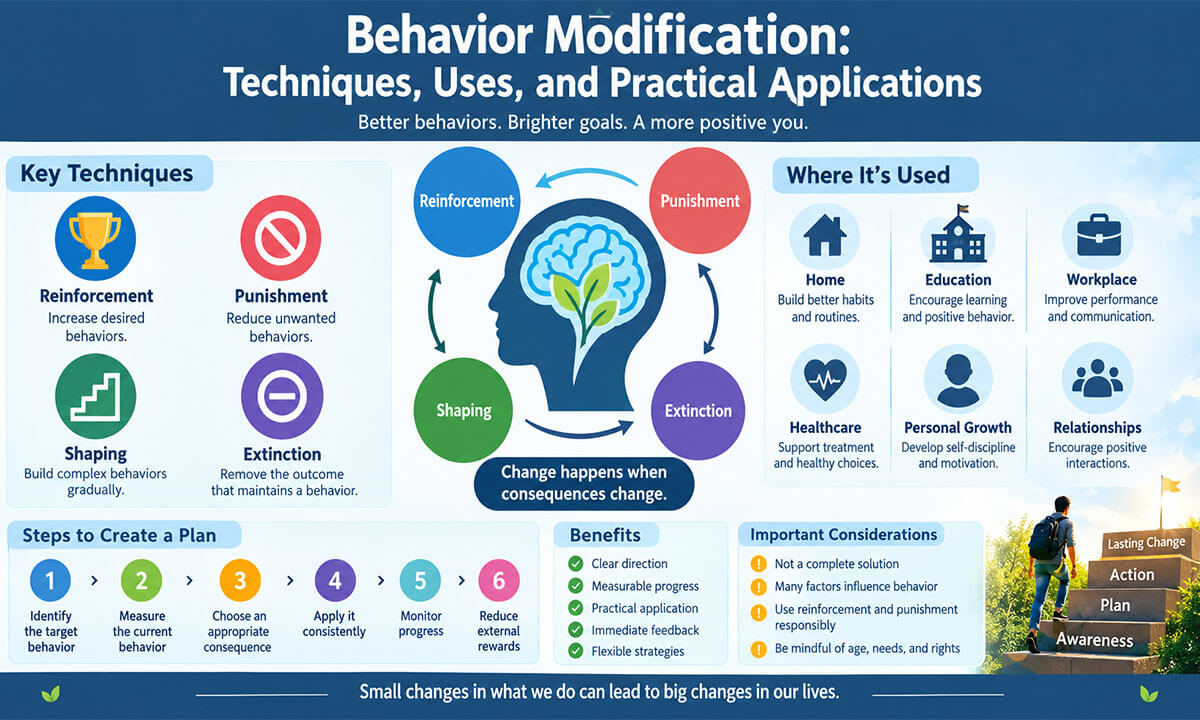
When a behavior is followed by a consequence that increases the likelihood of that behavior occurring again, the process is called reinforcement. When a consequence makes a behavior less likely to occur again, it is called punishment.
Two other necessary processes are shaping and extinction. Together, these mechanisms provide several ways to encourage desired behaviors and reduce unwanted ones.
Four Core Techniques of Behavior Modification:
Most behavior modification techniques fall into one of four mechanisms. It helps to know the differences before trying to use any of them.
1. Reinforcement: Reinforcement is used to increase the likelihood that a behavior will happen again. Positive reinforcement occurs when something desirable is added after a behavior. For example, a teacher may praise a student for completing homework on time. The praise can encourage the student to continue completing assignments.
Negative reinforcement works differently. It involves removing something unpleasant after a desired behavior occurs. For example, a warning sound in a car may stop when the driver puts on a seatbelt. The removal of the unpleasant sound can encourage the person to wear the seatbelt.
An essential point is that positive and negative do not mean good and bad. They refer to whether something is added or removed. Reinforcement is defined by its effect on behavior. If the behavior becomes more likely, reinforcement has occurred.
2. Punishment: Punishment is intended to reduce the likelihood of a behavior happening again. Positive punishment involves adding something unpleasant after an unwanted behavior. Negative punishment involves removing something desirable.
For example, if a child loses access to a favorite activity after breaking an agreed rule, this can be considered negative punishment because something desirable has been removed.
Punishment can sometimes reduce an unwanted behavior quickly. However, punishment by itself may not teach the person what behavior should replace the unwanted action. Research discussed by PositivePsychology.com suggests that reinforcing an appropriate alternative behavior can help create more lasting change than relying on punishment alone.
3. Shaping: Shaping involves developing a desired behavior gradually. Instead of expecting a person to perform a complicated behavior perfectly from the beginning, smaller steps toward the final behavior are reinforced.
For example, suppose a child is learning to communicate using a new word. A parent or teacher might initially encourage an attempt that is close to the target word. As the child improves, reinforcement can be provided for increasingly accurate responses.
Shaping can be particularly useful when a desired behavior is complex or when a person is not yet capable of performing the complete behavior.
4. Extinction: Extinction occurs when a behavior that was previously reinforced stops receiving the consequence that maintained it. Consider a student who regularly interrupts a class because the teacher immediately responds. If the teacher stops providing attention for interruptions and instead responds when the student raises their hand, the interrupting behavior may gradually decrease.
Extinction does not always produce an immediate change. A behavior may temporarily become stronger before it decreases. Consistency is therefore important when using this approach.
Behavior Modification in Everyday Life:
Behavior modification is not limited to psychologists, therapists, or research settings. People experience behavioral consequences throughout everyday life.
Parents may use praise to encourage children to complete household responsibilities. Teachers may use recognition to encourage participation. Employers may provide bonuses or other forms of recognition for meeting specific goals.
Individuals can also use behavior modification for personal development.
For example, someone who wants to exercise regularly might place their workout clothes somewhere visible and track each completed workout. Someone who wants to spend less time on social media might create a routine in which they receive a small reward for completing a period of focused work before checking their phone.
Habit tracking can also function as a form of behavior modification. Recording progress provides feedback and can help people notice patterns that they might otherwise overlook.
Behavior Modification in Education:
Schools provide many opportunities to apply behavior modification principles.
Teachers can use reinforcement to encourage behaviors such as:
- Completing assignments
- Arriving on time
- Participating respectfully
- Following classroom rules
- Helping classmates
- Staying focused during lessons
For example, a teacher might recognize students who consistently submit their work on time. The recognition provides a consequence that may encourage the behavior to continue.
However, teachers should be careful about what they unintentionally reinforce. If a teacher consistently gives attention to students who interrupt while ignoring students who raise their hands, students may learn that interrupting is an effective way to receive attention.
This demonstrates a crucial principle of behavior modification. Consequences can shape behavior even when nobody intentionally designs them.
Behavior Modification in the Workplace:
Workplaces also contain many behavioral patterns that can be understood through behavior modification. Employees may receive recognition, bonuses, promotions, feedback, or other consequences following particular behaviors. These consequences can influence future performance.
For example, an organization may reward employees for completing projects on time. If employees value the reward, they may become more likely to maintain the desired behavior.
Managers should also consider unintended reinforcement. If employees receive immediate attention whenever they complain but receive little response when they present thoughtful solutions, the workplace may unintentionally encourage complaints rather than constructive communication.
Understanding these patterns can help organizations create clearer expectations and more consistent feedback systems.
How to Create a Behavior Modification Plan:
A behavior modification plan does not need to be complicated. Several basic steps can make it more practical and measurable; the necessary ones are given below:
Step 1: Identify the Target Behavior: Start by choosing one specific behavior.
Instead of saying “I want to become healthier,” identify something measurable such as “walk for 30 minutes five days a week.”
A clear target makes it easier to determine whether change is actually taking place.
Step 2: Measure the Behavior: Before changing a behavior, it can be useful to understand how often it currently occurs.
For example, someone trying to reduce phone use might first record how many hours they spend on their phone each day.
Measurement provides a starting point and makes progress easier to observe.
Step 3: Choose an Appropriate Consequence: Identify something that can encourage the desired behavior.
The consequence needs to matter to the individual. A reward that has little value to someone may not have much influence on their behavior.
Step 4: Apply the Consequence Consistently: Timing is important. A consequence that occurs soon after the behavior creates a clearer connection between the action and its outcome. Delayed consequences can weaken that connection.
Consistency is also considerable. If a consequence is applied sometimes but not others, the behavioral pattern may become less predictable.
Step 5: Monitor Progress: Behavior change is rarely perfectly linear. People may experience improvements, setbacks, and periods when progress slows.
A temporary setback does not necessarily mean that the plan has failed. Instead, it can provide useful information about what needs to be changed.
Step 6: Gradually Reduce External Rewards: Once a behavior becomes established, external rewards may not need to continue at the same level.
Over time, a person may begin to value the behavior itself. For example, someone who initially exercises because of a reward may eventually continue because exercise has become part of their routine and contributes to their personal goals. This relates to the broader distinction between external and intrinsic motivation.
Why Specific Goals Matter:
One of the most strategic aspects of behavior modification is defining the desired behavior clearly.
“Study harder” is difficult to measure.
“Study mathematics for 45 minutes after dinner” is much clearer.
Specific goals make it easier to observe progress and connect behavior with consequences. Goal setting research has also emphasized the importance of clear and specific goals in supporting performance and motivation.
A good behavioral goal should answer questions such as:
- What behavior should change?
- When should it happen?
- How often should it happen?
- How long should it continue?
- How will progress be measured?
- What consequence will follow the behavior?
These questions turn a general intention into a practical plan.
Benefits of Behavior Modification:
Behavior modification can offer numerous practical benefits; some of them are briefly given below:
- Clear Direction: It gives people a specific behavior to work on rather than asking them to make a vague change.
- Measurable Progress: Because target behaviors can be observed and recorded, progress can be easier to evaluate.
- Practical Application: The principles can be applied in homes, schools, workplaces, healthcare settings, and personal routines.
- Immediate Feedback: When consequences follow behavior quickly, people can more easily understand the relationship between their actions and outcomes.
- Flexible Strategies: Different techniques can be selected depending on the behavior and the individual.
Limitations and Important Considerations:
Behavior modification should not be viewed as a simple solution to every psychological or behavioral problem.
Human behavior can be influenced by many factors, including emotions, relationships, environment, beliefs, physical conditions, and social circumstances. A behavioral strategy may be useful for a specific behavior without explaining every reason behind that behavior.
It is also essential to use reinforcement and punishment responsibly. The goal should be to encourage healthy and constructive behavior rather than control people through fear or excessive punishment.
In educational, clinical, parenting, and workplace settings, behavioral strategies should be appropriate to the person’s age, needs, circumstances, and rights.
In conclusion, behavior modification is a practical approach to changing specific behaviors through carefully planned consequences. It focuses on observable actions and provides ways to increase desirable behaviors and reduce behaviors that cause difficulties.
The four major techniques discussed in this approach are reinforcement, punishment, shaping, and extinction. Reinforcement increases the likelihood of a behavior, while punishment aims to decrease it. Shaping develops complex behaviors gradually, and extinction reduces behaviors when the consequence that previously maintained them is removed.
The principles of behavior modification can be found in everyday life. They influence how students learn, how employees respond to workplace systems, how children develop routines, and how adults build personal habits.
The most useful starting point is often simple. Choose one specific behavior, define how it will be measured, identify an appropriate consequence, apply the plan consistently, and monitor the results. Behavior change may take time and may include setbacks, but a clear and consistent approach can make the process easier to understand and manage.
Ultimately, behavior modification reminds us that our surroundings and the consequences of our actions can shape what we do. By becoming more aware of these patterns, we can make more deliberate choices about the behaviors we want to develop, maintain, or change.
References:
- Baer, D. M., Wolf, M. M., & Risley, T. R. (1968). Some current dimensions of applied behavior analysis. Journal of Applied Behavior Analysis, 1(1), 91–97. https://doi.org/10.1901/jaba.1968.1-91
- Lattal, K. A. (2010). Delayed reinforcement of operant behavior. Journal of the Experimental Analysis of Behavior, 93(1), 129–139. https://doi.org/10.1901/jeab.2010.93-129
- Locke, E. A., & Latham, G. P. (2002). Building a practically useful theory of goal setting and task motivation: A 35 year odyssey. American Psychologist, 57(9), 705–717. https://doi.org/10.1037/0003-066X.57.9.705
- Ryan, R. M., & Deci, E. L. (2000). Self determination theory and the facilitation of intrinsic motivation, social development, and well being. American Psychologist, 55(1), 68–78. https://doi.org/10.1037/0003-066X.55.1.68
- Thompson, R. H., Iwata, B. A., Conners, J., & Roscoe, E. M. (1999). Effects of reinforcement for alternative behavior during punishment of self injury. Journal of Applied Behavior Analysis, 32(3), 317–328. https://doi.org/10.1901/jaba.1999.32-317

is an experienced educator and academic currently serving as a Lecturer at Nurul Amin Degree College. With a career dedicated to student development and institutional excellence, he brings a wealth of classroom expertise and pedagogical knowledge to his current role. Before joining the faculty, he served as an Assistant Teacher at Zinzira PM Pilot School and College.