How Phonetics and Pronunciation Shape Second Language Proficiency:
Learning a second language is a rewarding process, but it can also be challenging. Learners usually spend a great deal of time studying vocabulary, grammar, reading, and writing. However, pronunciation is sometimes given less attention. This can become a problem because knowing the right words and grammar does not always mean that communication will be successful.
Phonetics and pronunciation play an important role in second language proficiency. They help learners understand how speech sounds are produced, how different sounds are distinguished, and how words and sentences are spoken naturally. A learner may know thousands of words but still struggle to communicate if their pronunciation makes those words difficult to understand.
Good pronunciation does not mean that a learner must sound exactly like a native speaker. The main goal is clear and effective communication. Understanding phonetics and practicing pronunciation can help learners speak more clearly, listen more accurately, and communicate with greater confidence.
What Is Phonetics?
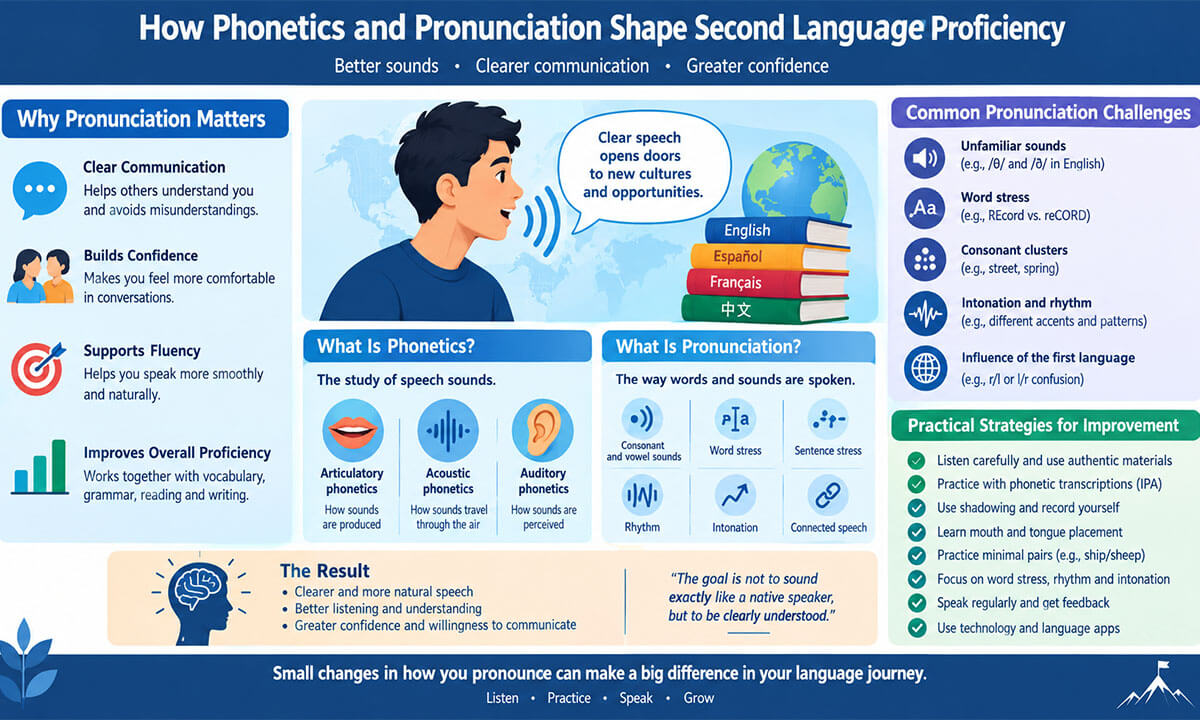
Phonetics is the study of human speech sounds. It examines how sounds are produced by the mouth and vocal organs, how they travel through the air, and how listeners hear and understand them.
Phonetics can generally be divided into three main areas:
- Articulatory phonetics studies how speech sounds are produced using the tongue, lips, teeth, vocal cords, and other parts of the speech system.
- Acoustic phonetics examines the physical properties of speech sounds as they travel through the air.
- Auditory phonetics focuses on how listeners perceive and interpret speech sounds.
For language learners, articulatory and auditory phonetics are particularly useful. Learners need to understand how unfamiliar sounds are produced and also learn to hear differences between sounds that may seem similar.
What Is Pronunciation?
Pronunciation refers to the way words and sounds are spoken. It includes much more than individual sounds. Effective pronunciation involves several features of spoken language, including:
- Individual consonant and vowel sounds
- Word stress
- Sentence stress
- Rhythm
- Intonation
- Connected speech
- Pausing
- Linking between words
These features work together to make speech understandable and natural.
For example, two speakers may use exactly the same words, but one may sound easier to understand because they use appropriate stress, rhythm, and intonation.
Why Pronunciation Matters in Second Language Learning:
Pronunciation has a direct effect on communication. A learner may have excellent grammar and vocabulary, but unclear pronunciation can still create misunderstandings.
Imagine a learner asking for directions in another country. They know the correct sentence and vocabulary, but the listener cannot understand some of the words because the sounds are unclear. The learner may then need to repeat the sentence several times.
This shows why pronunciation is not simply an issue of sounding natural. It is closely connected with intelligibility, which means how easily other people can understand what a speaker says.
Good pronunciation can also make conversations more comfortable. When listeners understand a speaker easily, communication becomes smoother, and the speaker can participate more confidently.
The Relationship Between Phonetics and Pronunciation:
Phonetics provides learners with a framework for understanding pronunciation. Instead of simply memorizing how words sound, learners can understand what their mouth, tongue, lips, and vocal cords are doing.
For example, some languages contain sounds that do not exist in a learner’s first language. When learners encounter these sounds, they may replace them with a familiar sound.
English provides many examples. The sounds /θ/ and /ð/, found in words such as think and this, are difficult for speakers whose first languages do not contain them. A learner may replace these sounds with sounds that are more familiar.
Phonetic knowledge can help learners notice these differences and practice producing the new sounds more accurately.
How the First Language Influences Pronunciation:
A learner’s first language has a strong influence on second language pronunciation. People naturally use the sound patterns they already know when learning another language.
This influence is sometimes called language transfer.
For example, Japanese learners of English may experience difficulty distinguishing the English /r/ and /l/ sounds because Japanese does not distinguish these sounds in the same way English does.
Similarly, learners whose first language does not commonly use consonant clusters may find English words such as street, spring, or asked difficult to pronounce.
These challenges do not mean that learners cannot master the sounds. They simply show that previous language experience influences how new sounds are perceived and produced.
Pronunciation and Listening Skills:
Pronunciation and listening are closely connected. Learners need to hear a sound accurately before they can consistently produce it accurately.
Suppose a learner cannot easily distinguish between ship and sheep. If the difference between the vowel sounds is not clearly perceived, producing the difference may also be difficult.
This is why pronunciation practice should include both listening and speaking.
Learners can listen to pairs of similar words and identify the difference before practicing the sounds themselves. This develops phonological awareness and helps learners connect what they hear with what they produce.
How Pronunciation Influences Fluency:
Fluency is not simply the ability to speak quickly. It also involves speaking smoothly, maintaining an appropriate rhythm, and producing speech without excessive hesitation.
Pronunciation contributes to this process.
When learners are uncertain about how to pronounce words, they may stop frequently, speak very slowly, or avoid certain words. As pronunciation becomes more automatic, speaking can become smoother.
For example, a learner who repeatedly practices common phrases such as:
- “Could you help me?”
- “I’d like some water.”
- “What do you mean?”
- “How can I get there?”
May eventually produce these expressions more naturally without thinking about every individual sound. Pronunciation practice therefore supports both clarity and speaking fluency.
The Importance of Word Stress:
Word stress refers to the emphasis placed on a particular syllable within a word. Changing the stressed syllable can sometimes change the meaning or grammatical function of a word.
For example:
REcord can function as a noun.
reCORD can function as a verb.
Learners need to understand which syllables receive greater prominence. Stress can involve changes in loudness, length, pitch, and vowel quality.
Incorrect word stress does not always make a word impossible to understand, but it can make communication more difficult, particularly when the listener expects a different stress pattern.
Sentence Stress and Rhythm:
Pronunciation also operates at the sentence level.
In English, some words usually receive more stress than others. Content words such as nouns, main verbs, adjectives, and adverbs often receive greater emphasis, while many grammatical words are pronounced more weakly.
Consider:
I WANT to BUY a NEW BOOK.
The essential words can receive greater prominence, while smaller grammatical words may be less prominent.
This pattern contributes to the rhythm of spoken English. Learners who pronounce every word with equal emphasis may sound less natural and may also find it difficult to follow rapid speech.
The Role of Intonation:
Intonation refers to changes in pitch during speech. It can communicate meaning, emotion, attitude, and whether a speaker has finished an idea.
For example, the same words can sound different depending on the speaker’s pitch movement.
Intonation can help listeners understand whether someone is asking a question, making a statement, expressing surprise, showing uncertainty, or emphasizing a particular point.
Learning pronunciation therefore involves more than learning individual sounds. Learners also need to pay attention to how pitch moves throughout an utterance.
Common Pronunciation Challenges:
Second language learners face different pronunciation problems depending on their first language and the language they are learning.
- Unfamiliar Sounds: A language may contain sounds that do not exist in the learner’s first language. Learners may substitute familiar sounds for unfamiliar ones.
- Vowel Differences: Languages organize vowel sounds differently. Learners may have difficulty distinguishing between vowels that sound similar to them. For example, English learners may need to distinguish between ship and sheep, or full and fool.
- Consonant Clusters: Words containing several consonants together can be difficult for learners whose first language has simpler syllable structures. Words such as street, texts, and splashed may require additional practice.
- Word Stress: Learners may place stress on the wrong syllable because their first language follows different stress patterns.
- Intonation: Learners may transfer the rhythm and pitch patterns of their first language into the second language. This can sometimes make their speech sound less natural or make intended meanings less clear.
- Connected Speech: Native speakers often connect words during natural conversation. Sounds may become reduced, linked, or changed. For example, want to may be pronounced differently in rapid informal speech than when each word is carefully pronounced separately. Learners who only practice isolated words may therefore struggle to understand natural conversations.
The International Phonetic Alphabet and Language Learning:
The International Phonetic Alphabet, commonly known as the IPA, provides symbols for representing speech sounds. It can be particularly useful for language learners because spelling does not always accurately show pronunciation.
For example, English contains many words whose spelling and pronunciation do not correspond in a simple way. A phonetic transcription can show learners exactly which sounds are expected.
Learners do not need to memorize the entire IPA system. Learning the symbols that are relevant to the target language can be enough to make pronunciation dictionaries and learning resources much easier to use.
Practical Ways to Improve Pronunciation:
Improving pronunciation requires regular and focused practice. Several strategies can make this process more effective.
- Listen Carefully: Spend time listening to natural speech. Pay attention not only to individual words but also to stress, rhythm, intonation, and connected speech. Podcasts, interviews, films, audiobooks, and language learning materials can provide useful listening practice.
- Use Shadowing: Shadowing involves listening to a speaker and repeating the speech almost immediately. Instead of simply repeating individual words, try to copy the speaker’s rhythm, pauses, stress, and intonation. Start with short sections and gradually increase the length.
- Record Yourself: Recording your own speech can reveal pronunciation problems that you may not notice while speaking. Read a short passage, record it, and compare your version with a reliable pronunciation model. Focus on a few specific differences rather than trying to correct everything at once.
- Practice Minimal Pairs: Minimal pairs are words that differ by only one sound.
Examples include:
-
- ship and sheep
- bit and beat
- fan and van
- rice and rise
Practicing these pairs helps learners develop both sound recognition and sound production.
- Learn Mouth and Tongue Position: When learning a difficult sound, find out where the tongue, lips, and teeth should be positioned. A pronunciation teacher or reliable pronunciation video can demonstrate these movements. Once learners understand the physical position required, producing unfamiliar sounds can become easier.
- Practice Word Stress: When learning a new word, do not learn only its meaning and spelling. Learn how it is pronounced and which syllable receives stress. Pronunciation dictionaries can be particularly helpful for this.
- Practice Phrases Instead of Isolated Words: Real communication takes place through phrases and sentences rather than individual words. Instead of practicing only coffee, practice expressions such as: “I’d like a cup of coffee.” This helps learners develop rhythm, stress, linking, and fluency at the same time.
- Speak Regularly: Pronunciation improves through active use. Learners should look for opportunities to speak with teachers, classmates, language partners, or other speakers of the target language. Regular practice helps pronunciation become more automatic.
Pronunciation and Confidence:
Pronunciation can also affect a learner’s confidence. Some learners become nervous because they are afraid of making pronunciation mistakes. They may avoid conversations, speak less frequently, or remain silent even when they know what they want to say.
This can create a cycle. Limited speaking practice means fewer opportunities to improve, which can increase anxiety about speaking.
Learners should therefore view pronunciation mistakes as a normal part of language development. Mistakes provide information about what needs more practice.
Native Like Pronunciation Is Not the Only Goal:
One crucial point is that second language proficiency should not be measured only by whether someone sounds like a native speaker. People can speak a language fluently while maintaining an accent influenced by their first language. An accent is not automatically a sign of poor language ability.
The more useful goal is intelligible pronunciation. Learners should aim to make their speech clear enough that other people can understand them without unnecessary difficulty. This perspective can make pronunciation practice more realistic and less stressful.
The Role of Teachers in Pronunciation Development:
Teachers can play a vital role in helping learners develop pronunciation. Effective pronunciation instruction can include demonstrations, listening activities, phonetic explanations, minimal pair exercises, repetition, recording activities, and conversational practice.
Teachers can also identify pronunciation problems that are particularly common among learners with a specific first language. This allows instruction to focus on sounds and patterns that require additional attention.
Feedback should be specific. Instead of simply saying that a pronunciation is wrong, a teacher can explain what needs to change, such as tongue position, vowel length, stress, or intonation.
Technology and Pronunciation Practice:
Modern technology provides learners with many opportunities to practice pronunciation outside the classroom. Learners can use pronunciation dictionaries, speech recording tools, language learning applications, online videos, and speech recognition systems.
These resources can provide additional practice, but learners should still use reliable language models and, when possible, receive feedback from qualified teachers or experienced speakers. Technology is most useful when it supports regular practice rather than replacing active communication.
The Psychological Benefits of Better Pronunciation:
Improved pronunciation can have positive effects on communication confidence.
When learners notice that other people understand them more easily, they may become more willing to participate in conversations. This increased participation creates additional opportunities to practice vocabulary, grammar, listening, and fluency.
In this way, pronunciation can influence other areas of language development. Better pronunciation can support confidence, and greater confidence can encourage more communication.
A Simple Pronunciation Practice Routine:
Learners do not need to spend hours every day practicing pronunciation. A short and consistent routine can be useful.
A 20-minute practice session could include:
- 5 minutes: Listen carefully to a native or highly proficient speaker.
- 5 minutes: Practice difficult sounds or minimal pairs.
- 5 minutes: Shadow a short recording.
- 5 minutes: Record yourself speaking and review the recording.
The most significant part is consistency. Regular practice is generally more useful than occasional long sessions.
In conclusion, phonetics and pronunciation are important parts of second language proficiency. They influence how clearly learners communicate, how easily they understand spoken language, and how confidently they participate in conversations.
Phonetics helps learners understand the physical and acoustic nature of speech sounds, while pronunciation practice helps them use those sounds effectively. Word stress, sentence stress, rhythm, intonation, and connected speech are also essential parts of successful spoken communication.
Learners may face challenges because their first language does not contain certain sounds or uses different pronunciation patterns. However, these difficulties can be addressed through focused listening, phonetic awareness, shadowing, minimal pair practice, recording, feedback, and regular conversation.
The goal of pronunciation learning should not be to eliminate every trace of a learner’s accent. The more important goal is clear, understandable, and confident communication.
With consistent practice and greater awareness of how speech sounds work, learners can improve their pronunciation and strengthen their overall second language proficiency.

is an experienced educator and academic currently serving as a Lecturer at Nurul Amin Degree College. With a career dedicated to student development and institutional excellence, he brings a wealth of classroom expertise and pedagogical knowledge to his current role. Before joining the faculty, he served as an Assistant Teacher at Zinzira PM Pilot School and College.