Open Archival Information System (OAIS):
The rapid growth of digital information has created a major challenge for libraries, archives, museums, universities, research institutions, and other organizations. Digital materials may appear easy to preserve because they do not physically deteriorate like paper documents. However, digital information can become inaccessible when file formats become obsolete, storage technologies change, software is no longer supported, or essential metadata is lost.
The Open Archival Information System (OAIS) provides a conceptual framework for addressing these long-term digital preservation challenges. It describes the functions, responsibilities, information packages, and relationships that an archive needs in order to preserve information and make it available to a defined group of users over time. The current international standard is ISO 14721:2025, which replaced the earlier ISO 14721:2012 edition.
OAIS is not a particular software program or digital repository. Instead, it is a reference model that helps organizations understand how a trustworthy digital preservation system should operate.
What Is OAIS?
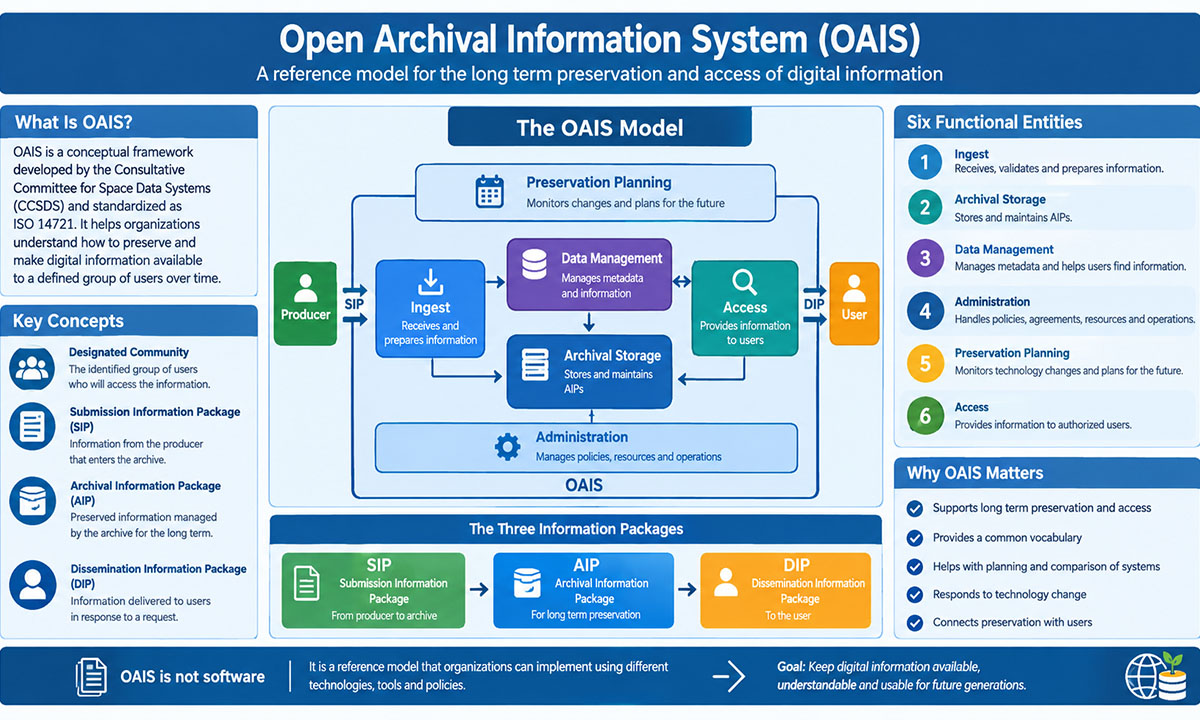
OAIS is a reference model developed through the Consultative Committee for Space Data Systems (CCSDS) and standardized internationally through ISO 14721.
According to ISO, an OAIS is an archive system made up of hardware, software, information, and policy-based processes operated by an organization and its staff. The organization accepts responsibility for preserving information and making it available to a Designated Community.
The word Open does not mean that everyone must have unrestricted access to the archive. Instead, it refers to the open development process through which the reference model and related standards are developed. An OAIS can therefore support open, restricted, closed, or other forms of access depending on the policies of the organization.
Why Was the OAIS Model Developed?
The OAIS model emerged from concerns about the long-term preservation of digital information. Space agencies were among the organizations facing serious problems related to preserving large quantities of scientific and technical data for future use.
The underlying problem is simple. Saving a digital file today does not necessarily mean that people will be able to use it many years from now.
For example, an organization may preserve a document in a particular file format. Years later, the software required to open that format may disappear. Storage devices may also become obsolete. Even if the original file remains intact, users may no longer have the technical environment needed to understand or access it.
OAIS provides a common framework for thinking about these problems. It helps organizations plan how digital information will be received, preserved, managed, maintained, and delivered to users over time.
Main Purpose of OAIS:
The main purpose of OAIS is to support the long-term preservation and access of digital information.
The model provides:
- A common vocabulary for digital preservation.
- A framework for understanding archival functions.
- A way to compare different archival systems.
- Guidance for developing digital preservation strategies.
- A framework for managing information and preservation metadata.
- A way to describe relationships between producers, archives, and users.
- A basis for developing and evaluating digital preservation systems.
The model is particularly useful because it focuses not only on storing digital files but also on ensuring that those files remain understandable and usable in the future.
Key Concepts of OAIS:
1. Designated Community: The Designated Community is an important concept in the OAIS model. It refers to the identified group of users that the archive intends to serve. The archive must understand the knowledge and technical abilities of this community when deciding how information should be preserved and presented.
For example, a university research repository may serve researchers and students. A national archive may serve historians, government researchers, journalists, and members of the public.
The archive therefore needs to preserve enough information and metadata so that the Designated Community can understand and use the preserved material in the future.
2. Long-Term Preservation: OAIS is concerned with preservation over a period long enough for technological changes to become significant. This means an archive cannot simply keep a file on a hard drive and consider the preservation task complete. It needs to consider changes in:
- File formats
- Storage media
- Hardware
- Software
- Metadata
- User knowledge
- Access technologies
ISO describes long-term preservation as a period during which changing technologies, media, formats, and the knowledge base of the Designated Community may affect access to information.
OAIS Information Packages:
One of the most recognizable parts of the OAIS model is its use of information packages. There are three major types:
1. Submission Information Package (SIP): A Submission Information Package, or SIP, is the information package submitted to the archive by an information producer. The producer could be a researcher, government department, university, library, organization, or another institution.
A SIP may contain:
- Digital files
- Descriptive information
- Technical metadata
- Administrative information
- Other information needed by the archive
The exact contents depend on the archive and its policies. The SIP represents the information when it enters the preservation system.
2. Archival Information Package (AIP): The Archival Information Package, or AIP, is the package managed by the archive for long-term preservation. The archive may transform or reorganize information received through a SIP before creating an AIP. The AIP contains the content and preservation information needed to manage the material over time.
The Society of American Archivists describes the AIP as the content and metadata managed by a preservation repository and organized so that preservation services can be performed. The AIP is therefore central to the preservation function.
3. Dissemination Information Package (DIP): A Dissemination Information Package, or DIP, is the information delivered from the archive to a user in response to an access request. The information provided to a user does not necessarily have to be identical to the AIP.
For example, an archive may preserve a high-quality master image as part of an AIP but provide a smaller image or another convenient format to users.
The Society of American Archivists identifies SIP, AIP, and DIP as the three major information package categories in the OAIS model.
Six Functional Entities of OAIS:
The OAIS reference model identifies six major functional areas that work together to support digital preservation.
1. Ingest: Ingest is responsible for receiving information from producers and preparing it for preservation.
Its activities may include:
- Receiving submitted information
- Checking files
- Validating information
- Creating or receiving metadata
- Preparing archival packages
- Transferring information into archival storage
In simple terms, ingest is the process through which information enters the archive.
2. Archival Storage: Archival Storage is responsible for storing and maintaining the archival information.
Its activities can include:
- Storing AIPs
- Maintaining backup copies
- Monitoring storage
- Performing error checking
- Replacing or refreshing storage media
- Supporting recovery when necessary
The objective is to keep preserved information available and protected from loss.
3. Data Management: Data Management manages information about the archived materials.
This can include:
- Descriptive metadata
- Identifiers
- Information about archived objects
- Search information
- Database management
- Administrative information
Data Management helps the archive organize information and helps users discover relevant materials.
4. Administration: Administration manages the overall operation of the archive.
This function can involve:
- Developing policies
- Managing agreements with information producers
- Monitoring the archive
- Managing access policies
- Managing finances and resources
- Supporting standards and procedures
- Coordinating archival operations
Administration is important because digital preservation is not only a technical activity. It also requires organizational policies, people, resources, and responsibilities.
5. Preservation Planning: Preservation Planning focuses on changes that could affect the future accessibility of digital information.
Technology changes continuously. File formats can become obsolete, software can disappear, and new storage technologies can replace older ones.
Preservation Planning monitors these developments and helps the archive decide when preservation actions are necessary.
Possible actions may include:
- Format migration
- Emulation
- File conversion
- Metadata enhancement
- Technology monitoring
- Risk assessment
The goal is to ensure that preserved information remains understandable and usable.
6. Access: Access provides users with the information they are permitted to receive.
It supports activities such as:
- Searching the archive
- Identifying relevant information
- Requesting materials
- Retrieving information
- Delivering DIPs to users
Access connects the archive with its Designated Community.
OAIS and Digital Preservation:
Digital preservation is more than digital storage. A storage system may keep a file unchanged for many years, but preservation requires more than keeping the original bits. The archive must also consider whether users will be able to understand and use those bits in the future.
For example, consider an archive containing thousands of research documents saved in an old file format. If the format becomes unsupported, the archive may need to migrate the documents to a newer format or use another preservation strategy.
OAIS provides a framework for thinking about these activities systematically. It includes preservation planning, information management, archival storage, access, and other functions as parts of a larger preservation environment.
Importance of OAIS for Libraries and Archives:
OAIS is particularly relevant to modern libraries and archival institutions because their collections increasingly include digital materials.
Libraries may preserve:
- Electronic books
- Digital journals
- Institutional repositories
- Research datasets
- Theses and dissertations
- Digitized photographs
- Audio recordings
- Video materials
- Websites
- Digital manuscripts
Without a structured preservation approach, these resources may become difficult or impossible to access in the future. OAIS helps libraries and archives think about preservation as a continuing organizational responsibility rather than a one-time technical activity.
OAIS and Institutional Repositories:
Institutional repositories are another vital area where OAIS concepts can be useful.
A university repository may receive research papers, theses, datasets, and other scholarly materials from researchers. The repository needs to collect these materials, preserve them, manage their metadata, and make appropriate versions available to users.
OAIS terminology can help repository managers describe these activities consistently.
For example:
Researcher → SIP → Repository Ingest → AIP → Preservation → DIP → User
This simple flow illustrates how information can move through an OAIS-based preservation environment.
OAIS Is a Reference Model, Not Software:
One necessary point should be understood clearly. OAIS is not a software package. An organization cannot simply install “OAIS” on a computer. Instead, OAIS provides a conceptual and functional framework. Different organizations can implement its concepts using different technologies, software systems, databases, storage environments, metadata standards, and institutional policies.
The reference model is designed to help organizations describe and compare archival systems rather than prescribe one particular technical implementation.
Benefits of Using the OAIS Model:
The OAIS framework can provide several benefits; some of them are given below:
- Better preservation planning: It encourages organizations to think about preservation over the long term rather than focusing only on current storage.
- Common terminology: OAIS gives professionals a shared vocabulary for discussing digital preservation.
- Improved organizational planning: The model highlights the prominence of people, policies, technology, information, and responsibilities.
- Support for technology change: The framework recognizes that digital preservation must respond to changing technologies and formats.
- Improved access: OAIS connects preservation activities with the eventual delivery of information to users.
- Easier system comparison: Organizations can use the model to describe and compare different archival architectures and preservation approaches.
OAIS and the Current Standard:
It is crucial to note that the OAIS standard has been updated. ISO 14721:2012 was the previous edition, but ISO now lists it as withdrawn. The current edition is ISO 14721:2025, published in March 2025.
The current CCSDS reference model is CCSDS 650.0 M 3, published in December 2024, and corresponds to the current ISO model.
This update matters for students, researchers, librarians, archivists, and digital preservation professionals because older articles and study materials may still refer to ISO 14721:2012.
Challenges in Implementing OAIS:
Although OAIS provides a strong conceptual framework, implementing digital preservation remains challenging.
Organizations may face:
- High technology costs
- Limited budgets
- Lack of trained staff
- Rapid technological change
- Large quantities of digital data
- File format obsolescence
- Metadata problems
- Cybersecurity risks
- Hardware failure
- Lack of institutional preservation policies
OAIS does not remove these problems. Instead, it provides a framework that helps organizations identify and manage the responsibilities associated with long-term preservation.
In conclusion, the Open Archival Information System (OAIS) is an imperative reference model for understanding and managing the long-term preservation of digital information. It provides a common framework for how digital information can be received, stored, managed, preserved, and delivered to users.
Its major concepts include the Designated Community, Submission Information Package, Archival Information Package, and Dissemination Information Package. Its six functional areas are Ingest, Archival Storage, Data Management, Administration, Preservation Planning, and Access.
For libraries, archives, universities, research institutions, and other organizations managing digital collections, OAIS provides a useful way to think about preservation as a continuous process. It also makes clear that successful digital preservation requires more than technology. It requires appropriate policies, trained people, reliable infrastructure, metadata, planning, and a clear understanding of the users who need the information.
With ISO 14721:2025 now serving as the current international edition, OAIS remains an important foundation for understanding how organizations can approach long-term digital preservation and continued access to valuable information.
References:
- International Organization for Standardization. (2025). ISO 14721:2025: Space data system practices: Reference model for an open archival information system (OAIS). Retrieved from: https://www.iso.org/standard/87471.html
- Consultative Committee for Space Data Systems. (2024). Reference model for an open archival information system (OAIS), CCSDS 650.0 M 3. Retrieved from: https://ccsds.org/Pubs/650x0m3.pdf
- Society of American Archivists. (n.d.). Open Archival Information System (OAIS). Retrieved from: https://www2.archivists.org/groups/standards-committee/open-archival-information-system-oais
- Archaeology Data Service. (n.d.). Open Archival Information System (OAIS). Retrieved from: https://guides.archaeologydataservice.ac.uk/guidesintro/oais/

is an experienced educator and academic currently serving as a Lecturer at Nurul Amin Degree College. With a career dedicated to student development and institutional excellence, he brings a wealth of classroom expertise and pedagogical knowledge to his current role. Before joining the faculty, he served as an Assistant Teacher at Zinzira PM Pilot School and College.