From Allowance to Paycheck: Teaching Kids About Money
Teaching children about money is one of the most practical lessons parents can provide. Children use money from an early age, but using money and understanding money are very different things. A child may know how to buy a snack, but that does not mean they understand saving, budgeting, earning, or making responsible spending decisions.
Financial habits often develop through everyday experiences. Giving children small amounts of money, allowing them to make choices, and talking openly about financial decisions can help them gradually understand how money works. As they grow older, these lessons can expand from allowance and saving to earning a paycheck, managing expenses, understanding credit, and preparing for the future.
The goal is not to make children financial experts. It is to help them develop good habits and confidence so they can make responsible financial decisions as they become adults.
Why Is Teaching Kids About Money Important?
Financial literacy is an essential life skill. Children eventually need to make decisions about spending, saving, education, employment, housing, transportation, and many other financial responsibilities.
However, children do not automatically understand these concepts. They need opportunities to learn through conversations and practical experiences.
Early financial education can help children understand that:
- Money is limited.
- Earning money usually requires time and effort.
- Spending money means giving up the opportunity to use it for something else.
- Saving can help people reach larger goals.
- Planning can prevent unnecessary financial problems.
- Borrowed money must eventually be repaid.
- Financial decisions have consequences.
Parents do not need to give complicated financial lectures. Simple conversations during everyday activities can be effective.
For example, when shopping, parents can explain why they are comparing prices. When planning a family purchase, they can discuss saving for it. These ordinary situations provide valuable lessons.
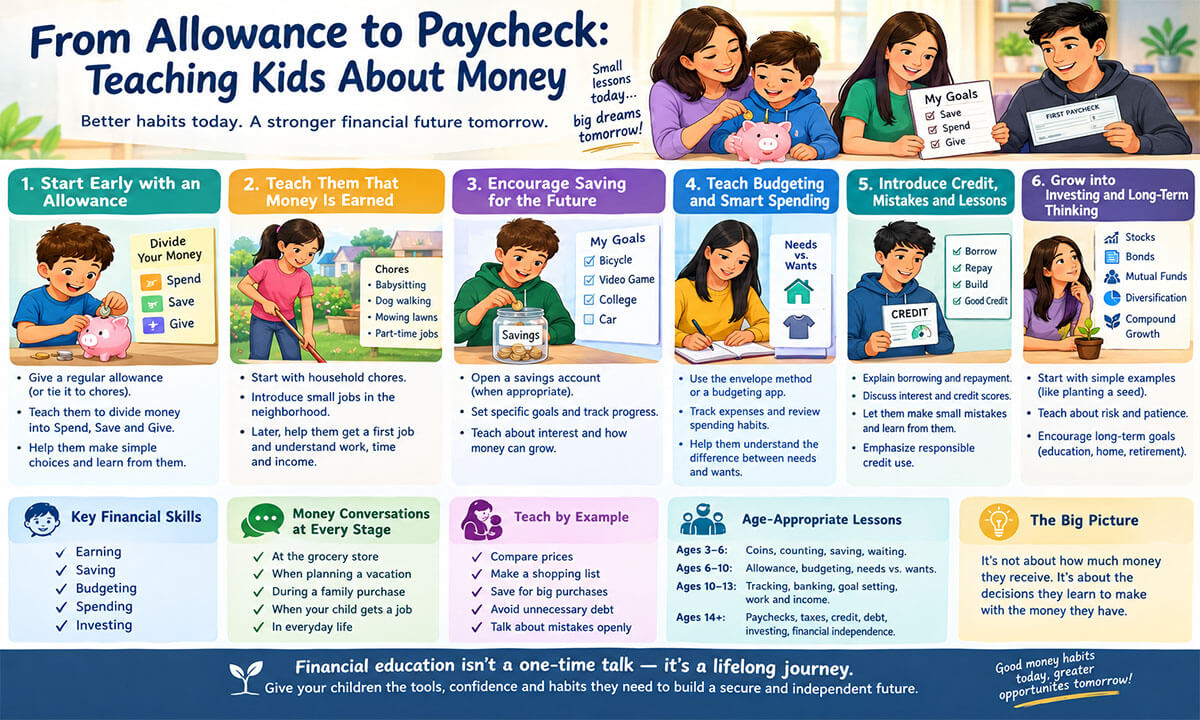
Start With an Allowance:
An allowance can be one of the easiest ways to introduce children to money management. It gives them a small amount of money that they can manage themselves.
The exact amount is less important than the opportunity to make decisions.
Some families provide a regular allowance, while others connect part of the allowance to household responsibilities. There is no single method that works for every family. Parents can choose an approach that fits their financial situation and family values.
The crucial thing is to make the system clear and consistent.
A child who receives money regularly can begin learning questions such as:
- Should I spend this money now?
- Should I save it?
- How much do I need for something I want?
- What happens if I spend everything today?
These simple questions introduce the foundations of financial decision-making.
Teach Children to Divide Their Money:
A useful approach is to divide money into different purposes. Parents can use three categories:
- Spend: This is money the child can use for things they want. It might be used for snacks, small toys, games, or other personal choices. Allowing children to spend some of their own money gives them independence. They can also experience the consequences of poor choices without facing serious financial harm.
- Save: This money is kept for something the child wants in the future. For example, a child might save for a bicycle, a book, a game, or a larger toy. Saving for a specific goal makes the idea easier to understand.
- Give: Children can also set aside a small amount for helping others. They might contribute to a charity, buy something for someone in need, or support a cause that matters to the family. This can teach children that money is not only about personal consumption. It can also be used to help others.
Teach Children That Money Is Earned:
Allowance can introduce money management, but children also need to understand where money comes from.
As children become older, parents can explain the connection between work, time, skills, and income.
Younger children can participate in age-appropriate household responsibilities. Older children may eventually earn money through suitable jobs or small services.
The lesson is simple: income usually comes from providing time, effort, skills, or services.
1. Chores and Responsibility: Parents can decide whether household chores should be paid or treated as normal family responsibilities.
If some chores are connected to payment, parents can explain the arrangement clearly. For example, a child might receive a certain amount for completing specific additional tasks.
This can teach children that completing responsibilities can have financial consequences.
However, it is also useful for children to understand that not every responsibility deserves payment. Helping with ordinary family duties can be part of being a responsible member of a household.
2. Moving From Chores to Real Jobs: As teenagers become older, they may have opportunities to earn money outside the home, depending on local laws, safety requirements, and family circumstances.
Possible activities may include tutoring, babysitting, helping with a family business, pet care, or other suitable part-time work.
These experiences can teach lessons that are difficult to learn from allowance alone.
A teenager who earns a paycheck may begin to understand:
- How income is connected to working hours
- Why reliability matters
- Why employers expect responsibilities to be completed
- How taxes and other deductions can affect take-home pay
- Why time management is important
- Why income should be planned rather than spent immediately
The first paycheck can be an important moment in a young person’s financial education.
Teach Children About Saving:
Saving is one of the most important financial habits children can develop. Young children may find it difficult to understand why they should give up something they want today for something they may receive months later. Parents can make saving easier by connecting it to specific goals.
For example, instead of simply saying, “You need to save,” a parent could help a child create a goal such as, “Let’s save enough for that bicycle.”
The goal becomes easier to understand when the child can see progress.
- Create a Savings Goal: A savings chart can be useful for younger children. If a child wants something that costs $100, the parent can create a simple chart showing the progress from $0 to $100. Every time the child saves money, they can mark their progress. This teaches an important lesson: larger purchases often require patience and planning.
- Introduce a Savings Account: Older children can also learn how banks work. Depending on the family’s circumstances and the child’s age, parents can help them open an appropriate savings account. A bank account can provide an opportunity to explain concepts such as deposits, withdrawals, balances, and interest. Parents should explain that financial products have different terms and conditions. Children can gradually learn to read those details rather than assuming that every financial product works in the same way.
Teach Budgeting Early:
Budgeting may sound like an adult concept, but children can learn the basic idea quite easily. A budget simply means deciding in advance how money will be used.
For a child, the budget may be very simple:
Money received → money saved → money spent → money given
As children become teenagers, their budgets can become more detailed.
They may need to plan for transportation, entertainment, clothing, mobile phone costs, school expenses, or other personal spending.
Use the Envelope Method: The envelope method can make budgeting visual.
Parents can give children separate envelopes labeled:
- Spend
- Save
- Give
When the child receives money, they divide it among the envelopes according to the family’s agreed plan.
The method can also be adapted for teenagers. Instead of physical envelopes, they can use a notebook, spreadsheet, or budgeting application.
The purpose is not the specific tool. The purpose is to teach intentional allocation of money.
Teach the Difference Between Needs and Wants:
One of the most useful financial lessons for children is understanding the difference between needs and wants.
Needs are things required for basic living or important responsibilities. Wants are things people would like to have but can live without.
For example, school supplies may be a need, while an expensive game may be a want.
The distinction is not always completely straightforward. Some expenses can depend on circumstances. That is why parents should encourage children to think rather than simply memorize categories.
Before buying something, parents can ask:
- “Do you need this, or do you want this?”
- “Do you have enough money for it?”
- “Would you still want it after waiting a week?”
These questions can encourage thoughtful spending.
Teach Children to Track Their Spending:
Teenagers can benefit from recording where their money goes.
They can use a notebook or spreadsheet to record:
- Money received
- Money spent
- Money saved
- Amount remaining
After several weeks, they can review their spending patterns.
They may discover that small purchases add up quickly. A few inexpensive snacks or online purchases can consume a significant portion of their available money.
Tracking expenses makes these patterns visible.
Let Children Make Small Financial Mistakes:
Children will make mistakes with money. That is part of learning. A child may spend all their savings on something they quickly stop using. Another child may forget to save for an important goal.
Parents may feel tempted to immediately replace the money. Sometimes, however, allowing children to experience reasonable consequences can teach a stronger lesson.
If a child spends all their money today, they may have to wait before they can afford something else they want.
The key is to keep the consequences appropriate to the child’s age and circumstances. Financial education should teach responsibility, not create unnecessary fear or hardship.
Parents can ask:
- “What happened?”
- “What would you do differently next time?”
- “What could you do to reach your goal now?”
These questions turn mistakes into learning experiences.
Introduce the Basics of Credit:
Credit becomes increasingly significant as children approach adulthood. Parents do not need to explain every detail of credit when a child is young. They can begin with the basic idea of borrowing.
When someone borrows money, they have an obligation to repay it according to the agreed terms.
Teenagers can gradually learn about:
- Borrowing
- Repayment
- Interest
- Credit reports
- Credit scores
- Late payments
- Different types of loans
- The risks of taking on more debt than they can afford
Parents should emphasize that credit is not free money. Borrowing can make something affordable in the short term while creating financial obligations for the future.
Teach Children About Earning a Paycheck:
A paycheck provides an excellent opportunity for teenagers to learn practical financial management.
When a teenager gets their first job, parents can encourage them to divide their income according to their priorities.
For example, they might allocate part of their income toward:
- Current spending
- Short-term savings
- Emergency savings
- Education or future goals
- Giving
The exact percentages should depend on the teenager’s income, responsibilities, and goals.
The key lesson is to create a plan before spending.
Explain Take-Home Pay: Teenagers may be surprised when their first paycheck is smaller than the amount they expected.
This provides an opportunity to explain deductions such as taxes and other applicable payroll deductions.
Understanding the difference between gross pay and take-home pay can help teenagers create realistic budgets.
Introduce Investing Carefully:
Once children understand earning, spending, saving, and budgeting, parents can introduce the basic idea of investing.
For younger children, a simple example can work.
You can compare investing to planting a seed. A seed takes time to grow. In a similar way, invested money may grow over a long period, although investment returns are not guaranteed and investments can lose value.
Teenagers can gradually learn about:
- Stocks
- Bonds
- Mutual funds
- Diversification
- Risk
- Compound growth
- Long-term investing
The emphasis should be on understanding rather than chasing quick profits.
Parents should also explain that investments involve risk and that past performance does not guarantee future results.
Teach Long-Term Thinking:
Children naturally tend to focus on what they want now. Financial education can help them develop a longer view.
A teenager might want to spend an entire paycheck on entertainment or clothing. Instead of simply saying no, parents can ask what else that money could accomplish.
- Could part of it help pay for education?
- Could it build an emergency fund?
- Could it support a future goal?
- Could saving today reduce financial pressure later?
These questions encourage children to think about opportunity costs. Choosing one financial option often means giving up another option.
Be a Financial Role Model:
Children learn not only from what parents tell them but also from what they observe.
If parents regularly discuss financial decisions calmly and responsibly, children can learn from those behaviors.
Parents can demonstrate habits such as:
- Comparing prices
- Creating shopping lists
- Saving for major purchases
- Avoiding unnecessary debt
- Reviewing household expenses
- Planning for future goals
- Talking about financial mistakes honestly
Parents do not need to pretend that they always make perfect decisions. Showing children how adults correct mistakes can be just as valuable.
Teach Money Lessons According to Age:
Financial education should change as children grow.
- Young Children: Focus on basic ideas such as identifying coins and notes, counting money, saving, spending, and waiting for something they want.
- School Age Children: Introduce allowance, simple budgeting, saving goals, needs and wants, and charitable giving.
- Preteens: Teach expense tracking, comparison shopping, goal setting, banking basics, and the connection between work and income.
- Teenagers: Introduce paychecks, taxes, budgeting, credit, debt, banking, saving for education, investing basics, and financial independence.
The goal is gradual development. Children do not need to understand everything at once.
Make Money Conversations Normal:
Money should not be treated as a mysterious or forbidden subject. Parents can use everyday situations to start conversations.
- At a grocery store, talk about comparing prices.
- When planning a vacation, discuss saving and budgeting.
- When a teenager gets a job, talk about managing their paycheck.
- When making a large purchase, explain how the family evaluates whether it is affordable.
These small conversations can add up to meaningful financial education.
In conclusion, teaching children about money is a gradual process that begins with simple experiences and becomes more sophisticated as they grow. An allowance can introduce spending and saving. Chores and small jobs can teach the connection between effort and income. A first paycheck can introduce budgeting, taxes, and financial responsibility. Later, teenagers can learn about credit, debt, investing, and long-term financial planning.
The most important lesson is not how much money a child receives. It is how they learn to make decisions with the money they have.
Children will make financial mistakes, and those mistakes can become valuable learning opportunities when parents respond with guidance rather than judgment. By giving children age-appropriate responsibilities, allowing them to make reasonable choices, and discussing money openly, parents can help them develop habits that remain useful long after childhood.
Financial education is not about teaching children to chase money. It is about helping them understand money so they can use it responsibly, make thoughtful choices, and work toward greater financial independence as they grow.

is an experienced educator and academic currently serving as a Lecturer at Nurul Amin Degree College. With a career dedicated to student development and institutional excellence, he brings a wealth of classroom expertise and pedagogical knowledge to his current role. Before joining the faculty, he served as an Assistant Teacher at Zinzira PM Pilot School and College.