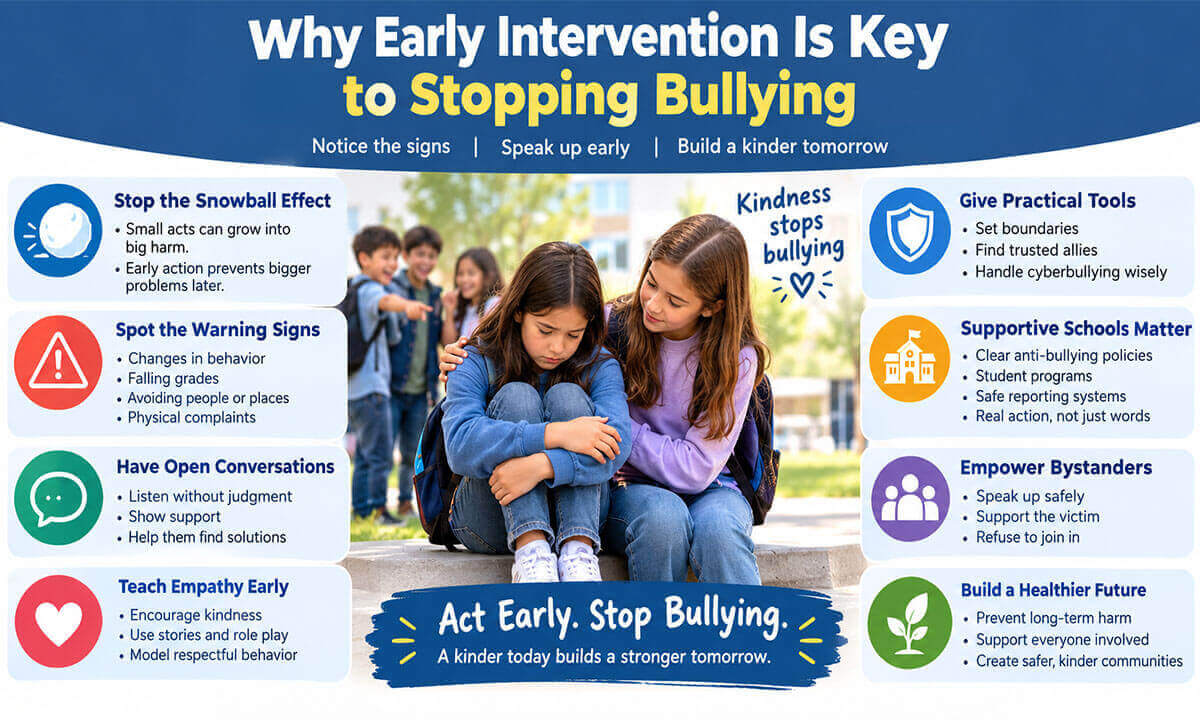
Why Early Intervention Is Key to Stopping Bullying:
Bullying can begin with something that seems small, such as a hurtful joke, repeated teasing, exclusion from a group, or an insulting comment online. However, when these behaviors are ignored, they can become more frequent and more harmful. Bullying can affect a child’s emotional well-being, relationships, school participation, and sense of safety.
This is why early intervention is so important. Acting early does not mean waiting until a situation becomes serious before taking action. It means recognizing warning signs, listening to children, addressing harmful behavior, and providing support before the situation becomes more difficult to manage.
Early intervention also involves more than protecting children who experience bullying. It means helping children who engage in bullying understand the impact of their behavior, supporting bystanders who witness it, and creating school and family environments where respect and empathy are expected.
The Snowball Effect of Bullying:
Bullying can gradually become more serious when it is not addressed. A child may initially experience occasional teasing, but repeated incidents can develop into social exclusion, threats, physical aggression, or cyberbullying.
The emotional impact can also grow over time. A child who repeatedly experiences humiliation or rejection may begin to believe that something is wrong with them. They may become less willing to participate in class, spend time with friends, or attend school.
Early action can interrupt this pattern. When adults respond to concerning behavior at an early stage, they have a better opportunity to understand what is happening and provide appropriate support.
This does not mean every disagreement between children is bullying. Children sometimes argue, make mistakes, or experience ordinary conflicts. Bullying generally involves harmful behavior that is repeated or has a significant power imbalance. Understanding this difference helps adults respond appropriately rather than treating every childhood conflict in exactly the same way.
Recognizing the Warning Signs:
Children do not always tell adults when they are being bullied. Some may feel embarrassed, frightened, or worried that reporting the problem will make things worse. Others may not have the words to explain what they are experiencing.
Adults should therefore pay attention to changes in behavior.
Some possible warning signs include:
- Sudden withdrawal from friends or family
- Reluctance to attend school
- A noticeable decline in academic performance
- Avoiding particular places, activities, or people
- Changes in sleeping or eating patterns
- Frequent complaints of headaches or stomach pain
- Loss or damage of personal belongings
- Increased irritability, sadness, or fear
- Spending unusual amounts of time alone
- Becoming unusually secretive about online activities
None of these signs automatically proves that bullying is occurring. They may have many possible causes. However, significant or unexplained changes should encourage adults to check in with the child.
A simple conversation can sometimes reveal a problem that might otherwise remain hidden.
Why Early Conversations Matter:
One of the most necessary parts of early intervention is creating opportunities for children to talk.
Instead of immediately asking, “Who did this?” or “Why didn’t you tell someone?”, adults can begin with supportive statements such as:
“I have noticed that you seem different lately. Is there anything bothering you?”
The goal is to make the child feel heard rather than questioned or blamed.
Adults should listen carefully and avoid dismissing the child’s experience. Telling a child to “just ignore it” may unintentionally communicate that their problem is not crucial.
A better approach is to acknowledge what happened and work with the child to identify safe and practical next steps.
Schools can also create regular opportunities for students to discuss safety, relationships, friendship problems, and online behavior. When these conversations happen before a serious incident occurs, children may feel more comfortable asking for help when they need it.
Teaching Empathy From an Early Age:
Prevention begins long before a serious bullying incident occurs. One important part of prevention is helping children develop empathy.
Empathy allows children to understand that other people have feelings, experiences, and perspectives that may be different from their own. It can help children think about the consequences of their behavior before they hurt someone.
Parents and teachers can encourage empathy through everyday activities.
- Encourage children to consider other people’s feelings: Questions such as “How do you think that made your friend feel?” can encourage children to think beyond their own perspective.
- Use stories and role-playing: Stories allow children to explore situations from different viewpoints. Role-playing can also help students practice responding to exclusion, teasing, disagreement, and peer pressure.
- Model respectful behavior: Children learn from adults around them. Parents, teachers, and other adults can demonstrate how to disagree respectfully, apologize, listen, and treat people with dignity.
- Praise helpful behavior: When children include someone who is alone, defend a classmate, or show kindness, adults can recognize that behavior. Positive feedback helps children understand that respect and cooperation are valued.
Giving Children Practical Tools:
Children need more than general advice about being kind. They also need practical strategies for responding to difficult situations. One useful skill is setting boundaries. Children can learn simple, confident statements such as:
- “That is not okay.“
- “Please stop.“
- “I don’t want you to speak to me like that.“
However, children should not be expected to confront someone who may physically harm them. Safety should always come first.
Children should also know when and how to seek help. They can identify trusted adults at home and school and understand that asking for help is not a sign of weakness.
Addressing Cyberbullying Early:
Bullying does not stop at the school gate. Social media, messaging platforms, online games, and other digital spaces can provide new opportunities for harmful behavior.
Cyberbullying can be particularly difficult because harmful content can spread quickly and may reach a large audience.
Children should learn to:
- Avoid responding to abusive messages when doing so may escalate the situation
- Save evidence of serious or repeated harassment
- Block accounts when appropriate
- Report harmful behavior through platform tools
- Tell a trusted adult
- Protect personal information and account security
Parents and teachers should also understand children’s digital environments. Open conversations about online experiences can make it easier for children to report problems.
The Role of Schools:
Schools have an essential responsibility in preventing and responding to bullying. A school-wide approach is generally more useful than placing the entire responsibility on individual students.
Schools can establish clear expectations about respectful behavior and explain what students should do when bullying occurs.
Effective prevention can include:
- Clear anti-bullying policies
- Staff training
- Student education
- Safe reporting systems
- Counseling and support services
- Classroom discussions about empathy and respect
- Monitoring areas where bullying may occur
- Appropriate responses to repeated harmful behavior
- Support for students who experience bullying
- Guidance for students who engage in bullying
A policy is only useful when students and staff understand it and know how it is applied. Schools also need to distinguish bullying from ordinary disagreements while taking repeated harmful behavior seriously.
The Power of Bystanders:
Bystanders are often present when bullying occurs. They may laugh, remain silent, walk away, or try to help.
Teaching students how to respond safely can make them part of the solution.
A student does not necessarily need to confront a bully directly. Depending on the situation, a bystander can:
- Stay with the student who is being targeted
- Tell a trusted adult
- Report the incident
- Refuse to participate in mocking or exclusion
- Encourage others to treat the person respectfully
- Offer support after the incident
Small actions can help a targeted student feel less isolated.
At the same time, children should not be placed in dangerous situations. Adults need to teach students the difference between safe intervention and putting themselves at risk.
Supporting Children Who Engage in Bullying:
Early intervention should not focus only on punishment. Consequences may sometimes be necessary, especially when behavior is repeated or dangerous. However, adults should also try to understand why the behavior is occurring.
A child who bullies others may be experiencing social difficulties, peer pressure, family problems, or other challenges. Understanding these factors does not excuse harmful behavior. Instead, it can help adults provide appropriate guidance.
Children who engage in bullying can be taught how to manage anger, solve conflicts, communicate appropriately, understand other people’s feelings, and take responsibility for their actions.
The goal should be to stop harmful behavior while helping the child develop healthier ways of interacting with others.
Why Waiting Can Make the Problem Harder:
Delaying action can allow harmful patterns to become established. A child who experiences repeated bullying may begin avoiding school or social situations. A child who repeatedly bullies others may learn that aggressive behavior brings social rewards or that there are few consequences for harmful actions.
Early intervention provides an opportunity to change these patterns.
It also sends an important message: harmful behavior matters, and people deserve to feel safe and respected.
Creating a Culture of Prevention:
Stopping bullying is not the responsibility of one teacher, parent, or student. It requires cooperation among families, schools, students, and the wider community.
Prevention becomes stronger when children know where to seek help, adults know how to respond, and schools create environments where respect is part of everyday life.
This means talking about kindness before a serious incident happens. It means teaching digital citizenship before a child encounters cyberbullying. It means discussing empathy before students face difficult social situations.
Prevention works best when it becomes part of everyday education rather than a response that begins only after something goes wrong.
In conclusion, bullying should not be treated as an unavoidable part of growing up. While conflicts and disagreements are a normal part of childhood, repeated harmful behavior needs appropriate attention.
Early intervention can prevent small problems from becoming larger ones. Recognizing warning signs, listening to children, encouraging empathy, teaching practical coping skills, supporting bystanders, addressing cyberbullying, and creating strong school policies can all contribute to safer environments.
The goal is not simply to stop one bullying incident. It is to help children develop the knowledge, confidence, empathy, and support systems they need to build healthier relationships.
When adults act early and children know that their concerns will be taken seriously, bullying becomes easier to identify and address. Most importantly, early action helps create schools and communities where children can learn, participate, and grow without living in fear of being mistreated.

is an experienced educator and academic currently serving as a Lecturer at Nurul Amin Degree College. With a career dedicated to student development and institutional excellence, he brings a wealth of classroom expertise and pedagogical knowledge to his current role. Before joining the faculty, he served as an Assistant Teacher at Zinzira PM Pilot School and College.