Why Open Educational Resources Foster Innovation in Teaching:
Education is changing rapidly. Teachers and students now have access to digital tools, online courses, interactive platforms, videos, simulations, and many other forms of learning material. Among these developments, Open Educational Resources, commonly known as OER, have become an important part of modern education.
OER are educational materials that are freely available for people to access, use, adapt, and share. They can include textbooks, lecture notes, lesson plans, videos, presentations, quizzes, activities, and interactive learning materials. Many OER are published under open licenses that allow educators to modify the content according to their teaching needs.
The importance of OER goes beyond reducing the cost of educational materials. They can give teachers greater freedom to experiment with teaching methods, adapt lessons for different learners, collaborate with other educators, and update learning materials when new information becomes available.
For these reasons, OER can play a vital role in encouraging innovation in teaching and learning.
What Are Open Educational Resources?
Open Educational Resources are teaching, learning, and research materials that are freely accessible and can often be reused, adapted, and shared.
Examples of OER include:
- Open textbooks
- Lesson plans
- Lecture notes
- Educational videos
- Online courses
- Presentations
- Worksheets
- Quizzes and assessment materials
- Interactive simulations
- Educational activities
A major feature of OER is the permission to adapt the material. Traditional educational resources may restrict how teachers can copy or change their content. Openly licensed resources can give educators more freedom to modify materials for their particular students and teaching environments.
This flexibility is one of the main reasons OER can support innovation.
How OER Foster Innovation in Teaching:
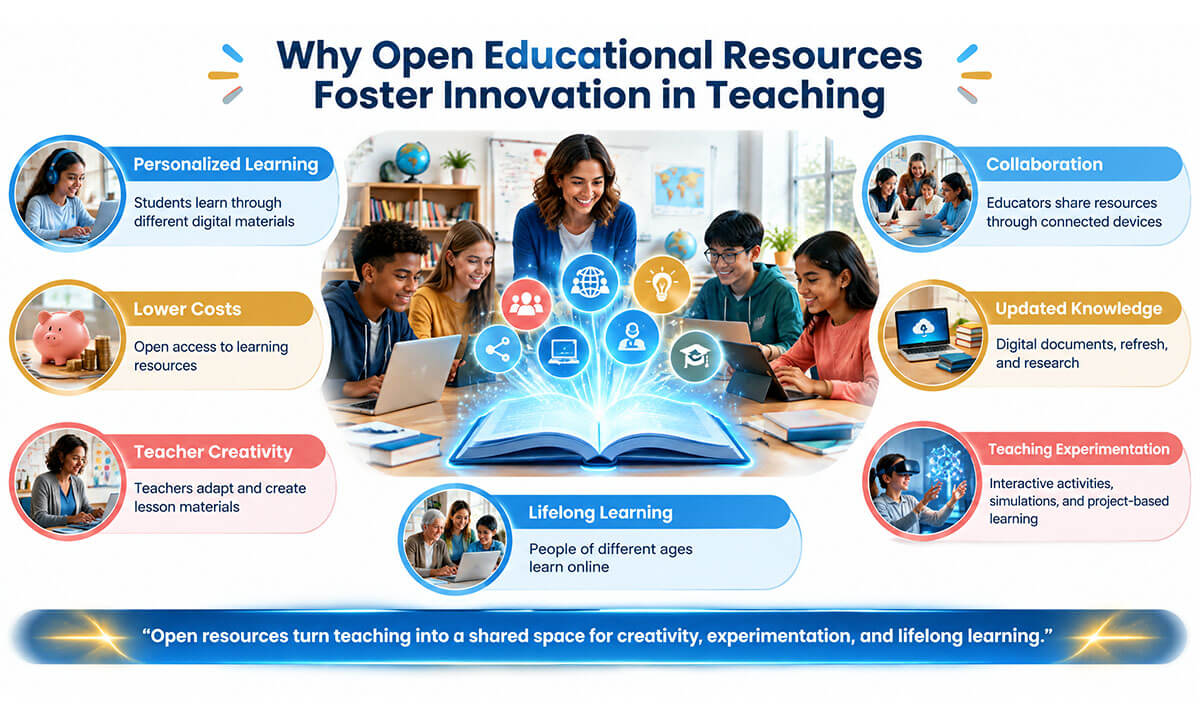
1. They Support Personalized Learning: Students do not all learn in the same way or at the same pace. Some students may understand a concept quickly through written explanations, while others may benefit from videos, diagrams, examples, demonstrations, or practical activities.
OER allow teachers to select and modify different types of materials according to their students’ needs.
For example, a teacher teaching a difficult science topic can combine an open textbook chapter with an educational video, an interactive simulation, and a practical classroom activity. Instead of relying on one textbook, the teacher can create a learning experience using several different resources.
This flexibility can make teaching more responsive to individual learning needs.
2. They Reduce Financial Barriers: The cost of textbooks and other educational materials can create difficulties for students and families. Some students may not be able to purchase all the required books for a course.
OER can reduce this problem because many resources are available without the traditional purchase cost. Students can access learning materials online without having to buy expensive textbooks.
This can be particularly important for students from financially disadvantaged backgrounds. When students have access to the same core learning materials, differences in access to educational resources can be reduced.
However, free access does not automatically guarantee equal educational opportunities. Students also need reliable internet connections, suitable devices, digital skills, and support from teachers and institutions.
3. They Give Teachers Greater Creative Freedom: Teachers often need to adapt lessons to make them suitable for their particular students. A resource designed for one group of learners may not work equally well for another group.
OER provide opportunities for teachers to modify existing content rather than creating every resource from the beginning.
A teacher might simplify a difficult reading, add local examples, create new questions, translate material into another language, or combine several open resources into a new lesson.
This encourages teachers to experiment with different approaches and develop teaching materials that are better suited to their classrooms.
4. They Encourage Collaboration Among Educators: OER can create opportunities for teachers and educators to share knowledge and teaching materials.
For example, one teacher might create an open lesson about genetics. Another educator could improve the lesson by adding diagrams or activities. A third teacher could adapt it for students in a different educational system.
This process allows educational materials to develop through collaboration. Instead of each teacher working independently, educators can learn from one another and build on existing work.
Collaboration can therefore become an important source of innovation.
5. They Make It Easier to Update Learning Materials: Knowledge does not remain unchanged. New research, technologies, discoveries, and social developments can change what students need to learn.
Traditional textbooks can take considerable time to revise and republish. As a result, some printed materials may contain information that is no longer current.
OER can be updated more easily because educators can modify digital resources and publish revised versions. This is particularly useful in subjects such as information technology, science, medicine, and other rapidly changing fields.
The ability to update educational content can help teachers provide students with more relevant information.
6. They Encourage Experimentation With Teaching Methods: Innovation often requires teachers to try something different.
OER can support experimentation because educators can adapt resources to create new learning activities. For example, a teacher could turn an open reading into a group discussion, transform existing content into a problem-solving activity, or combine an open textbook with digital simulations.
Teachers can also experiment with blended learning, flipped classrooms, project-based learning, and other approaches.
The important point is that OER provide content that teachers can work with rather than treating educational material as something that must always be used exactly as published.
7. They Support Lifelong Learning: Education is not limited to schools and universities.
Professionals may need to develop new skills throughout their careers. Adults may want to learn a new language, improve their digital skills, study a scientific subject, or explore a personal interest.
Because many OER are freely available online, they can support learning beyond formal educational institutions. Students, professionals, independent learners, and other members of the public can use these resources for continued learning.
This can help create a culture in which learning continues throughout life.
OER and Digital Innovation:
The growth of digital technology has expanded the possibilities of OER. Educational resources can now include multimedia, interactive activities, simulations, online assessments, and other digital experiences.
Emerging technologies may provide even more possibilities. The LearnBU article points to artificial intelligence, adaptive learning technologies, and open platforms as areas that could influence the future development of OER.
For example, technology could help educators provide learning activities that respond to students’ progress. Interactive resources could also allow students to explore difficult concepts through simulations and visual demonstrations.
At the same time, technology should support good teaching rather than replace the role of educators. Teachers remain important for understanding students’ needs, providing guidance, encouraging discussion, and creating supportive learning environments.
Challenges of Using OER:
Although OER offer many opportunities, they also present challenges.
One challenge is quality. Not every freely available educational resource is accurate, well-designed, or suitable for a particular group of students. Teachers therefore need to evaluate resources carefully before using them.
Another challenge is digital access. Students without reliable internet access or suitable devices may have difficulty using online OER.
Teachers may also need training in finding, evaluating, adapting, and creating open resources. Without institutional support, educators may find it difficult to devote enough time to these activities.
Copyright and licensing also require attention. Teachers need to understand the conditions attached to different open licenses and respect the rights of creators when adapting or sharing resources.
How Institutions Can Encourage OER Use:
Schools, colleges, and universities can take several steps to encourage the effective use of OER.
- Provide Teacher Training: Educators can be trained to find reliable OER, evaluate their quality, understand open licenses, and adapt materials for their students.
- Create Institutional Support: Institutions can develop policies that recognize and encourage the creation and use of open educational materials.
- Support OER Development: Teachers may need time and technical support to create high-quality open resources. Institutions can provide training, technology, funding, and professional recognition.
- Build OER Communities: Teachers can create communities where they share resources, discuss teaching experiences, and work together to improve educational materials.
- Encourage Quality Evaluation: Institutions can establish processes for reviewing OER so that teachers and students can identify resources that are accurate, relevant, accessible, and appropriate for their educational context.
The Future of OER:
The future of OER is closely connected with developments in digital education. Artificial intelligence, adaptive learning systems, open platforms, multimedia resources, and interactive technologies could provide new ways to create and use open educational materials.
However, technological development alone will not guarantee successful OER adoption. Sustainable funding, teacher training, institutional support, digital access, and collaboration will remain important.
The strongest potential of OER comes from combining technology with the knowledge and creativity of educators. When teachers have the freedom to adapt resources and share their experiences, educational materials can continue to develop over time.
In conclusion, Open Educational Resources have the potential to change the way teachers create and use educational materials. They can reduce the financial burden of learning resources while giving educators greater freedom to adapt lessons, experiment with teaching approaches, collaborate with colleagues, and respond to changing knowledge.
OER can also support personalized learning and lifelong education by making a wide range of materials available to students and independent learners. Their value, however, depends on more than simply making resources free. Quality, accessibility, digital skills, licensing, teacher training, and institutional support all matter.
As education continues to become more digital, OER can provide an important foundation for innovation. By encouraging educators to share, adapt, improve, and create learning materials together, OER can help build a more flexible and collaborative approach to teaching and learning.

is an experienced educator and academic currently serving as a Lecturer at Nurul Amin Degree College. With a career dedicated to student development and institutional excellence, he brings a wealth of classroom expertise and pedagogical knowledge to his current role. Before joining the faculty, he served as an Assistant Teacher at Zinzira PM Pilot School and College.