The Intersection of Mental Health and Education Reform:
Education is often measured through grades, examinations, attendance, and academic achievement. These measures are important, but they do not tell the whole story of a student’s development. A student may have strong academic abilities but struggle to learn because of anxiety, depression, chronic stress, trauma, loneliness, bullying, or problems at home.
This is why mental health needs to be considered an important part of education reform. Students do not leave their emotions at the classroom door. Their mental and emotional experiences can affect their concentration, memory, motivation, relationships, behavior, and ability to participate in learning.
Education reform is therefore not only about changing textbooks, introducing technology, or improving examination systems. It can also involve creating learning environments where students feel safe, respected, supported, and able to ask for help.
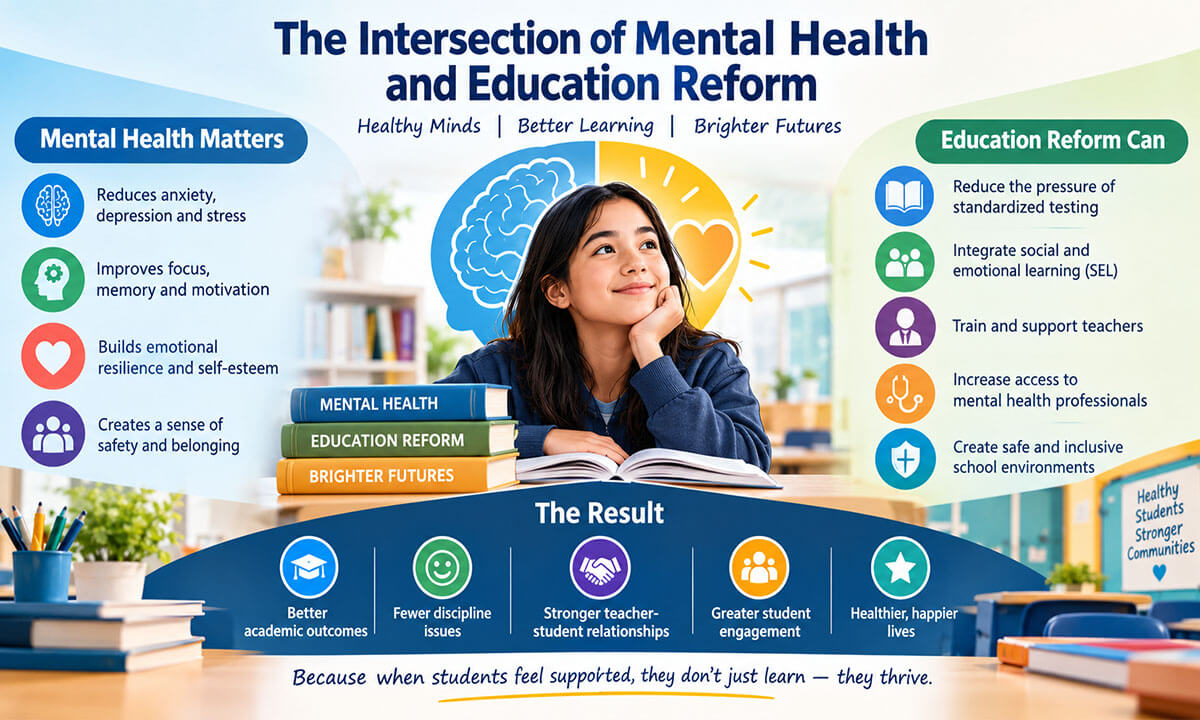
Why Mental Health Matters in Education:
Mental Health Affects Learning: Learning requires attention, memory, motivation, problem-solving, and emotional regulation. Mental health difficulties can interfere with these processes.
For example, a student experiencing severe anxiety may spend much of a lesson worrying about failure, social situations, family problems, or upcoming examinations. Even when the teacher provides good instruction, the student may struggle to concentrate on the material.
Depression can also affect motivation and energy. A student may stop participating in class, lose interest in activities, have difficulty completing assignments, or become absent from school.
Chronic stress can create similar difficulties. When students constantly feel under pressure, their ability to focus and respond effectively to academic challenges can suffer.
This does not mean that every student experiencing a mental health difficulty will perform poorly. It means that emotional well-being is one of several factors that can influence a student’s ability to learn.
Academic Achievement and Emotional Well-Being Are Connected: Academic success should not be viewed separately from students’ overall well-being.
Consider two students with similar academic abilities. One has a supportive family, positive relationships at school, adequate sleep, and access to help when facing difficulties. The other is experiencing bullying, intense academic pressure, and persistent emotional distress.
Their academic experiences may be very different even though they have similar intellectual abilities.
A supportive educational environment can help students develop confidence, persistence, self-regulation, and healthy relationships. These qualities can support learning as well as personal development.
The Current Mental Health Challenge in Education:
Mental health concerns among children and young people have become an important educational issue. Schools regularly encounter students dealing with anxiety, depression, stress, grief, bullying, family difficulties, social isolation, and other challenges.
However, identifying a problem is only the beginning. Students also need appropriate support.
The Mental Health Support Gap: Many schools face shortages of counselors, psychologists, social workers, and other trained professionals. In some settings, one counselor may be responsible for a very large number of students.
This creates a significant challenge. Teachers may notice changes in a student’s behavior, but teachers are not mental health professionals and should not be expected to provide clinical treatment.
Schools therefore need systems that allow teachers to identify concerns and connect students with qualified professionals when necessary.
Problems with Traditional Approaches to Education Reform:
Excessive Focus on Testing: Assessment is an important part of education. However, an excessive focus on examinations and standardized testing can create additional pressure for students and teachers.
Test scores can provide useful information about academic performance, but they cannot fully capture a student’s emotional state, family circumstances, relationships, creativity, resilience, or personal development.
A student is much more than a test score.
Education reform can therefore consider broader measures of educational success, including engagement, attendance, belonging, social development, and student well-being.
Limited Attention to Social and Emotional Learning: Academic knowledge is only one part of preparation for adult life. Students also need to learn how to communicate, manage emotions, solve interpersonal problems, make responsible decisions, understand other people’s perspectives, and deal with setbacks.
Social and emotional learning, commonly known as SEL, can support these areas.
SEL can help students develop skills such as:
- Self-awareness
- Emotional regulation
- Empathy
- Responsible decision-making
- Communication
- Relationship building
- Conflict resolution
- Goal setting
These skills are useful inside and outside the classroom.
Benefits of Integrating Mental Health into Education Reform:
1. Improved Learning Conditions: When students feel psychologically safe, they may be more willing to participate, ask questions, make mistakes, and seek assistance.
A classroom where students are afraid of humiliation or punishment can discourage participation. A classroom where mistakes are treated as part of learning can encourage curiosity and persistence.
Mental health support can therefore contribute to a healthier learning environment.
2. Better Classroom Behavior: Student behavior is influenced by many factors. Emotional distress can sometimes appear as withdrawal, irritability, aggression, difficulty concentrating, or refusal to participate.
Providing students with appropriate emotional and behavioral support can help schools respond to underlying needs rather than relying only on punishment.
This does not mean that schools should ignore inappropriate behavior. Instead, discipline can be combined with opportunities for students to understand their behavior, take responsibility, repair harm, and develop better coping strategies.
3. Stronger Teacher-Student Relationships: Teachers play a vital role in students’ educational experiences.
When teachers understand that behavior can sometimes communicate an unmet need, they may respond with greater patience and understanding. This does not make teachers therapists. Rather, it encourages teachers to recognize students as whole people.
Positive teacher-student relationships can help students feel that they belong at school. A sense of belonging can be particularly important for students who feel isolated or disconnected.
4. Greater Student Engagement: Students are more likely to engage with learning when they feel connected to their school and believe that their teachers care about their development.
Mental health initiatives can contribute to this environment by creating opportunities for students to discuss challenges, build relationships, develop coping skills, and access support.
How Education Systems Can Bridge the Gap:
1. Normalize Conversations About Mental Health: Schools can help reduce stigma by treating mental health as a normal part of overall health.
Age-appropriate discussions can teach students that experiencing stress, sadness, fear, frustration, or disappointment does not make someone weak.
At the same time, students should learn when ordinary emotional difficulties may require additional support.
Mental health education should be respectful, culturally appropriate, and suitable for students’ developmental levels.
2. Provide Mental Health Training for Educators: Teachers do not need to become therapists. However, basic training can help educators recognize potential warning signs and understand appropriate referral procedures.
Training can cover areas such as:
- Recognizing changes in student behavior
- Understanding basic mental health concepts
- Responding appropriately to students who disclose difficulties
- Maintaining professional boundaries
- Understanding safeguarding responsibilities
- Knowing how to refer students to qualified professionals
The goal is early recognition and appropriate support, not diagnosis by teachers.
3. Integrate Social and Emotional Learning: SEL does not necessarily have to become another separate academic subject.
Schools can incorporate social and emotional skills into existing activities. Literature classes can explore empathy and relationships. Group projects can develop communication and cooperation. Physical education can address goal setting and self-regulation. Classroom discussions can encourage reflection and respectful disagreement.
This approach can make emotional and interpersonal skills part of everyday education.
4. Increase Access to Qualified Professionals: Schools need appropriate access to trained mental health professionals.
Depending on the educational setting, this may include counselors, psychologists, social workers, nurses, and other qualified professionals.
These professionals can provide assessment, counseling, referrals, crisis support, family communication, and other services within their professional scope.
Where full-time professionals are not possible, schools can develop partnerships with community mental health services and other qualified providers.
5. Create Safer School Environments: Mental health reform cannot succeed if students continue to experience bullying, harassment, discrimination, violence, or persistent fear at school.
Schools can establish clear policies for preventing and responding to bullying and other forms of harmful behavior. Students should know where they can report problems and how concerns will be handled.
Creating a safe school environment is not simply a disciplinary responsibility. It is also part of supporting student well-being.
6. Involve Families and Communities: Students’ mental health is influenced by environments beyond school.
Schools can work with parents, caregivers, community organizations, and health professionals to create coordinated support systems.
Communication should respect privacy and professional boundaries while ensuring that appropriate people are involved when a student needs additional help.
The Role of Teachers:
Teachers have a crucial role in supporting student well-being, but their responsibilities need to be clearly defined.
A teacher can create a respectful classroom, listen to students, notice changes in behavior, encourage healthy learning habits, and refer students to appropriate services.
However, teachers should not be expected to diagnose mental health conditions or provide specialized treatment.
Education reform should therefore support teachers rather than placing another major responsibility on already demanding workloads.
The Importance of Prevention:
Mental health support should not begin only when a student reaches a crisis point. Schools can also focus on prevention.
Preventive approaches may include:
- Building supportive relationships
- Teaching emotional regulation
- Encouraging healthy routines
- Creating opportunities for physical activity
- Reducing unnecessary academic pressure
- Addressing bullying
- Strengthening student belonging
- Providing accessible counseling
- Teaching help-seeking skills
- Creating clear pathways for referrals
Prevention cannot eliminate every mental health problem, but it can create conditions that support healthier development.
Technology and Mental Health Support:
Technology is becoming increasingly essential in education and can also support access to mental health information and services.
Schools may use digital platforms to provide educational resources, appointment systems, communication tools, and information about available support.
However, technology should complement rather than replace human support. Privacy, confidentiality, accessibility, digital safety, and professional oversight are particularly important when technology is used for mental health-related purposes.
Building a More Holistic Education System:
Education reform can move beyond the idea that the primary purpose of school is to produce high test scores.
Academic knowledge remains important. Students need strong literacy, numeracy, scientific knowledge, critical thinking, and other academic skills.
But education also prepares young people to manage relationships, solve problems, communicate effectively, handle setbacks, make decisions, and participate in society.
A holistic education system recognizes these different dimensions of development.
This does not mean lowering academic expectations. Instead, it means recognizing that students are more likely to learn effectively when their broader needs are considered.
Looking Toward the Future:
The future of education will depend partly on how well schools respond to the changing needs of students.
Education systems can continue to focus primarily on grades and examinations, or they can develop broader approaches that combine academic achievement with student well-being.
Meaningful reform does not have to happen through one major change. It can develop through many practical steps, including better teacher training, stronger counseling services, effective SEL programs, safer classrooms, improved referral systems, family engagement, and more balanced approaches to assessment.
The specific approach will differ between countries, communities, and educational institutions. What works in one setting may not work in exactly the same way somewhere else. Successful reform should therefore consider local resources, culture, student needs, and available professional services.
In conclusion, mental health and education are closely connected because learning does not happen independently of students’ emotional and social lives. Anxiety, depression, chronic stress, trauma, bullying, and other difficulties can affect students’ ability to participate and learn, while supportive school environments can contribute to students’ development and sense of belonging.
Education reform therefore has an opportunity to look beyond grades and examination results. It can create systems that recognize academic achievement alongside emotional development, healthy relationships, safety, and personal growth.
The goal is not to turn teachers into therapists or schools into mental health clinics. The goal is to build an education system where mental health is recognized as an important part of student development, where concerns can be identified early, and where students can reach appropriate support when they need it.
When education considers both the mind and the learner, reform becomes more responsive to the realities of students’ lives.

is an experienced educator and academic currently serving as a Lecturer at Nurul Amin Degree College. With a career dedicated to student development and institutional excellence, he brings a wealth of classroom expertise and pedagogical knowledge to his current role. Before joining the faculty, he served as an Assistant Teacher at Zinzira PM Pilot School and College.