Basic Anatomy Related to Physical Activity:
Anatomy is the study of the structure of the human body and its different parts. It helps us understand how the body is organized and how its systems work together. In physical education, sports, and fitness, basic anatomical knowledge is important because it explains how the body moves, how physical performance can be improved, and how injuries can be prevented.
Physical activities such as walking, running, jumping, swimming, and lifting require the coordinated action of bones, muscles, joints, and connective tissues. Each structure has a specific role in producing movement and maintaining body stability. Knowledge of anatomy helps physical education teachers, athletes, coaches, and fitness professionals plan safe and effective exercise programs.
1. The Skeletal System:
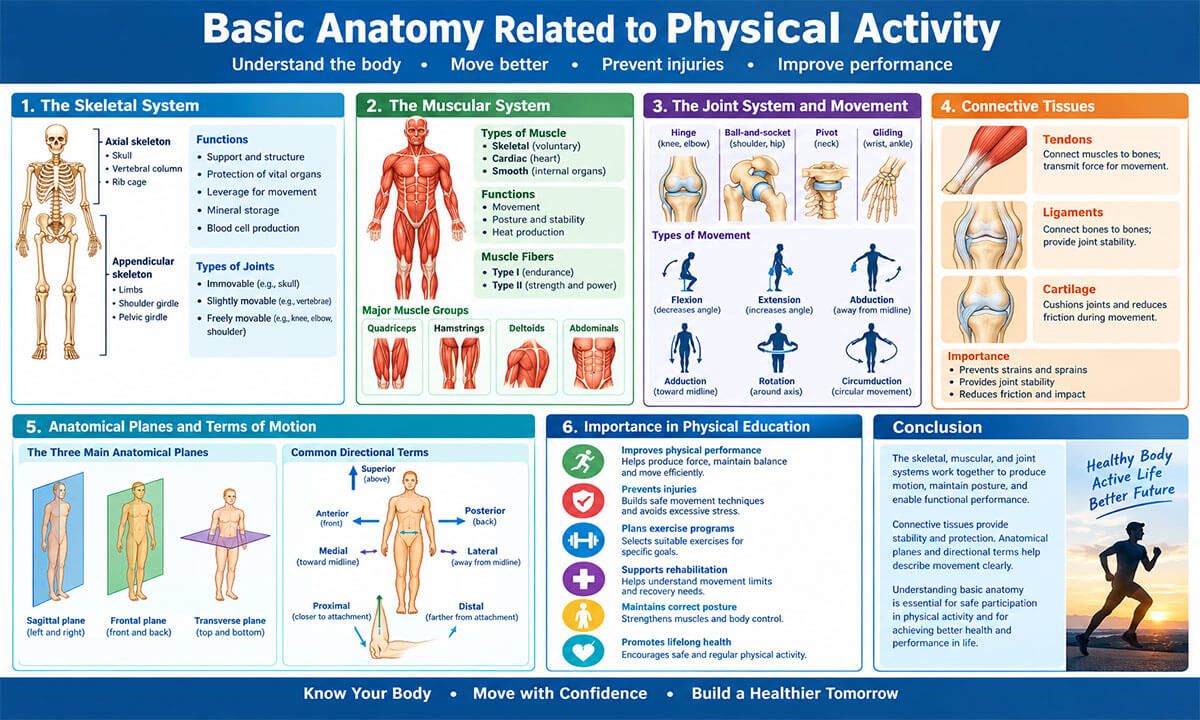
The skeletal system forms the framework of the human body. An adult human body typically contains 206 bones. These bones support the body, protect internal organs, and work with muscles to produce movement.
The skeletal system has two main divisions:
- Axial Skeleton: The axial skeleton includes the skull, vertebral column, and rib cage. It supports the central axis of the body and protects important organs. For example, the skull protects the brain, while the rib cage protects the heart and lungs.
- Appendicular Skeleton: The appendicular skeleton includes the bones of the arms and legs, together with the shoulder and pelvic girdles. These structures allow the body to perform various movements, including walking, running, throwing, and jumping.
Functions of the Skeletal System in Physical Activity: The skeletal system performs several important functions:
- Support: It provides the framework needed to maintain body shape and posture.
- Protection: It protects vital organs from injury.
- Movement: Bones act as levers, while joints provide points around which movement occurs.
- Mineral storage: Bones store minerals such as calcium and phosphorus.
- Blood cell production: Bone marrow produces blood cells.
Joints are the places where two or more bones meet. They can be classified according to their structure and movement. Fibrous joints, such as most skull sutures, allow little or no movement. Cartilaginous joints, such as the joints between vertebral bodies, allow limited movement. Synovial joints, such as the knee, shoulder, and elbow, allow a wide range of movement and are especially important in physical activity.
2. The Muscular System:
The muscular system produces movement through the contraction and relaxation of muscles. The human body contains more than 600 skeletal muscles, which work together to support posture, stabilize joints, and perform physical activities.
There are three main types of muscle tissue:
- Skeletal Muscle: Skeletal muscles are usually attached to bones through tendons. They are generally under voluntary control and allow activities such as walking, running, lifting, and throwing.
- Cardiac Muscle: Cardiac muscle is found in the heart. It contracts continuously to pump blood throughout the body. During exercise, the heart increases its pumping activity to supply working muscles with more oxygen and nutrients.
- Smooth Muscle: Smooth muscle is found in the walls of internal organs and blood vessels. It controls involuntary activities such as the movement of food through the digestive tract and changes in blood vessel diameter.
Functions of the Muscular System in Physical Activity: The muscular system performs several essential functions:
- Movement: Muscles contract to move body parts.
- Posture: Muscles help maintain an upright position and proper body alignment.
- Joint stability: Muscles support joints during movement.
- Heat production: Muscle contractions produce heat, helping maintain body temperature.
Muscles often work in opposing groups. The agonist is the primary muscle responsible for a particular movement, while the antagonist produces the opposite action or helps control the movement. For example, the biceps bend the elbow, while the triceps straighten it.
Types of Muscle Fibers: Skeletal muscle fibers are commonly classified into two broad groups:
- Type I fibers: These fibers contract relatively slowly and resist fatigue. They are useful for endurance activities such as long-distance running and cycling.
- Type II fibers: These fibers contract more quickly and can produce greater force or power. They are important for sprinting, jumping, and heavy lifting. Different Type II subtypes have different fatigue resistance and performance characteristics.
Understanding major muscle groups, including the quadriceps, hamstrings, deltoids, and abdominal muscles, helps individuals select suitable exercises for strength, endurance, and rehabilitation.
3. The Joint System and Movement:
Joints connect bones and allow different parts of the body to move. Their structure determines the direction and range of movement they can perform. Healthy joints are essential for efficient physical activity and the prevention of movement limitations.
Major Types of Joints:
- Hinge Joints: Hinge joints mainly allow bending and straightening. The elbow and knee are common examples, although the knee also permits some rotation.
- Ball and Socket Joints: These joints allow movement in several directions. The shoulder and hip joints are examples. They support activities such as throwing, kicking, and rotating the arms and legs.
- Pivot Joints: Pivot joints allow rotation around an axis. The joint between the first and second cervical vertebrae helps the head turn from side to side.
- Gliding Joints: Gliding joints allow small sliding movements between bones. Examples include joints between certain wrist and ankle bones.
Major Types of Body Movement: The human body performs a number of basic movements during physical activity:
- Flexion: Decreases the angle between body parts, as when bending the elbow.
- Extension: Increases the angle between body parts, as when straightening the knee.
- Abduction: Moves a body part away from the body’s midline, as when raising an arm sideways.
- Adduction: Moves a body part toward the body’s midline.
- Rotation: Turns a body part around its axis.
- Circumduction: Moves a body part in a circular pattern, combining several movements.
Bones, muscles, and joints work together to produce the coordinated movements needed for walking, running, jumping, lifting, and throwing. Understanding these movements helps teachers and coaches explain correct exercise techniques and improve performance.
4. Connective Tissues:
Connective tissues support, connect, and protect structures throughout the body. They are especially important in the musculoskeletal system because they help transfer force, stabilize joints, and reduce friction.
- Tendons: Tendons connect muscles to bones. When a muscle contracts, the tendon transfers force to the bone and helps produce movement. Strong and healthy tendons are important for activities that involve running, jumping, and lifting.
- Ligaments: Ligaments connect bones to other bones. They help stabilize joints and limit excessive movement. For example, ligaments in the knee help maintain joint stability during running and changes of direction.
- Cartilage: Cartilage is a firm and flexible connective tissue found in several parts of the body. Articular cartilage covers the ends of bones in many joints, allowing them to move smoothly and reducing friction. Other types of cartilage provide support in structures such as the nose and ears.
Importance of Connective Tissues in Physical Activity: Healthy connective tissues help the body tolerate physical stress. Sudden movements, excessive loads, poor exercise techniques, and insufficient recovery may contribute to injuries. A suitable warm-up, gradual increases in training intensity, proper technique, and adequate recovery can help reduce injury risk.
5. Anatomical Planes and Terms of Motion:
Anatomical planes are imaginary lines or surfaces used to divide the body into sections. They help describe and analyze movements accurately. These concepts are widely used in physical education, sports science, physiotherapy, and fitness assessment.
The Three Main Anatomical Planes:
- Sagittal Plane: The sagittal plane divides the body into left and right portions. Movements such as forward walking, running, squatting, and elbow flexion mainly occur in this plane.
- Frontal Plane: The frontal plane divides the body into front and back portions. Movements such as jumping jacks and raising the arms sideways mainly occur in this plane.
- Transverse Plane: The transverse plane divides the body into upper and lower portions. Rotational movements, such as turning the trunk during a throwing action, mainly occur in this plane.
Many sports movements involve more than one plane. For example, a tennis serve combines movements in quite a few planes to produce speed, balance, and power.
Common Anatomical Directional Terms: Directional terms help describe the position of one body part in relation to another.
- Anterior and posterior: Anterior means toward the front of the body, while posterior means toward the back.
- Medial and lateral: Medial means closer to the body’s midline, while lateral means farther from the midline.
- Superior and inferior: Superior means toward the head, while inferior means toward the feet.
- Proximal and distal: Proximal means closer to the point of attachment or the trunk, while distal means farther away.
For example, the elbow is proximal to the wrist, while the fingers are distal to the elbow. These terms provide a clear and consistent way to describe body positions and movements.
6. Importance of Basic Anatomy in Physical Education:
Basic anatomical knowledge is essential for effective teaching, training, and participation in physical activity. It helps individuals understand the body’s abilities and limitations.
- Improving physical performance: Knowledge of muscles, bones, and joints helps athletes understand how to produce force, maintain balance, and perform movements efficiently.
- Preventing injuries: Understanding body structures and joint movements helps individuals avoid excessive stress and use safer exercise techniques.
- Planning exercise programs: Coaches and fitness professionals can select suitable exercises according to the muscles and movements they want to develop.
- Supporting rehabilitation: Anatomical knowledge helps health and rehabilitation professionals understand movement limitations and plan appropriate recovery activities.
- Maintaining correct posture: Understanding the role of muscles and the skeleton helps individuals develop better posture and body control.
- Promoting lifelong health: Basic anatomy encourages people to participate in physical activity safely and make informed decisions about exercise and fitness.
In conclusion, basic anatomy is an essential foundation of physical education, sports, and fitness. It explains how the skeletal system provides support, how the muscular system produces movement, how joints allow mobility, and how connective tissues stabilize and protect the body. Anatomical planes and directional terms also help describe movements clearly and accurately.
Understanding these structures and their functions allows students, teachers, athletes, and fitness professionals to improve physical performance, select appropriate exercises, maintain correct movement techniques, and reduce the risk of injury. Therefore, basic anatomical knowledge is essential for safe participation in physical activity and the development of lifelong physical health.

is an experienced educator and academic currently serving as a Lecturer at Nurul Amin Degree College. With a career dedicated to student development and institutional excellence, he brings a wealth of classroom expertise and pedagogical knowledge to his current role. Before joining the faculty, he served as an Assistant Teacher at Zinzira PM Pilot School and College.