Basic Understanding of Shadow Libraries:
Access to information is an essential part of education, research, and scholarly communication. Students, teachers, researchers, and academics need books, journal articles, research papers, conference papers, and other academic resources. Libraries normally provide these resources through subscriptions, purchases, licenses, donations, and other authorized methods.
However, access to scholarly information is not equal everywhere. Many academic journals, books, and databases are expensive. Some resources are available only to users whose universities or research institutions have paid for access. Students and researchers from institutions with limited library budgets may therefore face difficulties when they need important academic materials.
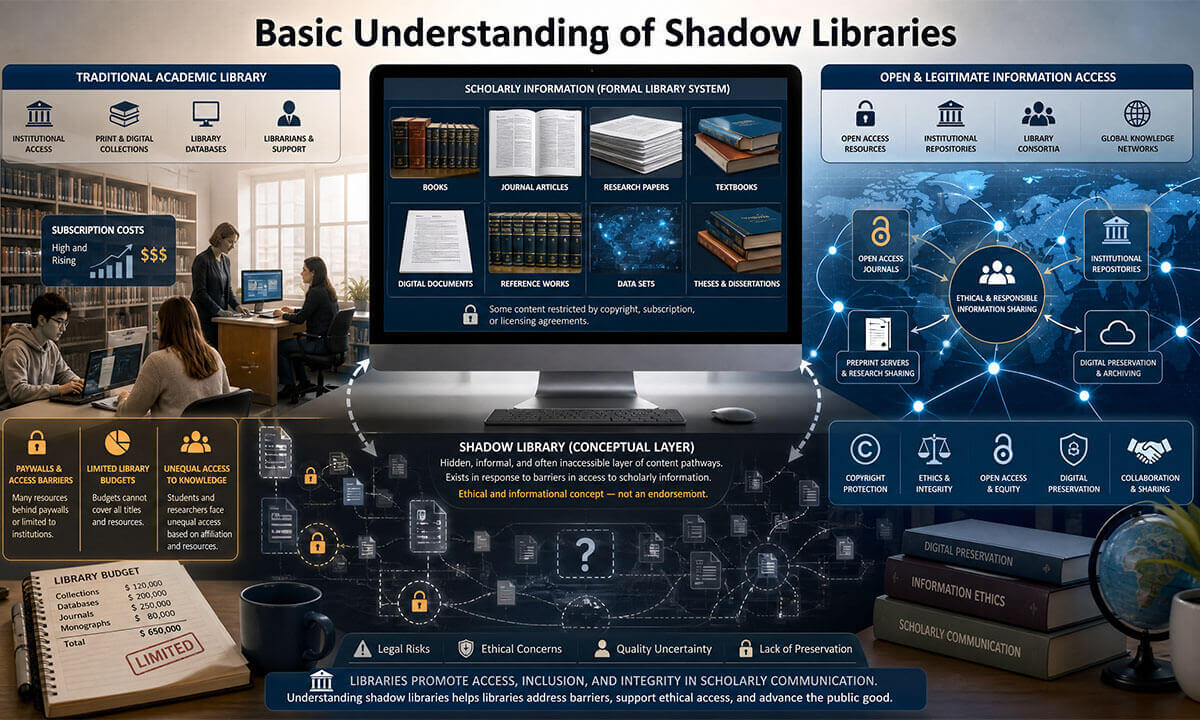
This situation has contributed to the development and use of shadow libraries. A shadow library is a digital collection that provides access to books, journal articles, research papers, and other information resources outside the normal system of library subscriptions and publishing agreements. In many cases, copyrighted materials are distributed without permission from the copyright holder.
Shadow libraries have become an important topic in Library and Information Science because they are connected with information access, copyright, scholarly communication, open access, information inequality, and the role of libraries.
The subject is also controversial. Supporters often argue that shadow libraries help people access knowledge when they cannot afford expensive academic resources. Publishers and copyright holders argue that unauthorized distribution violates copyright and can affect the financial sustainability of scholarly publishing.
The following questions and answers provide a basic understanding of shadow libraries.
What is a Shadow Library?
A shadow library is a digital collection that provides access to books, journal articles, research papers, textbooks, and other information resources outside the traditional library and publishing system.
Traditional libraries normally obtain resources through legal and authorized methods. They purchase books, subscribe to journals, license electronic databases, exchange resources with other libraries, and use legally available open access materials.
Shadow libraries operate differently. They may provide copies of copyrighted materials without obtaining permission from the copyright holder.
The term “shadow library” refers to the fact that these collections exist outside the formal and authorized information distribution system.
In simple terms, a shadow library is an online collection that provides access to information that may normally be restricted by payment, subscription, copyright, or other access controls.
Why Are They Called Shadow Libraries?
The term “shadow” refers to their position outside the formal library system.
A traditional library operates within an established structure. It has collection development policies, budgets, acquisition procedures, copyright responsibilities, professional staff, and relationships with publishers and information providers.
Shadow libraries may operate outside these established systems.
They can provide access to resources without following the normal subscription or licensing arrangements used by publishers and libraries.
The term therefore does not necessarily mean that the collection is completely hidden. Some shadow library platforms have been publicly known and widely discussed. The word mainly describes their position outside the formal scholarly information system.
Why Did Shadow Libraries Develop?
Shadow libraries developed partly because many people experience difficulties in accessing scholarly information.
Academic publishing can be expensive. Journal subscriptions can cost a large amount of money. Individual articles and academic books can also be expensive.
This creates a serious problem for students and researchers who do not have strong institutional library support.
Several factors have contributed to the development of shadow libraries:
- High cost of scholarly information: Academic journals, books, and databases can be expensive. Many individuals cannot afford to purchase them separately.
- Paywalls: Some scholarly articles are placed behind paywalls. Users need to pay or have institutional access before they can read the full article.
- Limited library budgets: Libraries cannot purchase every book or subscribe to every journal. Their collections are limited by available funds.
- Unequal access: Universities in wealthier countries may have larger budgets for scholarly resources. Institutions in developing countries may have fewer subscriptions and databases.
- Research requirements: Researchers often need a large number of articles and books for literature reviews, assignments, theses, dissertations, and research projects.
These conditions have created strong demand for alternative sources of information.
What Types of Materials Can Be Found in Shadow Libraries?
Shadow libraries may contain different types of digital information resources.
These can include:
- Journal articles
- Academic books
- Textbooks
- Research papers
- Conference papers
- Research reports
- Theses and dissertations
- Other digital publications
Academic journal articles and books are particularly important in discussions about shadow libraries.
The exact contents of a collection can vary from one platform to another.
What Are Some Well-Known Examples of Shadow Libraries?
Several platforms have become widely associated with shadow libraries.
- Sci-Hub: Sci-Hub is well known for providing access to scholarly journal articles that are normally available through subscription or payment.
- Library Genesis: Library Genesis, commonly known as LibGen, has been associated with large collections of books, academic literature, and other digital materials.
- Z Library: Z Library became widely known for its large collection of digital books and other publications.
These platforms are frequently discussed in academic and public debates about shadow libraries.
Their activities have also resulted in legal and copyright disputes.
How Do Shadow Libraries Differ From Traditional Libraries?
There are key differences between the two.
A traditional library normally acquires materials through authorized methods. It may purchase books, subscribe to journals, license databases, accept donations, or obtain materials through library cooperation.
A shadow library may distribute digital copies outside these formal arrangements.
The main difference is therefore related to authorization, copyright, and licensing.
A university library may pay a publisher for access to a database. A shadow library may provide copies of materials without having the same authorization.
Traditional libraries also provide many professional services. These include reference services, cataloguing, classification, information literacy training, preservation, circulation, research support, and user education.
Shadow libraries generally focus more on providing digital access to information.
Why Do Students Use Shadow Libraries?
Students may use shadow libraries for several reasons.
First, academic books and journal articles can be expensive.
Second, their university library may not have the required resource.
Third, the institution may not subscribe to a particular journal or database.
Fourth, students may need information quickly for assignments, examinations, research projects, or dissertations.
Fifth, some students may not have access to a large academic library.
Therefore, the use of shadow libraries can be connected to both financial and institutional barriers.
Why Do Researchers Use Shadow Libraries?
Researchers depend heavily on scholarly literature.
A research project often requires a large literature review. Researchers may need to read articles from different journals and books from different publishers.
However, a researcher’s institution may not subscribe to every required resource.
For example, a researcher may find an important article but discover that the full text requires payment. If the researcher’s institution does not have a subscription, access becomes difficult.
This problem can be particularly serious for researchers working in institutions with limited library budgets.
Shadow libraries may therefore become attractive because they can provide access to a wider range of scholarly materials.
However, researchers should consider copyright, legality, research ethics, and source reliability when obtaining academic information.
What Is the Main Purpose of Shadow Libraries?
The main purpose of shadow libraries is to provide access to information that may otherwise be restricted.
Supporters often argue that knowledge should be accessible to everyone, regardless of their financial situation or institutional affiliation.
From this point of view, shadow libraries can reduce barriers to academic information.
They can give students and researchers access to materials that may otherwise be difficult to obtain.
However, the purpose of increasing access does not automatically make the method legal.
This distinction is necessary. The question of why people need access is different from the question of whether the method of providing access is lawful.
What Are the Benefits of Shadow Libraries?
Shadow libraries can provide several practical benefits from the user’s point of view.
- Wider access to information: They can provide access to academic resources that may not be available through a user’s library.
- Support for research: Researchers may be able to locate literature needed for their research.
- Support for students: Students may gain access to academic books and articles that are otherwise difficult to obtain.
- Reduced financial barriers: Users may avoid the cost of purchasing individual articles or expensive academic books.
- Support for poorly funded institutions: Researchers and students in institutions with limited library resources may gain access to a wider range of scholarly literature.
These factors help explain why shadow libraries have become crucial in discussions about scholarly communication and information access.
What Are the Problems With Shadow Libraries?
Shadow libraries also create several important problems.
- Copyright infringement: Copyright is one of the most significant concerns.
Authors and rights holders have legal rights over their works. These rights can include reproduction and distribution.
When copyrighted material is distributed without authorization, copyright may be infringed.
- Financial concerns: Publishers argue that unauthorized distribution can reduce revenue from books, journals, and subscriptions.
- Ethical concerns: There is also an ethical question about whether it is appropriate to obtain and distribute copyrighted materials without permission.
- Security concerns: Users may also face privacy and security risks when using unofficial websites.
- Academic integrity: Students and researchers must consider their institution’s rules concerning copyright, plagiarism, and proper use of information.
Therefore, shadow libraries cannot be evaluated only from the perspective of convenience.
Are Shadow Libraries Legal?
The legal position depends on the country, the copyright status of the material, and the way the material is obtained and distributed.
However, many well-known shadow libraries have faced copyright complaints and legal action because copyrighted materials were made available without authorization.
Therefore, users should not assume that information is legal simply because it is available online.
The compulsory point is:
- Free access does not necessarily mean legal access.
- Copyright laws also differ between countries. Some countries have exceptions for education, research, libraries, fair dealing, or fair use. These exceptions are normally subject to specific conditions.
Therefore, the legality of a particular action should be considered according to the relevant law and circumstances.
What Is the Difference Between Shadow Libraries and Open Access?
Shadow libraries and open access are not the same.
Open access refers to scholarly information that is made freely available through an authorized model.
For example, an author may publish an article in an open access journal. A university may also make a permitted version of an article available through its institutional repository.
In these cases, access is provided through an authorized arrangement.
A shadow library may provide a copyrighted work without authorization.
The basic difference is therefore permission and authorization.
Open access aims to make knowledge freely available through legitimate channels.
Shadow libraries may make information available outside those channels.
Why Is Open Access Important?
Open access is important because it can reduce barriers to scholarly information.
When research articles are freely available through legal channels, students and researchers do not always need to depend on expensive subscriptions.
Open access can support:
- Wider access to research
- Knowledge sharing
- Research visibility
- International cooperation
- Educational opportunities
- Public access to research findings
Open access is therefore one possible response to the access problems that contribute to demand for shadow libraries.
What Is the Relationship Between Shadow Libraries and Information Inequality?
Information inequality refers to differences in people’s ability to access information.
Not every student, researcher, university, or country has the same level of access to scholarly resources.
A well-funded university may have access to thousands of journals and databases.
A smaller institution may have access to only a limited number of resources.
This difference can affect education and research.
A researcher may have the necessary knowledge and research skills but still be unable to obtain important literature because of financial or institutional barriers.
Shadow libraries have become part of this discussion because they can provide access to information outside the normal subscription system.
Therefore, the growth of shadow libraries can be understood partly as a response to inequality in access to scholarly information.
Why Is the Issue Important for Developing Countries?
The issue can be especially important in developing countries.
Many universities and research institutions operate with limited budgets. They may not be able to subscribe to every major international journal and database.
Students and researchers may therefore experience serious information barriers.
For example, a student working on a dissertation may identify several important international journal articles. But the student’s university may have access to only some of them.
This creates a gap between the information that researchers need and the information that their institutions can provide.
Shadow libraries may appear attractive under these circumstances because they can provide an alternative source of access.
However, the long-term solution requires better legitimate access to scholarly information.
This can include stronger library funding, affordable subscriptions, library consortia, open access, institutional repositories, and improved resource sharing.
What Is the Role of Libraries in Addressing the Problem?
Libraries have an important role in improving access to scholarly information.
Libraries can provide access through legitimate methods.
- Subscription services: Libraries can subscribe to academic journals and databases.
- Interlibrary loan: A library can obtain a required resource from another library when it is not available in its own collection.
- Library consortia: Several libraries can work together to negotiate access to electronic resources.
- Institutional repositories: Universities can maintain repositories containing research produced by their academic communities.
- Open access resources: Librarians can help users identify legally available open access resources.
- Information literacy: Librarians can teach users how to locate, evaluate, cite, and use information responsibly.
These services can reduce some of the access problems that lead users toward unauthorized sources.
What Is the Role of Library Consortia?
Library consortia can help libraries obtain scholarly resources at better rates.
A consortium is a group of libraries or institutions that cooperate for common purposes.
In the context of electronic resources, libraries can negotiate collectively with publishers and database providers.
This can be useful for institutions that cannot afford large subscriptions independently.
Library consortia can therefore help reduce information inequality and improve access to scholarly resources.
What Is the Role of Institutional Repositories?
An institutional repository is a digital collection maintained by a university or research institution.
It can contain materials produced by the institution’s researchers and students.
These may include:
- Research articles
- Theses
- Dissertations
- Conference papers
- Research reports
- Other scholarly materials
Institutional repositories can provide legal access to versions of scholarly works when copyright and publisher policies allow it.
They also support long-term preservation and dissemination of institutional research.
Can Shadow Libraries Be Considered a Response to Problems in Scholarly Publishing?
In some ways, yes.
The existence and popularity of shadow libraries can be seen as evidence that many users face problems accessing scholarly information.
These problems include:
- High subscription costs
- Expensive academic books
- Paywalls
- Limited library budgets
- Unequal access between institutions
- Limited access for independent researchers
However, recognizing these problems does not mean that unauthorized distribution is automatically acceptable.
Two questions need to be considered separately:
Why do users need alternative access?
Is the method of providing that access legal and ethical?
The first question concerns information access.
The second concerns copyright and ethics.
What Are the Ethical Issues Related to Shadow Libraries?
The debate involves several ethical questions.
- Should knowledge be freely available? Supporters argue that education and research depend on broad access to knowledge.
- Should copyright be respected? Authors and rights holders also have legitimate interests in protecting their work.
- What happens when legal access is too expensive? This is one of the most difficult questions in the debate.
- Who should pay for scholarly publishing? Possible sources include universities, governments, research organizations, publishers, libraries, funders, and readers.
- Should publicly funded research be freely available? This question has become an important part of discussions about open access.
These questions show that shadow libraries are not only a technological issue. They are also a legal, economic, social, ethical, and library-related issue.
Do Shadow Libraries Support the Right to Knowledge?
The concept of the right to knowledge is an important part of the debate.
Supporters of broad information access argue that people should be able to obtain information needed for education and research.
If key academic information is available only to people who can afford it, poorer students and researchers may be disadvantaged.
This raises a difficult question:
Should access to scholarly knowledge depend mainly on a person’s ability to pay?
At the same time, scholarly publishing also requires financial resources. Authors, editors, reviewers, publishers, libraries, and technology providers all contribute to the scholarly communication process.
Therefore, the challenge is to find a system that provides wider access while also respecting intellectual property and supporting scholarly communication.
What Risks Can Users Face?
Users should consider several risks when accessing information from unofficial sources.
- Legal risk: Accessing or distributing copyrighted materials may have legal consequences depending on the applicable law.
- Security risk: Unofficial websites may expose users to harmful advertisements, malicious files, or other security threats.
- Privacy risk: Some websites may collect information about users or their browsing activities.
- Accuracy concerns: A digital copy may be incomplete, incorrectly identified, or different from the official version.
- Academic concerns: Students must follow their institution’s rules concerning copyright, plagiarism, citation, and academic integrity.
For these reasons, users should evaluate information sources carefully.
What Are the Legal Alternatives to Shadow Libraries?
Students and researchers have several legitimate options.
- University library: The university or college library should normally be the first source.
- Interlibrary loan: Users can request materials that are not available in their own library.
- Open access journals: Many journals provide free access to their articles.
- Institutional repositories: Universities often provide legally accessible copies of research produced by their researchers.
- Subject repositories: Some academic fields have repositories where researchers can legally share research materials.
- Google Scholar: Google Scholar can help users locate scholarly publications and sometimes identify legally available copies.
- Open educational resources: Open educational resources can provide free learning materials for students and teachers.
These options can improve access without relying on unauthorized distribution.
What Should Students Do When They Cannot Access an Article?
Students should first check whether their college or university library provides access.
They can also:
- Search the library catalogue.
- Search the library’s subscribed databases.
- Ask a librarian for assistance.
- Check an institutional repository.
- Search for an open access version.
- Look for an author-permitted version.
- Use interlibrary loan where available.
A librarian can often help identify a legal source that the student may not know about.
What Should Researchers Do When They Cannot Access a Book or Article?
Researchers should also explore legitimate alternatives.
They can contact their library, request the resource through interlibrary loan, search institutional repositories, look for open access versions, or contact the author when appropriate.
Researchers should also check whether their institution has access through another database or library consortium.
This approach can sometimes provide the required resource without violating copyright.
What Is the Future of Shadow Libraries?
The future of shadow libraries is difficult to predict.
As long as scholarly information remains expensive or difficult to access, there will probably be demand for alternative sources.
At the same time, publishers continue to protect copyrighted content through legal and technological measures.
Open access is also expanding. More universities, governments, research organizations, and funding agencies are supporting policies that encourage wider access to research.
If more scholarly literature becomes legally available at no cost, some of the demand for shadow libraries may decrease.
The future will therefore depend partly on whether the scholarly publishing system can provide affordable and widely accessible information.
What Is the Main Lesson From Shadow Libraries?
The main lesson is that access to knowledge matters.
The growth of shadow libraries shows that many students and researchers experience difficulties accessing scholarly information.
At the same time, access problems do not remove the importance of copyright.
A sustainable information system needs to consider both sides.
It needs to provide wider access to knowledge.
It also needs to respect the rights of authors and other copyright holders.
In conclusion, shadow libraries are an important topic in Library and Information Science because they are closely connected with access to scholarly information, copyright, open access, information inequality, and scholarly communication.
They developed partly because many students and researchers face barriers when trying to obtain academic books, journal articles, research papers, and other scholarly resources. High subscription costs, expensive books, paywalls, limited library budgets, and differences between institutions can make access difficult.
Shadow libraries can provide users with access to information that may otherwise be difficult to obtain. This explains why they have become popular among some students and researchers, particularly where legitimate access to scholarly resources is limited.
However, shadow libraries also raise serious legal and ethical concerns. Copyrighted materials may be distributed without authorization. Publishers and authors may lose control over the distribution of their works. Users may also face legal, security, privacy, and academic integrity concerns.
It is therefore momentous to distinguish the need for access from the method used to obtain access. The need for scholarly information is legitimate and important. But access should, where possible, be obtained through legal and reliable channels.
Open access, institutional repositories, library consortia, interlibrary loan services, affordable subscriptions, and open educational resources can help address the access problems that contribute to the use of shadow libraries.
Libraries have a particularly authoritative role in this area. They can improve access to scholarly information, guide users toward legitimate resources, teach information literacy, support open access, and cooperate with other libraries.
Generally, shadow libraries reflect a larger problem in the scholarly communication system. The challenge is not simply whether information should be free or paid. The larger question is how society can provide fair, reliable, affordable, and sustainable access to knowledge while respecting copyright and the rights of creators.

is an experienced educator and academic currently serving as a Lecturer at Nurul Amin Degree College. With a career dedicated to student development and institutional excellence, he brings a wealth of classroom expertise and pedagogical knowledge to his current role. Before joining the faculty, he served as an Assistant Teacher at Zinzira PM Pilot School and College.