How Digital Libraries Support Open Access to Knowledge:
Access to knowledge is an essential part of education, research, and social development. Libraries have traditionally played a major role in providing people with access to books, journals, newspapers, reports, and other information resources. However, traditional libraries can face limitations. Physical collections require space, maintenance, and financial resources. Users also need to visit the library to access many of these materials.
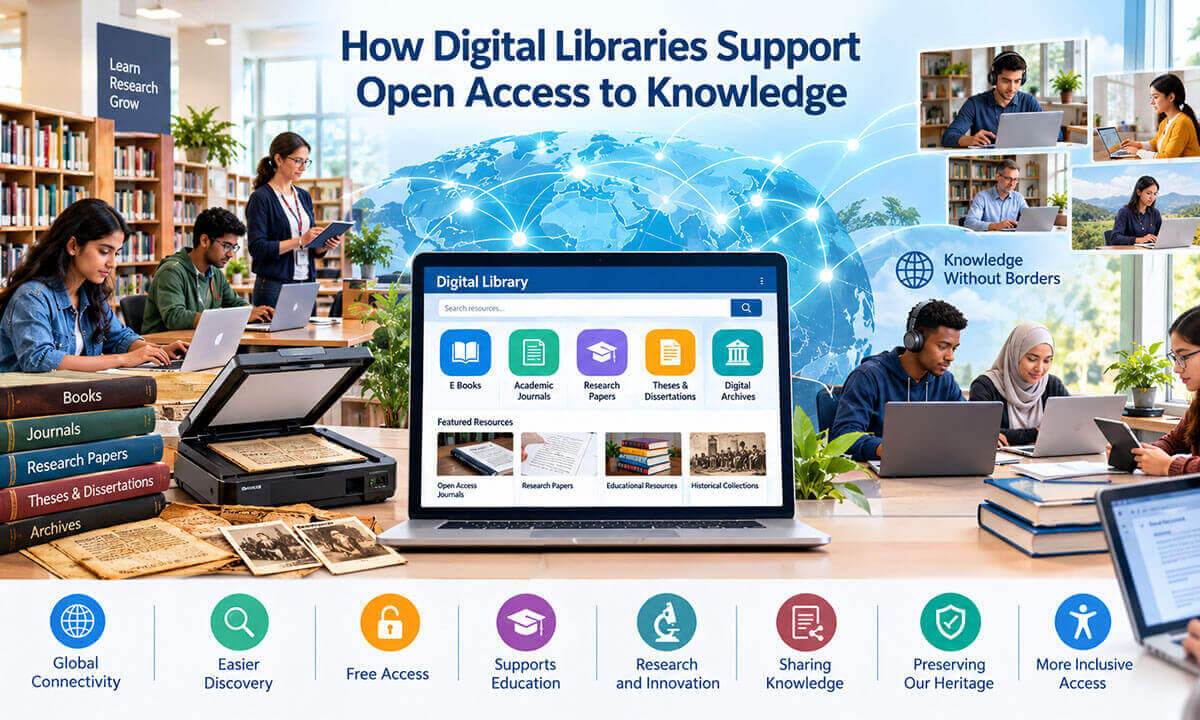
The growth of information and communication technology has changed the way people create, store, find, and use information. Digital libraries have become an important part of this change. A digital library provides access to information resources in digital form through computers, mobile devices, and the internet. These resources may include e-books, electronic journals, research papers, theses, dissertations, conference papers, institutional publications, databases, photographs, audio files, videos, and historical documents.
Digital libraries also support the principles of open access. Open access aims to make scholarly and educational information available to users without unnecessary financial, legal, or technical barriers. Digital libraries can help achieve this goal by making knowledge available to a wider audience, preserving scholarly work, supporting online learning, and improving access to research.
This article discusses how digital libraries support open access to knowledge, their major functions, benefits, challenges, and their role in education and research.
1. Meaning of Digital Libraries:
A digital library is an organized collection of digital information resources that users can access through electronic systems. It provides services similar to a traditional library but uses digital technologies to collect, organize, preserve, search, and provide access to information.
A digital library can contain materials created in digital form as well as materials converted from physical formats. For example, a university may digitize old theses and make them available through its institutional repository.
Digital libraries usually include several important components:
- Digital information resources
- Metadata
- Search and discovery systems
- Digital repositories
- Authentication and access systems
- Digital preservation systems
- Internet and network infrastructure
- Library professionals and technical staff
These components work together to help users find and use information efficiently.
2. Meaning of Open Access:
Open access refers to the free availability of scholarly and educational information through the internet. Users can read, download, copy, share, and use open access materials according to the conditions of the relevant license.
The open access movement developed partly in response to the increasing cost of scholarly journals and the difficulties faced by researchers and institutions in accessing academic information.
Open access is commonly supported through two major approaches.
2.1 Open Access Journals: Open access journals make research articles freely available online. Users do not normally need to pay a subscription fee to read the articles.
Some journals are fully open access, while others use different publishing models.
2.2 Institutional Repositories: Institutional repositories allow universities and research organizations to collect and provide access to the scholarly work produced by their researchers, teachers, and students.
Repositories may contain:
- Research articles
- Theses and dissertations
- Conference papers
- Research reports
- Working papers
- Teaching materials
- Institutional publications
- Data sets
Digital libraries can provide the infrastructure needed to manage and provide access to these resources.
3. Digital Libraries Remove Geographical Barriers:
One of the most indispensable ways digital libraries support open access is by reducing geographical barriers.
A traditional library mainly serves people who can physically reach it. A digital library can serve users from different cities and countries. A researcher can access a digital collection from home, a university, a workplace, or another location with internet access.
For example, a student studying in a rural area may use an institutional repository to access research papers published by a university in another country. The user does not need to travel to that university’s physical library.
This wider access is particularly important for students and researchers who live far from major academic institutions.
4. Digital Libraries Provide 24 Hour Access:
Traditional libraries usually operate according to fixed opening hours. Digital libraries can provide access throughout the day and night.
Users can search for information whenever they need it. This is useful for students who study outside normal library hours and researchers who work according to different schedules.
Twenty-four-hour access also became especially important during periods when physical libraries were closed because of emergencies or other restrictions.
5. Digital Libraries Reduce Access Costs:
The cost of scholarly information can be a major barrier to education and research. Academic journals, books, databases, and other resources can be expensive.
Digital libraries can reduce some of these costs by providing access to freely available resources. Institutional repositories, open access journals, digital archives, and government publications can often be accessed without subscription charges.
This does not mean that every digital library is free. Many digital libraries still contain licensed resources that require institutional subscriptions. However, digital libraries can bring open resources together and make them easier to discover.
6. Digital Libraries Support Research:
Researchers need access to large amounts of reliable information. Digital libraries help researchers search and retrieve scholarly materials more quickly.
A digital library can provide access to:
- Journal articles
- Research reports
- Theses and dissertations
- Conference proceedings
- Government documents
- Historical records
- Research data
- Electronic books
Advanced search functions allow users to search by author, title, subject, keyword, date, document type, and other fields.
This saves time and helps researchers identify relevant literature.
Digital repositories also increase the visibility of research. When research papers are stored in repositories and indexed by search engines, researchers from other institutions can discover them more easily.
7. Digital Libraries Support Students and Teachers:
Digital libraries have become important resources for teaching and learning.
Students can use digital collections to find textbooks, research papers, lecture materials, theses, reference works, and other educational resources. Teachers can also use digital materials when preparing lectures, assignments, and learning activities.
Digital access is particularly useful for distance education and online learning. Students do not always need to visit a physical library to find supporting materials for their courses.
Digital libraries can also support independent learning. A learner can explore subjects beyond the materials provided in the classroom.
8. Digital Libraries Preserve Knowledge:
Preservation is another crucial function of digital libraries.
Many valuable documents are physically fragile. Old manuscripts, newspapers, photographs, maps, and rare books can deteriorate because of age, environmental conditions, frequent handling, and natural disasters.
Digitization creates digital copies of these materials. These copies can be stored and preserved for future use.
Digital preservation does not completely replace the need to preserve original materials. Digital files also face risks such as file corruption, technological changes, storage failure, and obsolete formats. Therefore, digital preservation requires proper policies, backup systems, metadata, and regular migration of files when necessary.
9. Digital Libraries Improve Discoverability:
Having information available is not enough. Users must also be able to find it.
Digital libraries improve discoverability through metadata, classification, indexing, keywords, subject headings, and search tools.
Metadata provides information about a digital resource. It may include the title, author, date, subject, description, publisher, language, and other details.
Good metadata makes digital resources easier to find and identify.
Search engines and harvesting systems can also help expose repository content to a wider audience. As a result, research stored in one institution can become visible to users around the world.
10. Digital Libraries Support Sharing of Scholarly Work:
Traditional publication systems can make research available mainly to people whose institutions can afford journal subscriptions. Digital repositories provide another way for researchers to share their work.
Researchers can deposit eligible versions of their publications in institutional or subject repositories. Students can also make theses and dissertations available through university repositories when institutional policies permit it.
This creates a larger scholarly communication network.
Researchers can discover work produced by others, build on previous studies, and develop new research questions.
11. Digital Libraries Promote Equality in Access to Knowledge:
Open access has an authoritative social dimension. People do not have equal financial resources or equal access to educational institutions.
Digital libraries can help reduce some of these differences.
A student at a well-funded university and a student at a smaller institution may both be able to access freely available digital resources. Researchers from developing countries can also benefit from open scholarly materials that would otherwise be difficult to obtain.
However, digital access does not automatically create equality. Users still need internet connectivity, suitable devices, digital skills, and accessible content. Therefore, digital libraries need to be supported by broader digital inclusion policies.
12. Digital Libraries Support Persons with Disabilities:
Digital information can also improve access for users with disabilities when resources are designed according to accessibility standards.
For example, properly structured digital documents can work with screen readers. Adjustable text size can help users with visual difficulties. Searchable text can make documents easier to navigate.
Digital libraries should therefore consider accessibility when selecting, digitizing, and providing information resources.
Accessibility should be treated as an important part of open access. Information is not truly accessible if some users cannot use it because of the way it has been presented.
13. Role of Librarians in Supporting Open Access:
Librarians continue to have an important role in digital libraries.
Their responsibilities may include:
- Selecting digital resources
- Organizing digital collections
- Creating and managing metadata
- Supporting institutional repositories
- Teaching information literacy
- Helping users search for reliable information
- Managing copyright and licensing issues
- Supporting digital preservation
- Promoting open access resources
- Training users in digital library services
The role of the librarian has therefore expanded. Modern librarians need both traditional library knowledge and digital skills.
They also help users distinguish reliable scholarly information from inaccurate or misleading online content.
14. Digital Libraries and Information Literacy:
Easy access to information does not always mean that users know how to use information correctly.
The internet contains reliable academic sources as well as inaccurate, biased, outdated, and misleading information.
Digital libraries can support information literacy by helping users understand how to:
- Identify an information need.
- Develop effective search strategies.
- Find appropriate sources.
- Evaluate the credibility of information.
- Use information ethically.
- Cite sources correctly.
- Respect copyright and licensing conditions.
Information literacy is therefore an important part of open access. Users need the skills to make meaningful use of the information that becomes available to them.
15. Copyright and Licensing Issues:
Open access does not mean that every digital resource can be copied or used without restrictions.
Copyright remains an important issue in digital libraries. Libraries need to understand copyright laws, licensing agreements, and the rights of authors and publishers.
Creative Commons licenses are commonly used to communicate how digital works can be reused. Different licenses allow different levels of use.
Digital libraries should clearly state the rights associated with their resources. This helps users understand whether they can download, reproduce, modify, or redistribute a particular work.
Proper copyright management protects both users and content creators.
16. Challenges Faced by Digital Libraries:
Although digital libraries provide many benefits, they also face several challenges.
16.1 Digital Divide: Not everyone has reliable internet access or suitable digital devices. This limits the ability of some users to benefit from digital libraries.
16.2 Infrastructure Costs: Digital libraries require servers, storage, software, networks, security systems, and technical support. These services require financial investment.
16.3 Digital Preservation: Digital files can become inaccessible when hardware, software, or file formats become outdated. Long-term preservation requires continuous management.
16.4 Copyright Restrictions: Some materials cannot be made openly available because of copyright or licensing restrictions.
16.5 Lack of Digital Skills: Some users may not have enough knowledge to search digital collections effectively or evaluate online information.
16.6 Information Security: Digital libraries need to protect collections and user information from unauthorized access, data loss, and other security risks.
16.7 Quality Control: A large amount of digital information is available online. Digital libraries must use appropriate selection and quality control practices to maintain reliable collections.
17. Future Role of Digital Libraries in Open Access:
The role of digital libraries is likely to continue growing as more educational and research activities move into digital environments.
Technologies such as artificial intelligence, machine learning, linked data, improved discovery systems, optical character recognition, and digital preservation tools may improve the way users find and use information.
Digital libraries may also become more closely connected with institutional repositories, research data platforms, learning management systems, and open educational resources.
However, technology should support library goals rather than replace the professional role of librarians. Human judgment remains important in collection development, information organization, user education, copyright management, and evaluation of information quality.
In conclusion, digital libraries play a significant role in supporting open access to knowledge. They make information available beyond the physical boundaries of traditional libraries and allow users to access resources from different locations and at different times. They can reduce some financial and geographical barriers, support research and education, preserve valuable cultural and scholarly materials, and increase the visibility of academic work.
Digital libraries also support institutional repositories and open access publishing. Through these services, research produced by universities and research organizations can reach a wider audience. Students, teachers, researchers, and members of the public can benefit from information that might otherwise be difficult or expensive to obtain.
At the same time, digital libraries do not remove every barrier to knowledge. Problems such as the digital divide, copyright restrictions, infrastructure costs, preservation, information security, and lack of digital skills still need attention.
The success of open access therefore depends on more than simply putting information online. Digital resources must be organized, preserved, discoverable, accessible, and legally available for use. Librarians have an important role in achieving these goals.
Overall, digital libraries provide an important foundation for wider access to knowledge. When supported by appropriate technology, policies, funding, digital literacy, and open access practices, they can help create a more accessible and inclusive information environment for education, research, and lifelong learning.

is an experienced educator and academic currently serving as a Lecturer at Nurul Amin Degree College. With a career dedicated to student development and institutional excellence, he brings a wealth of classroom expertise and pedagogical knowledge to his current role. Before joining the faculty, he served as an Assistant Teacher at Zinzira PM Pilot School and College.