How to Understand and Respond to Vague Dissertation Feedback from Your Supervisor:
Writing a dissertation is an important part of higher education, particularly for students pursuing master’s and doctoral degrees. It requires extensive research, critical thinking, academic writing, and careful analysis. During this process, students usually receive feedback from their supervisors or academic advisors. This feedback helps them identify weaknesses, improve their arguments, correct mistakes, and develop a stronger research paper.
However, receiving feedback does not always make the revision process easier. Sometimes, supervisors provide comments that are unclear, too brief, or difficult to understand. For example, they may write comments such as “needs more depth,” “not critical enough,” “improve the flow,” or “this section is unclear.” Although these comments indicate that something needs improvement, they do not always explain exactly what the student should change.
Such feedback can create confusion, frustration, and unnecessary stress. Students may spend hours rewriting entire sections without understanding the actual problem. In some cases, they may make changes that do not address the supervisor’s concerns.
Understanding dissertation feedback is therefore an essential academic skill. Students need to learn how to interpret comments, identify the underlying problems, ask appropriate questions, and make meaningful revisions. This article explains how to understand vague dissertation feedback and use it effectively to improve academic research.
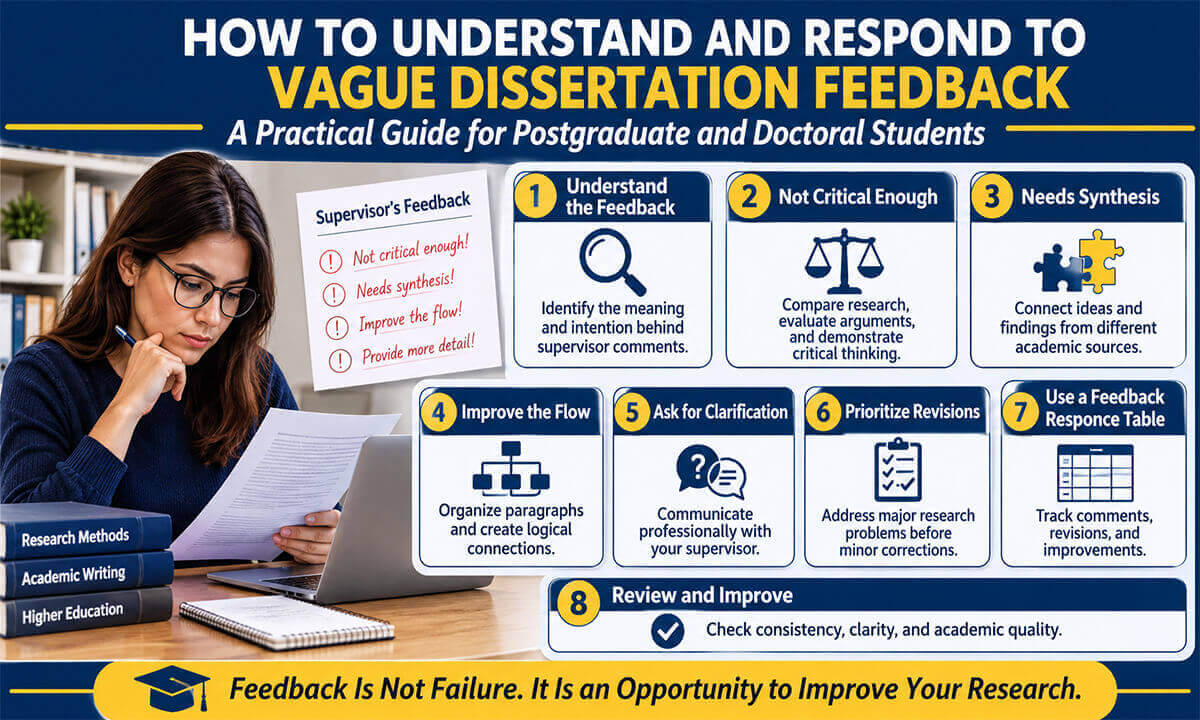
1. Understanding the Purpose of Dissertation Feedback:
Dissertation feedback is guidance provided by a supervisor, research advisor, or academic examiner to help students improve their research work. It identifies areas that require correction, clarification, further development, or restructuring.
The main purpose of feedback is not simply to point out mistakes. It also helps students develop their academic writing abilities, strengthen their research arguments, and demonstrate a deeper understanding of their research topics.
Feedback can focus on several aspects of a dissertation, including:
- Research questions and objectives.
- Literature review and theoretical framework.
- Research methodology and study design.
- Data collection and analysis.
- Discussion and interpretation of findings.
- Academic writing and presentation.
- References and citation practices.
- Overall organization and consistency.
Students should understand that critical feedback does not necessarily mean their research is poor. It often means that the supervisor has identified opportunities to make the work clearer, more accurate, and academically stronger.
The most crucial task is to understand what each comment means before making changes.
2. Read the Meaning and Tone of Your Supervisor’s Comments:
One of the first steps in understanding dissertation feedback is identifying the tone and intention behind each comment.
Supervisors communicate their expectations in different ways. Some comments are direct instructions, while others are questions or suggestions. Understanding these differences can prevent unnecessary revisions.
2.1 Direct instructions: A direct instruction clearly tells students what they need to do.
Examples include:
- “Remove this paragraph.”
- “Move this section to Chapter Three.”
- “Expand the discussion.”
- “Correct the references.”
These comments generally require a specific action. Students should follow the instructions carefully and check whether the requested changes have been completed.
2.2 Suggestions or tentative comments: Sometimes, supervisors express their concerns indirectly.
For example:
- “I wonder whether this section belongs here.”
- “Perhaps this argument needs further explanation.”
- “This might be better placed in the methodology chapter.”
These comments are not always instructions to delete or rewrite something. They may be asking students to reconsider their decisions and explain their reasoning.
Students should examine the context before making changes.
2.3 Questions that require justification: A supervisor may ask questions such as:
- “Why did you select this theoretical framework?”
- “Why are two research models necessary?”
- “What is the reason for choosing this research method?”
These questions usually require an explanation rather than an immediate change.
For example, if a supervisor asks why two theoretical models were selected, the student should explain how both models contribute to the research objectives. Removing one model without understanding the comment may weaken the study.
Therefore, students should distinguish between instructions, suggestions, and questions before revising their work.
3. Common Types of Vague Dissertation Feedback and How to Respond:
Supervisors frequently use short academic expressions to identify problems in dissertations. Although these comments may appear simple, they can represent different academic weaknesses. Understanding their meanings can help students make appropriate revisions.
3.1 “Not Critical Enough” or “Too Descriptive”: This is one of the most common comments in dissertation writing.
It usually means that the student has described information from different sources without critically examining it.
For example, a student may write:
“Author A discussed the importance of digital libraries. Author B examined the development of electronic resources. Author C explained the role of information technology in modern libraries.”
Although these statements provide information, they do not demonstrate critical thinking.
A critical discussion should compare different perspectives, identify similarities and disagreements, examine the strengths and weaknesses of existing research, and explain how the findings relate to the current study.
How to improve it:
- Compare the arguments presented by different researchers.
- Identify agreements and disagreements between studies.
- Discuss the strengths and limitations of previous research.
- Explain what existing studies fail to address.
- Connect the discussion to your research questions.
For example:
“Although previous researchers have emphasized the importance of digital library services, their findings suggest that technological development alone cannot guarantee successful implementation. Financial limitations, staff training, and institutional support also influence the effectiveness of digital library systems.”
This approach demonstrates analysis rather than simply reporting information.
3.2 “Needs Synthesis”: Synthesis means combining information from different academic sources to develop a meaningful discussion.
A literature review should not present research findings as separate summaries of individual authors. Instead, it should organize information around common themes, research questions, or important concepts.
For example, a weak literature review might discuss three researchers separately, explaining what each one discovered.
A stronger literature review would organize their findings under a common theme, such as technological challenges in digital libraries.
The student could then explain where the researchers agree, where their findings differ, and what conclusions can be drawn from their combined contributions.
How to improve it:
- Identify common themes across the literature.
- Group related studies together.
- Compare the findings of different researchers.
- Explain important similarities and differences.
- Develop a concluding statement for each theme.
The purpose of synthesis is to demonstrate how different studies collectively contribute to understanding a research problem.
3.3 “So What?”: This comment indicates that the student has presented information without explaining its significance.
Academic writing should not simply describe facts, statistics, or research findings. It should also explain why the information matters.
For example:
“A number of participants reported difficulties accessing digital library resources.”
This statement presents a finding, but it does not explain its importance.
A more meaningful discussion would be:
“More than a few participants reported difficulties accessing digital library resources. This finding suggests that limited internet access and insufficient technological infrastructure may prevent students from benefiting fully from digital library services. Therefore, improving technological facilities should be considered an important part of library development.”
How to improve it:
- Explain why the finding is important.
- Connect the information to your research objectives.
- Compare the findings with previous studies.
- Discuss the possible implications.
- Explain how the finding contributes to answering the research questions.
Every important paragraph should communicate not only what was discovered but also why the discovery matters.
3.4 “Doesn’t Flow” or “Lacks Coherence”: This feedback means that the ideas in a dissertation are not connected properly.
A dissertation should present information in a logical sequence. Each paragraph should contribute to the overall discussion, and the transition between sections should be clear.
For example, a paragraph about research methodology should not suddenly move into an unrelated discussion about the historical development of libraries without explaining the connection.
How to improve it:
- Organize paragraphs around related ideas.
- Use appropriate transition sentences.
- Make the purpose of each section clear.
- Remove unnecessary repetition.
- Ensure that every paragraph supports the main research argument.
One useful technique is to write a short sentence describing the purpose of each paragraph. If two consecutive paragraphs have no logical relationship, the structure may need improvement.
3.5 “Be Consistent”: Consistency is essential in academic writing.
This comment usually means that the student has used different terms, formats, numbers, abbreviations, or writing styles for the same purpose.
For example, a dissertation may use the terms “digital library,” “electronic library,” and “online library” interchangeably without explaining whether they refer to the same concept.
Other examples include:
- Using different spellings of the same technical term.
- Changing between past and present tense unnecessarily.
- Presenting references in different citation formats.
- Using different abbreviations for the same organization.
- Reporting inconsistent figures in different chapters.
How to improve it:
Choose one appropriate form for each term and use it throughout the dissertation. Review the entire document rather than correcting only the sentence identified by the supervisor.
Using the search function in a word processor can help identify repeated inconsistencies.
3.6 “Unclear” or “Clarify”: This comment means that the supervisor cannot fully understand the intended meaning of a sentence, paragraph, or argument.
Unclear writing may result from complicated sentences, undefined technical terms, ambiguous expressions, or insufficient explanation.
For example:
“Technology has influenced the development of modern information systems in different ways.”
This statement is too general. It does not explain which technologies or what kind of influence is being discussed.
A clearer version would be:
“Technologies such as RFID, artificial intelligence, and cloud computing have improved library operations by supporting automated circulation, information retrieval, and digital resource management.”
How to improve it:
- Use clear and specific language.
- Explain technical terms when they first appear.
- Avoid unnecessarily complicated sentences.
- Provide examples when appropriate.
- Make sure each statement communicates one understandable idea.
Students can also ask someone outside their research field to read a paragraph. If that person cannot explain its meaning, the writing may need further clarification.
3.7 “Too Broad”: A research topic is too broad when it covers more issues, populations, locations, or research questions than can reasonably be investigated within the available time and resources.
For example, “The Impact of Technology on Education” is a very broad research topic.
A more focused topic might be:
“The Impact of Digital Learning Platforms on Academic Performance among Undergraduate Students at Selected Universities.”
The revised topic identifies a particular area of investigation and a specific population.
How to improve it: Students can narrow their research scope by considering:
- A particular geographical location.
- A specific population or group.
- A defined period.
- A particular research problem.
- A specific theoretical or conceptual area.
A focused research topic makes it easier to collect relevant data, conduct meaningful analysis, and complete the dissertation within the available time.
3.8 “Go Deeper” or “Provide More Detail”: This comment can have two different meanings.
First, the supervisor may want additional evidence, examples, references, or explanations.
Second, the supervisor may want deeper analysis of the information already presented.
For example, simply writing more paragraphs about the history of a topic may not address a request for deeper analysis.
If a student has already included sufficient research evidence, the real problem may be a lack of interpretation.
How to improve it:
- Identify whether additional evidence is necessary.
- Explain the meaning of existing findings.
- Compare results with previous research.
- Discuss possible causes and consequences.
- Examine the implications for the research problem.
Students should remember that a longer dissertation is not automatically a better dissertation. The goal is to provide meaningful information and stronger academic reasoning.
3.9 “Justify Your Choice”: This comment means that the student has made a research decision without explaining why it is appropriate.
Research involves many decisions, including selecting a methodology, sampling technique, theoretical framework, data collection instrument, and analysis method.
For example, a student may write:
“A quantitative research approach was used in this study.”
However, the statement does not explain why the approach was selected.
A stronger explanation would be:
“A quantitative research approach was selected because the study aimed to measure participants’ opinions and identify patterns in their responses through numerical data. This approach was considered appropriate for addressing the research objectives.”
How to improve it:
Explain the research decision, provide relevant academic support, and demonstrate how the decision contributes to achieving the research objectives.
A good justification should connect the selected approach to the purpose and requirements of the study.
3.10 “Not Aligned”: Alignment means that the different parts of a dissertation should work together toward a common research purpose.
The research title, problem statement, objectives, questions, methodology, findings, and conclusion should be logically connected.
For example, if the research question investigates students’ experiences with digital library services, the methodology should collect information that helps answer that question. The findings and discussion should then address the same issue.
How to improve it:
- Review the research title.
- Examine the research objectives and questions.
- Check whether the methodology addresses those questions.
- Ensure that the findings respond to the research objectives.
- Make sure the conclusion reflects the actual results.
A well-aligned dissertation presents a clear and consistent research argument from beginning to end.
3.11 “Not at Doctoral Level”: This comment can be particularly stressful for doctoral students.
However, it does not necessarily mean that the student lacks the ability to complete a PhD. It usually indicates that the dissertation does not yet demonstrate the level of critical analysis, independent thinking, methodological understanding, or academic contribution expected at the doctoral level.
Doctoral research should go beyond describing existing knowledge. It should demonstrate a strong understanding of the research problem, evaluate existing evidence, develop meaningful arguments, and make an original contribution to knowledge.
How to improve it:
- Strengthen critical analysis.
- Develop a clear research argument.
- Improve the theoretical and methodological justification.
- Identify gaps in existing research.
- Explain the original contribution of the study.
- Review academic writing and presentation carefully.
Students should identify the specific weaknesses behind this comment rather than treating it as a personal judgment.
3.12 “Needs More Work” Without Further Explanation: Sometimes supervisors simply write “needs more work” without identifying the exact problem.
This can be frustrating because the student does not know whether the issue concerns the content, structure, methodology, analysis, or writing quality.
In this situation, students should avoid making random changes.
How to improve it:
Review the section carefully and identify possible weaknesses. Then prepare a short message explaining your understanding of the problem and ask the supervisor to confirm whether your interpretation is correct.
This approach makes communication more effective and reduces unnecessary revisions.
4. How to Ask Your Supervisor for Clarification:
Students should not feel uncomfortable asking questions when feedback is unclear.
Academic supervision is a collaborative process. Supervisors provide guidance, while students are responsible for understanding and applying that guidance.
However, questions should be clear, specific, and professional.
Instead of writing:
“I don’t understand your comments. What should I do?”
A student can write:
“Thank you for your feedback on Section 2.3. I understand that the discussion needs stronger justification. However, I would like to confirm whether you would prefer additional supporting literature or a deeper analysis of the existing studies.”
When a comment has two possible meanings, students can present both interpretations.
For example:
“Regarding your comment on the theoretical framework, I understand it in two possible ways. Option A is to remove the second model and provide a stronger justification for the first. Option B is to retain both models and explain why they are necessary. I currently believe Option B may better support the research objectives. Could you please confirm whether this interpretation is correct?”
This type of communication makes it easier for supervisors to respond because they can understand the problem and provide a specific answer.
Students should also collect related questions and send them together rather than sending several separate messages about individual comments.
5. Organize Dissertation Feedback Before Revising:
Receiving numerous comments can make a dissertation appear more difficult to revise than it actually is. One effective solution is to organize the feedback into different categories.
5.1 Word-level feedback: These comments focus on individual words, sentences, grammar, punctuation, spelling, or citation formatting.
Examples include:
- Correct the spelling.
- Improve this sentence.
- Use the appropriate academic term.
- Check the tense.
These problems are generally easier to correct.
5.2 Paragraph-level feedback: These comments focus on the development and organization of paragraphs.
Examples include:
- Improve the flow.
- Add supporting evidence.
- Clarify the argument.
- Develop the discussion.
- Improve the connection between ideas.
These issues require more attention because they affect how information is communicated.
5.3 Argument-level feedback: These comments concern the overall research argument and structure.
Examples include:
- The research question is too broad.
- The theoretical framework is not justified.
- The methodology does not address the research objectives.
- The findings do not answer the research questions.
These are often the most significant issues because they can affect several chapters of the dissertation.
Students should normally address argument-level problems first, followed by paragraph-level and word-level corrections.
This approach prevents unnecessary work. For example, there is little value in spending hours correcting sentences in a section that may later need to be completely reorganized.
6. Develop a Practical Dissertation Revision Plan:
A revision plan helps students manage supervisor feedback systematically. Instead of trying to correct everything at once, students should divide the work into manageable tasks. The following steps can make the process easier.
Step 1: Read all comments carefully: Read the complete feedback before starting any revision. This helps identify repeated concerns and understand the supervisor’s overall expectations.
Step 2: Identify the main problems: Group similar comments together. Several individual comments may refer to the same underlying problem.
For example, “too descriptive,” “needs analysis,” and “not critical enough” may all indicate a weakness in critical discussion.
Step 3: Prioritize important revisions: Start with changes that affect the overall research structure, argument, or methodology.
Then address paragraph organization and language-related problems.
Step 4: Decide how to respond: There are generally three possible responses to feedback:
- Accept the suggestion and make the requested change.
- Modify the existing work to address the underlying concern.
- Provide a reasoned academic explanation when there is a valid reason for retaining the original decision.
Students should not reject feedback simply because they disagree with it. Any disagreement should be supported by relevant academic evidence and a clear explanation.
Step 5: Make the necessary changes: Revise the dissertation carefully and ensure that each change addresses the supervisor’s concern.
Avoid adding unnecessary information because additional material can create new problems and lead to further revisions.
Step 6: Review the revised document: After completing the revisions, read the entire section again. Check whether the argument remains logical and whether the changes have introduced any inconsistencies.
Step 7: Prepare a revision record: Keep a record of the feedback and the actions taken. This will help demonstrate that the supervisor’s comments have been considered and addressed.
7. Use a Feedback Response Table:
A feedback response table is a useful tool for organizing dissertation revisions. It provides a clear record of the supervisor’s comments, the location of each problem, and the changes made by the student. A simple example is presented below:
|
Supervisor’s feedback |
Action taken |
|
Not critical enough |
Added comparisons and critical analysis of previous studies. |
|
Needs synthesis |
Reorganized the literature review around common themes. |
|
Improve the flow |
Revised paragraph order and added connecting sentences. |
|
Too broad |
Narrowed the research scope and clarified the study population. |
|
Justify the methodology |
Added an explanation of why the selected method suits the research objectives. |
|
Be consistent |
Reviewed terminology, abbreviations, and references throughout the dissertation. |
Students can also include chapter numbers, section headings, page numbers, and additional explanations.
When submitting the revised dissertation, this table can be attached to a short response document explaining the major changes.
It allows supervisors to review the revisions more easily and reduces the possibility of repeatedly discussing the same problems.
8. Common Mistakes Students Should Avoid:
Students sometimes make the revision process more difficult because they misunderstand the purpose of feedback. The following mistakes should be avoided:
- Writing more instead of improving the analysis: When a supervisor asks for greater depth, adding unnecessary paragraphs may not solve the problem. Students should focus on stronger explanations and critical interpretation.
- Treating every question as an instruction: A supervisor’s question may ask for justification rather than a change. Students should understand the intention before deleting or replacing important information.
- Assuming that every comment is a major problem: A large number of corrections does not necessarily mean that the entire dissertation is weak. Some comments may involve simple language or formatting issues.
- Correcting only the highlighted sentence: Some comments apply to the entire dissertation. For example, “be consistent” may require checking every chapter rather than correcting one sentence.
- Accepting all tracked changes without further review: Accepting corrections does not mean that all academic concerns have been addressed. Students must also examine the substantive feedback concerning research arguments, methodology, and analysis.
- Making unnecessary changes: Students should avoid rewriting sections that are already appropriate unless there is a clear academic reason to do so.
- Ignoring unclear feedback: If a comment remains confusing, students should request clarification rather than making assumptions.
9. A Practical Example of Interpreting Dissertation Feedback:
Consider a student conducting research on the obstacles to the transition from traditional libraries to smart libraries.
The supervisor reviews the literature review and writes:
“Needs more depth. The discussion is too descriptive.”
The student initially assumes that more paragraphs and additional references are required. However, this may not address the actual concern.
The student should examine the existing discussion.
Suppose the literature review describes RFID technology, artificial intelligence, automated library systems, and digital resource management separately. It explains what each technology does but does not discuss the challenges associated with implementing them.
The student can improve the discussion by examining the financial, technological, and human resource requirements of smart libraries.
For example:
“Although RFID and artificial intelligence can improve library operations, their successful implementation depends on adequate financial investment, technological infrastructure, and trained personnel. Libraries with limited budgets may experience difficulties adopting these technologies. Furthermore, insufficient staff training can reduce the effectiveness of newly introduced systems. Therefore, the transition to smart libraries requires not only technological investment but also institutional planning and human resource development.”
This revised discussion demonstrates critical analysis because it examines the relationship between technology, financial resources, staff capabilities, and institutional readiness.
The example shows why understanding the meaning of feedback is more important than simply increasing the length of a dissertation.
10. Develop a Positive Attitude Toward Academic Feedback:
Dissertation writing can be mentally demanding. Students may feel disappointed when their work receives extensive criticism, especially after spending months collecting information and preparing chapters.
However, feedback should be viewed as part of the academic learning process.
A dissertation is rarely completed perfectly in its first draft. Research develops through reading, writing, reviewing, correcting, and improving.
Students should remember various necessary principles:
- Feedback is an opportunity to improve academic work.
- Critical comments are not necessarily personal criticism.
- Asking questions is a normal part of academic communication.
- Revision requires patience and careful planning.
- Good academic writing develops through repeated practice.
- The purpose of revision is to improve the quality of research, not simply to satisfy every comment mechanically.
Maintaining a positive and practical attitude can help students manage the challenges of dissertation writing more effectively.
In conclusion, understanding and responding to vague dissertation feedback is an important skill for every postgraduate and doctoral student. Supervisors may identify problems through short comments such as “not critical enough,” “needs synthesis,” “improve the flow,” or “provide more detail.” Although these comments can initially create confusion, they usually point toward specific weaknesses in the research, academic arguments, structure, or writing.
Students should carefully examine the meaning and intention behind each comment before making revisions. They should distinguish between direct instructions, suggestions, and questions that require justification. Organizing feedback into word-level, paragraph-level, and argument-level categories can also make the revision process more manageable.
Effective communication with supervisors is equally important. When comments are unclear, students should ask specific questions and explain their understanding of the feedback. A revision plan and response table can further help them track changes and demonstrate how each concern has been addressed.
Most notably, students should understand that dissertation feedback is not simply a list of mistakes. It is an opportunity to develop critical thinking, improve research skills, and produce stronger academic work. By approaching feedback systematically and responding with clear reasoning, students can turn confusing comments into practical steps toward completing a successful dissertation.
Reference:
- Bao, J., & Feng, D. (2023). Supervisory feedback and doctoral students’ academic literacy development: The case of writing for publication. Teaching in Higher Education, 1–18. https://doi.org/10.1080/13562517.2023.2283727
- Carter, S., & Kumar, V. (2017). ‘Ignoring me is part of learning’: Supervisory feedback on doctoral writing. Innovations in Education and Teaching International, 54(1), 68–75. https://doi.org/10.1080/14703297.2015.1123104
- Hattie, J., & Timperley, H. (2007). The Power of Feedback. Review of Educational Research, 77(1), 81-112. https://doi.org/10.3102/003465430298487
- Jansen, D. (2026). How to read vague dissertation feedback from your advisor. Grad Coach. https://gradcoach.com/dissertation-feedback/
- Nicol, D. J., & Macfarlane‐Dick, D. (2006). Formative assessment and self‐regulated learning: a model and seven principles of good feedback practice. Studies in Higher Education, 31(2), 199–218. https://doi.org/10.1080/03075070600572090
- Peng, Y. (2025). Toward an understanding of doctoral students’ feedback literacy in academic publishing: An ecological perspective. Humanities and Social Sciences Communications, 12, Article 1819. https://doi.org/10.1057/s41599-025-06101-2
- Vinte, J., & Bostanci, H. B. (2025). The Impact of Thesis Feedback on Doctoral Students’ Academic Writing. Journal of Language Teaching and Learning, 15(2), 44-65. https://doi.org/10.66887/jltl.v15i2.769

is an experienced educator and academic currently serving as a Lecturer at Nurul Amin Degree College. With a career dedicated to student development and institutional excellence, he brings a wealth of classroom expertise and pedagogical knowledge to his current role. Before joining the faculty, he served as an Assistant Teacher at Zinzira PM Pilot School and College.