Growth, Development, and Body Types in Physical Education: Meaning, Stages, and Importance
Growth, development, and body types are important concepts in physical education, sports science, and human biology. They help us understand how the human body changes over time, how physical and mental abilities develop, and how body structure may influence sports performance. These concepts are useful for physical education teachers, coaches, trainers, and healthcare professionals who want to support individuals according to their needs and abilities.
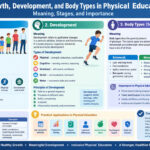
Growth refers to an increase in body size and mass, while development involves changes in physical, cognitive, emotional, social, and motor abilities. Body types, also known as somatotypes, describe general patterns of body structure. Understanding these concepts helps educators design suitable exercise programs, promote healthy growth, and encourage participation in physical activities throughout life.
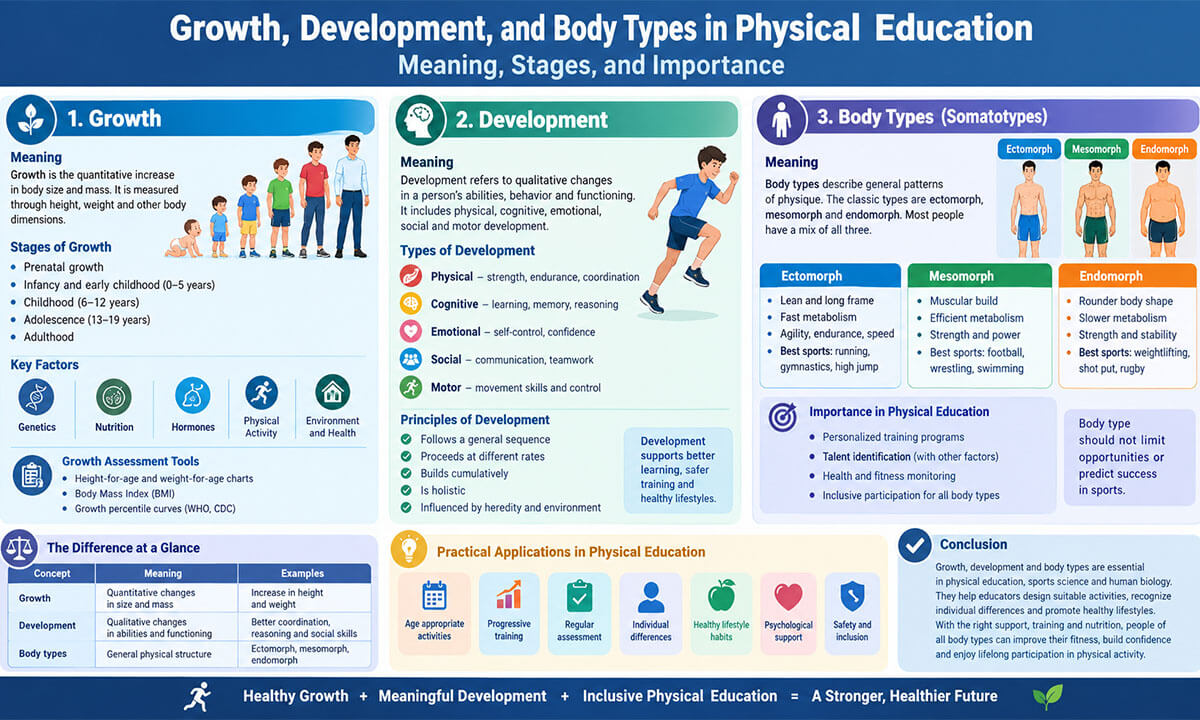
1. Growth (Meaning, Stages, and Factors):
Definition of Growth:
Growth is the quantitative increase in the size and mass of the human body. It can be measured through height, weight, body dimensions, and other physical measurements. Growth begins at conception and continues through childhood and adolescence until physical maturity is reached. Some body changes also occur during adulthood and old age.
Stages of Growth:
Human growth occurs in several stages; some of them are given below:
- Prenatal Growth: This stage begins at conception and continues until birth. The body’s organs, tissues, and major systems begin to form and develop.
- Infancy and Early Childhood (0 to 5 years): This period is characterized by rapid growth in height and weight. Children also develop basic movement skills, such as crawling, standing, walking, and grasping objects.
- Childhood (6 to 12 years): Growth becomes more gradual and steady. Bones and muscles continue to develop, and children improve their balance, coordination, strength, and movement skills.
- Adolescence (13 to 19 years): Puberty brings major physical changes. Growth spurts occur, body composition changes, and reproductive maturity develops. The timing and rate of these changes differ among individuals.
- Adulthood: Most increases in height stop after physical maturity. Maintaining muscle strength, bone health, body composition, and overall physical fitness becomes increasingly important.
Factors Affecting Growth:
Quite a few factors influence human growth, which are:
- Genetics: Genetic characteristics influence body size, body proportions, and the timing of physical maturation.
- Nutrition: A balanced diet containing adequate protein, carbohydrates, fats, vitamins, and minerals supports healthy growth and tissue development.
- Hormones: Growth hormone, thyroid hormones, and sex hormones play important roles in regulating growth and maturation.
- Physical Activity: Regular physical activity supports bone strength, muscle development, and overall health. However, exercise alone cannot overcome nutritional deficiencies or genetic limitations.
- Environment and Health: Living conditions, sleep, access to healthcare, and exposure to chronic illnesses can influence growth.
Methods of Assessing Growth:
Growth can be assessed through numerous methods, including:
- Height and weight measurements.
- Height-for-age and weight-for-age charts.
- Body Mass Index (BMI), interpreted according to age and other relevant factors.
- Growth charts and percentile curves developed by organizations such as the World Health Organization (WHO) and the Centers for Disease Control and Prevention (CDC).
These methods help identify growth patterns and possible concerns. Measurements should be interpreted according to age, sex, developmental stage, and appropriate health standards.
2. Development (Meaning, Types, and Principles):
Definition of Development:
Development refers to qualitative changes in a person’s abilities, behavior, and functioning over time. It includes physical, cognitive, emotional, social, and motor development. Unlike growth, which mainly involves measurable changes in body size, development focuses on improvements in skills, understanding, coordination, and behavior.
Development continues throughout life as individuals gain experience, learn new skills, and adapt to different situations.
Types of Development:
- Physical Development: Physical development involves changes in the body and improvements in physical abilities. It includes strength, endurance, flexibility, balance, coordination, and the ability to perform different movements. In physical education, physical development helps students improve fitness, learn movement skills, and participate safely in sports and exercise.
- Cognitive Development: Cognitive development refers to changes in thinking, learning, memory, attention, reasoning, and problem-solving. It helps individuals understand instructions, make decisions, develop strategies, and learn the rules of games.
- Emotional Development: Emotional development involves recognizing, understanding, and managing emotions. Physical activities can provide opportunities for students to develop confidence, patience, self-control, and the ability to cope with success and failure.
- Social Development: Social development concerns the ability to communicate, cooperate, build relationships, and respect others. Team sports and group activities help students learn teamwork, leadership, discipline, fairness, and respect for different abilities.
- Motor Development: Motor development refers to changes in movement abilities and the control of the body. It is especially important in physical education because it influences how individuals learn and perform physical skills.
Motor skills are commonly grouped into the following categories:
-
- Rudimentary motor skills: Basic movements developed during infancy, such as reaching, grasping, crawling, and walking.
- Fundamental motor skills: Basic movement patterns developed during childhood, such as running, jumping, throwing, catching, kicking, and balancing.
- Specialized motor skills: More complex movements that combine fundamental skills for particular activities, such as swimming strokes, football techniques, gymnastics routines, and basketball skills.
These skills develop at different rates depending on individual experience, opportunities for practice, maturation, and the learning environment.
Principles of Development:
Human development follows quite a few vital principles.
- Development Follows a General Sequence: Many developmental changes follow a predictable sequence. For example, infants generally gain control of their heads before they develop the ability to sit and walk independently. However, individual development does not always follow exactly the same timetable.
- Development Proceeds at Different Rates: People develop at different speeds. Two children of the same age may have different levels of strength, coordination, confidence, and physical maturity.
- Development Is Cumulative: New skills and abilities often build on previously learned skills. For example, learning to balance and control body movements can support the development of more complex gymnastics and sports skills.
- Development Is Holistic: Physical, cognitive, emotional, and social development influence one another. Therefore, physical education should support the whole person rather than focus only on physical fitness.
- Development Is Influenced by Both Heredity and Environment: Genetic characteristics influence development, while nutrition, education, practice, family support, health, and environmental opportunities also play important roles.
Importance of Development in Physical Education:
Understanding development allows teachers and coaches to:
- Design activities suitable for learners’ abilities and maturity.
- Select appropriate teaching methods and exercise intensity.
- Improve fundamental movement skills before introducing complex techniques.
- Reduce the risk of injury caused by unsuitable training.
- Support confidence, cooperation, and emotional well-being.
- Recognize individual differences and provide equal opportunities for participation.
Chronological age alone is not always enough to determine whether a learner is ready for a particular activity. Physical maturity, previous experience, coordination, and emotional readiness should also be considered.
3. Body Types (Somatotypes) (Meaning and Characteristics):
Definition of Body Types:
Body types, also known as somatotypes, describe broad patterns of human physique. The traditional classification associated with psychologist William H. Sheldon identifies three main types: ectomorph, mesomorph, and endomorph.
These categories are useful as a basic introduction to body structure. However, they do not fully explain an individual’s health, athletic ability, or future performance. Most people have a combination of characteristics rather than belonging entirely to one category.
(A) Ectomorph: An ectomorphic physique is traditionally described as relatively lean, with a narrow frame and comparatively long limbs.
Main characteristics:
- A relatively slender body structure.
- Narrow shoulders and hips in some individuals.
- Lower body mass compared with some other physiques of similar height.
- Potential difficulty gaining body mass for some individuals.
Possible physical strengths: Depending on training and individual characteristics, a lean physique may be advantageous in activities where moving body mass efficiently is important.
Examples of sports: Long-distance running, high jump, and some forms of gymnastics may favor certain characteristics associated with a lean physique. However, success also depends on technique, training, health, and other individual factors.
(B) Mesomorph: A mesomorphic physique is traditionally described as having a relatively muscular and athletic build.
Main characteristics:
- Relatively broad shoulders.
- A comparatively muscular body structure.
- Potential to develop muscle and strength effectively with suitable training.
- A body shape that may appear naturally athletic.
Possible physical strengths: Muscle mass and strength can be beneficial in activities requiring acceleration, power, and force production.
Examples of sports: Sprinting, football, wrestling, swimming, and other strength or power activities may benefit from particular characteristics often associated with this physique.
However, individuals with different body structures can also succeed in these sports.
(C) Endomorph: An endomorphic physique is traditionally described as having a rounder body shape and a greater tendency to carry body fat.
Main characteristics:
- A relatively rounded body structure.
- A wider waist or hips in some individuals.
- Potential to carry more body mass.
- Variation in fat distribution and muscle mass.
Possible physical strengths: Depending on an individual’s training and body composition, greater body mass and strength can be useful in certain activities that involve force production, stability, or contact.
Examples of sports: Weightlifting, shot put, rugby, and wrestling include events or positions in which particular combinations of body mass, strength, and power can be advantageous.
Body fat distribution and metabolism vary considerably among individuals. The traditional endomorph label should not be used to assume that someone has a slow metabolism or cannot improve fitness.
4. Importance of Body Types in Physical Education and Sports:
Understanding body structure can help physical education professionals recognize physical differences and plan suitable activities. However, body type should never be the only factor used to select sports or determine athletic potential.
- Individualized Training Programs: People respond differently to exercise because of differences in age, training experience, health, genetics, body composition, and recovery. Training programs should be designed around these factors rather than relying only on somatotype labels.
For example, a person who wants to improve strength may benefit from progressive resistance training, while someone preparing for a long-distance event may need a program that develops aerobic endurance.
- Talent Identification: Body dimensions can be relevant in some sports. Height may be useful in basketball, while particular combinations of strength, speed, and body proportions may benefit athletes in other disciplines.
Nevertheless, talent identification should also consider motivation, skill, coordination, decision-making, training history, and the willingness to learn. No body type guarantees success in a particular sport.
- Health and Fitness Monitoring: Body structure and body composition provide different kinds of information about physical health. Monitoring fitness, strength, endurance, and relevant health measurements can help individuals set realistic goals and evaluate progress.
Teachers and coaches should avoid judging health or fitness solely by appearance.
- Encouraging Inclusive Participation: All learners should have opportunities to participate in physical education, regardless of body shape, height, weight, or natural physique. Activities can be adapted to suit different abilities, and students should be encouraged to improve their own performance rather than compare their bodies with others.
5. Difference Between Growth, Development, and Body Types:
Although these concepts are closely related, they have different meanings.
|
Concept |
Meaning |
Examples |
|
Growth |
Quantitative changes in body size and mass | Increase in height and weight |
|
Development |
Qualitative changes in abilities and functioning | Improved coordination, reasoning, and social skills |
|
Body types |
Broad descriptions of physical structure | Traditionally classified as ectomorph, mesomorph, and endomorph |
Growth mainly describes how the body increases in size. Development explains how abilities and functions change. Body types describe general physical characteristics that may influence how a person moves or responds to certain activities.
Body Composition and Somatotype: Body composition refers to the proportions of fat mass and fat-free mass in the body. Fat-free mass includes muscle, bones, organs, and body water.
Somatotype, in contrast, is a classification of general physique. It should not be treated as a fixed genetic destiny. Body composition can change through nutrition, physical activity, resistance training, and other lifestyle factors.
An individual’s physical characteristics can also change throughout life. Therefore, body type alone cannot determine fitness, health, or athletic potential.
6. Practical Applications in Physical Education:
Knowledge of growth, development, and body types can improve the planning and delivery of physical education programs.
- Age-appropriate activities: Young children should have opportunities to practice basic movements through play, while older learners can gradually develop more complex movement and sports skills.
- Progressive training: Exercise intensity and difficulty should increase gradually according to the learner’s ability, experience, and recovery.
- Regular assessment: Teachers can monitor improvements in movement skills, strength, endurance, flexibility, and coordination through appropriate assessments.
- Individual differences: Students should be assessed according to their progress and abilities rather than being expected to achieve identical results.
- Healthy lifestyle habits: Adequate nutrition, sufficient sleep, regular physical activity, and proper recovery support healthy growth, development, and physical performance.
- Psychological support: Encouragement, constructive feedback, and realistic goals help learners build confidence and maintain interest in physical activity.
- Safety and inclusion: Teachers should adapt activities when necessary and provide a supportive environment where students of different body types and abilities can participate comfortably.
In conclusion, growth, development, and body types are essential concepts in physical education, sports science, and human biology. Growth refers to increases in body size and mass, while development involves changes in physical, cognitive, emotional, social, and motor abilities. Body types describe general patterns of physique that may influence some aspects of physical performance.
Understanding these concepts helps physical education teachers and coaches design appropriate activities, recognize individual differences, monitor progress, and promote healthy lifestyles. However, body type should not be used to limit a person’s opportunities or predict athletic success on its own. With suitable training, proper nutrition, adequate recovery, and consistent practice, people with different physical characteristics can improve their fitness and develop valuable movement skills.
A scientific and inclusive approach to physical education recognizes that every individual develops at a different pace and has unique strengths. By supporting these differences, educators can help learners improve their physical abilities, build confidence, and develop a lifelong interest in health and physical activity.

is an experienced educator and academic currently serving as a Lecturer at Nurul Amin Degree College. With a career dedicated to student development and institutional excellence, he brings a wealth of classroom expertise and pedagogical knowledge to his current role. Before joining the faculty, he served as an Assistant Teacher at Zinzira PM Pilot School and College.