Self-Assessment for Academic Resilience: Learning from Mistakes
Every student makes mistakes. You may fail a test, forget an assignment deadline, misunderstand a question, submit work that is not your best, or struggle with a subject that once seemed easy. These experiences can be frustrating, but they do not have to define your academic ability.
What matters is what you do after a setback.
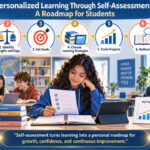
Self-assessment can help students understand their mistakes, recognize their strengths, identify areas that need improvement, and make better decisions in the future. Instead of simply asking, “What grade did I get?” students can ask more useful questions such as, “What went wrong?”, “Why did it happen?”, and “What can I do differently next time?”
This process is closely connected to academic resilience. Academic resilience is the ability to continue learning and working toward academic goals when difficulties arise. It does not mean that students never struggle. Rather, it means they learn how to respond to challenges and recover from setbacks.
When students learn to examine their own learning honestly and constructively, mistakes can become valuable sources of information. Self-assessment can turn disappointment into reflection, reflection into action, and action into improvement.
What Is Academic Resilience?
Academic resilience refers to a student’s ability to cope with academic challenges and continue making progress despite setbacks.
Students experience many different forms of academic difficulty. They may receive a low grade, struggle to understand a lesson, feel overwhelmed by several assignments, have trouble managing time, or lose confidence after repeated mistakes.
A resilient student does not necessarily find these experiences easy. The difference is often in how the student responds.
For example, imagine two students who both receive a poor grade on a mathematics test.
The first student thinks, “I am bad at mathematics. There is no point trying.”
The second student thinks, “I did poorly this time. I need to find out which topics I misunderstood and change how I prepare.”
Both students experienced the same setback. However, their responses are different.
Academic resilience develops when students learn to respond to difficulties with reflection, persistence, problem-solving, and appropriate support.
It is also essential to understand that resilience does not mean handling every problem alone. Asking a teacher for help, working with classmates, talking to a parent, or seeking academic support can all be healthy parts of resilience.
What Is Self-Assessment?
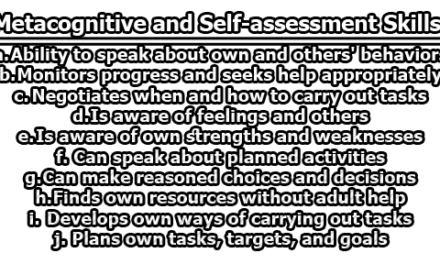
Self-assessment is the process of examining your own learning, performance, habits, and progress.
In education, students are often assessed by teachers through tests, assignments, projects, presentations, and examinations. These external assessments are useful, but students can also learn by assessing themselves.
Self-assessment encourages students to become active participants in their own learning.
Instead of waiting for a teacher to point out every problem, students learn to identify questions such as:
- Did I understand the main idea?
- Did I follow the instructions correctly?
- Which parts of the assignment were difficult?
- What mistakes did I make?
- How did I prepare?
- Did I manage my time effectively?
- What should I change next time?
- What did I do well?
These questions encourage students to look beyond the final grade and examine the learning process.
Why Self-Assessment Supports Academic Resilience:
Self-assessment and academic resilience can support each other in several ways.
1. It Builds Self-Awareness: Students cannot improve effectively if they do not understand what is causing their difficulties.
Self-assessment helps students notice patterns in their learning.
For example, a student may discover that poor results are not caused by a lack of ability. The real problem may be starting assignments too late, failing to review class notes, misunderstanding instructions, or becoming distracted while studying.
Once the problem is identified, the student has something specific to work on.
Self-awareness therefore changes a vague problem into a manageable one.
2. It Helps Students Learn from Mistakes: A mistake becomes more useful when a student takes time to understand it.
Suppose a student loses marks because several questions were left unanswered. Simply seeing the low score does not explain why this happened. Through reflection, the student may realize that too much time was spent on the first few questions.
The lesson is not simply “I failed the test.”
The more useful lesson is “I need to manage my time better during examinations.”
This kind of reflection makes mistakes informative.
3. It Encourages Responsibility: Self-assessment encourages students to take responsibility for their learning without blaming themselves for every problem.
There may be external factors that affect academic performance. Students may face difficult circumstances, limited resources, unclear instructions, or other challenges. At the same time, students can still examine the parts of their learning process that they can control.
This creates a healthier sense of responsibility.
The goal is not to ask, “Whose fault was this?”
A better question is, “What can I do now?”
4. It Makes Improvement More Specific: Telling yourself to “study harder” is not always useful.
A student may need a more specific plan.
For example:
- Review class notes for 20 minutes after each lesson.
- Complete five practice problems every day.
- Start assignments three days before the deadline.
- Ask the teacher about difficult topics.
- Use practice tests before an examination.
Self-assessment helps students identify the specific behavior that needs to change.
Mistakes Can Become Learning Opportunities:
Many students view mistakes as evidence that they are not intelligent or capable. This can make academic setbacks emotionally difficult.
However, mistakes can also provide useful information.
A wrong answer may show that a concept has not been understood. A weak essay may reveal problems with organization or evidence. A missed deadline may show poor planning. A failed presentation may highlight the need for more preparation or practice.
The mistake itself is not the entire story.
The important question is what the student learns from it.
For example, imagine a student who performs poorly on a science examination. Instead of simply feeling disappointed, the student reviews the paper and categorizes the mistakes.
The student discovers:
- Some answers were wrong because the concepts were not understood.
- Some questions were misunderstood.
- Several marks were lost because of careless errors.
- A few questions were left incomplete because of poor time management.
Now the student has a much clearer picture of what needs attention.
The failure has become feedback.
How to Practice Self-Assessment for Academic Resilience:
Self-assessment does not have to be complicated. A few minutes of honest reflection after important learning activities can make a difference.
1. Reflect After Every Major Assignment: After completing an assignment, take a few minutes to think about the process.
Ask yourself:
- What did I do well?
- What was difficult?
- What mistakes did I make?
- What helped me?
- What distracted me?
- What would I change next time?
Writing the answers in a notebook or digital document can help you notice patterns over time.
2. Create a Simple Self-Assessment Rubric: A rubric does not need to be complicated.
You can rate yourself from 1 to 5 on areas such as:
| Area |
Self-Rating |
| Understanding of the topic |
1 to 5 |
| Organization |
1 to 5 |
| Time management |
1 to 5 |
| Preparation |
1 to 5 |
| Focus |
1 to 5 |
|
Quality of work |
1 to 5 |
The purpose is not to give yourself another stressful grade.
The purpose is to identify areas for improvement.
3. Review Your Mistakes: After receiving an assignment or test, do not only look at the final score.
Look at the mistakes.
Try to classify them.
For example:
- Knowledge gap
- Misunderstood question
- Careless mistake
- Poor time management
- Lack of preparation
- Failure to follow instructions
This approach helps you understand the cause of the problem instead of simply focusing on the result.
4. Identify Your Academic Triggers: Students often have certain situations that make learning more difficult.
You might notice that you procrastinate when an assignment feels difficult. You might become anxious before examinations. You might lose concentration when studying for long periods without breaks.
Keep a simple record of these situations.
Ask:
- When does the problem usually happen?
- What am I thinking at that moment?
- What am I feeling?
- What do I usually do?
- What happens afterward?
Understanding your triggers can help you prepare better responses.
5. Set Small Improvement Goals: After identifying a problem, choose one realistic action.
If you regularly miss deadlines, start using a calendar.
If you struggle with difficult chapters, schedule regular review sessions.
If you make careless mistakes, spend five minutes checking your work before submission.
Small changes are often easier to maintain than dramatic changes.
Turning Reflection Into Action:
Reflection is useful, but reflection alone is not enough.
A student may understand exactly what went wrong but continue repeating the same behavior. This happens when reflection does not lead to action.
A simple process can help:
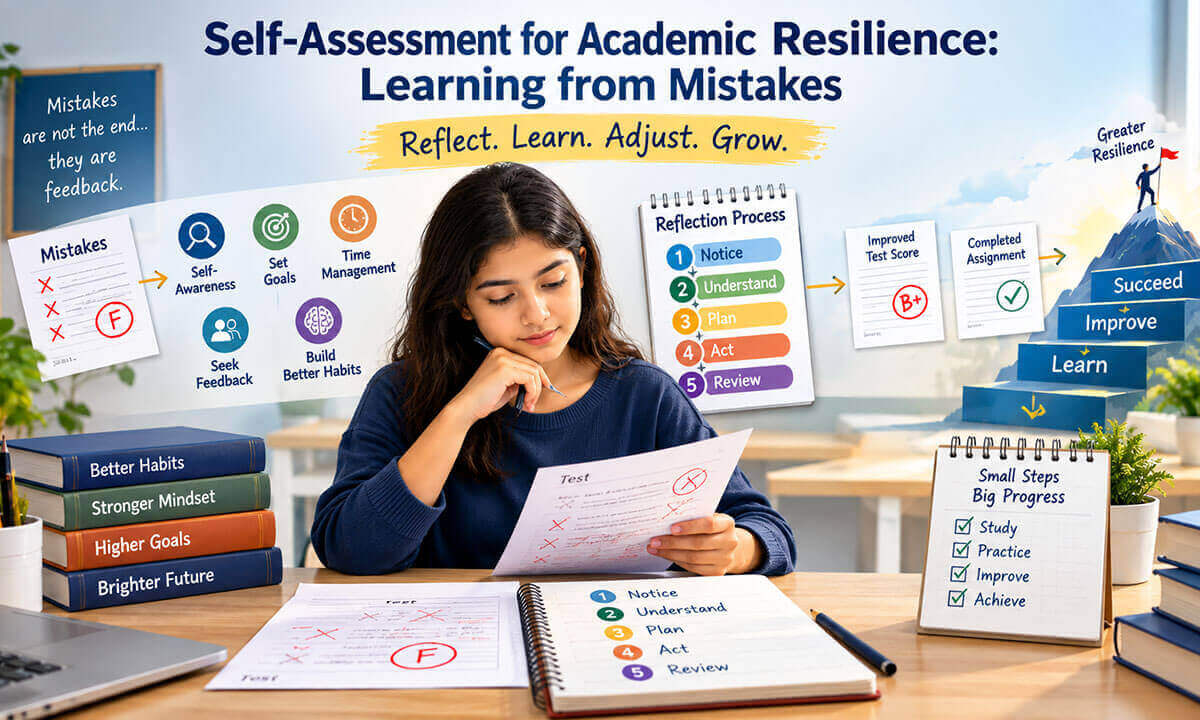
Notice → Understand → Plan → Act → Review
First, notice the problem.
Next, understand why it happened.
Then create a practical plan.
Put the plan into action.
Finally, review whether the new approach worked.
For example, a student notices that assignments are often submitted late. After reflection, the student realizes that most work is started one day before the deadline.
The student then creates a new plan. Every assignment will be started at least three days before the deadline. A reminder will be set on the phone.
After several weeks, the student reviews the results.
If the strategy works, it can become a regular habit. If it does not, the student can adjust the strategy.
This is resilience in practice.
Self-Talk Matters:
The way students talk to themselves after mistakes can affect how they respond to setbacks.
Statements such as “I am stupid,” “I can never do this,” or “I always fail” turn one difficult experience into a judgment about the entire self.
A more constructive approach is to describe the specific problem.
Instead of: “I am terrible at mathematics.”
Try: “I struggled with this topic and need more practice.”
Instead of: “I always mess everything up.”
Try: “My preparation was not effective this time. I need a different strategy.”
This does not mean pretending that everything is fine. It means being honest without being unnecessarily harsh.
Students can acknowledge disappointment while still believing that improvement is possible.
The Role of Growth Mindset:
The idea of a growth mindset is strongly associated with psychologist Carol Dweck. In simple terms, it involves viewing abilities as capable of developing rather than treating them as completely fixed.
A growth-oriented approach does not mean that everyone will achieve the same results or that effort alone solves every problem. It means recognizing that learning can involve practice, useful strategies, feedback, and support.
Self-assessment fits naturally with this approach.
When students review their work and notice improvement, they receive evidence that their learning strategies can change.
For example, a student may compare an early essay with a later one and notice better organization, clearer explanations, and stronger use of evidence.
That comparison can strengthen the belief that skills can develop over time.
Celebrating Progress:
Academic resilience is not only about studying mistakes.
Students also need to recognize progress.
Improvement may not always appear as a dramatic increase in grades. It can appear in smaller ways.
A student may:
- Complete work earlier.
- Ask questions more confidently.
- Make fewer careless mistakes.
- Understand difficult concepts more quickly.
- Study more consistently.
- Recover faster after a disappointing result.
- Use feedback more effectively.
These changes matter.
Recognizing progress can help students see that learning is a process rather than a single result.
How Teachers Can Support Self-Assessment:
Teachers play an important role in helping students develop reflective learning habits.
They can ask students questions such as:
- What did you learn from this assignment?
- Which part was most difficult?
- What strategy did you use?
- What would you change next time?
- What support would help you improve?
Teachers can also provide reflection sheets, checklists, rubrics, learning journals, and opportunities for students to review their own work.
Most importantly, mistakes should be treated as part of learning rather than as something students should feel ashamed of.
When students feel safe enough to acknowledge what they do not understand, they are more likely to seek help and make changes.
How Parents Can Support Academic Resilience:
Parents can also support self-assessment at home.
Instead of focusing only on grades, parents can ask questions about the learning process.
For example:
- “What did you find difficult?”
- “What did you learn from the test?”
- “What will you try differently next time?”
These questions encourage reflection rather than fear.
Parents can also help students create realistic routines for studying, sleeping, completing assignments, and taking breaks.
The goal should not be perfection.
The goal is to help students become more independent and capable of managing academic challenges.
A Simple Example of Learning From Failure:
Consider a student named Sarah.
Sarah receives a poor grade on her first mathematics examination. She feels disappointed and thinks she is not good at mathematics.
Instead of ignoring the result, she reviews her test.
She discovers that she understood many of the basic concepts but struggled with application questions. She also notices that she did not practice enough problems before the examination.
Sarah decides to change her study approach.
She begins practicing mathematics for 30 minutes each day. She asks her teacher about the topics she does not understand and joins a small study group.
On the next examination, her score improves.
The important result is not only the higher grade.
Sarah has also learned something about herself. She now knows how to examine a setback, identify a problem, create a plan, and try again.
That process can be useful far beyond one mathematics test.
Common Mistakes Students Make With Self-Assessment:
Self-assessment is useful, but it can also be done poorly.
- Being Too Harsh: Some students turn self-assessment into self-criticism.
The goal is not to punish yourself for mistakes.
The goal is to understand them.
- Focusing Only on Grades: Grades provide useful information, but they do not explain everything.
Students should also examine preparation, strategies, understanding, effort, and progress.
- Being Too General: Statements such as “I need to study more” are difficult to act on.
A specific plan is more useful.
- Reflecting Without Changing: If the same problem appears repeatedly, reflection should eventually lead to a change in behavior.
- Comparing Yourself Constantly With Others: Self-assessment should mainly focus on your own learning and progress.
Another student’s performance does not always tell you what you need to improve.
Tips for Making Self-Assessment a Habit:
Self-assessment works best when it becomes part of a regular routine.
Try these simple strategies:
- Spend 10 minutes each week reviewing your academic progress.
- Keep a learning journal or digital note.
- Review serious mistakes instead of immediately forgetting them.
- Write one thing you did well and one thing you want to improve.
- Set one small goal for the following week.
- Review whether the goal was achieved.
- Ask teachers or classmates for useful feedback.
- Adjust your study methods when they are not working.
- Recognize progress, even when it is small.
- Treat setbacks as information rather than as a final judgment about your ability.
In conclusion, academic life will always include challenges. Students will make mistakes, receive disappointing grades, miss deadlines, misunderstand concepts, and sometimes question their abilities. These experiences are a normal part of learning.
What matters is how students respond to them.
Self-assessment gives students a practical way to examine their learning, understand their mistakes, recognize their strengths, and make better decisions. It helps them move beyond the simple question of whether they succeeded or failed and toward more useful questions about what happened and what they can do next.
Academic resilience develops through this process. Students learn that one poor result does not have to determine what happens next. They can review the problem, seek support, change their strategy, and try again.
The goal is not to become a student who never makes mistakes. That is unrealistic.
The goal is to become a student who can learn from mistakes.
When students learn to reflect honestly, speak to themselves with patience, take practical action, and keep moving forward, setbacks become part of their education rather than the end of it.
A mistake can be disappointing. But with thoughtful self-assessment, it can also become a lesson that helps a student grow.

is an experienced educator and academic currently serving as a Lecturer at Nurul Amin Degree College. With a career dedicated to student development and institutional excellence, he brings a wealth of classroom expertise and pedagogical knowledge to his current role. Before joining the faculty, he served as an Assistant Teacher at Zinzira PM Pilot School and College.