Implementing Restorative Practices in School Discipline:
School discipline has traditionally focused on rules and consequences. When students break rules, schools may use detention, suspension, removal from class, or other forms of punishment. These approaches can sometimes address an immediate problem, but they do not always help students understand why their behavior caused harm or how they can make things right.
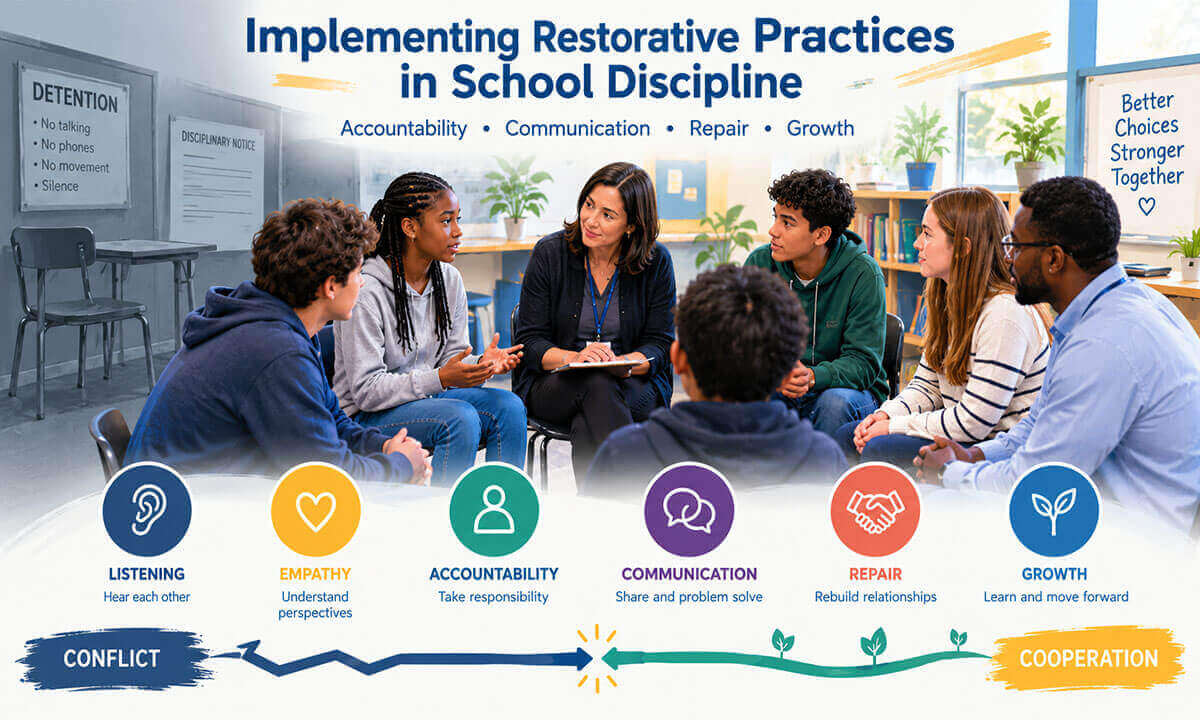
Restorative practices offer a different approach. Instead of asking only, “What rule was broken, and what punishment should follow?” restorative practices ask, “What happened? Who was affected? What needs to happen now to repair the harm?”
The goal is not to ignore inappropriate behavior or remove accountability. In fact, accountability is an important part of restorative practice. The difference is that students are encouraged to take responsibility, understand the effects of their actions, repair relationships, and learn better ways to deal with future problems.
When implemented carefully, restorative practices can become part of a wider school culture based on respect, communication, responsibility, and supportive relationships.
What Are Restorative Practices?
Restorative practices are approaches that focus on repairing harm and rebuilding relationships after conflict or inappropriate behavior. They can be used between students, between students and teachers, and across the wider school community.
The approach is based on the idea that harmful behavior affects people and relationships, not simply school rules. Therefore, responding to misconduct should involve more than assigning a consequence.
For example, imagine that a student pushes another student during an argument.
A traditional response might be: “You broke the school rule, so you will receive detention.”
A restorative response might involve questions such as:
- “What happened?”
- “Who was affected by what happened?”
- “How do you think the other student felt?”
- “What were you thinking at the time?”
- “What can you do to repair the harm?”
- “What can we do to prevent something similar from happening again?”
These questions encourage reflection and responsibility. The student is still expected to acknowledge the behavior and its consequences, but the process also creates an opportunity to learn from the incident.
The Shift From Punishment to Restoration:
One of the most significant changes in restorative discipline is the shift in the central question.
Traditional discipline often focuses on identifying the person who broke a rule and determining an appropriate punishment. Restorative discipline focuses more strongly on the people involved, the harm that occurred, and the steps needed to repair it.
The basic questions include:
- What happened?
- Who was affected?
- How were they affected?
- What does each person need?
- Who has a responsibility to repair the harm?
- How can the situation be handled differently in the future?
This does not mean that schools should eliminate all consequences. Serious behavior may still require formal disciplinary action. Restorative practices can work alongside existing safety and discipline procedures.
The main difference is that discipline becomes an opportunity for learning and repair rather than punishment alone.
Why Schools Are Rethinking Punitive Discipline:
Exclusionary discipline can have serious consequences for students. Being removed from school means losing valuable learning time. Repeated disciplinary exclusion can also affect students’ connection to school and their relationships with teachers and classmates.
There are also concerns about unequal disciplinary outcomes. Research and education policy discussions have documented racial and disability related disparities in school discipline. These patterns have encouraged schools and researchers to examine whether disciplinary systems are being applied fairly and whether they address the causes of student behavior.
Another concern is that punishment by itself may not teach students what they should do differently next time.
A student who receives detention after a conflict may understand that a rule was broken. However, that student may still need help with communication, emotional regulation, problem-solving, or conflict resolution.
Restorative practices attempt to address these areas directly.
Key Elements of Restorative Practices:
So, what does restorative discipline actually look like in action? Here are some fundamental elements:
1. Restorative Conversations: Restorative conversations are one of the simplest ways to introduce restorative practice into everyday school life.
When a student behaves inappropriately, a teacher can have a structured conversation with the student rather than immediately moving to punishment.
The teacher might ask:
- What happened?
- What were you thinking at the time?
- Who was affected?
- How do you think they were affected?
- What do you think needs to happen now?
- What could you do differently next time?
The purpose is not to interrogate the student. The purpose is to help the student reflect.
A good restorative conversation should be calm and respectful. Teachers should listen carefully and avoid humiliating the student.
2. Restorative Circles: Restorative circles provide a structured setting where several people can communicate about an issue.
Circles can be used before problems occur. For example, a teacher might hold a regular class circle where students discuss classroom expectations, relationships, concerns, and ways to support one another.
They can also be used after a conflict.
A restorative circle might include the students involved in the incident, teachers, school staff, parents, or other appropriate participants.
Everyone gets an opportunity to speak and listen. The goal is to understand what happened and agree on reasonable steps to repair the situation.
3. Mediation: Some conflicts require more structured support. Mediation can help when two or more students are having difficulty resolving a disagreement.
A trained staff member or trained student mediator can guide the conversation.
The mediator does not simply decide who is right or wrong. Instead, the mediator helps participants communicate, understand each other’s perspectives, and explore possible solutions.
Peer mediation can also give students valuable leadership and communication experience when it is properly supervised and used for appropriate conflicts.
4. Taking Responsibility: Restorative practice places responsibility at the center of the process.
Students are encouraged to recognize what they did, understand the consequences, and participate in repairing the harm.
Taking responsibility might involve:
- Giving a genuine apology
- Replacing or repairing damaged property
- Helping restore a classroom environment
- Having a conversation with someone who was harmed
- Agreeing to specific behavior changes
- Participating in a restorative meeting
- Developing a plan to handle similar situations differently
The response should be connected to the harm whenever possible. This makes the process more meaningful than an unrelated punishment.
5. Reintegration After Discipline: Sometimes students will still need to be removed from school or class because of serious behavior or safety concerns.
Restorative practice can still play an important role when the student returns.
A reintegration process might include a meeting with the student, family, teacher, counselor, or administrator. The group can discuss what happened, what the student needs to return successfully, and what expectations should be followed.
The purpose is to help the student reconnect with school rather than return feeling isolated or permanently labeled by a previous incident.
Benefits of Restorative Practices in Schools:
Why should schools embrace restorative approaches? The benefits speak for themselves:
1. Improved Relationships: Strong relationships are central to a healthy school environment. Restorative practices give students and adults regular opportunities to communicate and listen to one another.
When students believe that teachers will listen to them fairly, they may become more willing to communicate when problems occur.
2. Greater Student Accountability: Restorative practice does not remove responsibility. Instead, it changes how responsibility is understood.
Students are encouraged to recognize the effects of their actions and participate in repairing the harm. This can make accountability more personal and meaningful.
3. Better Conflict Resolution Skills: Students can learn practical skills through restorative processes.
These include:
- Listening
- Expressing feelings appropriately
- Understanding another person’s perspective
- Managing disagreements
- Taking responsibility
- Apologizing
- Finding solutions
- Preventing future conflicts
These skills are useful both inside and outside school.
4. Increased Sense of Belonging: Students who feel connected to their school are more likely to participate in school life.
Restorative approaches can support belonging by giving students opportunities to be heard and included in problem-solving.
5. Less Reliance on Exclusion: When schools have effective alternatives, they may be able to address some behavioral problems without repeatedly removing students from learning environments.
This does not mean that every incident should be handled through a restorative meeting. Schools still need clear procedures for serious safety concerns.
6. A More Supportive School Culture: Restorative practice works best when it becomes part of the overall school culture rather than being used only after serious incidents.
When respect, listening, accountability, and repair become normal parts of school life, students can learn that conflict does not automatically have to lead to punishment or hostility.
How Schools Can Implement Restorative Practices:
So, how can schools start embracing this shift? It’s not an overnight change, but with the right strategies, any school can transition successfully.
1. Train Teachers and Staff: Successful implementation begins with staff preparation.
Teachers and administrators need to understand what restorative practice means and how to use it appropriately.
Training can cover:
- Restorative questioning
- Active listening
- Conflict resolution
- Facilitation skills
- Restorative circles
- Mediation
- De escalation
- Cultural awareness
- Reintegration procedures
Without adequate training, restorative practices can become inconsistent or poorly managed.
2. Introduce the Approach to Students: Students also need to understand the purpose of restorative practices.
Schools can explain that restorative discipline is not a way to avoid consequences. It is a way to deal with problems while focusing on responsibility, relationships, and repair.
Teachers can introduce restorative questions during normal classroom activities before using them during serious conflicts.
3. Build a Restorative Mindset: A school cannot create a restorative culture simply by changing its disciplinary forms.
The underlying mindset also needs to change.
Teachers and administrators should ask: “What does this student need to learn from this situation?”
Rather than only: “What punishment should this student receive?”
This does not mean excusing poor behavior. It means treating behavior as something that can be addressed through accountability and learning.
4. Use Restorative Language: Language can strongly influence how students experience discipline.
Instead of: “Why are you always causing problems?”
A teacher might ask: “Can you tell me what happened?”
Instead of: “You should know better.”
The teacher might ask: “Who was affected by what happened?”
Instead of: “You are in trouble.”
The teacher might say: “We need to talk about what happened and how we can repair it.”
These small changes can make disciplinary conversations less confrontational.
5. Develop Clear Procedures: Schools should create clear guidelines explaining when and how restorative practices will be used.
The policy should address:
- Which incidents are appropriate for restorative responses
- Who can facilitate restorative meetings
- When parents or guardians should be involved
- How student safety will be protected
- How agreements will be recorded
- What happens when an agreement is not followed
- How serious incidents will be handled
- How students will be reintegrated after exclusion
Clear procedures help prevent restorative discipline from becoming inconsistent.
6. Involve Parents and Families: Families should understand what the school is trying to achieve.
Schools can organize information sessions, workshops, or meetings to explain restorative practices.
Parents and guardians can also provide important information about students’ experiences and needs.
Family involvement should be handled respectfully. The purpose should be cooperation rather than assigning blame.
7. Start Small: Schools do not necessarily need to change their entire discipline system at once.
A school might begin with restorative conversations in one grade level or introduce community circles in selected classrooms.
The school can then collect feedback and identify what needs improvement before expanding the approach.
Starting gradually can help teachers gain confidence and allow administrators to identify practical challenges.
8. Monitor Results: Schools should evaluate whether their restorative approach is working.
Possible measures include:
- Number of disciplinary referrals
- Suspension rates
- Repeat behavioral incidents
- Attendance
- Student perceptions of school safety
- Student sense of belonging
- Teacher experiences
- Parent feedback
- Completion of restorative agreements
Data should be examined carefully. A reduction in referrals alone does not prove that a program is successful. Schools should also consider whether students feel safe, whether serious incidents are being addressed properly, and whether disciplinary practices are being applied fairly.
Challenges in Implementing Restorative Practices:
Shifting from traditional discipline to restorative methods isn’t always easy. Here are a few challenges schools might face and how to overcome them.
- Resistance From Staff: Some teachers may worry that restorative practices are too time-consuming or that students will see them as a way to avoid consequences.
Schools can address these concerns through training, clear policies, staff discussion, and evidence from their own implementation.
Teachers should also have opportunities to discuss what is working and what is difficult.
- Lack of Time: Restorative conversations can take longer than issuing a detention.
This is a real challenge, particularly in schools with limited staff and large student populations.
Schools need to plan for the time required. Restorative practice should not simply be added to teachers’ existing responsibilities without providing appropriate support.
- Inadequate Training: Poorly facilitated restorative meetings can make conflicts worse.
Staff need practical training and opportunities to practice their skills. Schools may also need trained restorative coordinators or other staff members who can support more complex cases.
- Students May Not Participate Honestly: A restorative conversation cannot work well if participants feel forced to speak or are afraid of retaliation.
Students need to feel that the process is fair and safe. Facilitators should establish clear expectations and recognize when a restorative process is not appropriate.
- Serious Incidents Require Careful Handling: Restorative practices are not suitable for every situation or at every stage of every incident.
Safety must come first. Serious violence, threats, abuse, or other high-risk situations may require formal disciplinary, safeguarding, or legal procedures.
Restorative approaches can sometimes be used later as part of a broader response, but participation and safety need careful consideration.
- Restorative Practices Should Not Mean No Consequences: One common misunderstanding is that restorative discipline means students are never punished.
That is not the central idea.
Restorative practice means that consequences should be connected to responsibility and repair whenever possible. Students should understand that their actions have effects and that they have responsibilities toward other people.
A student who damages school property, for example, may need to help repair the harm. A student who hurts another student may need to participate in an appropriate restorative process. A student who repeatedly disrupts a class may need a structured support plan.
The exact response should depend on the behavior, the student’s circumstances, school policy, and safety considerations.
Creating a Long-Term Restorative Culture:
The strongest implementation goes beyond individual disciplinary incidents.
Schools can build restorative principles into everyday activities.
Teachers can use regular classroom circles. Students can participate in peer leadership programs. Staff can use restorative questions during ordinary disagreements. School leaders can model respectful communication.
Schools can also teach students that conflict is a normal part of human relationships. What matters is how people respond to conflict.
Gradually, these practices can help students see accountability as something connected to relationships and community rather than simply punishment.
In conclusion, implementing restorative practices in school discipline requires more than replacing detention with a conversation. It requires a broader change in how schools understand behavior, accountability, relationships, and student development.
The central question changes from “What punishment does this student deserve?” to “What happened, who was affected, and what needs to happen to repair the harm?”
Restorative practices can give students opportunities to reflect, listen, accept responsibility, repair relationships, and develop better ways of handling conflict. They can also help teachers and school leaders create stronger relationships with students.
However, successful implementation requires training, clear procedures, adequate time, family involvement, careful evaluation, and attention to safety. Restorative practices should not be treated as a quick solution or as a replacement for every form of disciplinary action.
When used thoughtfully, they can become an important part of a school discipline system that combines accountability with learning and repair. The goal is not simply to make students follow rules. It is to help them understand their responsibilities, learn from mistakes, and contribute to a respectful school community.

is an experienced educator and academic currently serving as a Lecturer at Nurul Amin Degree College. With a career dedicated to student development and institutional excellence, he brings a wealth of classroom expertise and pedagogical knowledge to his current role. Before joining the faculty, he served as an Assistant Teacher at Zinzira PM Pilot School and College.