Self-Assessment Techniques That Improve Learning Outcomes:
Learning is not only about attending classes, reading books, or completing assignments. It also involves understanding how well you are learning. Students can spend many hours studying and still struggle to remember information, understand difficult ideas, or perform well in assessments. One reason is that they may not stop to check their own progress.
Self-assessment is a useful way to understand what you know, what you do not know, and what you need to improve. It encourages learners to look at their own work and think about their learning process. Instead of waiting for a teacher or an exam to show them their weaknesses, students can identify problems earlier and take action.
Self-assessment can take many forms. Students can keep reflective journals, test themselves, explain ideas in their own words, analyze mistakes, track their progress, and use feedback from others. These activities can make learning more active and purposeful.
This article discusses ten self-assessment techniques that can help students improve their learning outcomes. It also explains how each technique works, why it is useful, and how students can use it in their daily study routine.
What Is Self-Assessment?
Self-assessment is the process of evaluating your own knowledge, skills, progress, and learning. It requires students to think about their performance and identify areas of strength and weakness.
For example, after studying a chapter, a student might ask:
- What did I understand?
- What do I still find difficult?
- Can I explain the main ideas without looking at my notes?
- Which areas need more practice?
- What should I change in my study method?
These questions help students become more aware of their learning.
Self-assessment does not mean simply giving yourself a grade. A useful self-assessment involves reflection, judgment, and action. Students identify a problem and then decide what they can do to improve it.
Why Is Self-Assessment Important for Learning?
Self-assessment can support learning in several ways.
- It increases awareness: Students become more aware of what they know and what they do not know. This can help them study more effectively.
- It improves focus: Students can identify weak areas instead of spending most of their time reviewing material they already understand.
- It encourages responsibility: Self-assessment gives learners a more active role in their education. They learn to take responsibility for their progress rather than depending completely on teachers.
- It supports deeper understanding: When students explain, question, and evaluate their own learning, they have to think more carefully about the subject.
- It helps identify learning problems: Self-assessment can reveal problems such as poor time management, weak memory, misunderstanding of concepts, or ineffective study habits.
Self-Assessment Techniques That Improve Learning Outcomes:
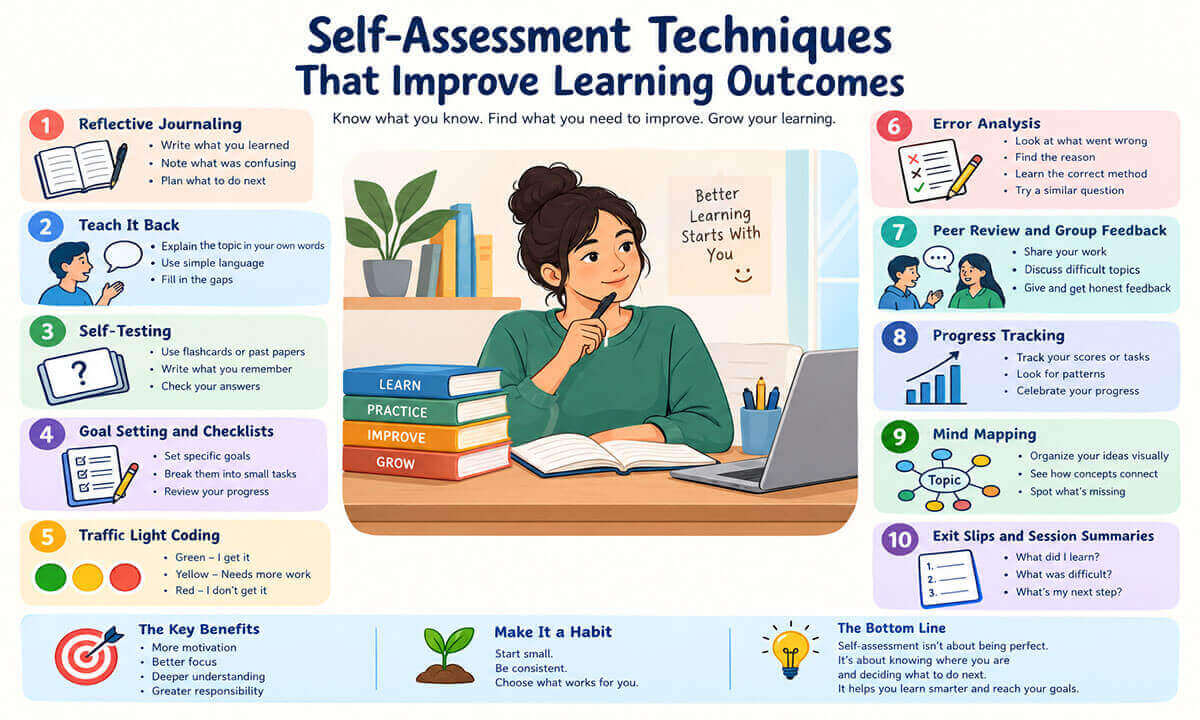
1. Reflective Journaling:
Reflective journaling is a simple way to think about your learning after a study session.
Students can spend five or ten minutes writing about what they studied and how well they understood it.
How It Works: At the end of a study session, answer a few questions:
- What did I learn today?
- What was difficult?
- What was unclear?
- Which study activity helped me most?
- What should I review later?
- What can I do differently during my next session?
There is no need to write a long entry. A few honest sentences can be enough.
Why It Works: Writing about learning encourages students to examine their own thinking. It can also help them identify repeated problems.
For example, a student may notice that mathematical problems are difficult because they often skip certain steps. Once the problem is identified, the student can change the study approach and practice those steps.
Reflective journaling can therefore turn everyday study into a process of continuous improvement.
2. The Teach It Back Method:
One of the best ways to check your understanding is to explain a topic in your own words.
After studying a concept, pretend that you are teaching it to someone who has never learned it before.
How It Works: Choose a topic and explain:
- What it means
- How it works
- Why it is important
- What examples can be used to explain it
Try to explain the topic without looking at your textbook or notes.
If you become confused or cannot explain an important part, that may show that your understanding is incomplete.
You can then return to your study material and review the difficult section.
Why It Works: Explaining a topic requires more than recognizing information. You have to organize your thoughts and express the main idea clearly.
This technique is often associated with the Feynman Technique. The basic idea is simple. If you can explain something clearly using simple language, you are more likely to understand it well.
It is also useful to use examples. Examples can help connect abstract ideas to familiar situations.
3. Self-testing:
Reading the same notes repeatedly can make information feel familiar. But familiarity does not always mean that you can remember or use the information when needed.
Self-testing provides a better way to check what you actually remember.
How It Works: After studying a topic, close your book and test yourself. You can:
- Use flashcards
- Answer practice questions
- Complete past exam questions
- Write everything you remember about a topic
- Create questions from your notes
- Explain answers without looking at the textbook
After completing the test, compare your answers with the correct information.
Why It Works: Self-testing requires you to retrieve information from memory. This gives you a clearer idea of what you have learned and what you still need to study.
It also helps identify knowledge gaps.
For example, you may feel that you understand a chapter because you have read it several times. But when you try to answer questions without looking at your notes, you may discover that you cannot remember some important details.
That information is useful because it tells you where further study is needed.
4. Goal Setting and Checklists:
Clear learning goals make self-assessment easier.
Instead of setting a broad goal such as “study English,” create a specific goal such as “learn ten new English words and use each one in a sentence.”
How It Works: At the beginning of a study session or week:
- Choose a specific learning goal.
- Break the goal into smaller tasks.
- Write the tasks on a checklist.
- Complete the tasks.
- Review your progress at the end.
Then ask yourself whether the goal was realistic.
If you did not complete the tasks, think about why.
Maybe the task took longer than expected. Maybe you were distracted. Or perhaps the goal was too large.
Why It Works: Goal setting gives students something specific to evaluate. It also makes progress easier to see.
A checklist can show whether you completed a task, but the reflection afterward is even more important. It helps you understand why you succeeded or struggled.
5. Traffic Light Coding:
Traffic light coding is a simple visual method for assessing your understanding.
Students use three colors to classify their knowledge.
- Green: I understand this topic well.
- Yellow: I understand some of it but need more practice.
- Red: I do not understand this topic yet.
How It Works: After studying a topic, give it a color.
You can mark topics in your notebook, textbook, study planner, or digital notes.
For example:
| Topic | Status |
| Basic concepts | Green |
| Applications | Yellow |
| Advanced problems | Red |
When you study again, spend more time on the yellow and red areas.
Why It Works: This method gives students a quick picture of their current understanding.
It can also prevent inefficient studying. Students do not need to spend equal amounts of time on every topic. They can focus more attention on areas that need improvement.
6. Error Analysis:
Mistakes can provide useful information when students examine them carefully.
Instead of simply looking at a wrong answer and moving on, try to understand why the mistake happened.
How It Works: When you make a mistake:
- Record the incorrect answer.
- Find the correct answer.
- Identify why your answer was wrong.
- Write down the correct method or idea.
- Try a similar question.
- Check whether you can solve it correctly.
The reason behind the mistake is essential.
You may have misunderstood the question, forgotten a rule, made a calculation error, or used the wrong method.
Why It Works: Error analysis changes mistakes into useful feedback.
For example, if a student repeatedly loses marks because they do not read questions carefully, they can develop a habit of underlining key information before answering.
The goal is not simply to know that an answer was wrong. The goal is to understand the cause of the mistake and reduce the chance of repeating it.
7. Peer Review and Group Feedback:
Self-assessment does not always have to happen alone. Other learners can provide useful feedback that helps students understand their own work.
How It Works: Students can work with a study partner or small group. They can:
- Exchange written assignments
- Ask each other questions
- Explain difficult concepts
- Discuss answers
- Review presentations
- Give constructive feedback
The purpose should not be to criticize. The purpose is to identify strengths and areas that need improvement.
Why It Works: Students may not always notice problems in their own work. Another person may see an unclear explanation, missing information, or incorrect reasoning.
Peer discussion can also improve understanding because students have to explain their ideas clearly.
However, peer feedback should be based on clear criteria. Students should know what they are expected to evaluate.
8. Progress Tracking:
Progress tracking involves recording learning performance over time.
Students can track test scores, completed tasks, reading progress, practice results, or their level of understanding.
How It Works: Create a simple record of your progress.
For example:
| Week | Practice Score |
| Week 1 | 55% |
| Week 2 | 62% |
| Week 3 | 68% |
| Week 4 | 74% |
The numbers are not the only thing that matters. Students should also think about what caused the changes.
Ask:
- What improved?
- What caused the improvement?
- Which areas are still weak?
- What should I focus on next?
- Why It Works
Progress tracking makes change easier to see.
Learning can sometimes feel slow because improvement happens gradually. A record can help students recognize progress that may not be obvious from day to day.
It can also reveal patterns. For example, a student may notice that performance improves when they practice regularly instead of studying only before an exam.
9. Mind Mapping:
Mind mapping is a visual method for organizing information and checking how different ideas are connected.
How It Works: Write the main topic in the center of a page.
Then add branches for related ideas.
For example, a mind map about photosynthesis might include:
- Definition
- Requirements
- Process
- Chemical equation
- Importance
- Factors affecting the process
Add smaller branches when necessary.
After creating the mind map, examine it carefully.
Ask yourself whether you understand the relationship between the ideas. If you cannot explain a branch, that may be an area that needs more study.
Why It Works: Mind maps help learners organize information and see connections between concepts.
They can also reveal missing knowledge. If you cannot add important details to a branch, you may need to review that part of the topic.
Mind mapping can therefore work as both a note-taking method and a self-assessment tool.
10. Exit Slips and Session Summaries:
An exit slip is a short summary completed at the end of a lesson or study session.
It does not need to take more than a few minutes.
How It Works: At the end of the session, answer three questions:
- What did I learn?
- What was difficult?
- What should I do next?
You can write the answers in a notebook or digital document.
For example:
What did I learn?
I learned how supply and demand affect market prices.
What was difficult?
I still find the concept of market equilibrium confusing.
What should I do next?
I will review two examples and complete three practice questions.
Why It Works: A session summary encourages students to review their learning while the material is still fresh.
It also creates a clear starting point for the next study session.
Instead of beginning the next session by asking, “What should I study?”, you already know which area needs attention.
How to Use Self-Assessment Effectively:
Students do not need to use all ten techniques at the same time. Using too many methods can make studying feel complicated.
A better approach is to choose techniques that fit your needs.
For example, you could use:
- Self-testing after learning new material
- Error analysis after practice tests
- Reflective journaling once or twice a week
- Traffic light coding when reviewing several topics
- Progress tracking to monitor longer-term improvement
The significant point is consistency.
Self-assessment should become part of the learning process rather than something students do only before exams.
Common Problems With Self-Assessment:
Self-assessment is useful, but it is not always accurate.
Students may overestimate or underestimate their knowledge. Some may think they understand a topic simply because the material looks familiar. Others may judge themselves too harshly after making mistakes.
This is why different assessment methods can be useful.
For example, instead of asking yourself only, “Do I understand this?”, test yourself with questions. Then explain the answer without looking at your notes.
Feedback from teachers and peers can also provide another perspective.
Self-assessment works best when students are honest about their performance and use evidence to support their judgments.
Making Self-Assessment a Regular Habit:
The value of self-assessment comes from regular use.
You do not need to spend a long time doing it. A few minutes at the end of a study session can be enough.
A simple routine might look like this:
- Before studying: Set one clear learning goal.
- During studying: Ask questions and check your understanding.
- After studying: Test yourself without looking at your notes.
- After testing: Identify mistakes and weak areas.
- Before the next session: Decide what needs more attention.
This creates a simple feedback process. You study, check your understanding, identify problems, and adjust your approach.
In conclusion, self-assessment is a necessary part of effective learning. It helps students understand their own strengths, recognize weaknesses, and make better decisions about how to study.
Techniques such as reflective journaling, teaching a topic back, self-testing, goal setting, traffic light coding, error analysis, peer feedback, progress tracking, mind mapping, and session summaries can all support this process.
The goal is not to judge yourself harshly. It is to understand where you are and decide what to do next.
You can start with one simple technique. After a study session, close your notes and ask yourself what you learned, what you still find difficult, and what you should study next. That small habit can make your learning more deliberate and focused.
Good learning requires more than collecting information. It requires knowing whether you understand that information and being willing to change your approach when you do not. Self-assessment helps students develop that awareness and take greater responsibility for their own learning.

is an experienced educator and academic currently serving as a Lecturer at Nurul Amin Degree College. With a career dedicated to student development and institutional excellence, he brings a wealth of classroom expertise and pedagogical knowledge to his current role. Before joining the faculty, he served as an Assistant Teacher at Zinzira PM Pilot School and College.