Tips to Engineer Your Success:
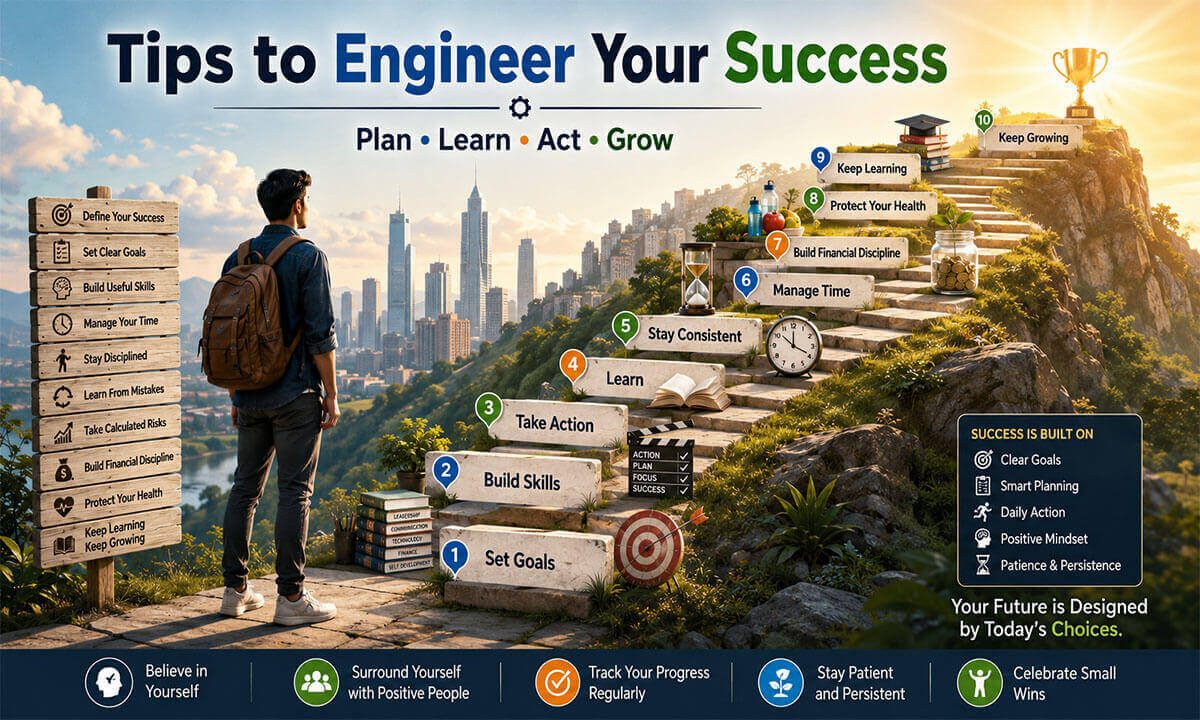
Success rarely happens by accident. Most successful people build their success through clear goals, consistent effort, good decisions, and a willingness to learn. They understand that success is not only about working hard. It is also about working in the right direction. To engineer your success means to take an active role in creating the life you want. Instead of waiting for the perfect opportunity, you prepare yourself, make thoughtful choices, and take steady action. You may not control everything that happens, but you can control how you respond and what you do next. Here are some practical tips to engineer your success step by step:
1. Define What Success Means to You:
Success does not mean the same thing to everyone. For one person, success may mean building a successful career. For another, it may mean financial stability, a peaceful family life, good health, or personal growth.
Before you work toward success, decide what you actually want.
For example, if you want a better career, your goal could be to gain a new skill, earn a professional qualification, or find a better job within the next year. A clear goal gives your effort a direction.
2. Set Clear and Realistic Goals:
A dream becomes more useful when you turn it into a specific goal.
Instead of saying, “I want to become successful,” say, “I want to improve my English communication skills within six months.”
Break large goals into smaller steps. If you want to write a book, for example, you could begin by writing 500 words each day. Small actions become powerful when you repeat them consistently.
3. Build Useful Skills:
Your skills can create opportunities for you. The more useful skills you develop, the more valuable you can become in your work and personal life.
Learn skills that match your goals. These may include communication, writing, technology, problem-solving, leadership, financial management, or another professional skill.
For example, someone who wants to work in a modern office may improve their computer skills, communication skills, and knowledge of office software. These skills can make that person more confident and employable.
4. Take Consistent Action:
Planning is important, but action creates progress.
You do not need to make huge changes every day. Focus on doing something useful regularly. Read a few pages, practice a skill, complete an important task, or contact someone who can help you move forward.
For example, a student who studies for one hour every day may make greater progress than someone who studies for ten hours only before an examination.
Consistency often matters more than intensity.
5. Learn From Your Mistakes:
Failure is not always the opposite of success. Sometimes it is part of the process.
When something goes wrong, ask yourself what you can learn from the experience. Avoid spending too much time blaming yourself or other people.
Suppose you apply for a job and do not get selected. Instead of giving up, review your interview performance. Perhaps you need better communication skills, stronger preparation, or more knowledge about the position. Use that information to improve your next attempt.
6. Manage Your Time Carefully:
Time is one of your most valuable resources. Once it is gone, you cannot get it back.
Learn to identify important tasks and complete them before less important activities. Avoid spending too much time on things that do not support your goals.
For example, if you have an important examination coming up, spending several hours scrolling through social media may not be the best use of your time. You can enjoy entertainment, but it should not control your schedule.
7. Develop a Strong Work Ethic:
Talent can help you, but discipline keeps you moving when motivation disappears.
A strong work ethic means doing what needs to be done even when you do not feel excited about it. It means being responsible, punctual, reliable, and willing to put in honest effort.
For example, a person who wants to become a good writer cannot depend only on inspiration. They need to write regularly, read widely, accept criticism, and keep improving.
8. Choose Your Environment Carefully:
The people and environments around you can influence your thinking and behavior.
Spend time with people who encourage learning, responsibility, and positive growth. This does not mean avoiding everyone who disagrees with you. It means being careful about whose advice you accept and whose habits you copy.
For example, if your friends regularly discuss their goals, learn new skills, and encourage one another, you may become more motivated to improve yourself.
9. Take Calculated Risks:
Growth often requires you to step outside your comfort zone.
This does not mean making careless decisions. A calculated risk means understanding the possible benefits and problems before taking action.
For example, accepting a new job may feel uncertain. However, if the position offers better experience, useful skills, and reasonable opportunities for growth, it may be a risk worth taking.
Do your research, prepare yourself, and then make the decision.
10. Build Financial Discipline:
Financial stability can give you greater freedom and reduce unnecessary stress.
Learn to live within your means. Track your spending, save regularly, avoid unnecessary debt, and think carefully before making large purchases.
For example, if you receive a monthly income, you can divide it among essential expenses, savings, and personal spending. Even a small amount saved regularly can develop good financial habits.
11. Protect Your Health and Energy:
Success is difficult to enjoy if you constantly feel exhausted.
Take care of your basic needs. Get enough sleep, eat reasonably well, stay physically active, and give yourself time to rest. Your mind and body are important tools for achieving your goals.
For example, a student may believe that studying all night will improve results. In reality, regular sleep and focused study can support better learning and concentration.
12. Keep Learning:
The world keeps changing, so your knowledge should keep growing.
Read books, take courses, listen to useful discussions, ask questions, and learn from experienced people. You do not have to become an expert in everything. Focus on learning what is useful for your goals.
For example, a person working in technology may need to learn new tools as technology changes. Someone working in education may need to understand new teaching methods and digital resources.
Continuous learning keeps you prepared for new opportunities.
13. Be Patient With the Process:
Success often takes longer than people expect.
You may work hard for months without seeing major results. That does not necessarily mean your effort is useless. Some forms of progress happen quietly before they become visible.
Think of learning a language. You may practice every day but still feel that you are not improving. After several months, however, you may suddenly notice that you understand conversations more easily and speak with greater confidence.
Give your efforts enough time to grow.
14. Review Your Progress:
Do not simply work hard. Stop occasionally and ask whether your work is producing the results you want.
Review your goals, habits, strengths, weaknesses, and progress. If something is not working, change your approach.
For example, if you planned to study for two hours every evening but often fail to do so, examine the reason. Perhaps you are too tired after work. You could move your study time to the morning or divide it into shorter sessions.
Good planning requires regular adjustment.
15. Believe That You Can Improve:
Your current abilities do not have to define your future.
You may not be good at something today, but practice and learning can help you become better. A growth-focused mindset allows you to see challenges as opportunities to develop.
Instead of saying, “I cannot do this,” try asking, “What do I need to learn to do this better?”
That small change in thinking can influence your actions.
In conclusion, success is not something that appears overnight. It is built through many small decisions and repeated actions. You engineer your success when you decide what you want, develop useful skills, manage your time, learn from mistakes, protect your health, and continue moving forward.
You will face setbacks. Some plans will fail. Some opportunities will not work out. That is normal. What matters is your ability to learn, adjust, and continue.
You do not need to have everything figured out today. Start with one clear goal and one useful action. Keep learning, stay consistent, and give yourself time to grow.
Your future is shaped not only by what you hope to achieve, but also by what you choose to do every day.

is an experienced educator and academic currently serving as a Lecturer at Nurul Amin Degree College. With a career dedicated to student development and institutional excellence, he brings a wealth of classroom expertise and pedagogical knowledge to his current role. Before joining the faculty, he served as an Assistant Teacher at Zinzira PM Pilot School and College.