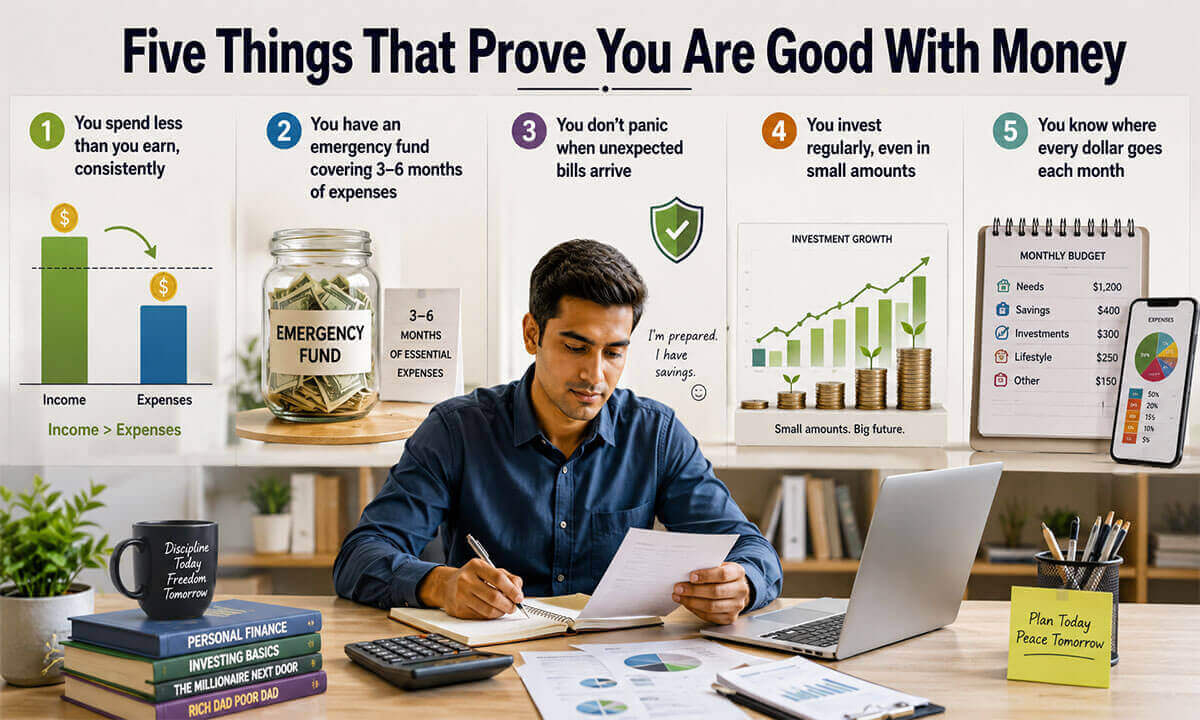
Five Things That Prove You Are Good With Money:
Being good with money is not about having a high salary or living a luxurious life. It is about knowing how to manage the money you have wisely. A person with a modest income can be financially responsible, while someone with a high income can still struggle with money. Good money habits give you greater control over your life. They help you deal with unexpected problems, prepare for the future, and enjoy your money without constant worry. You do not need to be a financial expert to manage money well. Simple habits, practiced consistently, can make a big difference. Here are five things that prove you are good with money.
1. You Spend Less Than You Earn, Consistently:
One of the clearest signs of good money management is spending less than you earn. When your income is higher than your expenses, you have money left over for savings, investments, and future goals.
For example, imagine that you earn $2,500 each month. If you spend $2,200, you have $300 left. You can use part of that money to build savings or invest for the future.
The important word here is consistently. Saving money once is easy. Building a habit of living within your income requires discipline.
This does not mean you can never enjoy your money. You can eat at restaurants, travel, buy clothes, or enjoy hobbies. The key is to make sure these expenses fit within your budget.
A simple rule is to ask yourself before buying something, “Can I afford this without creating a problem for myself later?”
2. You Have an Emergency Fund Covering 3 to 6 Months of Expenses:
Life does not always go according to plan. You may lose your job, face an unexpected repair, have a family emergency, or suddenly need to pay a large bill.
An emergency fund gives you protection during these difficult moments. A common goal is to save enough money to cover about three to six months of essential living expenses.
For example, suppose your necessary monthly expenses are $1,500. A three-month emergency fund would be $4,500, while a six-month fund would be $9,000.
You do not have to build this amount immediately. Start with a small target, such as $500 or $1,000. Then continue adding money until you reach a level that makes you feel financially secure.
An emergency fund can also prevent you from depending on credit cards or loans when something unexpected happens.
3. You Do Not Panic When Unexpected Bills Arrive:
Unexpected bills are part of life. A car may need repairs, a phone may stop working, or a household appliance may suddenly break.
Being good with money does not mean unexpected expenses never happen. It means you are prepared when they do happen.
For example, imagine that your washing machine suddenly stops working and the repair costs $300. If you have savings available, you can pay the bill without borrowing money or becoming extremely stressed.
This does not mean you will feel happy about the bill. Nobody enjoys unexpected expenses. The difference is that you know how to handle them.
Financial preparation gives you confidence. Instead of thinking, “How will I ever pay for this?” you can think, “This is inconvenient, but I have a plan.”
4. You Invest Regularly, Even in Small Amounts:
Saving money is considerable, but investing can help your money grow over the long term. You do not need to start with a large amount.
For example, someone might invest $25, $50, or $100 every month, depending on their financial situation. The amount may seem small at first, but regular contributions can become meaningful over many years.
The essential habit is consistency. You do not need to wait until you are wealthy before you start thinking about investing.
However, investing should be done carefully. It is important to understand what you are investing in, consider the risks, and avoid putting money into something simply because someone promises quick profits.
Good money management is about building wealth slowly and responsibly rather than trying to become rich overnight.
5. You Know Where Every Dollar Goes Each Month:
One more strong sign that you are good with money is knowing where your money goes.
Many people know how much they earn but do not know how much they spend. Small purchases can add up quickly. A coffee here, a meal there, a subscription you rarely use, and several online purchases can become a significant amount over a month.
For example, you may think you only spend $20 on small purchases each week. That becomes about $80 a month and nearly $1,000 a year.
Tracking your spending helps you see the truth about your financial habits. You can use a notebook, spreadsheet, budgeting app, or simple monthly list.
You do not need to track every expense forever. Even tracking your spending for a few months can help you understand your habits and identify areas where you can save.
Knowing where your money goes gives you greater control over your financial life.
Why These Habits Matter:
These five habits are connected. Spending less than you earn gives you extra money. That money can help build an emergency fund. An emergency fund protects you from unexpected bills. Once your finances are stable, you can invest regularly. Tracking your spending helps you maintain all of these habits.
You do not need to be perfect. Financial success is usually the result of small decisions repeated over time.
For example, saving $50 every month may not seem impressive today. But developing the habit of saving can be more important than the amount itself. As your income increases, you can increase your savings and investments as well.
In conclusion, being good with money is not about how expensive your car is, how large your house is, or how much money you earn. It is about how well you manage what you have.
If you consistently spend less than you earn, maintain an emergency fund, stay calm when unexpected bills arrive, invest regularly, and understand where your money goes, you are already building strong financial habits.
You do not need to change everything overnight. Start with one habit and improve gradually. Small financial decisions made today can create greater security and freedom in the future.
Ultimately, being good with money means making your money work for your goals instead of allowing your money to control your life.

is an experienced educator and academic currently serving as a Lecturer at Nurul Amin Degree College. With a career dedicated to student development and institutional excellence, he brings a wealth of classroom expertise and pedagogical knowledge to his current role. Before joining the faculty, he served as an Assistant Teacher at Zinzira PM Pilot School and College.