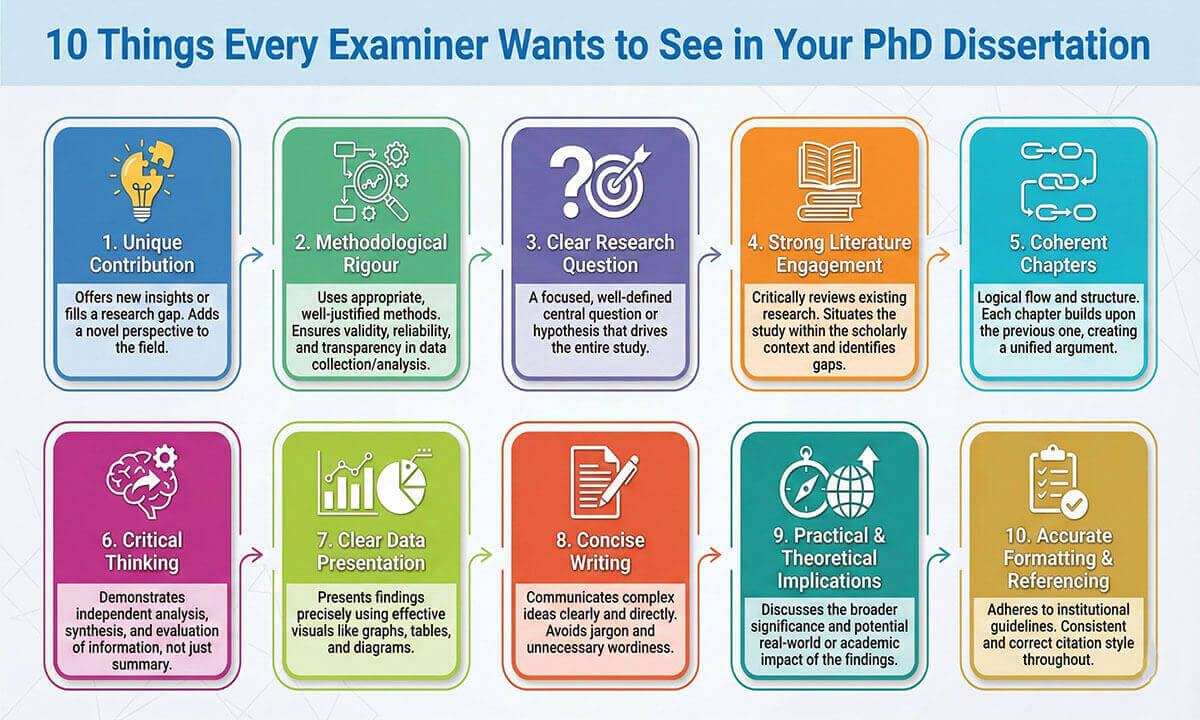
10 Things Every Examiner Wants to See in Your PhD Dissertation:
Earning a PhD is not simply about writing thousands of words or spending years in the library. A successful dissertation is one that demonstrates scholarly maturity, original thinking, and methodological skill. Examiners look for specific elements that show the candidate is ready to join the academic community as a researcher (Morley et al., 2020). Although expectations vary slightly between disciplines, many evaluation criteria remain remarkably consistent worldwide (Cryer, 2006; Wellington et al., 2017). In the rest of this article, we will explore 10 things every examiner wants to see in your PhD dissertation.
1) A Unique and Meaningful Contribution:
At the PhD level, the necessary goal is to add something new to your field. Examiners want to see how your research contributes to knowledge that did not exist before (Phillips & Pugh, 2010). This contribution can take different forms:
- New theory or framework
- New data in an under-researched area
- New application of an existing idea
- A better method or improved solution
Your contribution does not need to change the world, but it must show real value and be clearly explained. Other researchers or professionals should care about your findings (Delamont et al., 2004).
Good questions to ask yourself:
- What is new in my work?
- Why does it matter for theory or practice?
- How can I show that my study fills a real gap?
If you can answer these questions confidently, you are on the right track toward a dissertation that examiners respect.
2) Methodological Rigour:
Even an excellent idea fails if the method is weak. Methodological rigour means your approach is trustworthy, ethical, and clearly described so another researcher could follow the same steps (Creswell & Creswell, 2018).
Examiners look for:
- A clear explanation of why you chose qualitative, quantitative, or mixed methods
- A suitable and well-justified sample
- Ethical approval and protection of participants
- Transparent data collection and analysis procedures
The chosen method must match the research question (Bryman, 2016). For example, if you aim to measure how common an issue is, a large survey may be more appropriate than two interviews.
A helpful check:
If another PhD student could replicate your work step-by-step based on your description, your methodology is likely strong.
3) A Clear and Focused Research Question:
A strong research question works like a roadmap for your entire project. If the question is too broad, the project becomes chaotic. If it is focused and specific, every chapter has a clear purpose (Wellington et al., 2017).
A good research question usually identifies:
- What you are studying
- Who or where your research focuses on
- Sometimes how or why
Examples:
- Too broad: “How does education affect society?”
- Better: “How do online learning platforms affect student engagement in UK secondary schools?”
The more specific version helps you choose the right literature, methods, and analysis. It also prevents “scope creep,” where you add unnecessary topics that distract from the main goal.
Your research question should always connect directly to your findings and conclusion — this is one of the first things examiners check.
4) Strong Engagement with the Literature:
A good dissertation shows that you deeply understand the current knowledge in your field — what is known, what is debated, and what is missing (Booth et al., 2016). Examiners expect you to do more than summarise articles. They want to see critical engagement, where you compare ideas, highlight contradictions, and identify gaps that justify your study (Delamont et al., 2004).
Effective literature engagement includes:
- Organizing studies into themes rather than a long list
- Showing tensions or unanswered questions in previous research
- Clearly explaining how your study fills a gap
The goal is to convince examiners that your research is needed, not just interesting. When you show where your work fits into the bigger conversation, your contribution becomes easier to defend later (Wellington et al., 2017).
5) Coherence Across All Chapters:
A PhD dissertation should read like one connected story, not a collection of separate assignments. Each chapter must lead logically into the next, working together to answer your research question (Trafford & Leshem, 2008).
Examiners look for:
- A strong link between your research question, literature review, methods, results, and discussion
- Consistency between what you promise in the introduction and what you actually deliver in your findings
- Smooth transitions and clear chapter introductions and conclusions
A helpful strategy is to write a one-sentence purpose for each chapter and check that all sentences align with your main research aim (Phillips & Pugh, 2010). When chapters work together clearly, examiners feel confident in the quality and direction of your research.
6) Critical Thinking and Interpretation:
A PhD is not just about describing what you found — it is about why your findings matter. Examiners want to see that you can analyse data, challenge assumptions, and make informed judgments (Barnett, 1997).
Signs of strong critical thinking include:
- Explaining why the results occurred, not just reporting them
- Linking findings to theories and previous research
- Acknowledging limitations honestly (Lovitts, 2007)
- Discussing alternative interpretations
Critical thinking shows examiners that you are not just a technician collecting data, but a researcher who can contribute intellectually to your field. This is one of the most important skills they look for when deciding if the candidate is ready for a doctorate.
7) Clear and Effective Data Presentation:
Examiners want to see that your data is well-organized and easy to understand. Even the strongest findings can be overlooked if they are presented in a confusing way. Your task is to turn raw data into a clear story that supports your research question (Yin, 2018).
Good practices include:
- Using tables, figures, or charts only when they help explain something important
- Giving every table or figure a brief explanation — never leave visuals without interpretation
- Organizing findings into themes for qualitative studies
- Showing patterns, relationships, or differences rather than just giving numbers
Remember: Data presentation is not just about showing results — it is about helping the reader understand why those results matter.
8) Clear and Concise Academic Writing:
Good research can lose its impact when the writing is unclear. Examiners expect language that is precise, logical, and easy to follow (Thomson & Kamler, 2016). Good academic writing does not mean long or complicated sentences — it means clarity.
Tips for strong writing:
- Focus each paragraph on one main idea
- Use simple structure and avoid unnecessary jargon
- Explain technical terms the first time you use them
- Remove filler words like very, really, and quite
- Check the flow between sentences and paragraphs
Clear writing helps examiners see the strength of your arguments confidently (Phillips & Pugh, 2010).
9) Theoretical and Practical Implications:
PhD examiners will ask: “So what?”
You must show how your work contributes to both academic knowledge and real-world practice (Creswell & Creswell, 2018).
Two types of implications are important:
- Theoretical implications: How does your work extend or challenge existing theories? Does it introduce new concepts?
- Practical implications: How can professionals, policymakers, educators, or others apply your findings?
A strong dissertation clearly explains:
- What the results mean for theory
- What they mean for practitioners or society
- What future researchers can build on (Wellington et al., 2017)
This is where you prove that your research matters beyond the pages of your dissertation.
10) Accurate Formatting and Referencing:
After years of hard work, it may feel like formatting is a small detail — but for examiners, it is a powerful sign of professionalism and academic discipline. A dissertation with clean formatting and correct referencing shows that you respect academic standards and pay attention to detail (Phillips & Pugh, 2010).
Examiners look for:
- Consistency with your university’s formatting rules (margins, headings, fonts, spacing)
- Correct in-text citations and reference list formatting (e.g., APA 7th)
- Accurate and complete reference entries for every source cited
- Proper use of page numbers, figure numbers, and table labels
- No unexplained abbreviations or missing captions
Small mistakes — like a missing citation, a misaligned table, or inconsistent styles — can distract the examiner and reduce confidence in your research quality (Cryer, 2006). Tools such as Zotero, Mendeley, or EndNote can help ensure accuracy and consistency in referencing.
Strong presentation doesn’t make a weak dissertation strong — but poor presentation can make a strong dissertation look weak.
In conclusion, a successful PhD dissertation does not need to be world-changing, but it must consistently demonstrate scholarly quality. Examiners expect:
- Original contribution
- Strong methodology
- Focused research aims
- Strategic literature engagement
- Coherent structure
- Critical and clear communication
- Relevant implications
- Precise formatting and referencing
By getting these fundamentals right, you not only satisfy academic standards — you produce research to be genuinely proud of. A dissertation is a marathon, but with a clear understanding of what examiners look for, you can run with confidence, direction, and purpose.
Frequently Asked Questions (FAQs):
What do examiners look for first in a dissertation?
They begin by checking whether the research aim and questions are clear. This helps them understand what you set out to study and whether the rest of the dissertation stays focused on that goal.
Can strong writing make up for weak research?
Good writing can make ideas easier to understand, but it cannot hide weak research. If your argument is not supported by strong evidence or if your methods are not suitable, examiners will notice.
How important is the supervisor’s feedback?
Very important, staying in regular contact with your supervisor and using their feedback can make your dissertation stronger. However, examiners grade your final work — not the supervisor’s guidance — so the responsibility is still yours.
Do examiners check every reference?
They may not check them all one by one, but they do look closely at your reference list and sample some of the sources. This helps them see whether your evidence is up-to-date, reliable, and correctly cited.
What happens if my methodology has limitations?
Every research project has limitations. What matters is explaining them honestly and clearly. Examiners want to see that you understand the strengths and weaknesses of your approach.
Do examiners care about formatting?
Yes, good formatting and correct referencing show professionalism. If the document is messy or hard to read, it can distract examiners and make a good study look less impressive.
Can poor English affect the grade?
Yes, if there are many grammar or spelling mistakes, the examiner may struggle to follow your ideas. Proofreading or having someone check your writing can make a big difference.
How long does it take to mark a dissertation?
It usually takes several weeks because examiners read the entire dissertation carefully. Most universities require two examiners to review it independently before results are confirmed.
References:
- Barnett, R. (1997). Higher education: A critical business. Buckingham: Open University Press.
- Booth, W. C., Colomb, G. G., & Williams, J. M. (2016). The Craft of Research. University of Chicago Press. https://doi.org/10.7208/chicago/9780226239873.001.0001
- Bryman, A. (2016). Social Research Methods (5th ed.). London: Oxford University Press.
- Creswell, J.W. and Creswell, J.D. (2018) Research Design: Qualitative, Quantitative, and Mixed Methods Approaches. Sage, Los Angeles.
- Cryer, P. (2006). The research student’s guide to success (3rd ed.). Open University Press.
- Delamont, S., Atkinson, P., & Parry, O. (2004). Supervising the doctorate (2nd ed.). Open University Press.
- Lovitts, B. E. (2007). Making the implicit explicit: Creating performance expectations for the dissertation.
- Morley, L., Leonard, D., & David, M. (2020). Quality and standards in postgraduate education. Routledge.
- Phillips, E. M., & Pugh, D. S. (2010). How to get a PhD: A handbook for students and their supervisors (5th ed.). Open University Press.
- Thomson, P., & Kamler, B. (2016). Helping doctoral students write: Pedagogies for supervision. Routledge.
- Trafford, V., & Leshem, S. (2008). Stepping stones to achieving your doctorate. Open University Press.
- Wellington, J., Bathmaker, A., Hunt, C., McCulloch, G., & Sikes, P. (2017). Succeeding with your doctorate (2nd ed.). SAGE.
- Yin, R. K. (2018). Case study research and applications (6th ed.). SAGE.

Library Lecturer at Nurul Amin Degree College