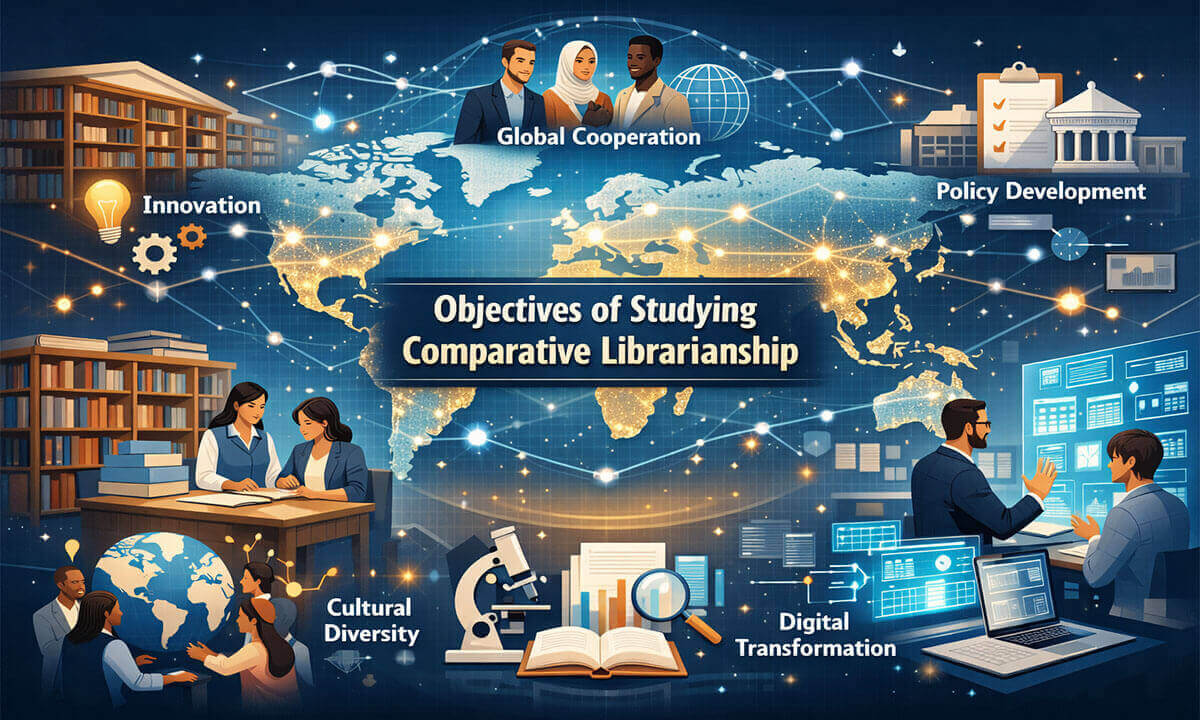
Objectives of Studying Comparative Librarianship:
Comparative Librarianship is an important subfield of Library and Information Science (LIS) that involves the systematic comparison of library systems, practices, policies, and services across different countries, cultures, or regions. The purpose is not merely to identify similarities and differences, but to understand how social, political, economic, and technological contexts shape library development. In an increasingly globalized and digitally connected world, studying comparative librarianship helps professionals adopt best practices, improve service delivery, and respond effectively to changing user needs. This field also supports evidence-based decision-making and fosters international cooperation among libraries. In the rest of this article, we will explore the key objectives of studying comparative librarianship.
1. To Understand Global Library Systems: A central objective of comparative librarianship is to develop a deep and structured understanding of how library systems operate across different countries and regions. Libraries are shaped by national priorities, governance models, and institutional frameworks, which vary significantly from one context to another. For instance, public libraries in welfare-oriented countries often receive strong government funding and emphasize universal access, while in other regions, libraries may rely more on private or community support. By examining these structural differences, researchers can better understand how policies, legal systems, and administrative practices influence library performance and accessibility. According to Lor (2019), comparative analysis helps reveal both convergences and divergences in library development, enabling professionals to interpret their own systems more critically and objectively. This broader perspective reduces the risk of assuming that one model fits all contexts and instead encourages context-sensitive thinking.
2. To Identify Best Practices and Innovations: Another major objective is to identify effective practices and innovative approaches used in different library environments. Comparative librarianship allows professionals to explore how libraries around the world address common challenges such as user engagement, digital transformation, and information access. For example, some countries have successfully implemented advanced digital library platforms, while others excel in community outreach and literacy programs. By studying these models, librarians can adopt or adapt strategies that are proven to work elsewhere, while also modifying them to suit local needs. Kumar (2007) emphasizes that such cross-national learning enhances service quality and operational efficiency. Importantly, this objective is not about copying systems blindly but about understanding the underlying principles that make certain practices successful, and then applying them thoughtfully within a different socio-cultural and institutional context.
3. To Promote International Cooperation and Collaboration: Comparative librarianship also aims to strengthen global cooperation among libraries and information institutions. In a world where information flows across borders, libraries increasingly face shared challenges such as digital preservation, open access, and information literacy. By comparing systems and recognizing common goals, libraries are better positioned to collaborate on international projects, share resources, and exchange expertise. Organizations like the International Federation of Library Associations and Institutions (IFLA) actively promote such collaboration by facilitating knowledge sharing and global dialogue (IFLA, 2018). Through comparative studies, librarians can identify opportunities for partnerships, including joint research initiatives, staff exchanges, and cooperative digital projects. This objective ultimately contributes to building a more interconnected and resilient global library community.
4. To Analyze the Impact of Socio-Cultural Factors: Libraries are deeply embedded within the cultural and social fabric of their communities, and comparative librarianship seeks to analyze how these factors influence library services and usage. Cultural values, language diversity, educational systems, and social norms all play a significant role in shaping how libraries are organized and how users interact with them. For example, reading habits, information-seeking behavior, and attitudes toward public institutions can vary widely across cultures. By comparing these differences, librarians can design services that are more inclusive and responsive to user needs. The foundational ideas of S. R. Ranganathan, particularly his user-centered approach to library science, remain highly relevant in this context. Modern interpretations of his work highlight the importance of adapting library services to meet the unique needs of diverse communities. This objective enhances cultural awareness and helps ensure that libraries remain accessible and relevant to all segments of society.
5. To Support Policy Development and Planning: A key objective of comparative librarianship is to inform effective policy-making and strategic planning within library systems. By examining how different countries design and implement library policies (such as funding allocation, copyright regulations, and access to information laws); researchers and administrators gain valuable insights into what works and what does not. Comparative evidence allows policymakers to benchmark their national systems against international standards and adopt more efficient and inclusive approaches. As noted by Lor and Britz (2010), such cross-national analysis strengthens evidence-based decision-making and reduces the risks associated with isolated policy development. This objective is particularly important in developing countries, where lessons from established systems can guide sustainable growth while still respecting local contexts.
6. To Enhance Professional Development: Comparative librarianship plays a significant role in the continuous professional development of librarians and information specialists. Exposure to international practices broadens professional knowledge and encourages critical reflection on one’s own methods. Librarians learn about diverse service models, management styles, and technological applications, which enhances their adaptability in a rapidly changing information environment. According to Aina (2004), this global perspective strengthens core competencies and prepares professionals to meet evolving user expectations. Furthermore, engaging with international literature, conferences, and collaborative projects fosters a culture of lifelong learning, which is essential in the modern knowledge society.
7. To Address Global Information Inequality: One more important objective is to identify and help reduce disparities in access to information across different regions of the world. Comparative studies often highlight the gap between developed and developing countries in terms of library infrastructure, digital resources, and technological capabilities. By analyzing these inequalities, librarians and policymakers can design targeted interventions to improve access for underserved populations. Organizations such as UNESCO emphasize the importance of equitable access to information as a fundamental component of education and development (UNESCO, 2020). Comparative librarianship thus contributes to global efforts aimed at promoting information justice, digital inclusion, and knowledge empowerment.
8. To Improve Library Education and Curriculum Design: Comparative librarianship also contributes to the development and improvement of LIS education. By analyzing curricula, teaching methods, and competency standards across different countries, educators can design programs that are both globally informed and locally relevant. This ensures that graduates are equipped with the skills needed to operate effectively in diverse and dynamic environments. Singh (2012) highlights that incorporating international perspectives into LIS education helps bridge the gap between theory and practice. It also prepares students to engage with global challenges, such as digital transformation and information ethics, making them more competitive and competent professionals in the international job market.
9. To Facilitate Adaptation to Technological Change: One of the essential objectives of comparative librarianship is to help libraries effectively adapt to rapid technological advancements. Libraries across the world are integrating technologies such as digital repositories, automated cataloging systems, artificial intelligence, and data analytics into their services. However, the pace and manner of adoption vary widely depending on economic resources, infrastructure, and institutional readiness. Through comparative analysis, librarians can study how different countries implement and manage these technologies, including both successes and challenges. This allows institutions to make informed decisions about adopting suitable technologies while avoiding costly mistakes. As highlighted by Borgman (2015), understanding global trends in digital scholarship and data management is crucial for modern libraries. Comparative librarianship, therefore, provides a practical framework for aligning technological innovation with local needs and capacities.
10. To Encourage Research and Knowledge Generation: Last but not the least; comparative librarianship aims to promote systematic research and the generation of new knowledge within the field of Library and Information Science. By offering a structured approach to cross-cultural and cross-national analysis, it enables researchers to explore complex questions about library development, user behavior, and information access. Comparative studies often lead to the formulation of new theories, models, and frameworks that can be applied across different contexts. According to Pickard (2013), such research enhances both the depth and breadth of LIS scholarship by moving beyond isolated case studies to more generalizable findings. This objective not only strengthens academic inquiry but also ensures that library practices are grounded in robust, evidence-based research, ultimately contributing to the advancement of the profession as a whole.
In conclusion, the study of comparative librarianship serves multiple important objectives that extend beyond simple comparison. It deepens understanding of global library systems, promotes innovation, supports policy development, and fosters international collaboration. Additionally, it plays a vital role in addressing information inequality, enhancing professional competence, and adapting to technological advancements. As libraries continue to evolve in response to global challenges, comparative librarianship remains a crucial tool for building more effective, inclusive, and sustainable information services worldwide.
Frequently Asked Questions (FAQs):
What is comparative librarianship?
Comparative librarianship is a branch of Library and Information Science that studies and compares library systems, services, policies, and practices across different countries or regions. Its purpose is to understand similarities and differences and apply useful insights to improve library services globally.
Why is comparative librarianship important?
It is important because it helps librarians learn from international experiences, adopt best practices, and improve decision-making. It also promotes global cooperation and helps address common challenges such as digital transformation and access to information.
How does comparative librarianship benefit developing countries?
It provides valuable insights into successful models from other countries, which can be adapted to local conditions. This helps in improving infrastructure, expanding access to information, and developing effective library policies in resource-limited settings.
What role does culture play in comparative librarianship?
Culture significantly influences how libraries operate and how users interact with them. Comparative librarianship helps librarians understand these cultural differences and design services that are inclusive and relevant to diverse communities.
How does comparative librarianship support policy-making?
By analyzing policies from different countries, it provides evidence-based insights that help policymakers create effective and sustainable library strategies, laws, and funding models.
What is the role of technology in comparative librarianship?
Technology is a key focus area. Comparative studies examine how libraries adopt digital tools, automation, and online services, helping others implement suitable technologies based on their needs and resources.
How does it contribute to professional development?
It exposes librarians to global trends, innovative practices, and diverse perspectives, which enhances their skills, knowledge, and adaptability in a rapidly changing information environment.
Can comparative librarianship help reduce information inequality?
Yes, it highlights disparities in access to information and suggests strategies to bridge these gaps, supporting global efforts toward information equity and inclusion, often emphasized by organizations like UNESCO.
Who can study comparative librarianship?
It can be studied by LIS students, researchers, librarians, policymakers, and anyone interested in understanding global library systems and improving information services.
Is comparative librarianship only theoretical?
No, it is both theoretical and practical. While it involves research and analysis, its findings are widely used to improve real-world library services, policies, and systems.
How is comparative librarianship relevant today?
In today’s globalized and digital world, libraries face shared challenges and opportunities. Comparative librarianship helps professionals stay informed, innovative, and responsive to changing user needs and technological advancements.
References:
- Aina, L.O. (2004). Library and Information Science Text for Africa. Third World Information Services Ltd, Ibadan.
- Borgman, C. L. (2015). Big data, little data, no data: Scholarship in the networked world. MIT Press.
- Pickard, A.J. (2013). Research Methods in Information. UK Facet Publ., London.
- International Federation of Library Associations and Institutions. (2018). IFLA global vision report summary. https://www.ifla.org/global-vision-report-summary/
- Kumar, K. (2007). Library management in electronic environment. Har-Anand Publications.
- Lor, P. (2019). International and Comparative Librarianship: Concepts and Methods for Global Studies. Berlin, Boston: De Gruyter Saur. https://doi.org/10.1515/9783110267990
- Lor, P. J. (2010). International and comparative librarianship. In M. J. Bates & M. N. Maack (Eds.), Encyclopedia of library and information sciences (3rd ed., pp. 2847–2855). CRC Press. https://doi.org/10.1081/E-ELIS3-120044658
- Singh, S. (2012). Library and information science education in the knowledge society. Ess Ess Publications.
- (2020). Global education monitoring report 2020: Inclusion and education: All means all. https://unesdoc.unesco.org/ark:/48223/pf0000373724

is an experienced educator and academic currently serving as a Lecturer at Nurul Amin Degree College. With a career dedicated to student development and institutional excellence, he brings a wealth of classroom expertise and pedagogical knowledge to his current role. Before joining the faculty, he served as an Assistant Teacher at Zinzira PM Pilot School and College.