How School Policies Can Support Bullying Prevention Initiatives:
Nearly everyone remembers at least one classmate who struggled with being bullied at school. Whether experienced firsthand or observed from afar, the emotional toll of bullying is unmistakable. While awareness posters and occasional guest speaker assemblies are positive gestures, they often scratch only the surface. To create genuine, long-lasting safety for students, educational institutions require something far more structural: a comprehensive, active anti-bullying policy. Rather than serving as administrative paperwork, a well-constructed policy acts as an operational foundation that protects students, guides staff, and fosters a healthy learning environment. In the rest of this article, we will explore how school policies can support bullying prevention initiatives.
Why School Policies Matter:
When we think about stopping bullying, we often picture awareness posters in the hallways, anti-bullying assemblies, or teachers reminding kids to “be nice.” While those things come from a good place, they rarely solve the problem on their own. To genuinely stop bullying and protect kids, a school needs a strong, clear, and well-enforced school policy. Here is a brief look at why school policies matter so much and how they make a real difference in everyday school life.
1. They Draw a Clear Line Between Right and Wrong: One of the major issues with bullying is that people often disagree on what actually counts as “bullying.” A student might think making fun of someone’s clothes is “just a joke,” or a teacher might overlook subtle exclusion on the playground as “kids being kids.”
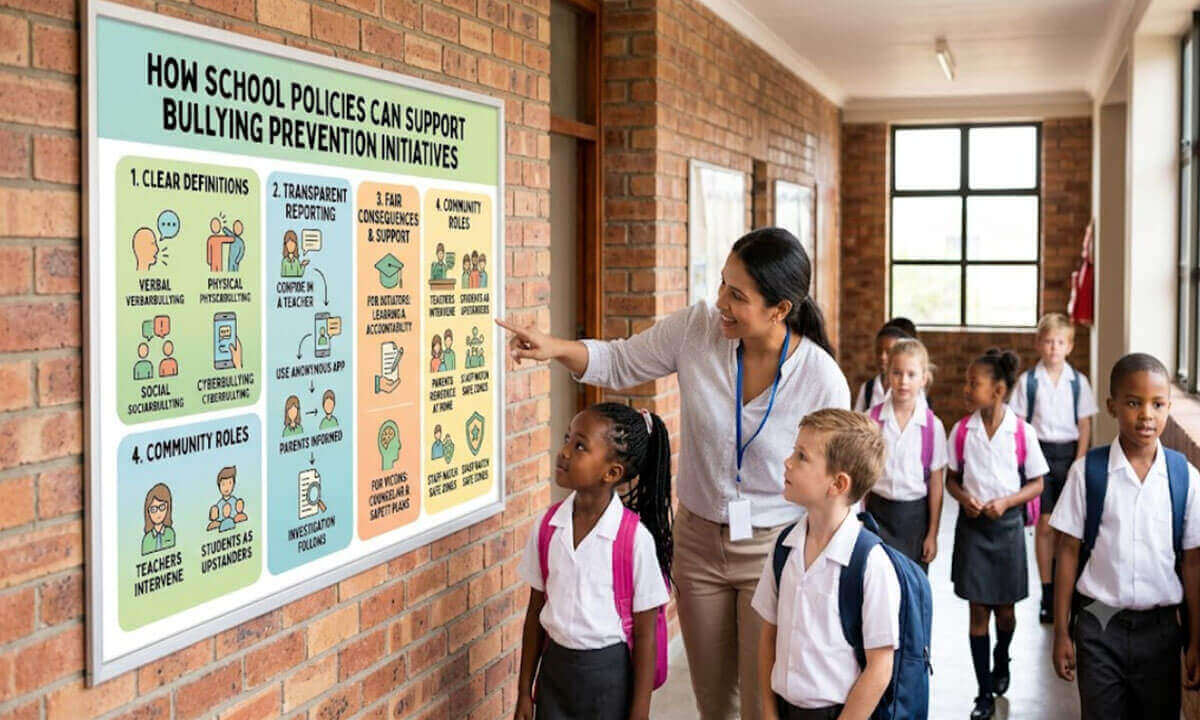
A written policy eliminates the guesswork. It clearly defines different types of bullying—whether physical (hitting or pushing), verbal (name-calling or threats), social (spreading rumors or excluding someone), or digital (cyberbullying). When these behaviors are written down clearly, everyone in the school community knows exactly where the line is drawn.
2. They Take the Pressure Off Teachers and Staff: Without a clear policy, individual teachers are left to handle bullying based on their personal judgment. One teacher might give a strict detention for an insult, while another might just issue a verbal warning for the exact same offense.
This inconsistency creates confusion and feels unfair to students. A solid policy acts as a standardized guide for school staff. It gives teachers, counselors, and principals a clear set of instructions on:
- How to spot the warning signs of bullying.
- How to intervene safely when an incident happens.
- What steps to follow after an incident is reported.
When staff members have a firm policy backing them up, they can act quickly and confidently instead of second-guessing their decisions.
3. They Give Students a Safe Way to Ask for Help: Reporting bullying can be terrifying for a student. Many kids stay silent because they fear the bully will retaliate, or because they worry adults won’t take them seriously.
An effective policy sets up simple, safe, and transparent reporting systems. It tells students exactly who they can talk to, guarantees their privacy, and in many cases, provides ways to report incidents anonymously. Knowing that there is a structured, step-by-step process gives students the confidence to speak up when they or their friends are being mistreated.
4. They Ensure Fair and Consistent Consequences: For a policy to work, it must have real teeth. If a school makes a rule against bullying but does nothing when someone breaks it, students quickly learn that the rules don’t matter.
A well-structured policy lays out clear, predictable consequences for bullying behavior. Importantly, a good policy doesn’t just focus on strict punishment (like suspensions); it also includes constructive steps. It gives bullies a chance to understand the harm they caused, learn empathy, and change their behavior, while making sure the victim is kept safe throughout the process.
5. They Provide Real Support for Victims: When a student experiences bullying, the impact doesn’t end when the bell rings. It can affect their mental health, self-esteem, and school grades for a long time.
School policies ensure that helping the victim is a priority, not an afterthought. A comprehensive policy guarantees that victims receive immediate support, such as access to school counselors, safe spaces during breaks, and ongoing check-ins to make sure the bullying has permanently stopped.
6. They Build a Culture of Respect: At the end of the day, a policy does more than just address bad behavior after it happens; it shapes the overall environment of the school.
When a school treats its anti-bullying policy as a living, active document that gets reviewed and discussed regularly, it sends a powerful message to everyone: Safety, respect, and kindness are non-negotiable here. Over time, this shifts the entire school culture. Bullying stops being seen as a normal rite of passage and starts being recognized for what it really is—unacceptable.
Essential Elements of an Effective Anti-Bullying Policy:
When a school sets out to write an anti-bullying policy, it cannot just be a collection of fancy rules or vague promises to “promote kindness.” To actually work in the real world, a policy needs to be practical, clear, and easy for everyone (students, parents, and teachers) to understand and follow.
Here is a brief breakdown of the essential elements that make an anti-bullying policy truly effective.
1. Clear and Precise Definitions of Bullying: If a policy doesn’t clearly explain what bullying is, people will interpret it differently. A good policy explicitly defines bullying so there is no room for excuses like “I was just joking” or “It wasn’t that big of a deal.”
It should break down the main forms of bullying:
- Physical Bullying: Hitting, kicking, tripping, shoving, damaging property, or making unwanted physical contact.
- Verbal Bullying: Name-calling, insults, teasing, verbal threats, or targeted taunting.
- Social and Relational Bullying: Spreading rumors, purposeful exclusion from group activities, embarrassing someone in public, or turning peers against a student.
- Cyberbullying: Sending mean messages, posting harmful photos, spreading rumors online, or impersonating someone on social media, messaging apps, or gaming platforms.
The policy should also highlight that bullying involves a pattern of behavior or a power imbalance, making it different from a routine disagreement between friends.
2. A Simple, Safe Reporting System: A policy is useless if students are too scared or confused to report what is happening. An effective policy removes the friction and fear from reporting by answering four key questions: Who do I tell? How do I tell them? What happens next? Will I be safe?
Key features of a good reporting system include:
- Multiple Contact Points: Students should be able to report to a trusted teacher, school counselor, principal, or designated staff member.
- Anonymous Reporting Options: Online forms or physical drop-boxes allow students to report incidents without fear of being labeled a “snitch” or facing retaliation.
- Clear Guidelines for Parents and Witnesses: Explaining how parents and student bystanders can report mistreatment they observe.
3. Step-by-Step Investigation Procedures: Once a report is submitted, the policy must outline a clear roadmap for how the school will handle it. This prevents reports from sitting on a desk or being swept under the rug.
A solid procedure specifies:
- Timeline: How quickly the school will start investigating (e.g., within 24 to 48 hours).
- Investigation Steps: Interviewing the victim, the accused student, and any witnesses separately and privately.
- Documentation: Keeping detailed, confidential records of what happened, who was involved, and what actions were taken.
- Parental Notification: Informing the parents of all involved students promptly while respecting student privacy laws.
4. Fair and Proportional Consequences: Disciplinary actions should never be arbitrary or overly harsh just for the sake of punishment. They need to fit the severity and frequency of the behavior while giving the student who bullied an opportunity to learn and reform.
An effective policy uses a graduated approach to discipline:
- Minor or First-Time Incidents: Verbal warnings, restorative conversations, reflection assignments, or parent-teacher conferences.
- Repeated or Severe Incidents: Loss of privileges (like recess or extracurriculars), detention, in-school suspension, or out-of-school suspension.
- Restorative Actions: Requiring the student to take concrete steps to repair the harm they caused, such as writing a genuine apology or participating in mediated conflict resolution.
5. Dedicated Support for the Victim: Punishing the bully is only half the job; taking care of the target is just as important. An effective policy puts victim protection front and center.
This includes:
- Immediate Safety Plans: Ensuring the victim feels safe at school right away (e.g., changing seating charts, adjusting hallway schedules, or assigning a designated adult supervisor).
- Mental Health Resources: Offering direct access to school counselors or external support services.
- Follow-Up Checks: Scheduling mandatory check-ins weeks and months after the incident to ensure the bullying has completely stopped and hasn’t resumed in secret.
6. Off-Campus and Cyberbullying Rules: In today’s digital world, bullying doesn’t stop when the final school bell rings. Online harassment that happens at night or over the weekend often bleeds into the classroom the next day, creating a hostile environment at school.
A modern policy explicitly extends its reach to off-campus and online behavior if that behavior directly impacts a student’s safety, mental well-being, or ability to learn while at school.
7. Annual Reviews and Community Involvement: A policy shouldn’t be written once and then forgotten in a filing cabinet. School environments and digital platforms change rapidly, which means policies must adapt.
An effective policy includes a requirement to be reviewed every year. School leaders should gather input from teachers, parents, mental health specialists, and students themselves to see what is working, what isn’t, and what new challenges (like new social media apps) need to be addressed.
Key Roles in Executing Bullying Prevention:
An anti-bullying policy on paper is only as good as the people who bring it to life. A policy doesn’t stop bullying on its own—people do. Preventing bullying requires a team effort. Everyone in the school ecosystem has a distinct role to play, from teachers on the ground to students in the hallways. Here is a brief look at the key roles needed to execute bullying prevention effectively.
1. School Administrators (Setting the Standards and Supporting the Team): School principals, vice-principals, and board members set the tone for the entire school culture. If leadership doesn’t take bullying seriously, no one else will either.
Their primary duties include:
- Enforcing the Policy Fairly: Ensuring that rules are applied consistently across all grade levels, without playing favorites or ignoring “minor” incidents.
- Providing Resources and Training: Allocating budget and time for staff training, counseling services, and anti-bullying programs.
- Creating a Safe Environment: Establishing clear reporting channels and making sure students and teachers know leadership has their back when they report bad behavior.
- Communicating with Parents: Handling tough conversations with families professionally and transparently when serious incidents occur.
2. Teachers and Classroom Staff (The First Line of Defense): Teachers spend more time with students than anyone else at school. They are in a prime position to notice subtle shifts in behavior, mood, or social dynamics.
Their key responsibilities include:
- Spotting Early Warning Signs: Recognizing the difference between friendly banter and targeted mistreatment. They watch for warning signs like a student suddenly becoming quiet, avoiding group work, or sitting alone at lunch.
- Intervening Immediately: Stepping in the moment inappropriate behavior happens. Leaving subtle insults or teasing unchecked sends a signal that the behavior is acceptable.
- Building a Respectful Classroom Culture: Setting clear ground rules for kindness, teamwork, and respect in their own classrooms right from day one.
- Following Reporting Protocols: Promptly documenting and reporting incidents to counselors or administrators so no student slips through the cracks.
3. School Counselors and Mental Health Professionals (Healing and Guidance): Counselors provide the emotional backbone of any anti-bullying effort. While administrators handle discipline, counselors focus on human behavior, mental health, and healing.
They support the school by:
- Supporting Victims: Giving targets of bullying a safe, private space to express their feelings, process trauma, and learn coping and self-advocacy strategies.
- Working with Instigators: Meeting with students who bully to get to the root cause of their behavior. Bullies often act out due to personal struggles, home issues, or low self-esteem; counselors help them build empathy and healthier social habits.
- Facilitating Mediation: Leading structured, restorative conversations between students when appropriate to resolve conflicts safely.
4. Support Staff (Watching the Unsupervised Spaces): Bullying rarely happens right in front of a teacher during a lesson. It usually occurs in “low-supervision zones”—the cafeteria, hallways, playgrounds, locker rooms, and school buses.
This makes support staff vital:
- Bus Drivers: Monitoring behavior on the ride to and from school, ensuring kids feel safe on board.
- Cafeteria and Playground Monitors: Keeping an eye on group dynamics during unstructured time, where social exclusion and physical bullying are most common.
- Janitorial and Administrative Staff: Reporting any suspicious behavior, vandalism, or distressed students they encounter around campus.
5. Students (Moving from Bystanders to “Upstanders”): Students hold the real power to change school culture. When peers make it clear that bullying isn’t cool, bullying behavior drops significantly.
Students play a key role by:
- Refusing to Join In: Not laughing at mean jokes, sharing embarrassing photos, or spreading rumors.
- Being an “Upstander”: Safely speaking up when they see someone being mistreated, or simply offering a friendly word to a classmate who is being excluded.
- Reporting Incidents: Using the school’s reporting tools to let an adult know when someone needs help.
- Leading Peer Programs: Participating in student-led anti-bullying clubs, peer mentorship programs, or kindness campaigns.
6. Parents and Guardians (Reinforcing Values at Home): Bullying prevention doesn’t end when the final bell rings. Parents are critical partners in creating a safe environment.
Parents contribute by:
- Modeling Respectful Behavior: Teaching children empathy, kindness, and conflict-resolution skills at home.
- Monitoring Online Activity: Keeping tabs on their child’s social media use and text messaging to spot cyberbullying early.
- Listening to Their Children: Paying attention to changes in their child’s mood, school performance, or willingness to go to school.
- Collaborating with the School: Working with teachers and administrators calmly and constructively if their child is being bullied or if their child is accused of bullying others.
Continuous Evaluation and Improvement:
Creating an anti-bullying policy isn’t a “one-and-done” task. You can’t just write a list of rules, print it out, bind it neatly, and leave it on a shelf for the next ten years expecting it to work. Kids change, technology evolves at lightning speed, and the ways students interact (both in the hallways and online) are constantly shifting. A policy that worked brilliantly five years ago might be completely useless against today’s cyberbullying trends or social media apps. That is why continuous evaluation and improvement is the secret sauce of any effective bullying prevention strategy. Here is a brief look at how schools can keep their anti-bullying efforts fresh, relevant, and powerful.
1. Gathering Real Feedback from the Whole School Community: If school leaders only talk to each other, they will miss what is actually happening on the ground. To evaluate a policy properly, schools need honest input from everyone involved:
- Students: They are the ones living the experience every day. Anonymous surveys, focus groups, or student council discussions can reveal where bullying really happens (like a specific stairwell or an unmonitored group chat) and whether kids actually trust the current reporting system.
- Teachers and Staff: Educators see pattern shifts in real time. They can tell administrators which procedures are too complicated, which consequences aren’t working, and where they need more training or support.
- Parents: Families bring a crucial perspective from outside the school gates. They can share whether their children feel safe coming to school, how well the administration communicates during an incident, and what issues are spilling over into life at home.
2. Tracking and Analyzing the Data: A good evaluation process doesn’t rely on guesswork or gut feelings; it relies on real data. Schools should keep confidential, detailed records of all reported bullying incidents and review them regularly.
By looking at the numbers, school leaders can answer important questions:
- Are reports going up or down? (Note: A rise in reports isn’t always bad! It often means students finally feel safe enough to speak up.)
- Where are most incidents happening? Is it the playground, the cafeteria, the school bus, or online?
- What types of bullying are most common? Are physical incidents dropping while cyberbullying surges?
- Are certain age groups or grades struggling more than others?
Analyzing these patterns helps schools deploy their resources where they are needed most—like adding an extra supervisor to the yard during lunch or running a specific workshop on digital safety for middle schoolers.
3. Updating Rules for New Tech and Online Trends: Cyberbullying is a moving target. New apps, anonymous messaging platforms, and online trends pop up overnight.
If a policy only mentions “texting and email,” it leaves huge loopholes for harassment happening on newer social media platforms, online gaming lobbies, or AI-generated content. Continuous improvement means regularly updating the policy’s cyberbullying definitions and digital safety guidelines so bullies can’t hide behind technicalities.
4. Assessing What Works (and Scrapping What Doesn’t): Not every initiative works as planned, and that’s okay—as long as the school is willing to adjust.
During annual reviews, administrators and committee members should look closely at their current interventions:
- Are the consequences actually changing bullies’ behavior, or are the same students repeatedly breaking the rules?
- Are victims getting enough long-term support, or do they still feel isolated months later?
- Are restorative justice meetings leading to real resolution, or are they feeling forced?
If a strategy isn’t producing real, positive changes, the school should be flexible enough to discard it and try a fresh, evidence-based approach.
5. Making the Policy Review an Annual Tradition: To ensure this evaluation actually happens, schools should make an annual policy review mandatory.
Setting aside a specific time each year (such as right before the new school year begins) to form a review committee (made up of administrators, teachers, counselors, parents, and student representatives) guarantees the policy is treated as a living, breathing document.
In conclusion, a well-crafted school policy is much more than a routine administrative document; it is the backbone of a safe educational community. By establishing unambiguous standards, transparent reporting paths, comprehensive staff training, and compassionate support systems, schools build an environment where students can focus on learning and personal growth without fear of harassment.

is an experienced educator and academic currently serving as a Lecturer at Nurul Amin Degree College. With a career dedicated to student development and institutional excellence, he brings a wealth of classroom expertise and pedagogical knowledge to his current role. Before joining the faculty, he served as an Assistant Teacher at Zinzira PM Pilot School and College.