Self-Assessment Strategies for Improving Critical Thinking Skills:
Critical thinking helps people understand problems, examine information, and make better decisions. But improving these skills requires regular practice and reflection. Self-assessment gives people a chance to review their own thinking, identify weaknesses, and learn from mistakes. By using simple self-assessment strategies, people can become more aware of how they think and make steady progress in critical thinking.
What Is Critical Thinking?
Critical thinking is the ability to examine information carefully, question ideas, and make thoughtful decisions. It helps people look beyond first impressions and consider facts before reaching a conclusion.
Critical thinking involves:
- Analyzing information objectively
- Questioning assumptions and beliefs
- Evaluating evidence before making decisions
- Considering different points of view
Critical thinking is not simply about being right. It is about understanding why a person holds a certain opinion or reaches a particular conclusion. Regular self-assessment can help people understand and improve the way they think.
Why Self-Assessment Matters in Critical Thinking:
Self-assessment helps people examine their own thinking. It allows them to see what they understand well and where they need to improve. Without reflection, it can be difficult to notice mistakes or patterns that affect judgment.
Self-assessment can help people:
- Identify weaknesses and gaps in their thinking
- Recognize personal biases and assumptions
- Review how they reach conclusions
- Learn from mistakes and feedback
- Improve their approach to solving problems
Regular self-assessment encourages people to think more carefully about their own reasoning. Generally, this can lead to better judgment, clearer thinking, and stronger critical thinking skills.
Self-Assessment Strategies for Improving Critical Thinking Skills:
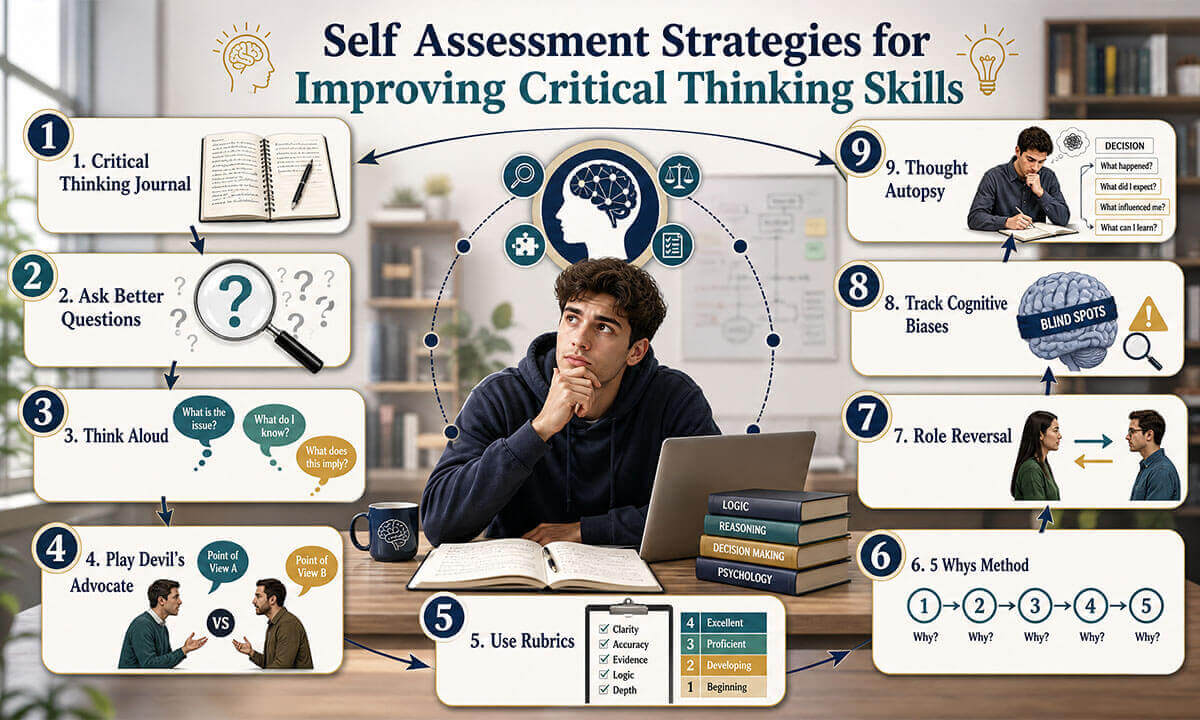
Strategy 1: Keep a Critical Thinking Journal:
Keeping a journal can help people understand how they think. It does not need to be a personal diary. The focus is on recording decisions, reactions, and reasoning.
How to Do It: Each day, write about:
- A problem or decision you faced
- Your first reaction or thought
- The evidence you used
- Other viewpoints you considered
- What you could have done differently
This simple habit helps people look back at their thinking and learn from their experiences.
Why It Works: A critical thinking journal can reveal patterns in the way a person thinks. It can also help identify assumptions, emotional reactions, and personal biases. Over time, regular reflection can lead to clearer and more careful thinking.
Strategy 2: Ask Yourself Better Questions:
Good questions can lead to better thinking. Instead of accepting the first explanation, ask questions that encourage deeper reflection.
Improve Your Inner Dialogue: Instead of asking: “Why is this happening to me?”
Ask:
- What assumptions am I making?
- What evidence supports my view?
- Is there evidence that challenges my view?
- What would another person think about this situation?
- Am I missing any important information?
These questions encourage people to examine their ideas from different angles.
Helpful Tip: Keep a short list of useful questions near your study area or save them on your phone. Use them whenever you need to make an important decision or solve a difficult problem.
Strategy 3: Use the Think-Aloud Method:
Sometimes, speaking about a problem can make the thinking process clearer. The think-aloud method involves explaining your thoughts step by step as you work through a problem.
How to Do It:
- Choose a problem or difficult decision.
- Explain your thoughts out loud.
- Describe the evidence you are using.
- Explain why you are choosing one option over another.
- Listen for gaps or weak points in your reasoning.
This method can help people notice unclear ideas and correct mistakes as they think.
Helpful Tip: A person can record their explanation and listen to it later. This can make it easier to notice assumptions or gaps that were missed at the time.
Strategy 4: Play Devil’s Advocate With Yourself:
Playing devil’s advocate means deliberately challenging your own opinion. Instead of only looking for information that supports your view, try to find reasons why your view might be wrong.
How It Works:
- Identify your current belief or solution.
- Think of reasons that could challenge it.
- Look for evidence that does not support your position.
- Consider what another person might argue.
- Decide whether your original view still makes sense.
This strategy helps reduce confirmation bias. It also encourages people to consider different perspectives before reaching a conclusion.
Strategy 5: Use Rubrics and Checklists:
Rubrics and checklists can provide a simple way to review your thinking. They give you clear points to consider before making a decision or reaching a conclusion.
Create Your Own Checklist: Ask yourself:
- Did I define the problem clearly?
- Did I identify the important information?
- Did I consider different perspectives?
- Did I check for assumptions and biases?
- Did I avoid weak or misleading arguments?
- Is my conclusion supported by evidence?
Using the same checklist regularly can make self-assessment easier and more consistent.
Strategy 6: Reflect With the 5 Whys:
The 5 Whys technique helps people explore the reasons behind a decision, belief, or problem. The method is simple. Ask “Why?” several times until you reach a deeper reason.
Example: “I decided not to attend the seminar.”
- Why? Because I thought it was not relevant.
- Why did I think that? I did not read the agenda.
- Why did I not read it? I assumed it would be similar to last year’s seminar.
- Why did I make that assumption? I did not take time to check the details.
- Why did I not check? I was busy and made a quick decision.
This process can reveal hidden assumptions and habits that affect decision-making. It also shows what could be improved next time.
Strategy 7: Use Role Reversal Exercises:
Role reversal means looking at a situation from another person’s point of view. It can help people understand ideas that are different from their own.
How It Works: When thinking about a situation:
- Choose another person involved in the situation.
- Try to understand their point of view.
- Consider their goals, concerns, and reasons.
- Explain the situation as if you were that person.
- Compare their view with your own.
This strategy can improve critical thinking and help people consider different perspectives before making a judgment.
Strategy 8: Track Your Cognitive Biases:
Cognitive biases can affect how people understand information and make decisions. They can cause people to focus on certain information while ignoring other evidence.
Common Biases to Watch:
- Confirmation bias: Favoring information that supports existing beliefs
- Anchoring bias: Relying too much on the first information received
- Hindsight bias: Believing that an event was predictable after it happened
- Availability bias: Judging something as more likely because examples are easy to remember
Keeping a simple bias log can help. When you notice a bias affecting your thinking, write down what happened and how it influenced your decision. This can improve awareness over time.
Strategy 9: Conduct a Thought Review:
After making an important decision, take some time to review your thinking. Look at what you believed, what information you used, and how you reached your conclusion.
Ask Yourself:
- What assumptions did I make?
- What information did I trust, and why?
- Did emotions affect my judgment?
- Did I consider other explanations?
- What did I learn from the result?
- What would I do differently next time?
This type of reflection turns everyday decisions into learning opportunities. It helps people understand both their strengths and their weaknesses in thinking. With regular practice, these reviews can support better judgment and stronger critical thinking skills.
In conclusion, improving critical thinking takes regular practice and honest self-assessment. Simple habits such as keeping a journal, asking better questions, checking personal biases, and reviewing decisions can make a real difference. These strategies help people understand their thinking and make better choices. With time and practice, self-assessment can lead to clearer reasoning, better judgment, and stronger critical thinking skills.
Quick Recap of the Strategies:
- Critical Thinking Journal – Reflect daily.
- Ask Better Questions – Challenge your assumptions.
- Think Aloud – Speak your logic.
- Play Devil’s Advocate – Argue with yourself.
- Use Rubrics – Be your own evaluator.
- 5 Whys Method – Dig beneath the surface.
- Role Reversal – Step into another’s shoes.
- Track Cognitive Biases – Know your brain’s blind spots.
- Thought Autopsy – Learn from your thinking patterns.

is an experienced educator and academic currently serving as a Lecturer at Nurul Amin Degree College. With a career dedicated to student development and institutional excellence, he brings a wealth of classroom expertise and pedagogical knowledge to his current role. Before joining the faculty, he served as an Assistant Teacher at Zinzira PM Pilot School and College.