The Benefits of Open Educational Resources for Lifelong Learners:
Learning does not have to stop after school or university. Many people want to continue learning, but traditional education can be expensive and difficult to fit into a busy schedule. Open Educational Resources, commonly known as OER, offer a simple alternative. OER provides free learning materials that people can access online. These resources can help learners develop new skills, explore personal interests, and continue their education at their own pace.
What Are Open Educational Resources?
Open Educational Resources are teaching and learning materials that are freely available for people to use. They can include:
- Textbooks
- Course materials
- Videos
- Quizzes and assessments
- Research papers
- Educational software
Many OER materials have open licenses. This means they can often be used, shared, adapted, or reused within the terms of the license.
For lifelong learners, OER makes it easier to find useful learning materials without depending on a formal classroom.
The Benefits of Open Educational Resources for Lifelong Learners:
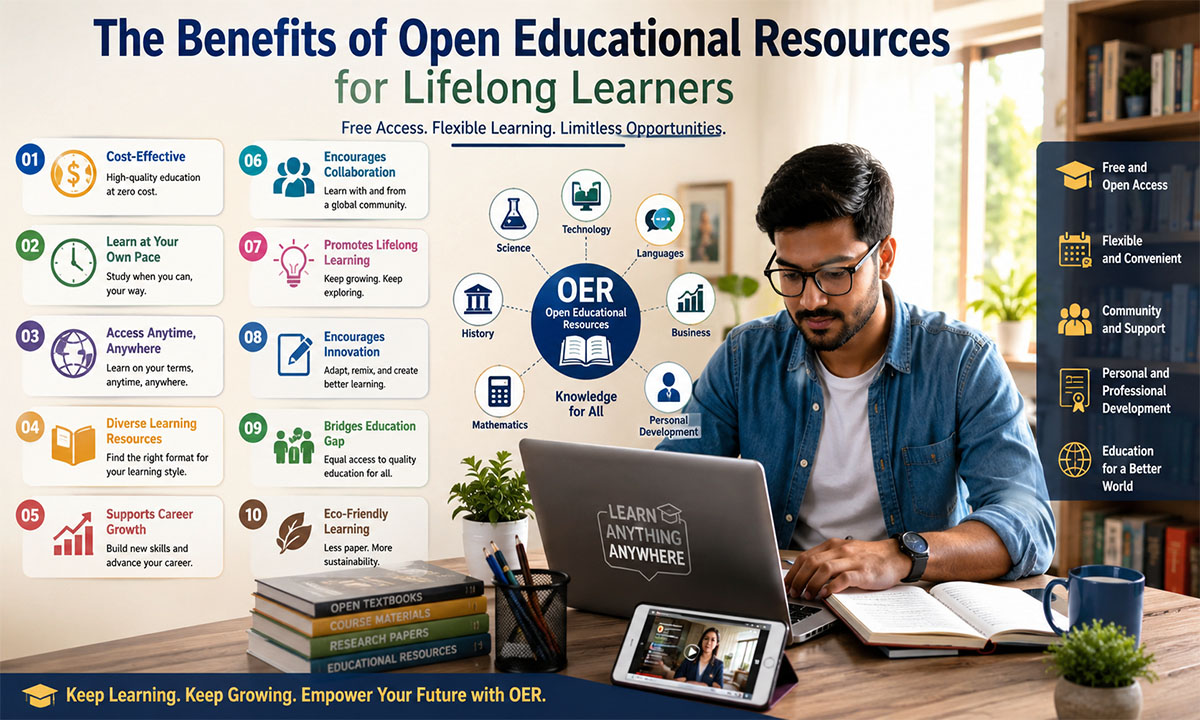
1. Reduces the Cost of Learning:
Education can be expensive. Textbooks, tuition fees, training programs, and other learning materials can create financial pressure.
OER helps reduce these costs by providing free learning materials. Learners can find textbooks, lectures, course materials, and other resources without paying for every item.
This makes continued learning more affordable, especially for people who cannot afford expensive courses or textbooks.
2. Allows Learners to Study at Their Own Pace:
People learn in different ways and at different speeds. Some may understand a topic quickly, while others may need more time.
OER gives learners greater control over their learning. They can pause a video, review a chapter, repeat an activity, or return to a topic whenever needed.
This flexibility is useful for people who have jobs, family responsibilities, or other commitments.
3. Provides Access to Learning Anytime and Anywhere:
OER can be accessed from many places through the internet. Learners can study at home, at work, in a library, or while travelling.
They do not need to wait for a new academic term or attend a physical campus. As long as they have access to the required technology and internet connection, they can study when it suits them.
4. Offers Different Types of Learning Materials:
Not everyone prefers the same learning method. Some people learn better through videos, while others prefer books, articles, exercises, or discussions.
OER includes many types of materials. Learners can choose resources that suit their needs.
For example:
- Video learners can use open lectures and educational videos.
- Readers can use open textbooks and research materials.
- Practical learners can use exercises, activities, and quizzes.
This variety allows learners to choose materials that work best for them.
5. Supports Career Development:
The job market changes over time. New technologies and skills continue to affect many professions. Lifelong learning can help people keep their knowledge and skills up to date.
OER provides opportunities to learn subjects such as programming, communication, business, languages, mathematics, and many other areas.
Learners can use these resources to improve existing skills, prepare for a new career, or develop knowledge that may support future employment opportunities.
6. Encourages Collaborative Learning:
Learning does not always have to happen alone. Some OER platforms and learning communities allow people to discuss topics, share ideas, and work together.
Learners can exchange information and learn from the experiences of others. Online communities can also help people find different viewpoints and approaches to the same topic.
This can make independent learning more engaging and useful.
7. Supports Lifelong Learning:
Learning is not limited to formal education. People can continue learning throughout their lives for personal, professional, or academic reasons.
OER makes this easier by providing access to materials on many subjects. A person may study history, philosophy, science, literature, technology, or another subject simply because they are interested in it.
There is no need to wait for a formal course to begin learning something new.
8. Encourages Creativity and Adaptation:
One significant feature of many OER materials is that they can be adapted according to their open license.
Teachers can combine different resources to create lessons that suit their students. Learners can also adapt materials for their own learning needs.
For example, educational content may be translated into another language or combined with other resources to make a topic easier to understand.
9. Helps Reduce Educational Barriers:
Access to education is not equal everywhere. The cost of textbooks, courses, and other educational materials can prevent people from continuing their studies.
OER can reduce some of these barriers by making learning materials freely available.
This can be particularly useful for learners in communities where educational resources are limited or expensive.
However, OER cannot remove every barrier. Internet access, devices, language, digital skills, and the quality of available materials can still affect access to learning.
10. Can Reduce the Use of Printed Materials:
Many educational materials are now available in digital form. This can reduce the need for printing textbooks, handouts, and other learning materials.
Using digital OER can therefore reduce paper use and some printing costs.
However, the environmental impact of digital learning also depends on factors such as electricity use, electronic devices, and data storage. So OER should be seen as one part of more sustainable learning practices.
How to Get Started With OER:
There are many platforms where learners can find free educational materials. Some useful examples include:
- MIT OpenCourseWare: Offers free course materials from MIT.
- Khan Academy: Provides free lessons and practice activities in several subjects.
- OpenStax: Provides free and openly licensed textbooks.
- edX: Offers access to courses from universities and other institutions, with some learning options available for free.
- Library of Congress: Provides access to a wide range of digital collections and educational materials.
Before using an OER, learners should check the license and usage conditions. Not every free resource allows the same types of reuse or modification.
In conclusion, Open Educational Resources have made lifelong learning easier and more affordable. They give people access to a wide range of educational materials without requiring them to follow a traditional classroom schedule.
OER can support personal learning, career development, academic study, and general curiosity. It also gives learners more choice over what they study, when they study, and which materials they use.
OER is not a complete replacement for formal education. But it is a useful resource for people who want to continue learning throughout their lives.

is an experienced educator and academic currently serving as a Lecturer at Nurul Amin Degree College. With a career dedicated to student development and institutional excellence, he brings a wealth of classroom expertise and pedagogical knowledge to his current role. Before joining the faculty, he served as an Assistant Teacher at Zinzira PM Pilot School and College.